Welp, the Scott administration has put out a press release trumpeting Zoie Saunders’ first day on the job as Vermont’s education secretary. Nowhere does it mention that her appointment is pending approval by the state Senate, which won’t even begin considering the matter until sometime next week.
Quite the opposite, in fact. The press release says that “Saunders will travel around the state in the coming weeks” and “In the months ahead, Secretary Saunders will kick off a formal listen and learn tour.”
Yeah, the fix is in. The Senate will put on a show of performing due diligence, but honestly, there’s no way in Hell they’re going to send her back to Florida.
One of the necessary quirks of the legislative process is that almost every bill passed by a policy committee must also go through one or more “money committee” — if a bill raises revenue, it goes to House Ways & Means and Senate Finance, and if it spends a damn dime it goes through House and Senate Appropriations. If a bill both raises and spends, it must be passed by all four.
There are good reasons for this. The money committees look at the entire landscape of government spending and taxation and make sure everything fits together. They are fiscal gatekeepers, in essence.
However… these committees can also derail a good piece of legislation without serious consideration of the rationale behind it. And that’s exactly what happened yesterday afternoon in the Senate Appropriations Committee. The potential consequence is a mass unsheltering event in mid-March affecting roughly 1,600 individuals, including children, seniors, and people with disabilities.
Not that anybody noticed, because there were apparently zero reporters present. It was the latest in a series of failures by our ever-shrinking media ecosystem. But hey, let’s get on with the story.
Our two most prominent #vtpoli news outlets, VTDigger and Seven Days, are always eager to pounce on any sign of scandal regarding money in politics. They seem especially set on tagging a “For Sale” sign on the reputation of U.S. Rep. Becca Balint.
And now the trial of Sam Bankman-Fried has produced new documentation about his efforts to connect with the Balint campaign, so we have articlesrecounting the lurid details of his internal communiqués and Raising Questions about Balint’s integrity — and even the legitimacy of her resounding victory in the 2022 Democratic primary.
Well, color me unimpressed. There is no scandal. I’ve never thought so, and these latest stories don’t change my view at all.
Sure, Balint’s team dallied with SBF — who, lest we forget, was considered a financial savant at the time. No one knew he was — allegedly — a fraudster of the highest order. They met with him, they accepted donations from his associates, and they benefited from a huge contribution made to a national PAC that spent the money for ads touting Balint’s candidacy.
But there is no hint that Balint changed her positions to suit SBF and his friends. And there is abundant evidence that his largesse had no meaningful effect on the outcome of the primary campaign. If the new revelations show anything, they show that SBF is one cynical bastard.
In the above photo, Sen. Bobby Starr is expounding on the moral failings of the “able-bodied” poor lazing around in taxpayer-funded motel rooms while his colleagues try to conceal their discomfort. It was just one of many dispiriting passages in Friday afternoon’s meeting of the Senate Appropriations Committee, in which the panel briefly took up and immediately dismissed one last effort to extend the motel voucher program (the one that currently provides shelter to 80% of Vermont’s homeless) beyond the end of June.
Well. Now that I’ve dropped you directly in the middle of the story, let’s go back and set the stage. After the full Senate on Thursday gave preliminary approval to an FY2024 budget that would end the voucher program on schedule, two first-term solons — Nader Hashim and Tanya Vyhovsky — did something very unusual for a pair of rookies in the seniority-heavy upper chamber: They tested the patience of their superiors by submitting a last-minute amendment that would have dedicated another $20 million to the voucher program. (It would have also defunded the detestable remote worker grant program, but that was just a bonus.)
The figure was based on conversations with housing advocates, who believe it’s the minimum amount required to prevent a large-scale unsheltering of voucher recipients. But multiple members of the committee, including chair Jane Kitchel, dismissed the number as inadequate. Kitchel said the $20 million would run out by year’s end, meaning the program would require a midyear injection of funds. She refused to engage in what she called “deficit” budgeting.
Hashim, who presented the amendment to the committee, didn’t have the information needed to counter Kitchel’s assertion, and no one else was given a chance to testify. Committee members also claimed that spending more on vouchers would mean fewer dollars for permanent housing, as if it was impossible to shift money from elsewhere in the budget or even — horrors! — raise revenue to cover the cost. So you see, they said with a metaphorical shrug of the shoulders, they had no choice but to end the voucher program.
I could go on, and I will, but let’s get back to Bobby Starr. You won’t want to miss this.
So. Prominent Chittenden County Landlord Stiffs Tenant. A story we’ve definitely heard before. But never with a twist like this one.
The landlord: Jason Jacob Hinsdale, scion of the family development/property management firm. The tenant: Scrappy BIPOC-owned Little Morocco Café. The situation: Hinsdale has imposed a 150%250% rent increase effective in August an increase he himself admits the market doesn’t justify.
The twist: Hinsdale’s wife, small-P progressive stalwart Sen. Kesha Ram Hinsdale, one of Vermont’s handful of BIPOC electeds.
It will be interesting to see how both of them play this out. Hinsdale’s move isn’t unusual for a landlord in a red-hot market but it could be political poison for Ram Hinsdale. She figures to face embarrassing questions about her husband’s power play, and he figures to come under pressure to get his loyal spouse out of this dilemma by not kicking Little Morocco to the curb.
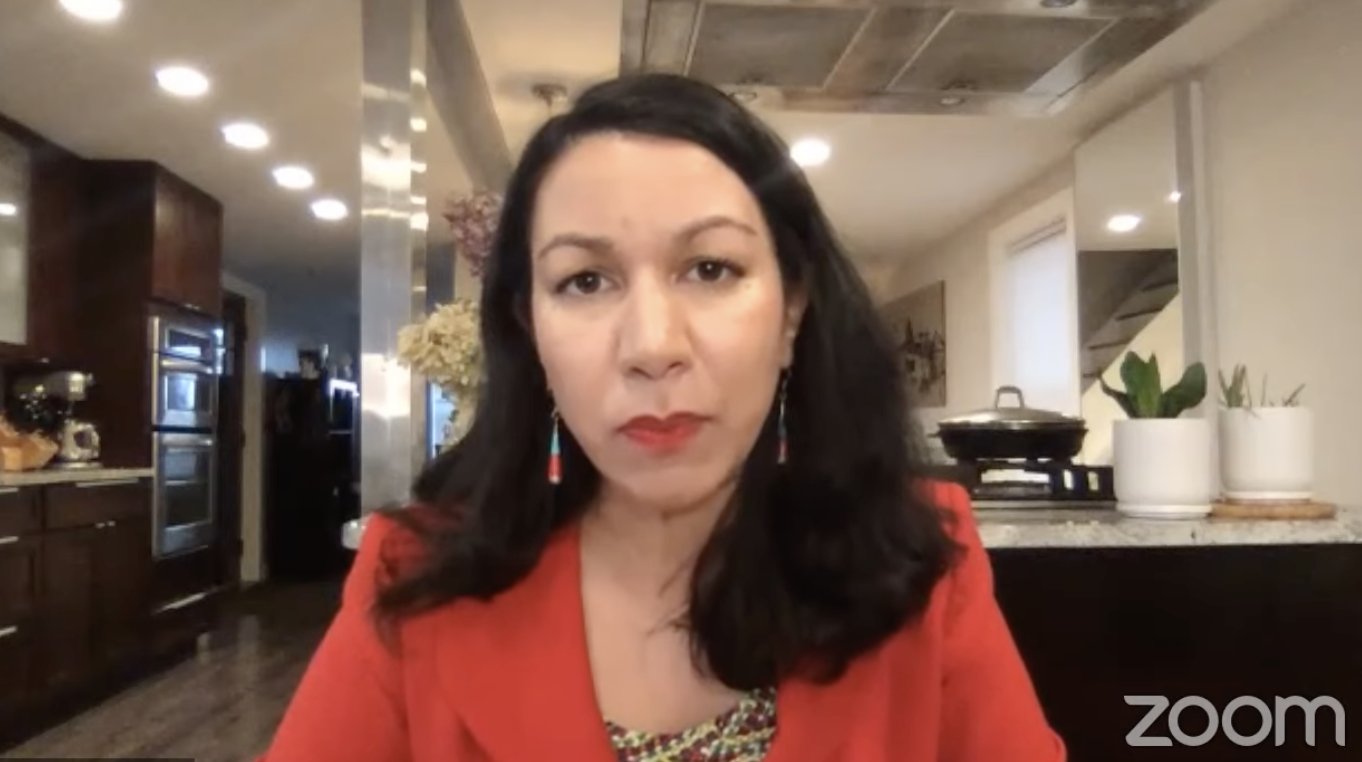
This is the three-dimensional realization of the conflict expressed in the above image: Ram Hinsdale trying to position herself as the progressive in the 2022 Democratic Congressional primary while speaking from the shiny, spotless, open concept kitchen of the suburban manse she now occupies.
Seems like I’ve been waiting forever for the Vermont Senate to undergo a demographic shift. Every two years there’s been talk of a retirement wave, but it never materializes. Senators consider stepping aside, then realize they’re indispensable. (They’re not.) And the voters rarely eject an incumbent except in cases of overt criminality (Norm McAllister) or advanced senescence (Bill Doyle).
The shift has been painfully incremental until this year, when almost one-third of all senators decided to bow out. The nine incomers are younger, five of them are women, and one is a person of color: Nader Hashim joins Kesha Ram Hinsdale and Randy Brock as the three non-white members of the upper chamber.
(The tiny Republican caucus managed to get older and no less male. Its two youngest members, Corey Parent and Joshua Terenzini, will be replaced by a couple of old white men.)
Got more numbers to plow through, but here’s the bottom line. The Senate is on the verge of a historic shift, but it’s happening in slow motion. We might reach the tipping point in two years’ time. We’re not quite there yet.
There are still plenty of tenured members in positions of power. They account for most of the committee chairs. But only — “only” — eight of the 30 senators will be 70 or older. At least 13 will be under 65, which doesn’t sound like a lot but in the Senate it definitely is.
The incoming Senate President Pro Tem, Phil Baruth, straddles the age divide. He’s only — “only” — 60. But he’s entering his sixth two-year term, so he’s familiar with the Senate and the elders are comfortable enough with him to make him their leader. As a senator he’s been a strong policy advocate unafraid to ruffle feathers, but as Pro Tem he’ll know he can’t push his caucus too far too fast.
The coming biennium may be the most combative in recent memory. The best comp might be Jim Douglas’ final years in office when he had huge budget battles with the Democratic Legislature and saw his veto of marriage equality overridden.
The stage is set. Phil Scott comfortably won re-election, and can rightly claim the overwhelming support of the Vermont electorate. Legislative leaders can equally assert a mandate, given the fact that the Democratic slash Progressive caucuses are at historic highs. Legislative leadership will have a nice margin for error on veto overrides.
On top of all that, the next couple of budget cycles are going to be tough. The federal tide of Covid relief funds has made it easy to pass budgets — until now. Tight budget times and both sides claiming mandates? That spells trouble by the bushelful.
Becca Balint’s one-sided primary victory leaves only token obstacles in her path to Congress. This is obvious.
What’s less obvious is that it puts Balint on track to become the most powerful person in Vermont Democratic politics. This is the extra dimension of the primary’s import. It was a hinge moment in the party’s progress.
Follow me, if you will, down a wary-too-soon but perfectly logical rabbit hole.
Patrick Leahy and Peter Welch are extremely powerful presences in the Vermont Democratic Party, more so than is visible publicly. (Bernie Sanders is treated with veneration but as a resolute independent, he doesn’t have the same level of influence.)
Leahy is about to exit the stage and take on an emeritus-equivalent position in the party. He’ll have a say as long as he draws breath, but he won’t have the power of the office anymore. His people took a huge hit in the primary. Most or all backed Molly Gray, or even worked on her campaign. They might never recover, especially given how negative Gray went in the closing weeks of the primary campaign. That won’t endear any of them to Balint.
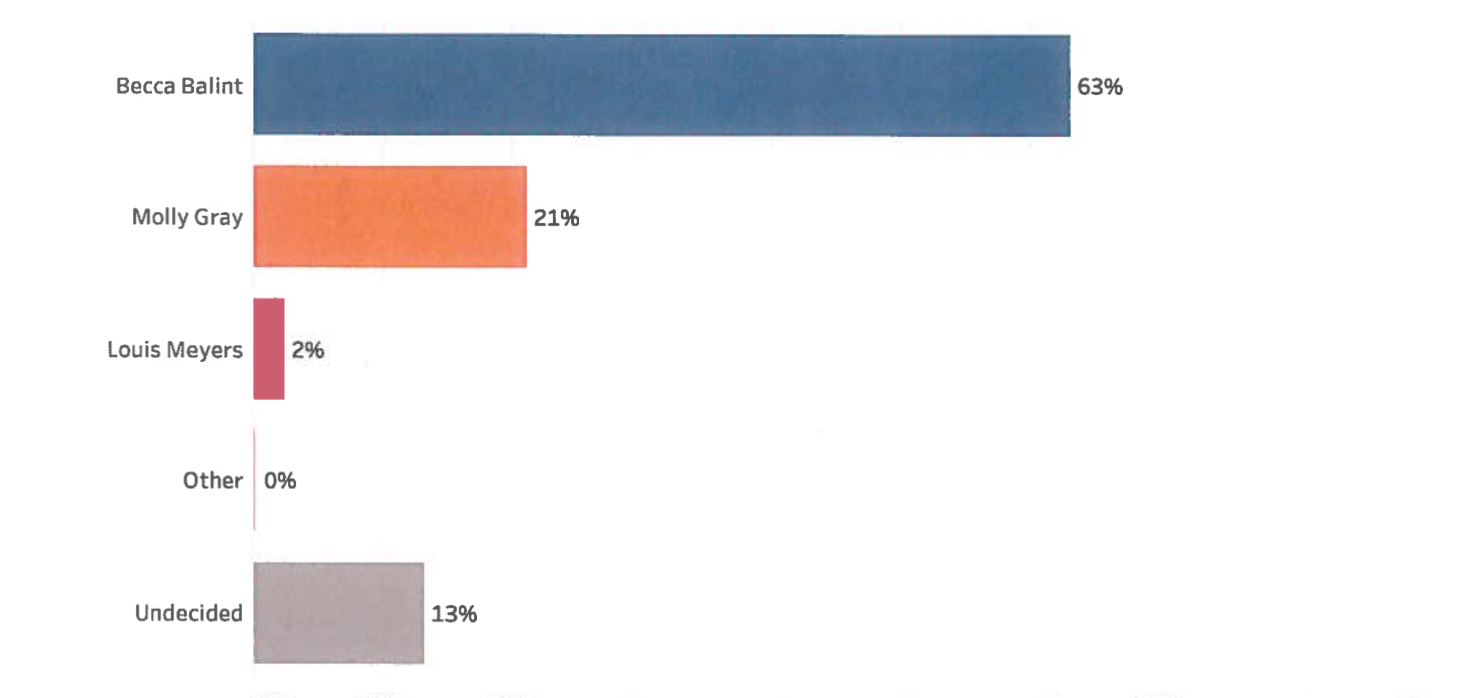
This Just In from the University of New Hampshire Survey Center: a poll sponsored by WCAX-TV that shows a shockingly one-sided Democratic primary for Vermont’s Congressional seat. Senate President Pro Tem Becca Balint 63%, Lt. Gov. Molly Gray 21%.
Yikes. Double yikes with nuts.
This is waaaaay outside the margin of error or any reasonable disclaimers you could devise. I mean, there aren’t enough grains of salt on the beach.
I mean, I had the sense that the momentum was with Balint. But 42 percentage points?
Considering that Gray has spent much of her campaign complaining about out-of-state “dark money” (from national LGBTQ+ groups, primarily), I expect she’ll release a statement decrying “out-of-state pollsters.”
One thing stands out when you look over the campaign finance filings for the three state Senate districts in Chittenden County: There are lots of candidates, and most of ’em aren’t raising much money anywhere outside of their own pockets. Seems like a potential equity issue; if you can afford a couple thousand bucks or more, or a LOT more, you don’t have to worry so much about fundraising from other people.
Maybe this is a byproduct of splitting up the formerly unified Chittenden district: No longer can candidates raise money from anywhere in the county. Now they have smaller fields to harvest. Likely a bigger factor: There are a lot of contested statewide races consuming a lot of Democratic money, perhaps away from legislative races.)
The king of the self-funders is Erhard Mahnke, affordable housing advocate and longtime Bernie Sanders associate. He dumped a cool $10,000 into his own campaign, and has only raised $666 from anyone else. That gives him a financial lead in the Chittenden Central district, because he hasn’t spent much so far.
Other notable self-funders include Brian Shelden and Irene Wrenner, Democratic candidates in Chittenden North. They’ve given nearly $7,500 to their own campaigns and raised less than that from other people. Meanwhile, the sole Republican, state Rep. Leland Morgan, has barely tried. He’s raised less than $700. Perhaps he’s looked at district demographics and decided he doesn’t really need to try. Or he’s waiting until after the primary.
Back in Chittenden Central, the top three fundraisers have done well from their own pockets and from others, too.