It gives me no pleasure to write this post, but I feel I have no choice because yesterday was a really bad day at VTDigger, starkly showcasing its shortcomings and weaknesses. The word “Digger” seems grossly inappropriate for the product they’re putting out these days. “Surface-Scratcher” is closer to the mark. Now that Digger seems to be regularly running stories about the weather, I might suggest “Vermont’s Friendly Companion,” which has a nice Old Farmers’ Almanac feel to it. Lyman Orton would approve.
First, an extremely curious editorial choice. Digger completely ignored Sen. Bernie Sanders’ endorsement of Amanda Janoo, a significant development in the gubernatorial campaign that was covered by yours truly, Seven Days, and Vermont Public, among others.
On the same day, Digger chose to spotlight the sudden departure of Digital Services Secretary Denise Reilly-Hughes in a story that incuriously regurgitated a Scott administration press release about the move. In itself, this would be annoying, not damning. What took it over the top was this little gem:
Reilly-Hughes’ departure comes as several significant IT projects are underway for Scott’s administration including a $70 million overhaul of the state’s human resources and finance systems.
The link is to an April story about the state “shifting gears” on the $70 million project. A hell of a lot has happened since then (not that Digger has bothered to pursue the story), and all of it has been bad for the administration. This project has gone so far off the rails that a change in ADS leadership comes as no surprise whatsoever.
VTDigger just wrapped up a successful fundraiser with a strong promise: “Reader support will power statewide election coverage, daily news and investigative reporting across Vermont.”
Yeah, well, none of that is happening. Election coverage has been meager, daily news is thin on the ground, and investigative reporting is a thing of the past.
Let’s make it clear that I WANT VTDIGGER TO FLOURISH. We need a strong, vibrant VTDigger as a foundational piece of our media ecosystem. My family continues to give monthly, and we have no plans to change that. But we definitely feel like we’re not getting our money’s worth, and that VTDigger is falling short of its mission.
I went back over the past 12 weekdays (activity is lower on weekends) using Digger’s “Latest Stories” page, and the results were depressing. A total of 38 original stories were posted, not counting reposts from other outlets. That’s an average of 3 1/4 stories per day including three pieces by Carly Berlin, a reporter shared with Vermont Public.
What’s more, out of 38 stories, I would classify eight as features, not hard news. Fall foliage, the Tunbridge Fair, a once-banned children’s book, a profile of a Vermont filmmaker, stuff like that.
On the other hand, try to find content that meets Digger’s fundraising promise of “statewide election coverage” and “investigative reporting.” I counted four campaign-related stories (when we’re in the midst of the general election season) and nothing that resembles investigative reporting. You know, actual digging.
We made a quick trip to Michigan last weekend and were suddenly immersed in American politics, post-Citizens United style. Our main exposure came in the form of campaign ads on bar and restaurant TV screens with the sound muted.
Lots and lots and LOTS of campaign ads. Every commercial break contained at least two political commercials about Michigan’s races for governor and U.S. Senate. The screenshot above is from a conservative attack ad against Democratic senatorial candidate Abdul El-Sayed. These ads blow ALL the dog whistles about El-Sayed’s ethnicity. One ad tries hard to tie him to progressive influencer and Fellow Brown Person Hasan Piker, who’s become the conservative movement’s bête noirein 2026.
It’s exhausting, even with no sound to go with the images. (The only TV we watched with sound was PBS’ Masterpiece Theatre, shout out Marble Hall Murders.) And Michigan voters will have to endure another five and a half weeks of this saturation bombardment. It’ll only get worse as the election draws closer, and even worse than that if the polls continue to show El-Sayed leading the very bland Republican candidate Mike Rogers. The conservatives are getting desperate.
But hey, this isn’t a blog about Michigan politics, so let’s get to the point. Which is, I’d forgotten what it’s like to be immersed in a high-profile election campaign. For the most part, it makes you want to bathe in Purell for a day or six. But there is one undeniable advantage to the nonstop barrage of political advertising: It reminds everyone that there is, in fact, an election with real consequences. Which is not the message you get from Vermont media.
I would not be so bold as to say that our news media are in the tank for Gov. Phil Scott. But their sadly reduced capacity has redounded to the governor’s benefit, over and over again. No one has the bandwidth and/or interest in covering state politics anymore. As a result, recent events that might be harmful to Scott’s popularity have gone completely unreported or, at best, substantially underreported.
Example #1: The legislative hearing that revealed the disastrous state of the administration’s biggest IT project, which includes the budget, human resources, and finance and accounting — a project that touches on everybody in state government and every dollar it spends. This project is so badly off the rails that no one can say how long it will take to fix, how much more it will cost, or even if it will ever come to fruition. That’s not coming from critics, but from top administration officials themselves. I cannot explain why this isn’t a big fat deal.
Example #2: Scott’s attempt to bigfoot the Democratic primary for Chittenden County State’s Attorney. He openly urged Republicans to take Democratic ballots and vote for challenger Bram Kranichfeld over incumbent Sarah Fair George. At best it’s an ethically questionable thing for a self-proclaimed non-politician to do.
Example #3: What the Scott administration has done to Act 143, the Legislature’s attempt to reform the emergency housing program. I’m preparing to write a full post about this. For now, I’ll just say that Scott signed it and immediately began subverting it. His administration has devised its own plan that certainly violates the spirit of Act 143 and probably the letter of the law as well. Carly Berlin, a reporter shared by VTDigger and Vermont Public, did post a story about this on September 1, but it didn’t explore the full extent of the administration’s skulduggery. Otherwise this sorry affair has gone pretty much uncovered. It ought to be a scandal.
Example #4: In late July, the University of New Hampshire Survey Center published a poll showing that one-half of Vermonters “have a positive overall view of socialism, while only about four in ten have a positive view of capitalism,” and “a plurality have a positive view of the Democratic Socialists of America (DSA).” (It also showed Donald Trump’s popularity at an all-time low of 22% in Vermont, bwahahaha.)
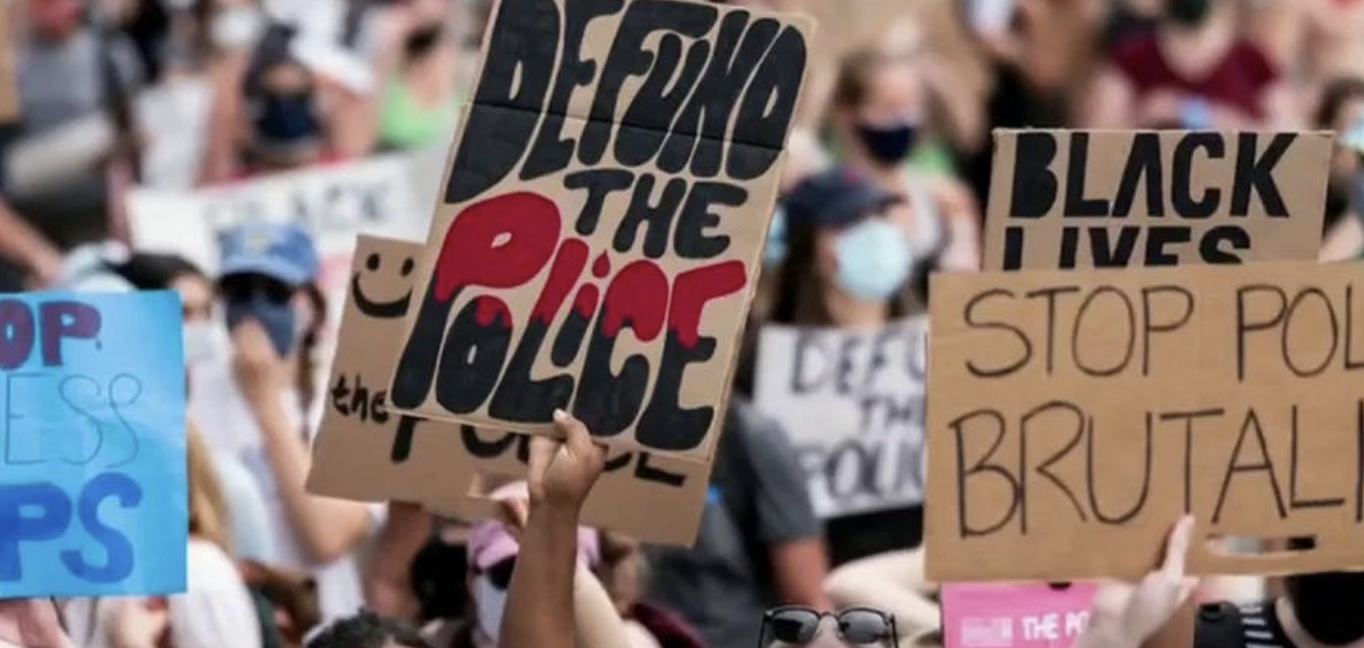
Ah yes, the golden days of the early ’20s, when hordes of left-wingers took over the streets of St. Johnsbury and the town’s progressive leadership responded by cutting the police department’s budget.
Oh wait, you say that didn’t happen?
Well, then explain this.
The briefly (and marginally) successful “defund the police” movement in Burlington is being blamed — several years later — for the Queen City’s struggle to fight crime, substance use, vandalism, and fears about public safety. And yet, according to VTDigger’s Kingdom correspondent K. Fiegenbaum, the town of St. Johnsbury is suffering from exactly the same suite of problems.
As are most or all of Vermont’s other cities and towns, from Rutland to Bennington to Brattleboro to St. Albans to Montpelier and beyond.
It’s almost as if the root causes lay beyond a certain city’s brief dalliance with trimming police budgets. It’s almost as if the problems are systemic, statewide, beyond the capacity of any local or county official to control. Even when, as in St. J, St. A, and Rutland, those officials are predominantly Republican and not at all “woke.”
Our Political Betters have been wrangling with unsheltered homelessness for years now. The Legislature’s priority has been trying to get a roof over the head of every Vermonter, while the Scott administration has been laser-focused on cost control. Well, now they’ve hit a new low in terms of creative problem-solving and pretending to care.
See, apparently people with no access to shelter have been sleeping on the covered porch of the Pavilion Building, one of the Capitol District’s most historic structures. And the administration’s solution was not to find them accommodation elsewhere — it’s to scare them off with piped-in bird noise.
Yeah, we don’t care where you go, but we don’t want you here.
The noise devices were installed earlier this summer by the Department of Buildings and General Services, but were only reported last week after Vermont Public filed a public records request. No word on whether BGS made any attempt to get the Department of Children and Families involved to try to actually solve the problem.
It speaks of the administration’s policy bankruptcy when it comes to finding shelter for the unhoused. They don’t have any answers or any ideas. (Stay tuned for a post about what the administration is doing to Act 143, the Legislature’s well-intentioned reform of the emergency housing program. The governor signed it, seemingly not in good faith, because his minions are reportedly hacking and slashing away at it.)
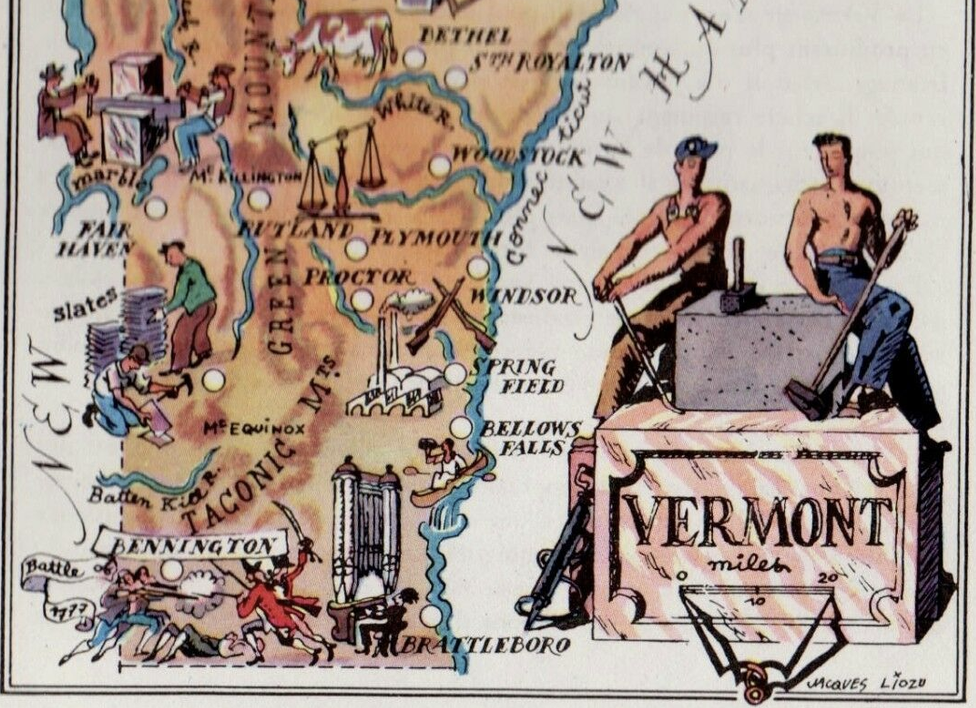
No, not THAT map. Although it’s fascinating in its own way; it seems that Vermont has been gay-friendly for a very long time. Ooh, strapping young men with powerful (ahem) tools!
But I digress, and right off the top too. I’m referring to a map prepared by VTDigger’s ace data reporter Erin Petenko which I dare not reproduce for copyright reasons. You’ll have to check it out in situ. Scroll down far enough in Digger’s recap of Amanda Janoo’s primary victory and you’ll see it.
The map shows how each Vermont city and town voted in the Democratic gubernatorial primary. You can see at a glance which candidate won where. (If you run your cursor over a town, the map shows you the winner’s name and their percentage of the vote. Also, for real nerds, the caption includes a link to the Secretary of State’s Excel spreadsheet containing all the results town-by-town.)
And the map is kind of a muddle with some really interesting features.
The first thing I noticed, because of my membership on the board of The Hardwick Gazette, is that Janoo did extremely well in The Gazette’s home turf. She took 72% of the vote in Greensboro, 68% in Hardwick, 67% in Stannard, 66% in Woodbury, 65% in Craftsbury, and 60% in Walden. She also did very well in nearby communities like Elmore, Barton, and Glover, hometown and legal nemesis of Lt. Gov. John Rodgers.
Indeed, Janoo scored well across a great swath of northern Vermont from Franklin County through Lamoille and Orleans and into the Northeast Kingdom. Just south of that you find a thinner band of Aly Richards strongpoints, from the Burlington suburbs through the Barre-Montpelier area and on to the upper Connecticut River Valley. And south of that is another Janoo band in Addison, Orange, and Windsor counties. Southern Vermont is a mixed bag, with Janoo scoring well in the southeast and south central, and getting a pocket of support along the New York border in places like Middletown Springs, Wells, and Pawlet. Richards dominated the rest of the southern tier below a line from Orwell to Norwich.
So it’s primary night in Vermont, and as the results come in, I’m here to read and react. Stay tuned!
Maybe Planet Hank Isn’t a Genius After All. The first contested race to be called by the Associated Press was the Republican primary for the chance to lose to U.S. Rep. Becca Balint in November. And the big winner was Gerald Malloy, who beat Mark Coester by a better than two-to-one margin. Coester’s low-rent campaign leaned heavily on AI-generated Balint attack videos produced by “Planet Hank” Poitras. I had worried that Hank could prove to be a rising star in Vermont conservative circles, because those folks are often drawn to extreme, flashy rhetoric. My concerns are significantly assuaged tonight. Not that we can close the books on Hank, but Coester’s lopsided loss blows a big hole in Hank’s reputation for strategery.
Malloy, meanwhile, kinda-sorta positioned himself as the “moderate,” if only by the current standards of Republican politics. The few Malloy campaign signs I spotted did not feature his notorious scary eagle logo, which I guess was part of the rebranding? No matter; Malloy is destined to go down to his third consecutive defeat in November. In 2022 he got 28% of the vote to Peter Welch’s 68.5% in the race for U.S. Senate. In 2024 he upped his total to 32% while Bernie Sanders took 63%. At this rate, Malloy will win an election in the year 2036. I think that’s a highly optimistic view of his political future.
Molly Gray’s Big Night. The second major race to be called was the Democratic primary for lieutenant governor. Turned out the UNH opinion polls got this one right; former LG Molly Gray had no trouble defeating Ryan McLaren and Esther Charlestin. McLaren’s furious fundraising and spending elevated him from a third-place tie with Charlestin to a solid but very distant second. As of this writing, Gray has more than twice as many votes as McLaren.
(The UNH polls were equally prophetic about the Malloy/Coester race. Maybe we should take the other results seriously?)
Instant reax: Gray had a huge advantage in name recognition entering the contest. Mclaren is well known in Democratic circles but had no public profile to speak of before he launched his campaign. He didn’t have much time to close that gap. And I have to say, he didn’t present a convincing rationale for his candidacy — not convincing enough for voters to abandon the candidate they knew. McLaren complained about internal Vermont Democratic Party doings, a tactic that didn’t resonate with the public and may have hurt him with party insiders. He apparently tossed another grenade last month that exploded in the forest and nobody heard? This intriguing nugget from VTDigger’s election night coverage:
In strongly worded interviews, McLaren told VTDigger last month that both of his opponents were falling back on the lieutenant governor role after failing to achieve a higher office (referring, in Gray’s case, to an unsuccessful U.S. House run in 2022).
The Digger story does not include a link to any previous coverage of McLaren’s “strongly worded” remarks, and I don’t remember reading anything about them. Did I miss it? Did Digger not think his statements were newsworthy? If so, that’s an egregious error.
Back in 2021, global currency trader Paul Belogour purchased three long-established Vermont newspapers: The Manchester Journal, The Bennington Banner, and The Brattleboro Reformer. It was part of a Brattleboro-area property buying spree by the mullet-haired skillionaire. At the time I noted that it could be a very good thing to be owned a rich guy who could prop up the struggling papers — or a very bad thing because rich-guy owners (See Also: Bezos, Jeff) can be inconsistent stewards with no concept of journalistic ethics. And Belougour’s homeland, Belarus, was dubbed by Reporters Without Borders “the most dangerous country in Europe for media personnel.” That’s saying something, since Putin’s Russia is right next door.
For the most part, things have seemed… okay at the three papers. The paper has published the occasional op-ed or letter from Belogour, mainly parroting Putin’s worldview on European affairs and alleged corruption in Ukraine. But he hasn’t meddled too much in the newsroom as far as I can tell.
Until now.
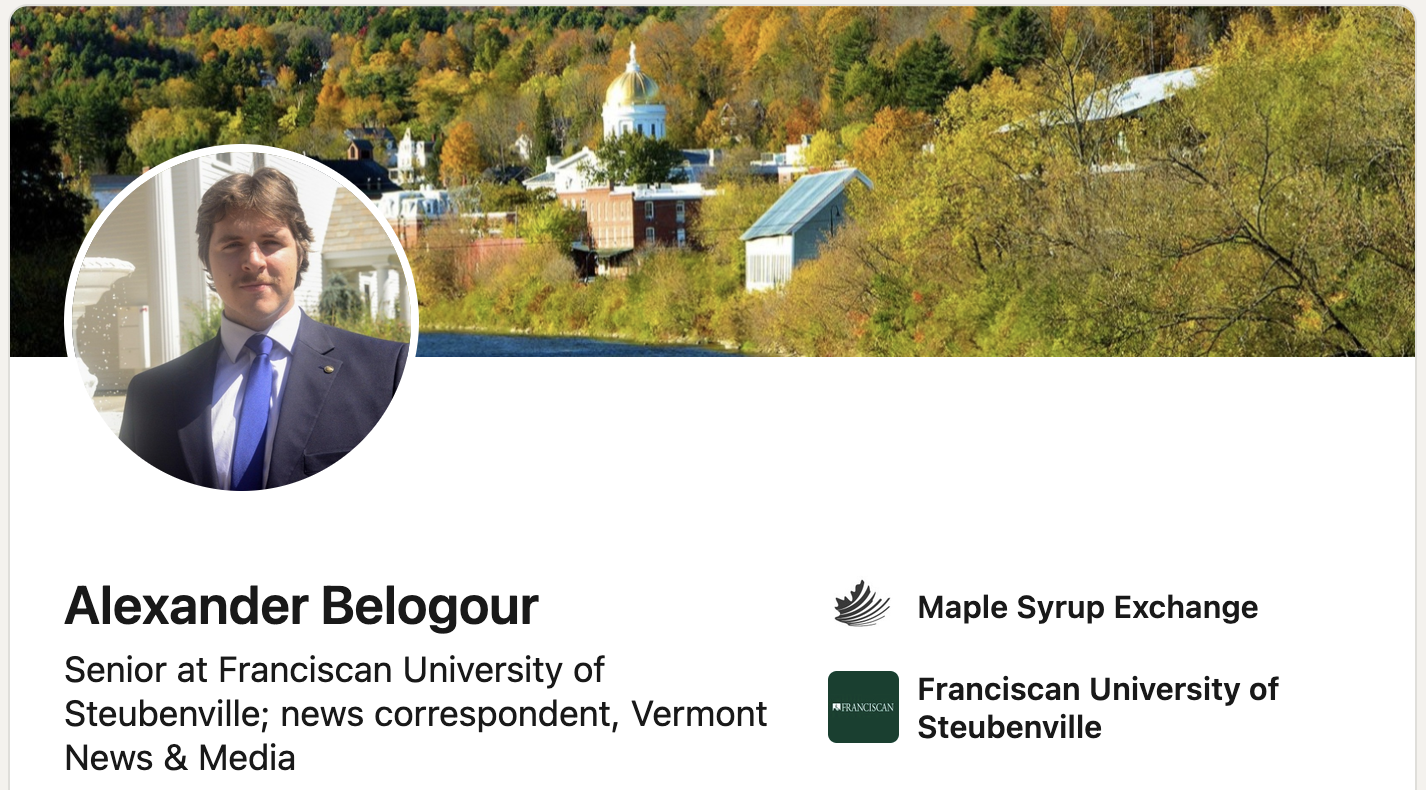
The above LinkedIn profile lists Alexander Belogour as a “correspondent” for the papers’ corporation, Vermont News & Media. Yes, he’s the owner’s son. And he is a devout Catholic who seems to be part of a national movement toward Catholicism among MAGA men, up to and including Trumpian red-ragger Steve Bannon and Vice President J.D. Vance. Young Belogour is a student at Franciscan University of Steubenville (Ohio), founded in 1946 to cash in on the postwar education boom fueled by the GI Bill (as were many other upstart institutions). Franciscan U was characterized in a 1998 National Catholic Reporter piece as “a sleepy regional college” transformed into an epicenter of conservative Charismatic Catholicism in the late 90s. Enrollment has more than doubled since then.
(The NCR also noted how Franciscan U has infected the culture of the entire city, which should serve as a warning to Poultney, former home of Green Mountain College and possible future home of a university run by a Florida-based evangelist.)
Well, Young Belogour has been spending his summer away from campus as a very busy reporter for his dad’s newspapers. To put it kindly, that’s a mixed blessing. And a troubling portent.
Update! Apparently the governor’s office did issue a statement slamming the tariffs. How Digger ignored it, I have no idea.
Update to the update! I got the timing wrong on the Digger story’s publication and Scott issuing a statement. Details below.
Following Donald Trump’s precipitous announcement of 50% tariffs on a variety of Canadian goods, VTDigger reporter Theo Wells-Spackman was tasked with chronicling the potential economic harm to our state, which is heavily dependent on cross-border trade and tourism. In the process, he gathered reactions from various Vermont officials. He did a decent job of it, but there was one notable and unexplained absence from the piece.
I’ll give you three guesses, and the first two don’t count.
The officials who made appearances in the story included, in this order, state economist Tom Kavet (who called Trump’s move “pure stupidity”), Treasurer Mike Pieciak, Amy Magnus of Vermont-based customs broker A.N. Deringer (the tariffs are “downright shocking”), and U.S. Sen. Peter Welch (Trump’s policy has “caused undeniable harm” and “economic chaos”).
A nice list. But who’s not there? Who’s conspicuous by their absence?
Why, our fearless, resolute Governor Phil Scott, that’s who. He was not quoted, nor was anyone from his administration. Wells-Spackman did not reveal whether he sought reaction from Scott or his minions. If he didn’t, well, that’s reportorial and editorial malpractice. The state’s top official should be heard from. If Wells-Spackman sought reaction and didn’t get any, that should have been reported in his article.
Either way, Phil Scott is conspicuous by his absence. And Digger might have let him off the hook for it.
Update. Apologies to the governor, and brickbats to VTDigger. Scott issued a full-throated statement yesterday afternoon at 1:00 slamming the Trump tariffs as “a bad idea” in bold font. This is all on Wells-Spackman, his editors, and Digger entire. His story was published at 6:21 p.m., more than five hours after the governor’s statement came out. Did they fail to notice? Did they somehow decide that the governor’s views weren’t relevant an article about “Vermont officials” reacting to the tariff announcement? It’s literally incredible.
The governor’s statement in full:
“My feelings on punitive tariffs imposed on Canada have not changed over the last two years and are simply a bad idea that will lead to increased costs on Vermonters. As I’ve said before, this added burden would create real challenges for our residents and businesses who are already facing economic headwinds. Canadians are our friendly neighbors and long‑time allies, and we should be working together to find solutions that strengthen the region, not further divide us. As I prepare to host the Premiers of Eastern Canadian Provinces in Vermont next month, my message is clear: we are good friends and partners, and I’m committed to strengthening our economic and cultural ties to benefit both sides of the border.”
Update to the update, and the updates are now longer than the original story. I got it wrong. The governor’s statement was issued the day after Digger published Wells-Spackman’s piece, not the same day. Careless error on my part, and I apologize. The story was published on 7/21, and Scott’s statrement came out midday on 7/22.
Which leaves me wondering about two things. First, did Wells-Spackman reach out to Scott’s office for comment? If not, why not? If so, why not include it in the story? And second, did Scott’s comms team cobble together a statement after Digger published? That’s a bit embarrassing.
And I hope this is the last time I have to revisit this cluster.