Tag Archives: Molly Gray

UNH Poll Predicts Janoo Victory Question Mark

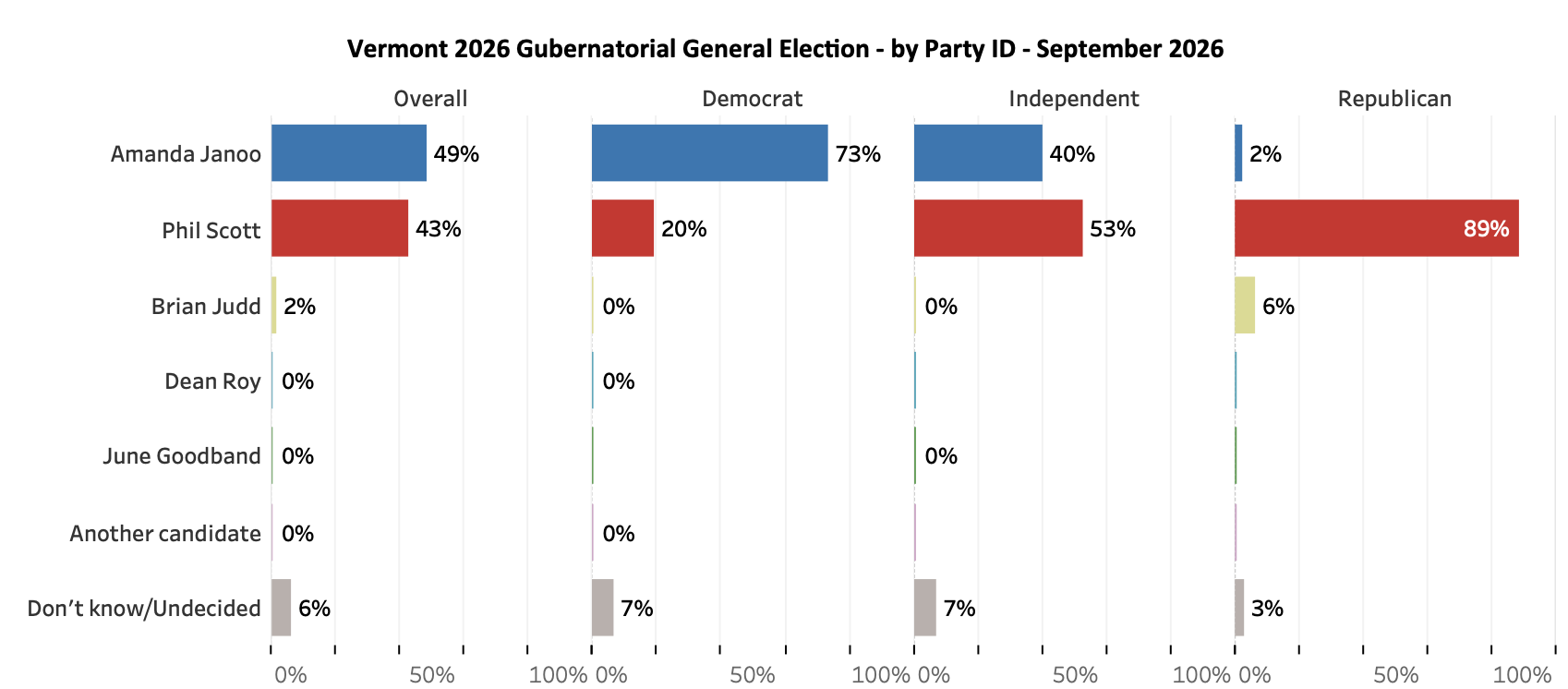
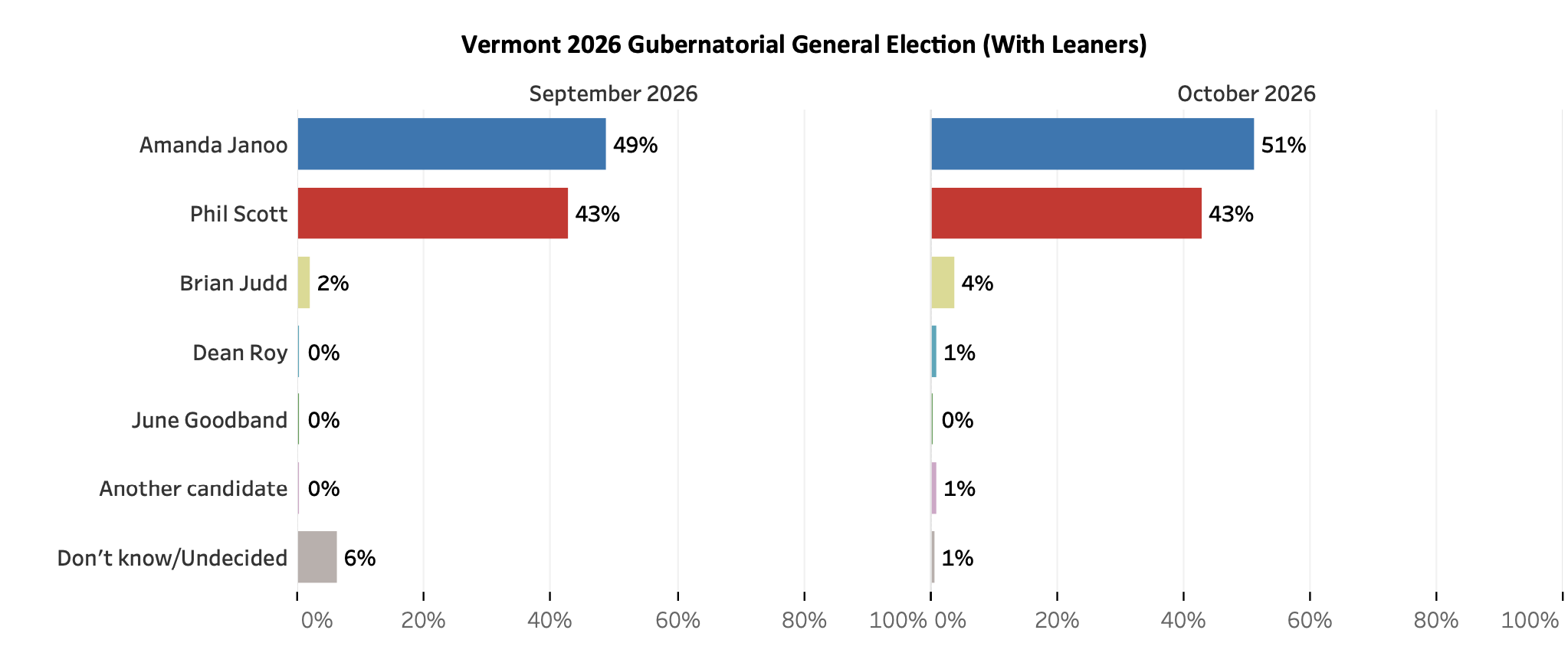
Well, there it is. The last (I think) pre-election poll in the race for Vermont governor. And yes, that’s Democrat Amanda Janoo holding an eight-point lead over Gov. Phil Scott, comfortably beyond the poll’s margin of error and a tick north of the all-important 50% mark.

The poll comes from the University of New Hampshire Survey Center, and must be accompanied by a couple of caveats. First, the UNH results have been more Janoo-friendly* than the single Vermont Public poll or the ongoing efforts of State Navigate. Second, I’m not sure the Center believes its own product. Its report was headlined “Blue Wave Lifts Janoo Over Scott in Vermont?”

*The Center’s latest Maine poll shows Democrat Troy Jackson with a nine-point lead over incumbent Republican Sen. Susan Collins. Either this will be a true wave election, or UNHSC will have some cleaning up to do.

That’s right, they attached a question mark to their own headline. It’s as if they can’t really believe the results of their own work.

Also worth noting, or puzzling over: The survey’s respondents don’t believe it themselves! 62% of all respondents, including 40% of Janoo voters, predict that Scott will win. Which is very close to where the prediction markets are heading. As recently as September 22, 94% of all bets predictions on Kalshi were for Scott. The governor’s share of the Kalshi action is now at 66% and Janoo is at 34%.
Continue reading →

Campaign Finance Pre-Election Final: ONE MEEEEEELLION DOLLARS

Well, the last pre-election campaign finance deadline has come and gone, and the big news is that the unknown underdog newbie pick-your-own-disparaging-descriptor Amanda Janoo has cleared seven figures in total fundraising.

That’s right, we’re talking Dr. Evil money. Janoo continued her late-stage sprint with an impressive haul of $170,000 in the last 15 days, for a grand total of $1,057,389.86 in donations.

Gov. Phil Scott, the invincible incumbent, has raised a much less impressive $720,000 including $130,000 in the most recent period. Of course, he entered the campaign with a hefty stash remaining from his 2024 walkover win, so he’s been able to spend $804,000 in all.

But still, the bottom line is this: Amanda Janoo has outraised and outspent Phil Scott for the entire campaign and in the most recent reporting period, covering the home stretch of the campaign. She’s received gifts from many more individuals than Scott, whose campaign has depended heavily on four-figure donations from the usual suspects in the business community. In her latest filing, Janoo reported receiving 26% of her total take in gifts of $100 or less. Scott, the alleged man o’ the people, got only 5% of his total in donations of $100 or less. (26% may seem low, but it’s actually a very respectable number. Most politicians don’t get that much from small donors.)

Continue reading →

Meet the New Poll, Same As the Old Polls

Another precinct has been heard from. The national NKOTB doing business as State Navigate has come out with its final pre-election poll on Vermont’s top two races, and the results track closely with previous polling. In the race for governor, incumbent Phil Scott has a narrow lead on challenger Amanda Janoo, but it’s within the dreaded Margin of Error and beneath the 50% threshold. That’s right: Mr. Popularity still hasn’t mustered a majority against a first-time candidate who was a virtual unknown in Vermont politics until the spring of this year. In the race for lieutenant governor, Democrat Molly Gray holds a seemingly insurmountable lead over incumbent Republican John Rodgers.

State Navigate, for those unfamiliar, is a nonprofit, nonpartisan outfit that does state-level polling through digital means. I haven’t done a deep dive, but they seem legitimate. Their results track closely with polls by the UNH Survey Center and Vermont Public.

Bottom line: This new poll gives Scott 49% to Janoo’s 46%. The undecideds are at 3%, and other candidates (mainly independent Brian Judd and June Goodband of the Peace and Justice Party) get 2%. State Navigate’s earlier poll showed the same margin between Scott and Janoo, but more voters undecided or opting for minor candidates. No surprise, more and more people are making up their minds and migrating to the top two choices. And no surprise, they’re more or less splitting down the middle. If that trend continues, Scott would win by the smallest margin of any of his six campaigns for governor. Hell, I think it might be the smallest margin of victory he’s ever enjoyed, going all the way back to his first state Senate race in 2000.

Continue reading →

They’re Pushing All Their Money Out the Door (Updated)

Well, it just got late early out there.

For one thing, city and town clerk’s offices are being flooded by early ballots. For another, candidates in our most competitive races are spending whatever money they have on hand.

Ballot returns seem to have shot up in the last week or so. The latest tally: as of today (October 21), Vermont voters have submitted 79,651 ballots. Judging by past turnouts in non-presidential years, it’s likely that close to 30% of all votes have already been cast*.

*Update: The day after I posted this piece, the Secretary of State’s office announced that returned ballots now number “over 88,000,” which is close to one-third of likely total turnout.

(Explainer: Turnout is always higher in presidential years. Over the last two decades, turnout in presidential years has averaged 339,000 in Vermont. When the presidency isn’t on the line, average turnout has been 253,000. But in recent years, turnout has been higher still; in 2022 it was 291,955. Generally speaking, voter participation has jumped since the Covid pandemic and the state started mailing ballots to every registered voter. I think it’s safe to assume our turnout will be less than 300,000 but not much less. Which would make 79,651 about 28% or so of the projected total.)

Candidates are aware that time’s running out. The mass media spending reports are pouring into the Secretary of State’s office, the vast majority from legislative candidates sending postcards and such. The races at the top of the ticket show what happens when those candidates don’t ahve a lot of money to burn.

Democratic gubernatorial candidate Amanda Janoo has continued to boost her spending, which remains very modest by normal standards. Her campaign has submitted two mass media reports in the last two days, totaling $95,516 in spending. That includes $65,000 in television advertising, $20,516 for good old-fashioned radio, and $10,000 for newfangled digital. That’s on top of $100,000 in media spends reported in her October 15 campaign finance report, $60,000 for TV and $40,000 for digital.

In all, it’s an impressive investment, but she still has room to do more. As of October 15, Janoo had a little more than $300,000 in the bank. I’d expect to see more filings from Team Janoo in the very near future.

Continue reading →

The Dirtiest Campaign in Vermont Is Run by a Democrat. Who’s Working for a Republican. Who’s Allegedly Devoted to Bipartisanship. (Updated with Another Endorsement)

If the Soviet Union was, in the words of WInston Churchill, “a riddle, wrapped in a mystery, inside an enigma,” then the re-election campaign of Lt. Gov. John Rodgers is a contradiction wrapped in a paradox inside an irony.

Two things. First, he claims to be “a voice for the working class,” but as previously noted, the vast majority of his money comes from the upper class — primarily from the Burlington area, far from the lives and concerns of the rural Vermonters he claims to represent.

Second, the former Democrat turned Republican leans heavily on bipartisanship, touting his ability to work with all parties. And yet since the August primary, his campaign has focused its energy on attacking his opponent, former lieutenant governor Molly Gray.

And the person who must be held responsible for this turn to the Dark Side is none other than Democratic State Rep. Matt Birong, who feels no apparent qualms about sticking it to a fellow Democrat on the reg.

Continue reading →

The Political Money is Kind of Underwhelming

Another campaign finance deadline has come and gone, and the big news is… there’s not much news. Well, not much new news, anyway. For the top two statewide races, the latest reports follow familiar patterns.

In the gubernatorial campaign, Democrat Amanda Janoo continues to hold a financial edge over Gov. Phil Scott, whose minimal-effort approach either indicates that (1) he’s very confident or (2) he’s lost his fastball after several easy victories. When you look at his fundraising numbers, you realize the last time he really had to work at it was 10 years ago, in 2016.

In the race for lieutenant governor, Democrat Molly Gray holds a substantial lead over incumbent Republican John Rodgers, whose campaign would be scraping bottom if not for big checks from a handful of donors and a $20,000 infusion from the state GOP. You know, Rodgers’ campaign signs tout him as “a voice of the working class,” but working Vermonters seem unappreciative. The vast majority of Rodgers’ money has come from Vermont’s upper class, and most of them hail from Chittenden County. Some kind of disconnect there.

The other four statewide races are uncompetitive, as the Republicans put up unknown and severely underfunded candidates against well-known Democrats.

The most recent filing deadline was Thursday, October 15. Reports covered the period between October 1 and October 15. So let’s get to the numbers.

Continue reading →

The Numbers The Numbers ALL THE NUMBERS

When a poll came out last week showing Amanda Janoo leading Gov. Phil Scott, it wasn’t well received by Team Scott. Campaign manager Dustin Degree called the University of New Hampshire Survey Center’s Green Mountain State Poll an “outlier,” which is factually incorrect on its face. It can’t be an “outlier” because there were no other polls to compare it to.

But I can understand the reaction. You thought you had it in the bag, and here comes an inconvenient poll poking holes in your Shield of Invulnerability.

Well, now we have a second survey, and what I can tell you is that each of them outlies the other. The new poll commissioned by Vermont Public is more favorable to Republicans across the board than the UNH survey. In the gubernatorial race, it puts Scott 10 points ahead of Janoo while UNH gives Janoo a six-point lead.

In the campaign for lieutenant governor, UNH has Democrat Molly Gray holding a decisive 19-point edge over incumbent John Rodgers while VP reports Gray with a lead of eight points. And there’s a huge divergence in the campaign for Vermont’s single seat in the U.S. House: Instead of incumbent Becca Balint’s 66-30 edge in the UNH poll, the Vermont Public survey gives Balint only a 15-point lead with, again, enough undecideds to turn the race around.

Those are big enough swings to cast doubt over the entire enterprise. I mean, each poll claims a margin of error under 3.5 points, but the differences between the two are waaaaaay bigger than that.

Continue reading →

I Just Felt the Earth Move Under My Feet

When was the last time we had an honest-to-God “Holy Shit” moment in the bland, predictable world of Vermont politics? I’m thinking it was 2014, when Scott Milne nearly defeated incumbent governor Peter Shumlin.

Well, we’ve got another one on our hands. Feast your eyes on the latest work from the University of New Hampshire Survey Center (full results downloadable here), which shows Democrat Amanda Janoo with a six-point lead over “unbeatable” Gov. Phil Scott, 49% to 43%. (The Survey Center labels the race a “statistical tie” because Janoo’s lead is within the poll’s margin of error.)

That’s right. No typo, no mistake. Janoo, who began this year a political unknown, seems to have the edge over our five-term governor.

Wow.

And before you cast doubt on the Survey Center’s reliability, three things. First, it’s been consistently right in Vermont this year. It foreshadowed Janoo’s win over fellow Democrat Aly Richards, Molly Gray’s mollywhopping of Ryan McLaren in the race for lieutenant governor, and Gerald Malloy’s trouncing of Mark Coester in the Republican Congressional primary.

Second, its methodology seems solid. This wasn’t one of your old-fashioned telephone surveys, which have become increasingly trouble-prone. Instead, UNHSC assembled a 2,700-person “probability-based web panel” used throughout this election year. About 40% of panel members responded to this poll. Data were weighted in a number of categories, including participation in the 2024 election. I’m not a statistician, but it looks reasonable to me.

Continue reading →

The Barons Seem Uninterested in Saving John Rodgers’ Bacon

The second most notable results from the September 1 campaign finance disclosures were about the race for lieutenant governor, and they once again show that incumbent Republican John Rodgers is in some trouble. Maybe a lot of trouble.

Two years ago, his campaign was buoyed by a wave of four-figure checks from the folks I call the Barons of Burlington: the moguls, developers, landlords, and others capable of making large donations to favored candidates. From July 1 onward, Rodgers’ 2024 campaign finance reports were riddled with familiar names: Pomerleaus, Pizzagallis, Tarrants, Bruce Lisman, Ray Pecor, Doug Nedde, etc., all kicking in sizable donations. The flood of cash may or may not have been the deciding factor in Rodgers’ win over incumbent David Zuckerman, but it sure as hell didn’t hurt.

This year, however, something has changed. The Barons are almost entirely absent from Rodgers’ filings. He did receive $1,000 from Ernie Pomerleau in August, but otherwise his September 1 report was barren of Barons. As a result, Rodgers lags far behind Democratic nominee Molly Gray in total fundraising and cash on hand. (Gray has received $2,250 from former Rodgers backer Brian Boardman plus $2,000 from ski resort tycoon Win Smith, so the balance of Barons tips slightly in her direction.)

Gray’s lead in spendable cash is kind of stunning, since she had to weather a costly primary battle while Rodgers faced no Republican opposition. The bottom line: Gray has raised $412,000 for the campaign to date compared with Rodgers’ $143,000. Gray has spent $339,000, and reported cash on hand totaling $73,000. Rodgers has somehow managed to spend $118,000 despite the lack of a primary challenge, and has only $26,000 in the bank.

Standard caveat: Money isn’t the only factor in a campaign, and Rodgers does have the incumbent’s advantage. But pre-primary polls by the University of New Hampshire Survey Center showed weakness in Rodgers’ position. The disparities in fundraising prowess and cash position are more evidence that Rodgers is on the back foot. And the reticence of the Barons suggests they might just see him as a lost cause.

Continue reading →

Primary Night Instant Reaction, To Be UPDATED Until All the Key Races are Settled

So it’s primary night in Vermont, and as the results come in, I’m here to read and react. Stay tuned!

Maybe Planet Hank Isn’t a Genius After All. The first contested race to be called by the Associated Press was the Republican primary for the chance to lose to U.S. Rep. Becca Balint in November. And the big winner was Gerald Malloy, who beat Mark Coester by a better than two-to-one margin. Coester’s low-rent campaign leaned heavily on AI-generated Balint attack videos produced by “Planet Hank” Poitras. I had worried that Hank could prove to be a rising star in Vermont conservative circles, because those folks are often drawn to extreme, flashy rhetoric. My concerns are significantly assuaged tonight. Not that we can close the books on Hank, but Coester’s lopsided loss blows a big hole in Hank’s reputation for strategery.

Malloy, meanwhile, kinda-sorta positioned himself as the “moderate,” if only by the current standards of Republican politics. The few Malloy campaign signs I spotted did not feature his notorious scary eagle logo, which I guess was part of the rebranding? No matter; Malloy is destined to go down to his third consecutive defeat in November. In 2022 he got 28% of the vote to Peter Welch’s 68.5% in the race for U.S. Senate. In 2024 he upped his total to 32% while Bernie Sanders took 63%. At this rate, Malloy will win an election in the year 2036. I think that’s a highly optimistic view of his political future.

Molly Gray’s Big Night. The second major race to be called was the Democratic primary for lieutenant governor. Turned out the UNH opinion polls got this one right; former LG Molly Gray had no trouble defeating Ryan McLaren and Esther Charlestin. McLaren’s furious fundraising and spending elevated him from a third-place tie with Charlestin to a solid but very distant second. As of this writing, Gray has more than twice as many votes as McLaren.

(The UNH polls were equally prophetic about the Malloy/Coester race. Maybe we should take the other results seriously?)

Instant reax: Gray had a huge advantage in name recognition entering the contest. Mclaren is well known in Democratic circles but had no public profile to speak of before he launched his campaign. He didn’t have much time to close that gap. And I have to say, he didn’t present a convincing rationale for his candidacy — not convincing enough for voters to abandon the candidate they knew. McLaren complained about internal Vermont Democratic Party doings, a tactic that didn’t resonate with the public and may have hurt him with party insiders. He apparently tossed another grenade last month that exploded in the forest and nobody heard? This intriguing nugget from VTDigger’s election night coverage:

In strongly worded interviews, McLaren told VTDigger last month that both of his opponents were falling back on the lieutenant governor role after failing to achieve a higher office (referring, in Gray’s case, to an unsuccessful U.S. House run in 2022).

The Digger story does not include a link to any previous coverage of McLaren’s “strongly worded” remarks, and I don’t remember reading anything about them. Did I miss it? Did Digger not think his statements were newsworthy? If so, that’s an egregious error.

Continue reading →