
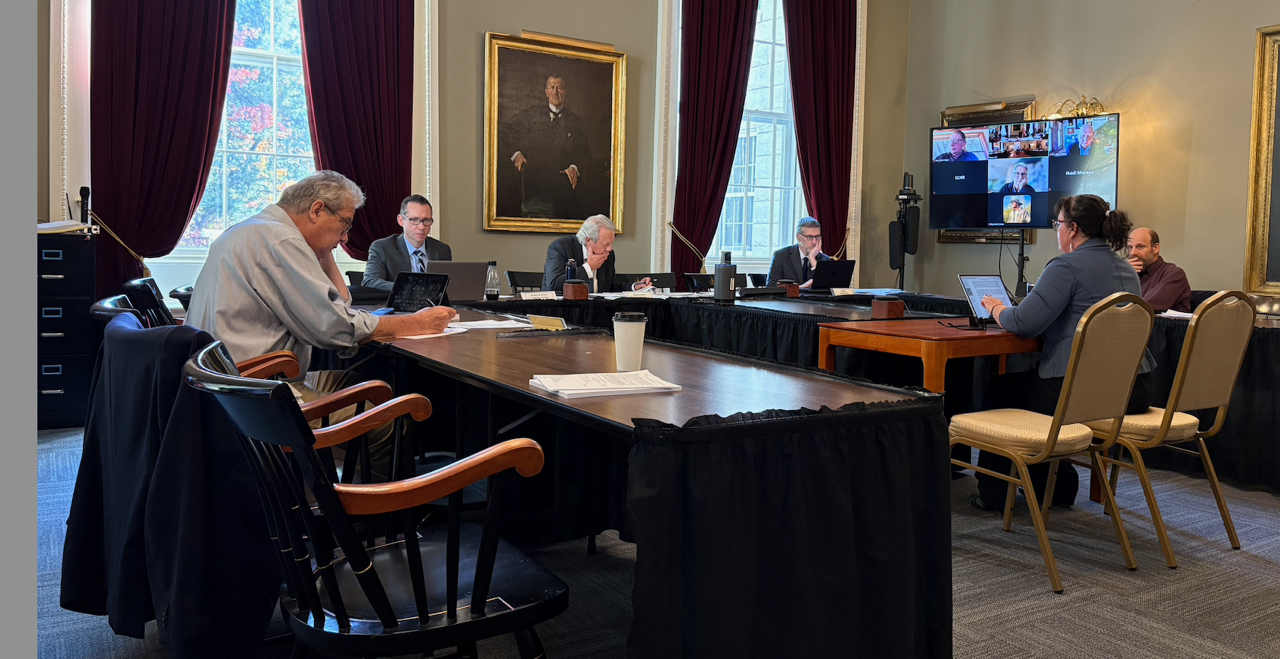
Turns out, it was too much to expect that this bunch of uninterested dudes would bring themselves to make a tough call. Instead, they kicked the can down the road and begged other parties to, in the words of Our Lord and Savior, “let this chalice pass from me.”
The occasion was a Thursday meeting of the Legislative Committee on Administrative Rules, the House-Senate panel tasked with reviewing and approving how the executive branch implements legislation. The top agenda item was Act 143, the law that set in process a reform of Vermont’s emergency housing program — more specifically, how the Scott administration interpreted the law and put it into practice.
And in the end, LCAR punted. Committee chair Rep. Trevor Squirrell said no decision would be made for two weeks, and practically begged advocacy groups and administration officials to get together in the meantime and work out their differences. In other words, the panel doesn’t want to reject the Act 143 rules, but can’t possibly ignore all the objections to the rules and the chaos they have caused.
This, after the chairs of the relevant policy committees made clear that in most respects, the rules failed to comport with legislative intent. (Squirrell said that LCAR would “rely heavily on” the chairs’ views, and then proceeded to treat them like an inconvenient fly buzzing around his head.) This, after advocate after advocate testified — again — that the rules have been a disaster and ought to be rejected.
The lesson — again: Never underestimate the ability of a legislative committee to duck an unpleasant situation. Also, speaking as Your Political Observer, never underestimate the ability of Democratic leadership to squander a prime opportunity to confront the Scott administration on a point of vulnerability. Which also happens to have deepened Vermont’s moral failure to address its crisis of unsheltered homelessness.
I mean, how often does a political opportunity also happen to be the right thing to do? Yeah, it was too much for the likes of Rep. Squirrel and his fellows* on LCAR.
*Committee members include seven men and ONE woman. Hat tip to legislative leadership for that!
Another crucial dimension: This was a significant dispute between the two branches. By looking for a way out of the quandary, LCAR abandoned an apparent position of strength. There appears to be very firm ground for the argument that the intent of Act 143 has been flouted. It’s clear that Squirrell’s committee would prefer taking the nearest escape hatch over defending the Legislature’s authority.
The first witnesses were from the Department of Children and Families. As they’d done previously, they depicted all the chaos as merely the result of a rushed implementation rather than any inherent design flaws. Which begs the question, whose idea was it to rush this thing through in the first place? Act 143 allowed a full year for developing a new program, and the administration insisted on doing it in a couple of months.
Anyway, the bureaucrats claimed that things are much better now and their work was fully in line with Act 143, nothing to see here, please keep moving along.
And then the advocates stepped, one by one, to the witness table.
First came Brenda Siegel of End Homelessness Vermont, seen above speaking to a largely inattentive committee. Of the five lawmakers in attendance (others were there via Zoom), only one is actually looking at Siegel. Gotta be inspiring to share your knowledge and expertise to a bunch of people staring at their screens.
Siegel testified that she supported Act 143, but that its implementation has been a betrayal. Since the new rules took effect on September 1, she said, “I have seen the most direct violation of the rights of people living with disabilities, the highest barriers, and the least flexibility that I have ever seen in this work.” The rules, she added, “are beyond the authority of the agency, contrary to the
intent of the Legislature, arbitrary, and not necessitated by an imminent peril.”
The plight of people with disabilities was carried forward by Sarah Launderville of the Vermont Center for Independent Living. People with disabilities often have tremendous difficulty navigating bureaucracy, and DCF’s spanking new 22-page intake form, which must be filled out over the phone with a case worker or department official, is an insurmountable obstacle for some. Launderville testified that Act 143 meant for intake assessments to be “tools to identify needs, reasonable accommodations, and connections to services. They should help people obtain housing and supports,” not provide fresh barriers to those least able to overcome them.
Leah Burdick from Vermont Legal Aid was next, and continued the theme. “The emergency rules… create multiple unnecessary barriers and administrative burdens for applicants,” she said, and asserted that the new rules violate the Americans with Disabilities Act. Which summons the notion of a lawsuit over the rules. Nothing of the sort was overtly threatened, but the prospect is there.
Jessica Radbord of the Vermont ACLU urged rejection of the rules for the sake of Vermont’s homeless “and to uphold the basic tenets of our tripartite system of government.” For instance, the executive branch is responsible for upholding the letter and intent of a new law. She went on to describe “the innumerable… ways that the rules do not comport with legislative intent.”
The hearing can be viewed here; witness testimony was submitted in written form and can be downloaded from LCAR’s website.
At the end of the hearing, Squirrell and committee member (and notable centrist squish) Sen. Seth Bongartz expressed the hope “that all parties can get together and work it out.” Those parties, many of whom have been working past capacity because of decisions made by the people they’d have to “get together” with, are likely to at least give it a shot, even though it seems a bit like they’re being asked to return to an abusive relationship. But there doesn’t seem to be much negotiating room, since the administration sees the problem solely in terms of a rocky implementation and believes its new rules are perfectly in line with Act 143. How do you square those very different viewpoints?
To be cynical for a moment, kicking the can two weeks down the road also brings us to the doorstep of Election Day. Could it be that Squirrell and his fellows are trying to avoid any hint of politics in this process? They do seem to be intent on running out the clock. Which might seem like the decent thing to do, except that (1) the administration is all but thumbing its nose at the Legislature and (2) some of our most vulnerable Vermonters are paying the price. Besides that, Mrs. Lincoln…

