
Our sadly diminished news media is all but ignoring the fact that (1) a humanitarian crisis and (2) a deeply consequential dispute between the Scott administration and the Legislature are both happening in the closing weeks of an election campaign. It’s been several weeks since this thing has gotten any coverage at all.
At issue is the administration’s implementation of Act 143, the bill designed to reform Vermont’s emergency housing system — making it more responsive to the needs of clients and less dependent on hotel/motel rooms. According to one of Act 143’s primary authors, House Human Services Committee chair Theresa Wood, the bill allowed a full year for implementation of a new system. Instead, the administration rushed it through and launched it on September 1. The result? Predictable chaos.
Last Friday, the two policy committees that shepherded Act 143 through the process (House Human Services, Senate Health & Welfare) held a joint hearing on the law’s implementation. (The video of the hearing can be viewed here.) The proceedings were dispiriting, to say the least. Witness after witness testified to the costs of a rushed implementation: new burdens on already overtaxed providers, local governments, and the health care system, massive confusion, bureaucratic waste, and an increase in unsheltered homelessness.
Aside from that, Mrs. Lincoln, how was the play?
The hearing was the first of a two-step process. The second will come tomorrow/Thursday October 15, when the Legislative Committee on Administrative Rules will consider Act 143’s implementation. LCAR has the authority to reject the new process, which would force the Scott administration back to the drawing board. The committee is likely to lean heavily on advice from the two policy committee chairs in making that decision.
Well, those chairs have provided a written statement to LCAR, and it’s broadly damning. Rep. Wood and Senate Health & Welfare chair Sen. Ginny Lyons conclude that in most respects, the administration’s new rules fail to meet legislative intent. They do not specifically call for the rules to be rejected, but it looks like, sounds like, feels like that’s what they want. Their memo calls for the development of “final rules” arising from a more prolonged and thoughtful process including “extended collaboration with community partners and individuals directly impacted by homelessness.”
Hm. The administration seems content with the rules they’ve already written. In their Friday testimony they acknowledged difficulties due to the rushed implementation process but didn’t admit to any structural flaws. If Wood and Lyons want different “final rules,” that implies an LCAR rejection of the rules now in place. Maybe I’m reading too much into it, but I don’t think so.
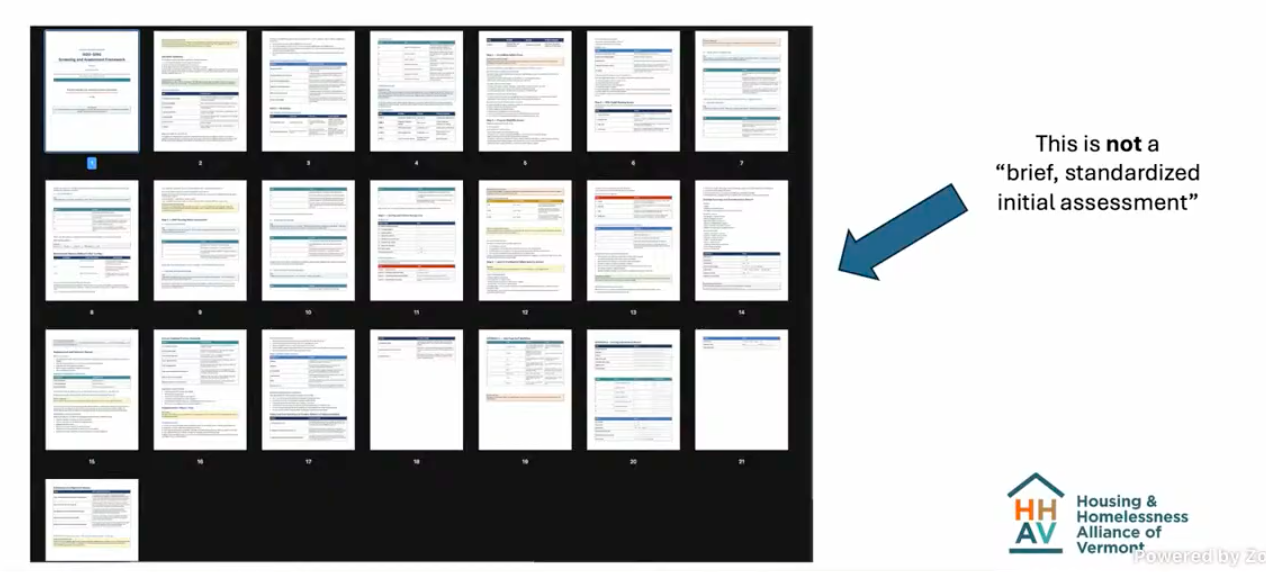
One example of the objections raised by Wood and Lyons. The illustration at the top of this post was presented to the joint hearing By Chad Simmons of the Housing and Homeless Alliance of Vermont. It shows the emergency housing assessment form implemented on September 1 and now required for anyone seeking emergency housing. Clients and advocates have characterized this form as excessively burdensome and difficult to complete. Wood and Lyons agree, writing that this form is not the “brief, standardized initial assessment” described in Act 143.
Overall, Wood and Lyons evaluate the administration’s new rules against 11 separate criteria. They find the rules comport with legislative intent on three criteria, fail to comport on seven, and need some adjustment on another. In baseball, batting .300 is a mark of success, but not in complying with the law.
I don’t know how LCAR will react. It’s usually a fairly quiet committee that makes sure all the boxes are checked but isn’t called on to wade into the deep waters of politics and policymaking. Will it call for a rewrite of the deeply troubled emergency housing program at a profoundly political moment in time? This could explode into a consequential issue in the campaign when there are already signs of trouble aplenty for the incumbent governor.
Or, ahem, it could become a consequential issue if anybody notices. Will anyone from the media cover LCAR? I sure hope so, but I’m not optimistic given their available resources and the collective shying-away from Statehouse affairs. I can tell you this: I’ll be watching.

