
After months of essentially ignoring the contested statewide primary races, our media outlets are suddenly starting to pay attention. It’s as if somebody glanced at a calendar and realized the primary is less than three weeks away, wow, we’d better get on the stick.
I mean, a story posted this week by Vermont Public termed the primary “sleepy,” to which I say, well, whose fault is that? The Democratic candidates for governor and lieutenant governor have been working their asses off, traveling around the state, speaking to anyone who will invite them, and fundraising at a robust pace. They’ve been doing their part; it’s the media that have, until now, made this a “sleepy” primary by paying it little attention.
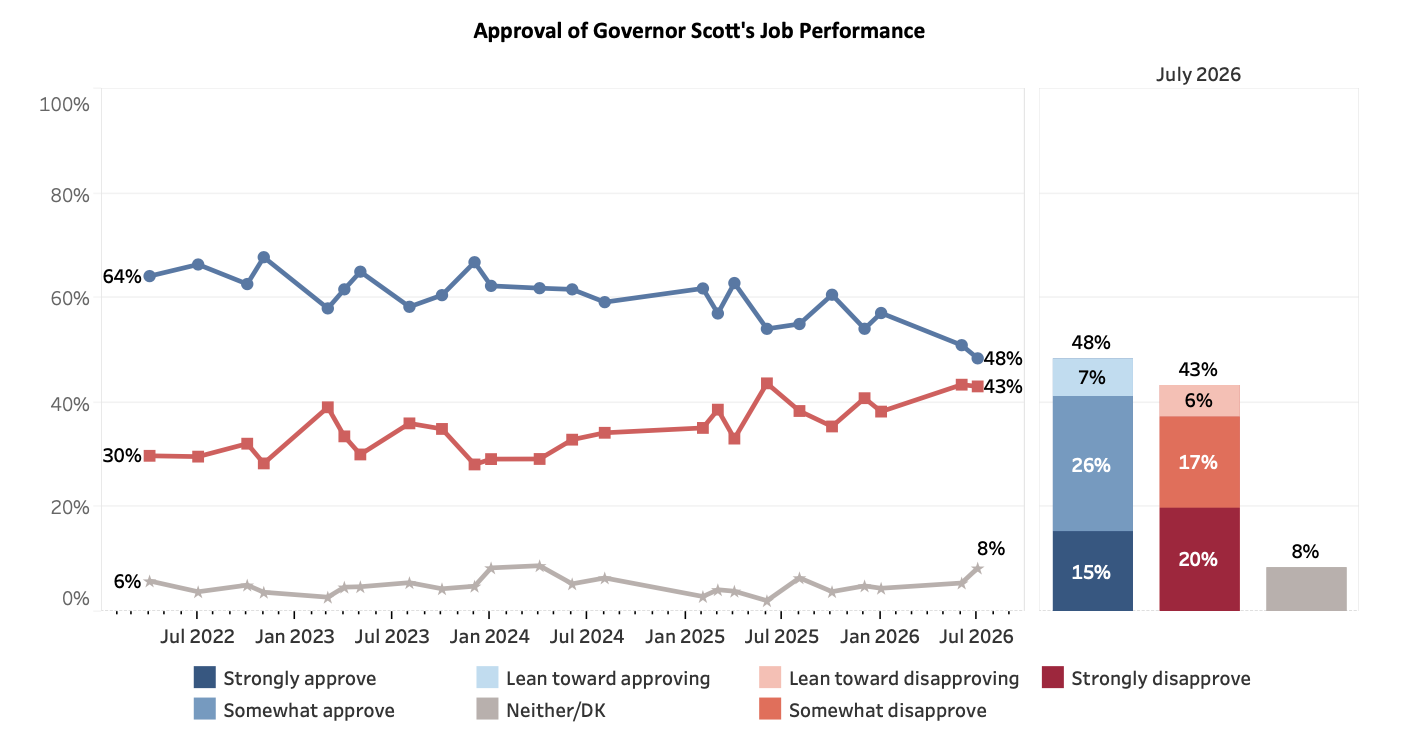
Enough ranting, let’s get to business. The University of New Hampshire Research Center has published another poll on Vermont politics, and the basic throughline is a gradual cementing of previously seen trends. But there are some notable results, such as a drop below 50% approval for our legendarily popular Gov. Phil Scott. In a June survey, Scott had fallen from his accustomed perch in the low to mid 60s down to 51%. (He was at 60% as recently as last fall.) Now he’s at 48%, with 43% disapproving and 8% expressing no opinion. What’s more, the ranks of the “Strongly” disapproving rose from 15% to 20%. Fresh dents in the Teflon?
There’s more in the gubernatorial numbers but first I want to hit the LG results, which show incumbent Republican John Rodgers in serious trouble. In hypothetical matchups, Rodgers loses to any of the three Democrats in the race — including Esther Charlestin. And he seems to be falling further behind. Another thing: on the gambling racket prediction marketplace Kalshi, for what it’s worth, 71% of the wagers are on the Democrats taking back the ol’ bucket of warm piss. (Fascinating Kalshi note: “Republican” held a 60-40 edge until July 3, when “Republican” took a sudden plunge and “Democrat” surged. The market has stayed essentially the same since then.) (Humbling Kalshi note: Bets on the LG race total less than $14,000, while bets on “LeBron James Next Team” are more than $214,000,000.)
Former LG Molly Gray does the best against Rodgers, with 49% supporting her (up from 45% in June) compared to only 29% for the incumbent (unchanged from June). The ranks of the undecided have slipped, and most of ’em went to Gray. Ryan McLaren, who remains little known among the voters, still manages to outpace Rodgers 43% to 27%. McLaren’s July total is 11 points better than his June figure, while Rodgers lost three points and the undecideds declined from 37% to 26%.
And even the cash-strapped Esther Charlestin has gained ground on Rodgers, beating him by 40% to 30%. That’s five points better than in June. Rodgers is polling in the neighborhood of “generic Republican” (read: H. Brooke Paige), a dramatic comedown from his post-2024 status as the great Republican hope. It’s way too soon to brand him a loser, but he’s definitely trending in that direction. (UNH apparently didn’t ask about Rodgers’ approval rating.)
Back to the gubernatorial. The Survey Center asked which issues made voters more or less likely to support Scott. The top three favorables were on “Handling of education” (16%), “Handling of taxes” (11%), and “Handling of cost of living” (9%). The top three issues most likely to turn voters away were, ahem, “Handling of education” (20%), “Handling of healthcare” (13%), and “Poor leadership” (12%). I guess we can see why Scott is hammering away at affordability; he rates the best on the kitchen-table stuff, while he fares worst on tackling our most challenging issues.
Yes, I know “Handling of education” was #1 in both rankings. My inference is that conservative voters appreciate Scott’s efforts to keep a lid on costs while liberal voters downgrade his lack of attention to, you know, the actual education of our youth.
The big takeaway: these results are kind of a roadmap for how to attack Scott, as an unimaginative caretaker with a single-minded focus on the cost of government. Hopefully the Democrats are taking notes.
Turning to the hypothetical general election matchups, the results haven’t moved tremendously but they’re all going in the same direction. Scott remains in the low 40s while the Democrats are still behind but gaining ground. Scott would beat Amanda Janoo 44% to 33% (it was 42-27 in June), and has a 43% to 35% lead over Aly Richards (41-25 in June). The undecideds dropped from 26% in June to 17% this time, and most of them went Democrat.
As for the primary contest, Janoo continues to lead Richards but not decisively, and a lot of voters remain undecided. In June it was 20% for Janoo, 12% for Richards, and a massive 64% undecided. In the July poll it was 26% Janoo, 19% Richards, and 52% undecided. More than half the voters said they “don’t know enough” about either candidate to make up their minds, so Richards has plenty of room to close a relatively small gap.
Distinct profiles of the two candidates are beginning to congeal. The survey found that “Janoo supporters tend to cite her policies while Richards supporters tend to mention her past experience.” The poll mirrors the candidates’ self-descriptions: Janoo has been running as a progressive idea person while Richards has presented herself as a manager and fixer.
On to the Democratic primary for lieutenant governor, which sees Gray holding her substantial lead over McLaren and Charlestin. In June, it was Gray 39, Charlestin 11, and McLaren 7. In July, Gray was still at 39 while McLaren stepped up to 11 and Charlestin dropped to 9. Undecideds continue to number in the low 40s.
More bad news for McLaren in the “Favorability” results. Among likely Democratic primary voters, Gray was at 45% approve, 22% “Neutral,” 11% disapprove, and 22% “don’t know enough to say.” McLaren was at 18% approve, 14% neutral, 3% disapprove, and a massive 64% “don’t know.” He’s even behind Charlestin in approval and name recognition. It bodes ill for his prospects come August 11. If I were a betting man, I’d put my chips on Gray.
The third race covered in the survey was the Congressional contest, and the results there were seemingly decisive. Gerald “Scary Eagle Man” Malloy has a massive 58% to 6% lead in the Republican primary over southeast Vermont nutjob Mark Coester. In June, Malloy’s lead was 48% to 19%. I guess those Planet Hank-produced AI videos that Coester can’t stop promoting are doing more harm than good?
The favorability results show where the gap is coming from. Malloy is viewed favorably by 62% of Republican voters, while 60% don’t know anything about Coester.
It doesn’t really matter anyway, because either Republican would have his ass handed to him by incumbent Democrat Becca Balint. Ironically, given the massive advantage Malloy enjoys in the primary, he fares no better than Coester in hypothetical general election matchups. Balint leads Malloy 63% to 25% and leads Coester 64% to 25%. Neither Republican has built a constituency beyond the hardcore Republican base. Which makes Coester’s awful primary numbers a bit of a puzzle; you’d think the dead-ender Republicans would favor Coester over Malloy.
That’s about it. The UNH Survey Center didn’t bother tracking the statewide races for Attorney General, Auditor, Secretary of State, and Treasurer, each of which feature an established figure challenged by a placeholder Republican with no serious prospects.
All this reminds me, I’ve got to pick up my primary ballot. On to the town clerk’s office!


This is an interesting analysis of the recent UNH poll results. The shifting approval numbers for Governor Scott and the competitive LG race certainly give voters a lot to consider as the primary approaches. Speaking of creating content around political discussions, I’ve been exploring tools that help with video creation. AI video creation tools – Visemix allows users to generate lip-synced videos from photos or audio, which could be useful for political commentary or campaign content.
Thanks for this thorough breakdown of the UNH poll. The media’s sudden attention to a primary they themselves labeled “sleepy” is a fair point — the candidates have clearly been putting in the work while coverage lagged. The Rodgers numbers are striking, especially the consistency of his decline across matchups. It’s also a good reminder of how much noise versus signal there is in prediction markets like Kalshi. On a side note, for anyone working with images and alt text while publishing pieces like this, tools such as AI image describer – Image Describer can help generate descriptions and alt text quickly.