Tag Archives: Ryan McLaren

Primary Night Instant Reaction, To Be UPDATED Until All the Key Races are Settled

So it’s primary night in Vermont, and as the results come in, I’m here to read and react. Stay tuned!

Maybe Planet Hank Isn’t a Genius After All. The first contested race to be called by the Associated Press was the Republican primary for the chance to lose to U.S. Rep. Becca Balint in November. And the big winner was Gerald Malloy, who beat Mark Coester by a better than two-to-one margin. Coester’s low-rent campaign leaned heavily on AI-generated Balint attack videos produced by “Planet Hank” Poitras. I had worried that Hank could prove to be a rising star in Vermont conservative circles, because those folks are often drawn to extreme, flashy rhetoric. My concerns are significantly assuaged tonight. Not that we can close the books on Hank, but Coester’s lopsided loss blows a big hole in Hank’s reputation for strategery.

Malloy, meanwhile, kinda-sorta positioned himself as the “moderate,” if only by the current standards of Republican politics. The few Malloy campaign signs I spotted did not feature his notorious scary eagle logo, which I guess was part of the rebranding? No matter; Malloy is destined to go down to his third consecutive defeat in November. In 2022 he got 28% of the vote to Peter Welch’s 68.5% in the race for U.S. Senate. In 2024 he upped his total to 32% while Bernie Sanders took 63%. At this rate, Malloy will win an election in the year 2036. I think that’s a highly optimistic view of his political future.

Molly Gray’s Big Night. The second major race to be called was the Democratic primary for lieutenant governor. Turned out the UNH opinion polls got this one right; former LG Molly Gray had no trouble defeating Ryan McLaren and Esther Charlestin. McLaren’s furious fundraising and spending elevated him from a third-place tie with Charlestin to a solid but very distant second. As of this writing, Gray has more than twice as many votes as McLaren.

(The UNH polls were equally prophetic about the Malloy/Coester race. Maybe we should take the other results seriously?)

Instant reax: Gray had a huge advantage in name recognition entering the contest. Mclaren is well known in Democratic circles but had no public profile to speak of before he launched his campaign. He didn’t have much time to close that gap. And I have to say, he didn’t present a convincing rationale for his candidacy — not convincing enough for voters to abandon the candidate they knew. McLaren complained about internal Vermont Democratic Party doings, a tactic that didn’t resonate with the public and may have hurt him with party insiders. He apparently tossed another grenade last month that exploded in the forest and nobody heard? This intriguing nugget from VTDigger’s election night coverage:

In strongly worded interviews, McLaren told VTDigger last month that both of his opponents were falling back on the lieutenant governor role after failing to achieve a higher office (referring, in Gray’s case, to an unsuccessful U.S. House run in 2022).

The Digger story does not include a link to any previous coverage of McLaren’s “strongly worded” remarks, and I don’t remember reading anything about them. Did I miss it? Did Digger not think his statements were newsworthy? If so, that’s an egregious error.

Continue reading
I Hope the Democrats Have Money Left After the Primary

The good news, if you favor the Democrats, is that many of their candidates have been able to raise impressive amounts of money in advance of next week’s primary.

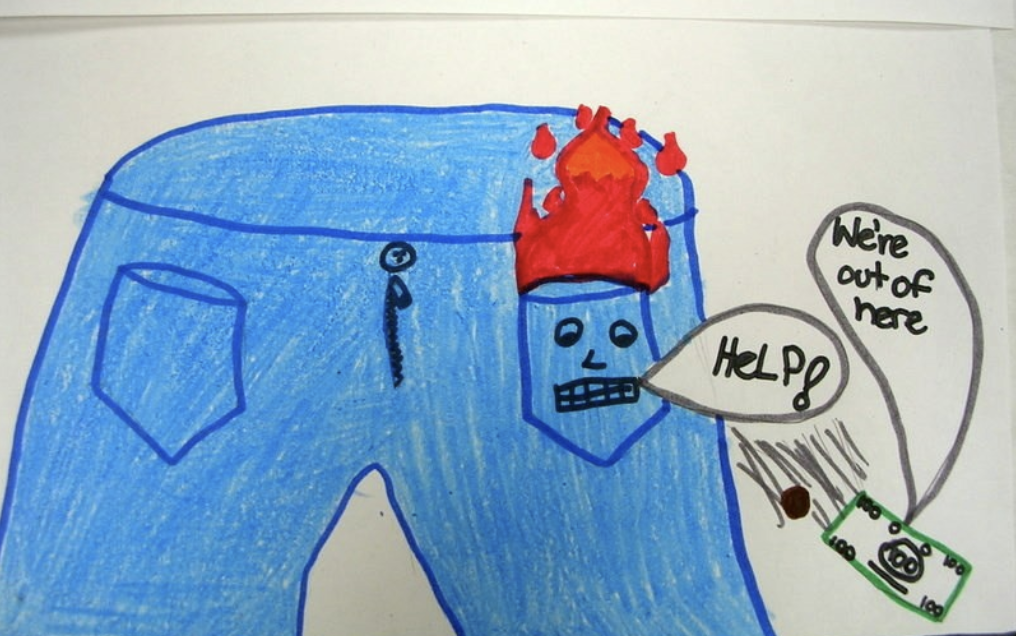
The bad news: They’ve spent a lot of their cash in ways that are only tangentially related to advancing the cause in November. Here’s hoping there’s more money where all of that came from.

I mean, look: The two top Democratic candidates for lieutenant governor, Molly Gray and Ryan McLaren, have raised a combined total of close to $750,000. That should be more than enough to fuel an entire campaign for the ol’ bucket of warm piss, but Gray and Mclaren are going to spend most of it by next Tuesday. Gray’s reported spending totaled $248,000 as of August 1, while McLaren had spent $293,000 by then — plus another $52,000 on TV ads reported separately after he’d filed his 8/1 report. Add it all up, that’s $593,000 spent, invested, squandered, take your pick, on the Democratic nomination for an essentially ceremonial office.

The two gubernatorial candidates, meanwhile, have raised $742,000 and spent $632,000. (Amanda Janoo: raised $303,000 and spent $255,000; Aly Richards raised $439,000 and spent $347,000.) The winner will have exceeded expectations for fundraising, but August 12 will find her back at the bottom of the mountain having to push the giant boulder up to the top. As of August 1, Richards had $92,000 in the bank but has spent another $30,000 on TV ads since then, which drops her account balance down to $62,000. Janoo had $46,000 in the bank on August 1 and has since spent $2,000 more on Facebook ads, so her known balance is at $44,000.

Gov. Phil Scott, meanwhile, has been coasting along. He entered the campaign with $240,000 left over from 2024. He’s spent virtually nothing and raised a modest amount, bringing his bank balance up to $309,000. In other words, the Democratic winner will have to do some heavy lifting just to catch up with the governor. And if he feels threatened at all, he’ll kick it in high gear and his base will respond. Two years ago Howard Dean estimated that a challenge to Scott would cost a minimum of $2 million; that seems like a reasonable amount. The Democratic nominee will have less than three months to build a warchest and mount a statewide challenge against a popular governor. Calling it “a tall order” seems like an understatement.

Continue reading

So Who’s Spending It, and Where’s It Going?

While us campaign finance sickos breathlessly await the August 1 filing deadline, we can occupy a bit of our time by tracking the mass media buys reported since July 1. There are quite a few, in fact.

Explainer for those who need it: Whenever a candidate spends $500 or more on mass media (radio, TV, digital ads, printing, mailing, etc.), they must report it to the Secretary of State’s office within a couple of days, a rule often honored more in the breach than the observance.

Can you guess where the most money was spent on mass media this month? That’s right, it’s the Democratic race for lieutenant governor by a country mile. Ryan Mclaren, last seen trailing badly in the polls, poured $125,100 into TV ad buys conducted by Georgia-based Canal Partners Media. Apparent front-runner Molly Gray has spent $112,918 on TV ad buys done by Virginia-based Screen Strategies Media and another $26,537 on postcard mailings by Berlin Rosen LLC of New York for a grand total of $168,135.

Couldn’t help noticing as I scanned all these reports that virtually all statewide candidates and some legislative hopefuls are contracting their printing and media buys out of state. I guess the big firms know what they’re doing, but home cooking seems to be a thing of the past.

Anyway, McLaren and Gray have combined to spend almost $300,000 on a non-gubernatorial primary election. That’s got to be an all-time record. If it’s not, make sure to let me know in the Comments.

Whatever, it’s a fuck-ton of money for a bucket of warm piss, and a further indication that incumbent Republican John Rodgers is extremely vulnerable; both Democrats must feel like the primary is their biggest hurdle.

Continue reading

Phil Scott Slides Below 50%, John Rodgers Is in Trouble, and Other Notes from a New UNH Poll

After months of essentially ignoring the contested statewide primary races, our media outlets are suddenly starting to pay attention. It’s as if somebody glanced at a calendar and realized the primary is less than three weeks away, wow, we’d better get on the stick.

I mean, a story posted this week by Vermont Public termed the primary “sleepy,” to which I say, well, whose fault is that? The Democratic candidates for governor and lieutenant governor have been working their asses off, traveling around the state, speaking to anyone who will invite them, and fundraising at a robust pace. They’ve been doing their part; it’s the media that have, until now, made this a “sleepy” primary by paying it little attention.

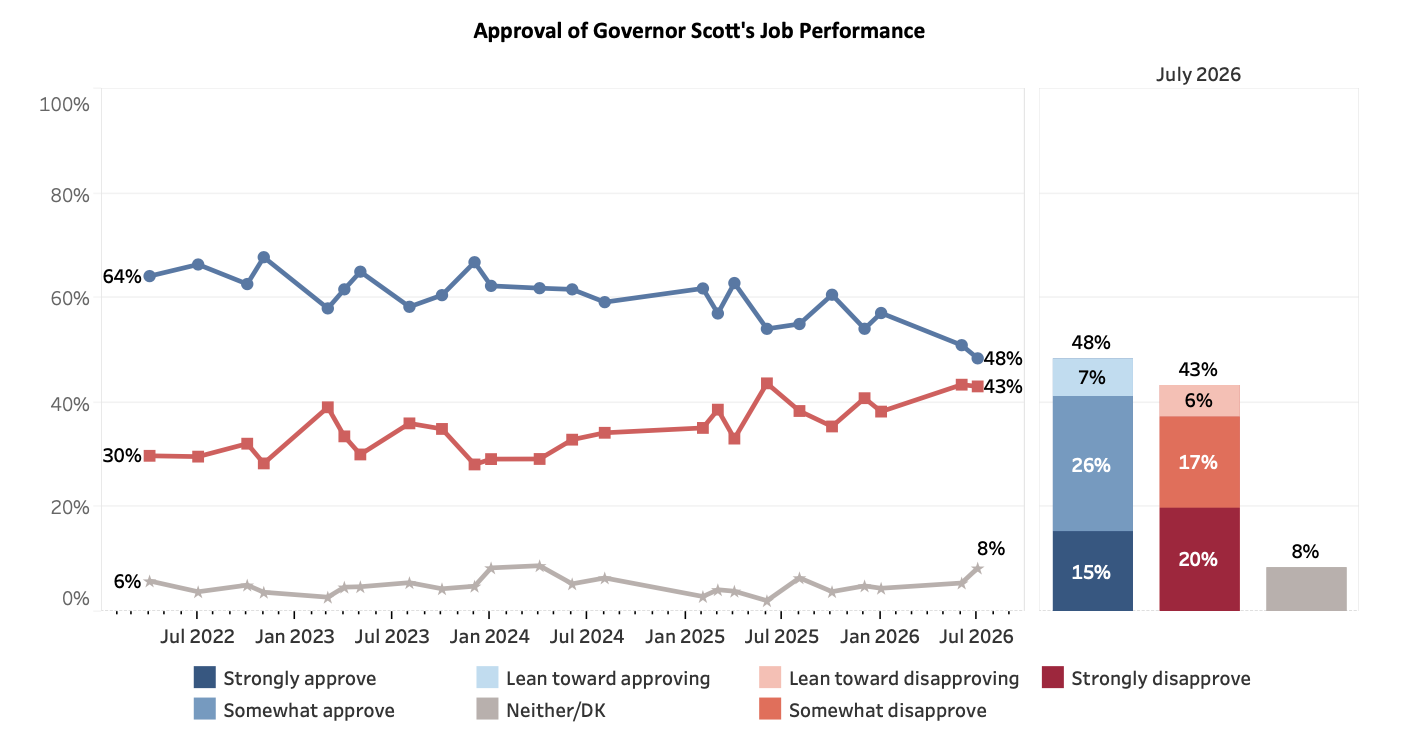
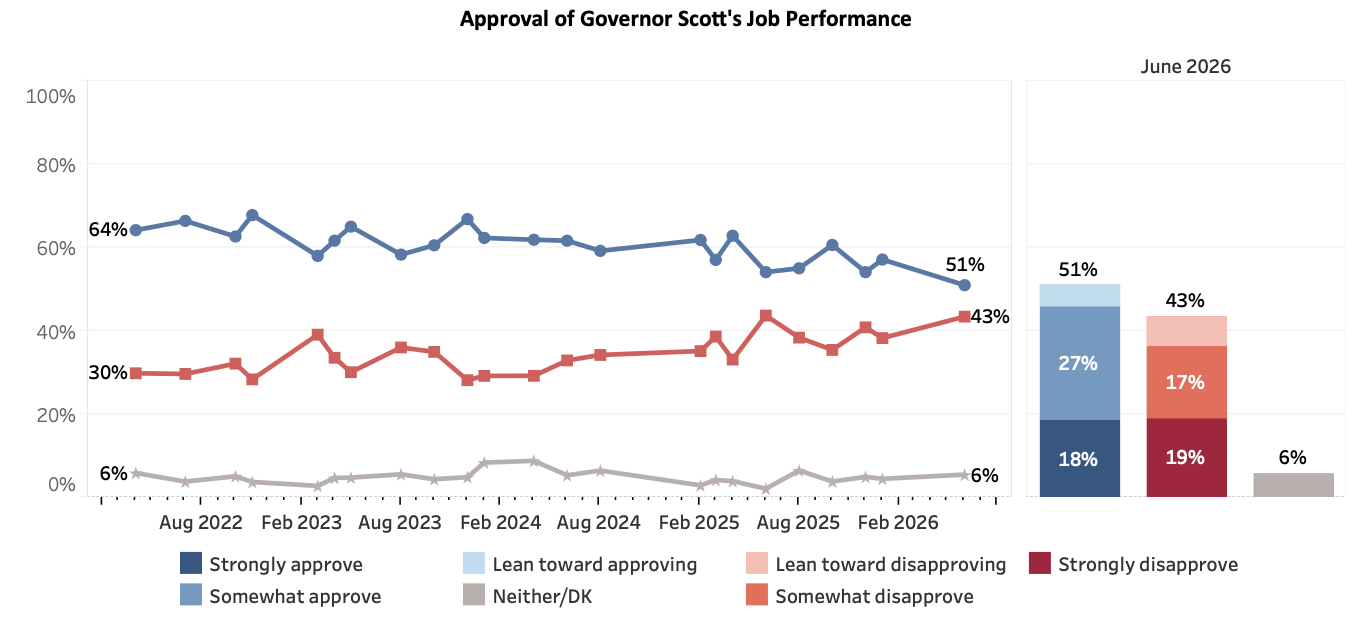
Enough ranting, let’s get to business. The University of New Hampshire Research Center has published another poll on Vermont politics, and the basic throughline is a gradual cementing of previously seen trends. But there are some notable results, such as a drop below 50% approval for our legendarily popular Gov. Phil Scott. In a June survey, Scott had fallen from his accustomed perch in the low to mid 60s down to 51%. (He was at 60% as recently as last fall.) Now he’s at 48%, with 43% disapproving and 8% expressing no opinion. What’s more, the ranks of the “Strongly” disapproving rose from 15% to 20%. Fresh dents in the Teflon?

There’s more in the gubernatorial numbers but first I want to hit the LG results, which show incumbent Republican John Rodgers in serious trouble. In hypothetical matchups, Rodgers loses to any of the three Democrats in the race — including Esther Charlestin. And he seems to be falling further behind. Another thing: on the gambling racket prediction marketplace Kalshi, for what it’s worth, 71% of the wagers are on the Democrats taking back the ol’ bucket of warm piss. (Fascinating Kalshi note: “Republican” held a 60-40 edge until July 3, when “Republican” took a sudden plunge and “Democrat” surged. The market has stayed essentially the same since then.) (Humbling Kalshi note: Bets on the LG race total less than $14,000, while bets on “LeBron James Next Team” are more than $214,000,000.)

Continue reading

The Money Race Is, As They Say, Heating Up. In Some Precincts, Anyway.

The first of July marked the most important pre-primary campaign finance deadline for Vermont candidates. The occasion was marked by a depressing lack of coverage in our respectable media. VTDigger ran a boilerplate piece that reported a bunch of numbers but offered little insight. Seven Days and Vermont Public didn’t do anything, as far as I can tell. Our daily papers are a wasteland for political coverage and I rarely watch local TV news, which is largely an exercise in cranking out enough easy content to space out the advertising.

Which is a damn shame because there are definite points of interest, and because this is the most meaningful pre-primary snapshot of the money races. The previous deadline of March 15 was so early that some major candidates (Aly Richards, for instance) had yet to toss their metaphorical hats in the ring. The next deadline of August 1 is very close to primary day, so whatever might be revealed in those reports won’t have much of a chance to sink in.

Altough that’s kind of a moot point since the media is largely ignoring campaign finance altogether. If there was a nuclear revelation to be found, chances are nobody would notice and it would go unreported.

So let’s get to the July 1 numbers and what they tell us about Campaign 2026.

Continue reading

Hey, We’ve Got a New Poll and… Phil Scott is Vulnerable??

Speaking from experience, one of the biggest mistakes political pundits can make is writing political obituaries for Gov. Phil Scott. He is the grand champeen of Vermont politicians, having gone undefeated since his original election to the state Senate way back in 2000. If he wins re-election in November, he will have done what no other Vermonter has managed: winning six gubernatorial elections. He’s a couple years shy of Howard Dean’s record tenancy in the corner office, but Dean first became governor upon the death of Dick Snelling. He was elected governor “only” five times.

Still, a new opinion poll brings some bad news for Scott. He remains the overwhelming favorite to go where no pol has gone before, but the bloom is coming off the rose. Storm clouds can be seen on the distant horizon. There are perceptible dents in his previously spotless Teflon coat. The tires are showing signs of wear.

Enough half-baked analogies. Since there are no polling organizations in Vermont, we have to settle for this offering from the University of New Hampshire Survey Center. There are a bunch of interesting numbers to be found, but let’s start with the bloom and the clouds and the dents and the tires.

Scott’s favorability rating, whose customary habitat is in the stratosphere, now sits uncomfortably close to 50%. In matchups with relatively little-known Democratic opponents, he comes nowhere near a majority. And only one-third of Vermonters think the state is headed in the right direction.

And now, the details.

Continue reading

Signs of Strife in Democratic Circles

I don’t know if there’s a fire, but there’s suddenly a hell of a lot of smoke around the Vermont Democratic Party. It’s not a great look at the beginning of a very important election season.

Within the last few days, some harsh criticism of party policies and leadership has come from four Democrats not known as troublemakers. Three are longtime Democrats who have held positions of responsibility in the party or in public office. The fourth is a respected figure in local politics whose bid for higher office had been strongly promoted by the party. The list in brief, followed by details:

  • One of the two leading Democratic candidates for lieutenant governor has accused the VDP of actively favoring the other top contender.
  • One of the Democrats’ best hopes for regaining a state Senate seat has cut short his campaign, citing “irreconcilable differences” with the party over fundraising and strategy.
  • A current Senate candidate has accused the party of violating the tradition of neutrality in primary contests and effectively selling its favor to chosen candidates.
  • A 2024 Senate hopeful says the VDP failed to deliver promised support to his candidacy through its much-touted “Coordinated Campaign.”

If one or two of these things had happened, you might chalk it off to sore losers or misunderstandings. But four, in a matter of days? That’s either a remarkable coincidence or a troubling pattern.

Now, let’s get to the particulars.

Continue reading

So… Molly Gray Is the… Outsider?

The most interesting race in the August primary is the Democratic contest for lieutenant governor. Three candidates have already filed: former LG Molly Gray, Democratic operative and Peter Welch staffer Ryan McLaren, and Esther Charlestin, 2024’s sacrificial la — ahem, Democratic candidate for governor. Charlestin, with all due respect, we can dismiss with gratitude for her willingness to serve. This is a race of two well-connected Dems, Gray and McLaren.

Gray was first out of the gate with a truly impressive haul of endorsements including 38 sitting lawmakers and a bunch of high-profile formers like Howard Dean and Kitty Toll.

This week, McLaren formally launched his bid at an Essex restaurant featuring what his campaign called “a packed venue” including “enthusiastic supporters, community leaders, and organizers from across Vermont.” The campaign’s press release boasted its own truly impressive endorser list: former treasurer Beth Pearce, former secretary of state Jim Condos, former LG David Zuckerman*, former House speakers Mitzi Johnson and Shap Smith, and an undisclosed “dozens of current and former members of the Vermont Legislature.” (The release also claimed endorsements from “hundreds of other community leaders,” but McLaren’s campaign website does not offer a list of endorsers.)

*Which ought to end the persistent speculation that Zuckerman will run for something in 2026. I honestly don’t think he will. He’s certainly not making another bid for Vermont’s own bucket of warm piss.

A couple of notes on the press release before I go on. One of those addressing the crowd was Kathryn Becker Van Haste, described as a “veteran Congressional aide and Senate campaign manager,” pointedly not described as a longtime aide to Independent Sen. Bernie Sanders. Seems an odd omission considering Bernie’s popularity, but maybe hee didn’t want his name brandished at a Democratic event.

Then there was this unintentional laugh line from Van Haste: “We need someone who doesn’t just want the title, but wants to do the work.” Uh, well, about that. The office of lieutenant governor, with all due respect, is pretty much all title and no work. The LG presides over the state Senate, but can only have an impact on “the work” beyond gavel-banging if allowed to do so by Senate leadership.

But I digress. (Always play to your strengths.)

Continue reading

With a Friendly Affect and Some Damn Sharp Elbows, Molly Gray Officially Enters the Race for LG

This is a screenshot of the first two rows of prominent Democrats and Progressives endorsing former lieutenant governor Molly Gray’s bid to return as The Hand That Holds The Gavel. Gray, who’d all but announced (to Seven Days) before Thanksgiving, finally made it official today, Monday, January 5.

After those first two rows there are 11 more. Declared Gray supporters include nine sitting state senators, 29 state representatives, plus prominent figures such as former governor Howard Dean and former lawmakers Brian Campion, Kitty Toll, and Jessica Brumsted.

It truly is an impressive haul, not only for the numbers but for the ideological spectrum. Team Gray ranges from the Progressive camp to centrist Democrats. If she’s left a lane open for another Democratic candidate, I can’t identify it. The lefty names on the list should help overcome the perception that she’s a policy squish, which helped doom her 2022 bid for Congress.

Not that endorsements are the be-all, end-all. But this is a show of force aimed at avoiding a competitive Democratic primary, and it may well succeed. Curtis-Hoff award winner Ryan McLaren, who’s been an aide to Peter Welch (as U.S. Representative and Senator) since 2015, has been considering a run for the office, but he has to know he’d be facing a very well-connected opponent with far more name recognition. This is not the softest of targets.

So how did we get here? Cue the semi-informed speculation!

Continue reading