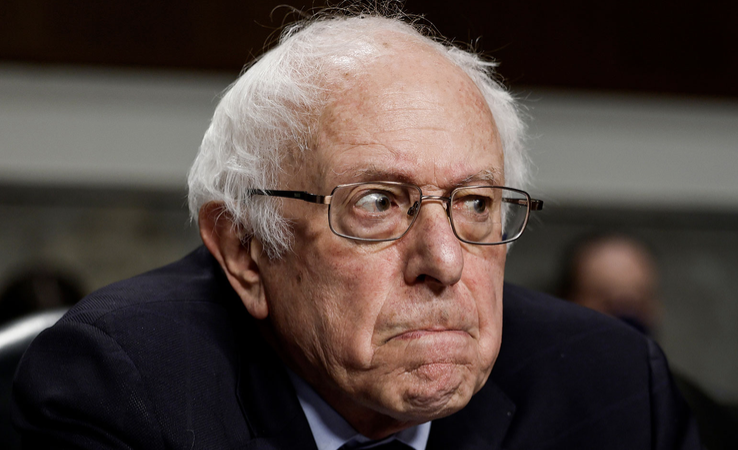
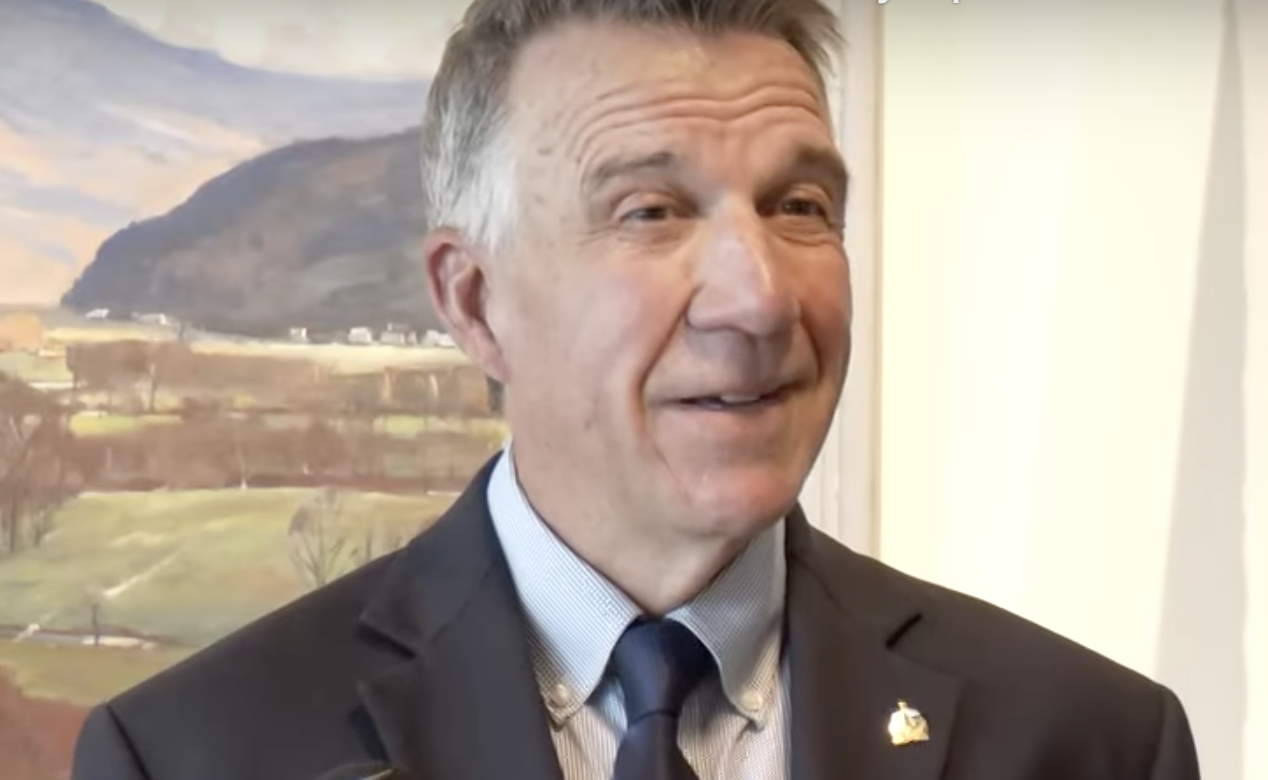
Well, it finally happened. Sen. Bernie Sanders has endorsed Amanda Janoo for governor. He posted an announcement video yesterday, and sent an email blast touting the endorsement this morning to his vaunted mailing list.
Finally, says I. Better late than never.
I still don’t know what took so damn long, but this is not a moment to be churlish. Or at least not a moment to dwell on the churlishness even if it can’t be entirely ignored.
In his slightly under three-minute endorsement video, he offers a hint about why he held off so long:
I personally like Phil Scott, and have worked with the governor on a number of issues over the years. But I believe it’s time for a change, time for new leadership, time for a kind of energy and bold ideas that we’re not seeing in Montpelier right now.
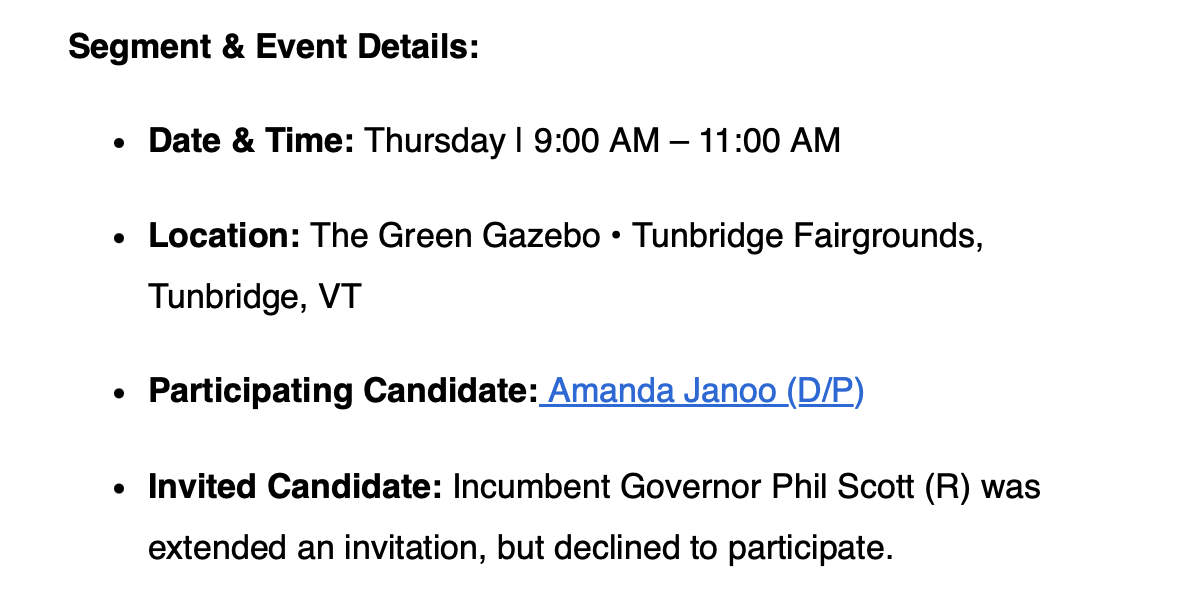
Yesterday, the Phil Scott campaign issued a press release proudly announcing a series of three debates with Democratic challenger Amanda Janoo. Good on him, I guess, for showing up three times — although he turned down at least two others, including the traditional opener at the Tunbridge Fair.
But the debates will be crammed into a single week, and the first won’t happen until October 21 — less than two weeks before Election Day.
By then, early voting will have been in progress for more than a month. And more than two months will have passed since Primary Day. Why such a long delay?
Here’s the lineup, including the ludicrous scheduling of debates on consecutive days:
Wednesday, October 21, broadcast on radio and television by Vermont Public
Thursday, October 22, broadcast on WPTZ-TV
Wednesday, October 28, broadcast on WCAX-TV
It’s a gross disservice to the voters, especially to those most likely to vote early: people with demanding work schedules and/or families with children, people with disabilities or suppressed immune systems, the elderly, and people of color who might fear the threat of ICE enforcement at polling places. Many of them will cast their votes without the opportunity of seeing the two major candidates exchanging views in open debate.
The latest round of campaign finance reports reveal that the race for governor is very real and very competitive. It’s more evidence to support those recent opinion polls showing Gov. Phil Scott and Democratic challenger Amanda Janoo are in a tight race.
What’s truly remarkable is that Janoo is now in a virtual tie with Scott in cash on hand. Reminder that she began September at a huge disadvantage: Scott $307,000, Janoo $59,000. Now Scott is reduced to a statistically meaningless edge: $296,000 to $280,000.
Janoo outraised Scott in September, $291,000 to $223,000. She also spent far less, $70,000 to Scott’s $234,000. (As previously reported in this space, Scott spent heavily on TV and digital ads in September, with five ad buys totaling more than $150,000.)
Those figures are pocket change by normal gubernatorial standards. But they mean that Scott can’t simply spend Janoo into oblivion. Even if he turns on the fundraising afterburners, time’s running short to spend effectively — and early voting is already underway.
I spent several hours yesterday poring over the two new opinion polls about the top contests in Vermont. So of course I missed something very interesting, which was pointed out to me by my Hardwick Gazette colleague Paul Fixx. I’ll relate that tidbit, along with a harbinger of sudden activity by Vermont Democrats in apparent response to the polls.
The tidbit, or maybe that’s underselling it: Phil Scott is less popular among Vermont Republicans than Donald Trump. According to the Vermont Public survey, 69% of Republican voters approve of Trump’s job performance and 15% disapprove. The same figures for Scott: 58% approve, 20% disapprove.
Huh. Maybe campaign manager Dustin Degree should stop complaining about the UNH Survey Center oversampling Democrats. He’s got problems with his own people. (The UNH survey didn’t ask respondents for their view of Trump’s performance. Its only Trump-related inquiry was about his tariff war with Canada. Democrats and independents overwhelmingly disapproved, while a solid majority of Republicans approved. Sheeple, I tell ya.)
The Republican antipathy for Scott has, until now, been a minor annoyance, more than made up for by his popularity among centrists and moderate Democrats. But when Scott’s favorability is at a low point, he kinda needs the Republican base in his corner. Now, those anti-Scott Republicans aren’t going to vote for Amanda Janoo, but what if they stay home or leave the governor’s line blank on their ballots? The Republicans already face a sizeable enthusiasm gap this year; ambivalence toward Scott isn’t going to help. But it’s a fact of life for a party whose center of gravity is clearly to the right of its leader.
Second thing. I got a long email today from state Rep. Emilie Kornheiser of Brattleboro. Not personally; I’m just on her mailing list. But the content was striking. It was a full-throated endorsement of Janoo that trumpeted the poll results:
I honestly can’t see my way through another two years of Phil Scott. I have done my darnedest, and done well, to negotiate with him and around him… but we really can’t go on like this. We need a government that is earnestly trying to do better – to meet the moment and all that is needed.
And somehow, through the miracle of all of you, it seems possible that we could do better! It’s actually happening….polling showing Amanda is pulling ahead of Phil Scott!
Kornheiser called on her supporters to GET INVOLVED in the gubernatorial race, all caps hers. She touted a statewide organizing meeting via Zoom that’s happening Wednesday evening. And she promoted not one, not two, but three separate Janoo events next week in Brattleboro. Janoo herself will hold a fundraiser on October 6 followed by one of her town hall meetings. And the next night, Treasurer Mike Pieciak will get stuck in, hosting a fundraiser on behalf of Janoo and LG candidate Molly Gray. All three will be in attendance.
It’s great to see top Democrats finally getting behind their literal standard-bearer. I just hope it isn’t too little, too late. If Scott wins a close race, the Democrats will only have themselves to blame for squandering a moment in history when Scott’s standing finally began to fade and an upstart candidate found a way to engage the grass roots.
When a poll came out last week showing Amanda Janoo leading Gov. Phil Scott, it wasn’t well received by Team Scott. Campaign manager Dustin Degree called the University of New Hampshire Survey Center’s Green Mountain State Poll an “outlier,” which is factually incorrect on its face. It can’t be an “outlier” because there were no other polls to compare it to.
But I can understand the reaction. You thought you had it in the bag, and here comes an inconvenient poll poking holes in your Shield of Invulnerability.
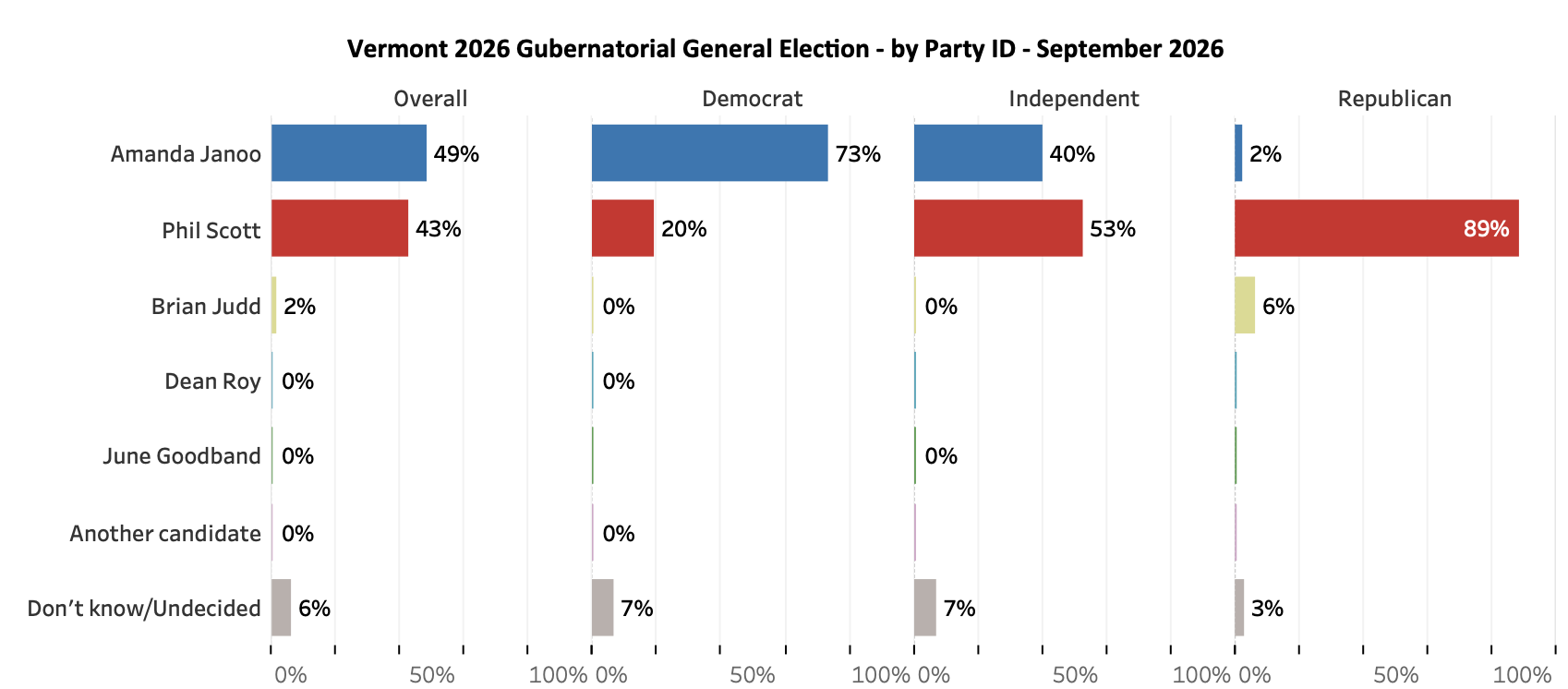
Well, now we have a second survey, and what I can tell you is that each of them outlies the other. The new poll commissioned by Vermont Public is more favorable to Republicans across the board than the UNH survey. In the gubernatorial race, it puts Scott 10 points ahead of Janoo while UNH gives Janoo a six-point lead.
In the campaign for lieutenant governor, UNH has Democrat Molly Gray holding a decisive 19-point edge over incumbent John Rodgers while VP reports Gray with a lead of eight points. And there’s a huge divergence in the campaign for Vermont’s single seat in the U.S. House: Instead of incumbent Becca Balint’s 66-30 edge in the UNH poll, the Vermont Public survey gives Balint only a 15-point lead with, again, enough undecideds to turn the race around.
Those are big enough swings to cast doubt over the entire enterprise. I mean, each poll claims a margin of error under 3.5 points, but the differences between the two are waaaaaay bigger than that.
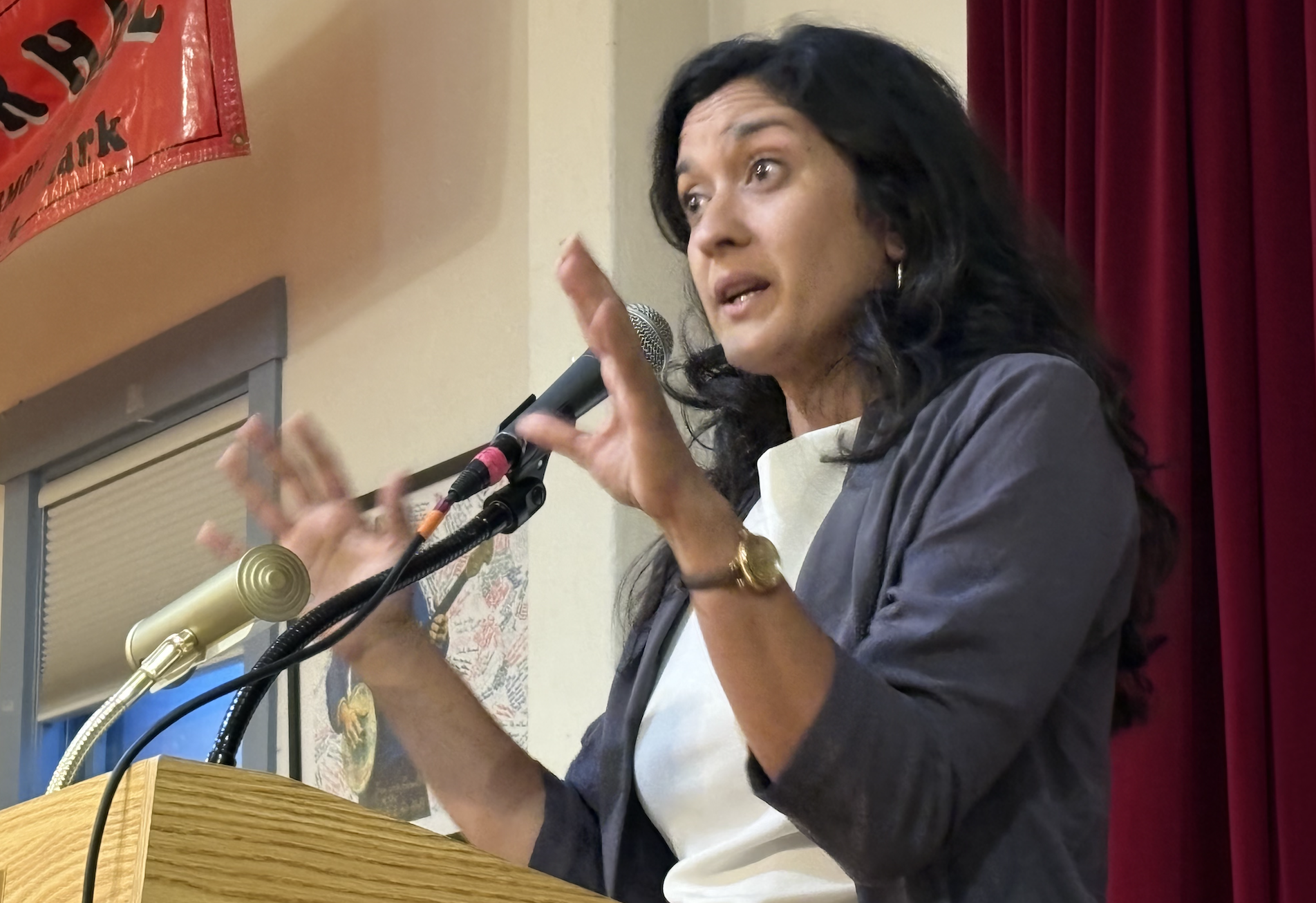
I spent my Sunday evening at the Old Labor Hall in Barre, where Democratic gubernatorial candidate Amanda Janoo appeared before a full house and held a campaign event that was unprecedented in my experience. Indeed, to call it “a campaign event” is to distort its message and purpose.
Well, I mean, it was an event held by a candidate during a political campaign, so anything a candidate does in public is part of the campaign, right?
But this one was fundamentally different. It wasn’t a rally. There were no applause lines, none of the delivery tricks designed to get people hootin’ and hollerin’. Janoo kept her tone conversational, as if her purpose was not to promote herself but to conduct an exchange of ideas.
One metric: The event began at 5:00 p.m. She didn’t mention her platform or policy ideas until 5:50. And throughout the event, she spent much more time interacting with the audience than promoting herself or attacking her opponent.
It was a full house at the Old Labor Hall, about 150 people by my estimate. (They’d originally set up 80-90 seats, but more chairs were rolled out as the crowd grew.) Not at all bad for a candidate who can’t afford to buy advertising and hasn’t gotten very much earned media coverage. There was plenty of enthusiasm, a buzz in the crowd if you will, and Janoo got a sustained standing ovation at the end of the night. It did underscore the notion that something is happening here, that the recent poll showing Janoo in the lead might reflect the developing reality of an expectation-shattering election.
When was the last time we had an honest-to-God “Holy Shit” moment in the bland, predictable world of Vermont politics? I’m thinking it was 2014, when Scott Milne nearly defeated incumbent governor Peter Shumlin.
Well, we’ve got another one on our hands. Feast your eyes on the latest work from the University of New Hampshire Survey Center (full results downloadable here), which shows Democrat Amanda Janoo with a six-point lead over “unbeatable” Gov. Phil Scott, 49% to 43%. (The Survey Center labels the race a “statistical tie” because Janoo’s lead is within the poll’s margin of error.)
That’s right. No typo, no mistake. Janoo, who began this year a political unknown, seems to have the edge over our five-term governor.
Wow.
And before you cast doubt on the Survey Center’s reliability, three things. First, it’s been consistently right in Vermont this year. It foreshadowed Janoo’s win over fellow Democrat Aly Richards, Molly Gray’s mollywhopping of Ryan McLaren in the race for lieutenant governor, and Gerald Malloy’s trouncing of Mark Coester in the Republican Congressional primary.
Second, its methodology seems solid. This wasn’t one of your old-fashioned telephone surveys, which have become increasingly trouble-prone. Instead, UNHSC assembled a 2,700-person “probability-based web panel” used throughout this election year. About 40% of panel members responded to this poll. Data were weighted in a number of categories, including participation in the 2024 election. I’m not a statistician, but it looks reasonable to me.
We made a quick trip to Michigan last weekend and were suddenly immersed in American politics, post-Citizens United style. Our main exposure came in the form of campaign ads on bar and restaurant TV screens with the sound muted.
Lots and lots and LOTS of campaign ads. Every commercial break contained at least two political commercials about Michigan’s races for governor and U.S. Senate. The screenshot above is from a conservative attack ad against Democratic senatorial candidate Abdul El-Sayed. These ads blow ALL the dog whistles about El-Sayed’s ethnicity. One ad tries hard to tie him to progressive influencer and Fellow Brown Person Hasan Piker, who’s become the conservative movement’s bête noirein 2026.
It’s exhausting, even with no sound to go with the images. (The only TV we watched with sound was PBS’ Masterpiece Theatre, shout out Marble Hall Murders.) And Michigan voters will have to endure another five and a half weeks of this saturation bombardment. It’ll only get worse as the election draws closer, and even worse than that if the polls continue to show El-Sayed leading the very bland Republican candidate Mike Rogers. The conservatives are getting desperate.
But hey, this isn’t a blog about Michigan politics, so let’s get to the point. Which is, I’d forgotten what it’s like to be immersed in a high-profile election campaign. For the most part, it makes you want to bathe in Purell for a day or six. But there is one undeniable advantage to the nonstop barrage of political advertising: It reminds everyone that there is, in fact, an election with real consequences. Which is not the message you get from Vermont media.
Recently I wrote a post criticizing Democratic Party bigwigs’ underwhelming support for their gubernatorial candidate Amanda Janoo. During the month of August, not a single Democratic officeholder donated to the badly underfunded Janoo campaign. (A few did donate to her campaign before August 1.) This is looking like a missed opportunity given recent signs of slippage in Gov. Phil Scott’s favorability numbers and the very real signs of life in Janoo’s organization. (She’s holding dozens of canvasses and honk-and-waves in coming weeks, which must mean she’s generating grassroots energy and attracting a lot of volunteers.)
But now it’s time to throw the same shade at Vermont’s very elder statesman, Independent Sen. Bernie Sanders. To his credit, he continues to work hard and travel his buns off in support of progressive-minded candidates across the country. Ballotpedia keeps a running tab of his endorsements — defined as “official statements, appearances at campaign rallies, and direct participation in campaign ads and materials.” It’s a very long list. In 2026 alone, Sanders has acted in support of 83 candidates across the country. That’s roughly one candidate every three days.
Amanda Janoo does not appear on the list. Nor do I recall Sanders issuing a statement about Janoo or appearing at one of her campaign events or, most valuable currency of all, sending an email to his vaunted contact list seeking donations for Janoo’s cash-starved campaign.
Janoo is a candidate straight out of Bernie Central Casting. She’s a creative, original thinker with a strong progressive streak. Her platform is a close match for Bernie’s. So why no love for the hometown candidate?
For many years, the beginning of every Vermont campaign’s homestretch has been marked by a gubernatorial debate at the Tunbridge Fair, broadcast by WDEV Radio. It’s the customary first leg in a series of campaign forums.
Until now. The Fair is this weekend, and the debate was scheduled for Thursday morning. But on Wednesday afternoon, former lieutenant governor and WDEV host David Zuckerman issued a statement touting the event as best he could, but ending with this little wet fart: