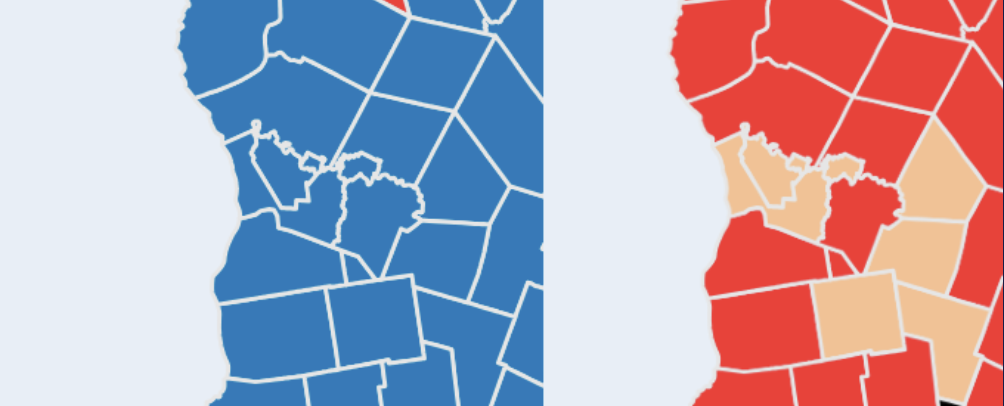
While I was staring at my computer screen on election night, I noticed what looked like a trend: Amanda Janoo was badly underperforming in the Burlington suburbs. The trend held through the evening and into the final results. This fact alone didn’t sink her campaign, but it blocked any chance she had of winning.
The two Burlington-area maplets above, taken from the Secretary of State’s election results website, tell the story in a glance. On the left is the race for lieutenant governor; if a town is blue, then Molly Gray won a majority of its votes. And yes, they’re all blue. Incumbent LG John Rodgers was skunked. (The tiny red sliver at the top of the LG image is the southern tip of Georgia, the closest Rodgers got to scoring in the Burlington area.) On the right is the governor’s race; the beige towns went for Janoo while the red ones gave majority support to Gov. Phil Scott. Janoo did win in some places, but mainly with very narrow majorities — not nearly enough to offset Republican votes elsewhere in Vermont.
We’re talking reliable Democratic territory here. Republicans are woefully uncompetitive in all but one community, Milton, which largely elected Democrats this time. But the governor did extremely well in the places surrounding Burlington. Shockingly well, compared to the rest of his party’s ticket.
I haven’t done exit polling or convened a focus group, but I can tell you what I think about this. I think these towns are full of affluent liberals whose ideology is tempered by caution, and they voted via their pocketbooks. Janoo advocated progressive ideas including a property tax hike on second homes and a higher tax on incomes over $250,000. I know, tiny violins. But a lot of these people have household incomes north of 250 G’s and maybe own vacation property as well, and I’m sure their property taxes are in nosebleed territory. There was plenty of straight ticket Democratic voting throughout, except for Janoo. And she couldn’t win without their support.
In Burlington and Winooski, Janoo did well. Not quite as well as Gray, but within shouting distance. Janoo got 71% of Burlington’s vote to Gray’s 82%. In Winooski it was Janoo 72, Gray 80. Not bad for a first-time candidate up against a well-known governor.
Butt everywhere else around Burlington, the differences were stark. I checked tallies for 13 communities: Charlotte, Colchester, Essex Junction City, Essex Town, Hinesburg, Jericho, Milton, Richmond, St. George, Shelburne, South Hero, and Williston. Here are the totals for the two races:
- Governor: Janoo 27,478, Scott 31,294
- Lieutenant governor: Gray 38,772, Rodgers 19,350
Phil Scott pulled almost 12,000 more votes than Rodgers, while Gray outdrew Janoo by 11,294. In those 13 communities, 17% of Gray voters crossed over to Scott for the gubernatorial contest. I haven”t checked all the legislative races, but considering that the Dems swept every seat involved except for one (!) in Milton, it’s safe to say the vast majority of those 11,294 votes were straight ticket Democratic except for the most consequential race on the ballot.
Janoo lost to Scott by 20,417 votes statewide. More than half that total was lost in “safe” Democratic territory around Burlington.
A few specifics that stand out: Phil Scott pulled 65% of the vote in Milton which, okay, not that unusual. (Although again, a lot of those voters filled in their little ovals for Democratic legislative candidates.) But Scott earned 58% of the vote in St. George and South Hero, 57% in Colchester and WIlliston, 56% in Essex Town, and 50% in Charlotte and Shelburne.
Janoo won in five of the 13 communities, but not by nearly enough. She got 55% in Richmond, 53% in South Burlington, 52% in Essex Junction City, 51% in Hinesburg, and 50% in Jericho. Gray’s percentages in those five: Richmond 70%, South Burlington 72%, Essex Junction City 68%, and 66% each in Hinesburg and Jericho. Gray won majorities in all 13 communities. Her closest call was in Milton, where she took 50% to Rodgers’ 48%.
Here’s an off topic tidbit I can’t resist tossing in. John Rodgers managed the neat trick of losing in his hometown. Glover went for Gray, 298 to 234. Probably something to do with Rodgers suing the town over access to a road that crosses his property, reflecting a degree of asshattery unsuitable in a candidate for elective office. Apparently the voters in general shared that view; incumbent statewide candidates rarely lose, but Rodgers managed the truly unique feat of losing by 25 percentage points.
Closing the loop on the main thing. Many of these voters are centrist Democrats, the kind who elect politicians like Tom Chittenden and, ahem, Pat Brennan. (Once, anyway.) Janoo did an exceptional job of making a progressive agenda feel inclusive, something Bernie Sanders has been doing for years. If she runs for governor again, she’ll have to make sure that inclusiveness extends to suburban Dems around Burlington. Might be a lot easier if Phil Scott isn’t on the ballot.

