
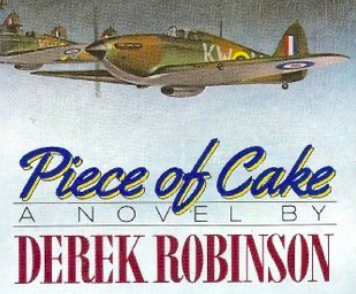
It’s been a while since I posted anything in my occasional “Bookshelf” series, spotlighting books I think are worth sharing. But in honor of the November 11 holiday, here’s a bit about a writer I just discovered a couple of years ago.
Derek Robinson is an English author with numerous books to his name. His most enduring works (or they should be if there’s any justice in the world, ha) are six novels about life in wartime, predominantly about the air war. Three are set in World War I, and the other three take place in World War II.
The novels are about how war is a massive meatgrinder that takes a heavy and indiscriminate toll on its participants. Robinson is reflexively compared to Joseph Heller, but that’s off target in some significant ways. “Cath-22” is a deeply cynical work that questions human nature and the entire project of war. Robinson doesn’t really question the necessity (or otherwise) of war; it’s simply a reality that has swallowed up all his characters, very few of whom survive the ordeal. I suspect that if you asked him, Robinson would say the Allies had no choice but to fight the two world wars. The consequences were terrible but unavoidable.
“Piece of Cake” was my introduction to Robinson, a happy discovery in a used bookstore. It’s the first of his three World War II novels, taking place in the very early days of the war. It tells the story of a squadron in the Royal Air Force struggling to prepare for the onset of the war. Officers are deeply flawed, the planes are woefully out of date, the pilots mostly untested, military intelligence rarely merits the I-word. Everything is rushed; men, machines, and systems often fail, but there’s no choice but to keep on going. Fatalities are common, and usually have nothing to do with combat. The more frequent causes are mechanical failure, bad weather, or ill-considered daredevil maneuvers.
Most of the characters are barely introduced at all because they are so often gone within a few pages. A few actually survive into future installments, but they are very much the exception. “Heroism” is almost entirely a mythical quality. (People who do heroic things have an especially high casualty rate.) The pilots (and officers and mechanics) are there to do a job, they don’t question it, they just get on with it and do their best. Which usually gets them killed.
If this sounds unbearably grim, well, yes, but that’s the nature of war. Robinson is a great writer. His books are highly readable in spite of the fact that death is never far away and usually arrives in the most unexpected, random ways possible.
I’ve read four of these six novels, and reread at least three. Robinson is one of the authors I turn to when I want a break from the serious nonfiction that makes up the bulk of my reading. His books remain in print, and are also widely available on the used-book market. Strongly recommended with appropriate trigger warnings.

