Don’t know if you’ve noticed, but it’s suddenly becoming quite pricey — by Vermont standards — to run for state Senate in a contested election. Could be primary, could be general. But if there’s going to be competition for a seat (or two or three), you’d best be prepared to raise $50,000 or more. It’s the new price of admission, drinks not included.
It’s a high bar. And when it’s already difficult for working people to serve in the Legislature, it’s an additional barrier to think that you have to spend months and months in nonstop fundraising. If this trend continues, it’s going to smother a lot of good candidacies in their cribs.
The trend kicked into high gear in 2024, thanks to the Barons of Burlington’s coordinated effort to decimate the Senate’s Democratic supermajority. Which they did, bankrolling six Republican candidates to victory in what were Democratic seats — plus stuffing John Rodgers’ pockets with enough campaign cash to barely beat incumbent lieutenant governor David Zuckerman.
While I was staring at my computer screen on election night, I noticed what looked like a trend: Amanda Janoo was badly underperforming in the Burlington suburbs. The trend held through the evening and into the final results. This fact alone didn’t sink her campaign, but it blocked any chance she had of winning.
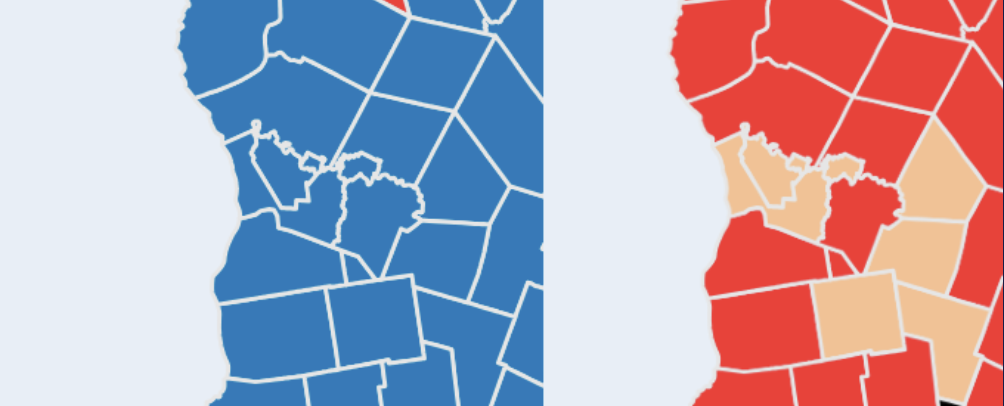
The two Burlington-area maplets above, taken from the Secretary of State’s election results website, tell the story in a glance. On the left is the race for lieutenant governor; if a town is blue, then Molly Gray won a majority of its votes. And yes, they’re all blue. Incumbent LG John Rodgers was skunked. (The tiny red sliver at the top of the LG image is the southern tip of Georgia, the closest Rodgers got to scoring in the Burlington area.) On the right is the governor’s race; the beige towns went for Janoo while the red ones gave majority support to Gov. Phil Scott. Janoo did win in some places, but mainly with very narrow majorities — not nearly enough to offset Republican votes elsewhere in Vermont.
We’re talking reliable Democratic territory here. Republicans are woefully uncompetitive in all but one community, Milton, which largely elected Democrats this time. But the governor did extremely well in the places surrounding Burlington. Shockingly well, compared to the rest of his party’s ticket.
I haven’t done exit polling or convened a focus group, but I can tell you what I think about this. I think these towns are full of affluent liberals whose ideology is tempered by caution, and they voted via their pocketbooks. Janoo advocated progressive ideas including a property tax hike on second homes and a higher tax on incomes over $250,000. I know, tiny violins. But a lot of these people have household incomes north of 250 G’s and maybe own vacation property as well, and I’m sure their property taxes are in nosebleed territory. There was plenty of straight ticket Democratic voting throughout, except for Janoo. And she couldn’t win without their support.
The blue wave crashed over every Republican breakwall just about everywhere. Nationally, the Democrats are on track to win lopsided majorities in both houses of Congress and are picking up governorships by the bushel. I’m old enough to have voted in the 1974 post-Watergate wave election; 2026 is on track to be a better night for Democrats.
Here in Vermont, only Gov. Phil Scott survived. He won by a seven-point margin over Democrat Amanda Janoo, but he will be a severely weakened force heading into his sixth (and presumably final) term. His reputed successor, Lt. Gov. John Rodgers, got literally and figuratively mollywhopped and will not be returning to Montpelier.
The big thing for Vermont is that the combined Democratic/Progressive caucuses will hold supermajorities in the House and Senate. We’re looking at a complete reversal of the 2024 Republican advance — and maybe even more.
Quite a few legislative races have yet to be called, but here’s where things stand as of right now. In the Senate, the Democrats have won 19 seats and have a solid lead in a 20th (Orange). Progressive Sen. Tanya Vyhovsky will caucus with them, so that’s 21 seats. Independent Dave Wolk picked off a seat in formerly deep red Rutland, sending *alleged* daughter-puncher Sen. Terry Williams to the showers. Wolk is a former Democratic senator, so he might be expected to caucus with the Democrats.
As for Senate Republicans… they only have seven wins, plus Minority Leader Scott Beck has a narrow lead over Democrat David Roth,so they might end up with eight.
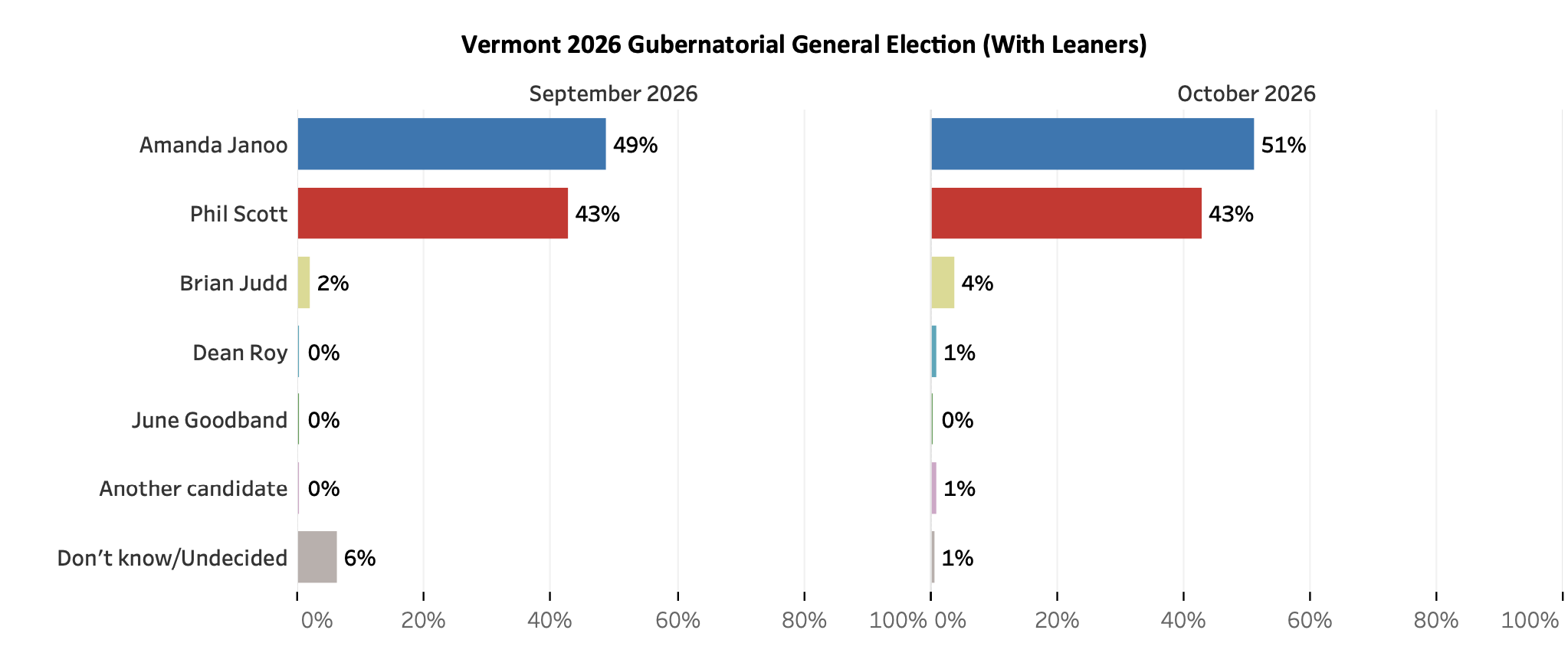
Well, there it is. The last (I think) pre-election poll in the race for Vermont governor. And yes, that’s Democrat Amanda Janoo holding an eight-point lead over Gov. Phil Scott, comfortably beyond the poll’s margin of error and a tick north of the all-important 50% mark.
The poll comes from the University of New Hampshire Survey Center, and must be accompanied by a couple of caveats. First, the UNH results have been more Janoo-friendly* than the single Vermont Public poll or the ongoing efforts of State Navigate. Second, I’m not sure the Center believes its own product. Its report was headlined “Blue Wave Lifts Janoo Over Scott in Vermont?”
*The Center’s latest Maine poll shows Democrat Troy Jackson with a nine-point lead over incumbent Republican Sen. Susan Collins. Either this will be a true wave election, or UNHSC will have some cleaning up to do.
That’s right, they attached a question mark to their own headline. It’s as if they can’t really believe the results of their own work.
Also worth noting, or puzzling over: The survey’s respondents don’t believe it themselves! 62% of all respondents, including 40% of Janoo voters, predict that Scott will win. Which is very close to where the prediction markets are heading. As recently as September 22, 94% of all bets predictions on Kalshi were for Scott. The governor’s share of the Kalshi action is now at 66% and Janoo is at 34%.
Well, the last pre-election campaign finance deadline has come and gone, and the big news is that the unknown underdog newbie pick-your-own-disparaging-descriptor Amanda Janoo has cleared seven figures in total fundraising.
That’s right, we’re talking Dr. Evil money. Janoo continued her late-stage sprint with an impressive haul of $170,000 in the last 15 days, for a grand total of $1,057,389.86 in donations.
Gov. Phil Scott, the invincible incumbent, has raised a much less impressive $720,000 including $130,000 in the most recent period. Of course, he entered the campaign with a hefty stash remaining from his 2024 walkover win, so he’s been able to spend $804,000 in all.
But still, the bottom line is this: Amanda Janoo has outraised and outspent Phil Scott for the entire campaign and in the most recent reporting period, covering the home stretch of the campaign. She’s received gifts from many more individuals than Scott, whose campaign has depended heavily on four-figure donations from the usual suspects in the business community. In her latest filing, Janoo reported receiving 26% of her total take in gifts of $100 or less. Scott, the alleged man o’ the people, got only 5% of his total in donations of $100 or less. (26% may seem low, but it’s actually a very respectable number. Most politicians don’t get that much from small donors.)
Another precinct has been heard from. The national NKOTB doing business as State Navigate has come out with its final pre-election poll on Vermont’s top two races, and the results track closely with previous polling. In the race for governor, incumbent Phil Scott has a narrow lead on challenger Amanda Janoo, but it’s within the dreaded Margin of Error and beneath the 50% threshold. That’s right: Mr. Popularity still hasn’t mustered a majority against a first-time candidate who was a virtual unknown in Vermont politics until the spring of this year. In the race for lieutenant governor, Democrat Molly Gray holds a seemingly insurmountable lead over incumbent Republican John Rodgers.
State Navigate, for those unfamiliar, is a nonprofit, nonpartisan outfit that does state-level polling through digital means. I haven’t done a deep dive, but they seem legitimate. Their results track closely with polls by the UNH Survey Center and Vermont Public.
Bottom line: This new poll gives Scott 49% to Janoo’s 46%. The undecideds are at 3%, and other candidates (mainly independent Brian Judd and June Goodband of the Peace and Justice Party) get 2%. State Navigate’s earlier poll showed the same margin between Scott and Janoo, but more voters undecided or opting for minor candidates. No surprise, more and more people are making up their minds and migrating to the top two choices. And no surprise, they’re more or less splitting down the middle. If that trend continues, Scott would win by the smallest margin of any of his six campaigns for governor. Hell, I think it might be the smallest margin of victory he’s ever enjoyed, going all the way back to his first state Senate race in 2000.
For one thing, city and town clerk’s offices are being flooded by early ballots. For another, candidates in our most competitive races are spending whatever money they have on hand.
Ballot returns seem to have shot up in the last week or so. The latest tally: as of today (October 21), Vermont voters have submitted 79,651 ballots. Judging by past turnouts in non-presidential years, it’s likely that close to 30% of all votes have already been cast*.
*Update: The day after I posted this piece, the Secretary of State’s office announced that returned ballots now number“over 88,000,” which is close to one-third of likely total turnout.
(Explainer: Turnout is always higher in presidential years. Over the last two decades, turnout in presidential years has averaged 339,000 in Vermont. When the presidency isn’t on the line, average turnout has been 253,000. But in recent years, turnout has been higher still; in 2022 it was 291,955. Generally speaking, voter participation has jumped since the Covid pandemic and the state started mailing ballots to every registered voter. I think it’s safe to assume our turnout will be less than 300,000 but not much less. Which would make 79,651 about 28% or so of the projected total.)
Candidates are aware that time’s running out. The mass media spending reports are pouring into the Secretary of State’s office, the vast majority from legislative candidates sending postcards and such. The races at the top of the ticket show what happens when those candidates don’t ahve a lot of money to burn.
Democratic gubernatorial candidate Amanda Janoo has continued to boost her spending, which remains very modest by normal standards. Her campaign has submitted two mass media reports in the last two days, totaling $95,516 in spending. That includes $65,000 in television advertising, $20,516 for good old-fashioned radio, and $10,000 for newfangled digital. That’s on top of $100,000 in media spends reported in her October 15 campaign finance report, $60,000 for TV and $40,000 for digital.
In all, it’s an impressive investment, but she still has room to do more. As of October 15, Janoo had a little more than $300,000 in the bank. I’d expect to see more filings from Team Janoo in the very near future.
If the Soviet Union was, in the words of WInston Churchill, “a riddle, wrapped in a mystery, inside an enigma,” then the re-election campaign of Lt. Gov. John Rodgers is a contradiction wrapped in a paradox inside an irony.
Two things. First, he claims to be “a voice for the working class,” but as previously noted, the vast majority of his money comes from the upper class — primarily from the Burlington area, far from the lives and concerns of the rural Vermonters he claims to represent.
Second, the former Democrat turned Republican leans heavily on bipartisanship, touting his ability to work with all parties. And yet since the August primary, his campaign has focused its energy on attacking his opponent, former lieutenant governor Molly Gray.
And the person who must be held responsible for this turn to the Dark Side is none other than Democratic State Rep. Matt Birong, who feels no apparent qualms about sticking it to a fellow Democrat on the reg.
Another campaign finance deadline has come and gone, and the big news is… there’s not much news. Well, not much new news, anyway. For the top two statewide races, the latest reports follow familiar patterns.
In the gubernatorial campaign, Democrat Amanda Janoo continues to hold a financial edge over Gov. Phil Scott, whose minimal-effort approach either indicates that (1) he’s very confident or (2) he’s lost his fastball after several easy victories. When you look at his fundraising numbers, you realize the last time he really had to work at it was 10 years ago, in 2016.
In the race for lieutenant governor, Democrat Molly Gray holds a substantial lead over incumbent Republican John Rodgers, whose campaign would be scraping bottom if not for big checks from a handful of donors and a $20,000 infusion from the state GOP. You know, Rodgers’ campaign signs tout him as “a voice of the working class,” but working Vermonters seem unappreciative. The vast majority of Rodgers’ money has come from Vermont’s upper class, and most of them hail from Chittenden County. Some kind of disconnect there.
The other four statewide races are uncompetitive, as the Republicans put up unknown and severely underfunded candidates against well-known Democrats.
The most recent filing deadline was Thursday, October 15. Reports covered the period between October 1 and October 15. So let’s get to the numbers.
The latest round of campaign finance reports reveal that the race for governor is very real and very competitive. It’s more evidence to support those recent opinion polls showing Gov. Phil Scott and Democratic challenger Amanda Janoo are in a tight race.
What’s truly remarkable is that Janoo is now in a virtual tie with Scott in cash on hand. Reminder that she began September at a huge disadvantage: Scott $307,000, Janoo $59,000. Now Scott is reduced to a statistically meaningless edge: $296,000 to $280,000.
Janoo outraised Scott in September, $291,000 to $223,000. She also spent far less, $70,000 to Scott’s $234,000. (As previously reported in this space, Scott spent heavily on TV and digital ads in September, with five ad buys totaling more than $150,000.)
Those figures are pocket change by normal gubernatorial standards. But they mean that Scott can’t simply spend Janoo into oblivion. Even if he turns on the fundraising afterburners, time’s running short to spend effectively — and early voting is already underway.