
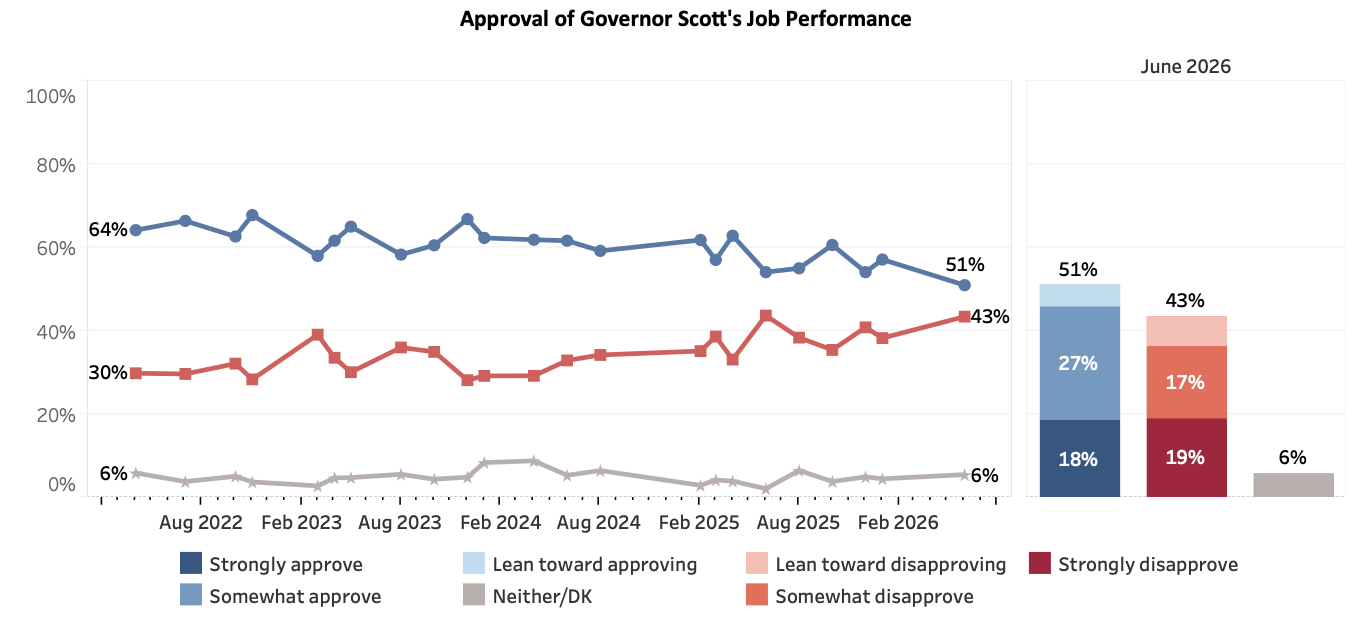
Speaking from experience, one of the biggest mistakes political pundits can make is writing political obituaries for Gov. Phil Scott. He is the grand champeen of Vermont politicians, having gone undefeated since his original election to the state Senate way back in 2000. If he wins re-election in November, he will have done what no other Vermonter has managed: winning six gubernatorial elections. He’s a couple years shy of Howard Dean’s record tenancy in the corner office, but Dean first became governor upon the death of Dick Snelling. He was elected governor “only” five times.
Still, a new opinion poll brings some bad news for Scott. He remains the overwhelming favorite to go where no pol has gone before, but the bloom is coming off the rose. Storm clouds can be seen on the distant horizon. There are perceptible dents in his previously spotless Teflon coat. The tires are showing signs of wear.
Enough half-baked analogies. Since there are no polling organizations in Vermont, we have to settle for this offering from the University of New Hampshire Survey Center. There are a bunch of interesting numbers to be found, but let’s start with the bloom and the clouds and the dents and the tires.
Scott’s favorability rating, whose customary habitat is in the stratosphere, now sits uncomfortably close to 50%. In matchups with relatively little-known Democratic opponents, he comes nowhere near a majority. And only one-third of Vermonters think the state is headed in the right direction.
And now, the details.
When asked to rate Scott’s performance as governor (graph seen above), 51% of respondents gave him a favorable rating while 43% gave the thumbs down. Within those numbers, there’s quite a lot of “meh” — only 18% strongly approve, and only 19% strongly disapprove. Fully one-third of those who view Scott favorably could change their minds: 27% “somewhat approve” of the governor, and 6% “lean toward approving.” They are persuadable, if the Democratic nominee runs a strong campaign and the donor base gets behind her.
In hypothetical matchups against the top two Democratic candidates, Scott was in the low forties: 42% to Amanda Janoo’s 27%, and 41% to Aly Richards’ 25%. “Don’t know/Undecided” was at 26% in both. It’s way, way early, and the undecideds usually split somewhere close to half-and-half, so Scott retains a substantial edge. But it must be disappointing to Team Scott to see him faring so poorly against candidates so unrecognized that their numbers are essentially the same. (Might as well have polled “Random Democrat.”) Still, it’s the best gubernatorial news the Dems have seen since at least 2016. Maybe this year Scott will have to get serious about fundraising and campaigning on his own behalf instead of spending his time and treasure supporting Republican legislative candidates, as he did in 2024.
Underscoring the apparent erosion in Scott’s support is the increasing pessimism expressed by respondents about Vermont’s direction. Back in 2021, at the height of the Covid pandemic, 49% of Vermonters said the state was going in the right direction. 27% said “wrong direction,” and the rest were unsure. Now, those numbers have essentially reversed: 49% say “wrong direction.” only 33% say “right direction,” and 18% were unsure.
Here’s where it gets fascinating. When broken down by party affiliation, most Democrats say the state is headed in the right direction (67% in 2021*, 52% now). Republicans have consistently and overwhelmingly believed Vermont is on the wrong track, but their “right direction” percentage has fallen from 18% in 2021 to only 10% today.
*The governor is fond of blaming the pandemic for derailing his agenda. I’ve long believed the pandemic was the best thing that ever happened to him politically. It cemented his reputation as a competent administrator and a trustworthy leader, as you can see in the two-thirds of Democrats who thought things were going well after a year-plus of living under Covid. Scott’s still eating free off his daily pandemic-era press conferences.
The big swing is among independents. 54% thought things were going well in 2021, and only 16% think so now. The tendency is to equate “independent” with “centrist,” but in a state where voters cannot officially declare party affiliation (and Bernie Sanders is our leading independent), that ain’t necessarily so. A lot of ’em undoubtedly lean left. Safe to say, these folks are dissatisfied and open to voting for change.
UNH conducted polls for the primary and general election for governor, lieutenant governor, and U.S. Representative. They all provide evidence for an uncomfortable truth: Name recognition is a powerful force. People see a familiar name on the ballot, they’re gonna fill in that ovoid.
Not exactly a strong argument for democracy, but there we are.
The biggest single indicator of the sheer power of familiarity: the Democratic race for lieutenant governor. Molly Gray, a former LG making her third appearance on a statewide ballot, holds a huge lead. What’s more, the other “major” candidate, Ryan McLaren, actually finishes in third place behind Esther Charlestin, the unsuccessful 2024 gubernatorial candidate. The numbers: Gray 39%, Charlestin 11%, McLaren 7%, and “don’t know/undecided” leading the pack at 42%. Success is far from assured for Gray, but McLaren has one hell of a lot of work to do and precious little time to do it. The primary is less than six weeks away.
Sticking with LG for the moment, the general election poll indicates that incumbent Republican John Rodgers is extremely vulnerable. Gray beats Rodgers 45% to 29% with 26% undecided. Charlestin beats Rodgers by a much closer 35-30 margin with fully 33% undecided. McLaren squeaks ahead of Rodgers 32-30, with 37% undecided.
Lesson: Even if you’re politically well connected (as McLaren is), it’s awfully damn difficult to run a statewide campaign if you begin as an unknown in wider circles. Other Lesson: John Rodgers is a deeply flawed candidate, perhaps fatally so.
Circling back to the Democratic gubernatorial contest, close to two-thirds of primary voters are in the “undecided” camp. Janoo holds a far from decisive 20-12 advantage over Richards. A bit of a surprise, but it’s nothing definitive.
The Congressional results contain no surprises at all. Incumbent Dem Becca Balint is wiping the floor (if not anyone’s ass) with the competition. Hypothetical matchups with the two Republicans, Gerald Malloy and Mark Coester, produce identical results: 57% for Balint and only 25% for the Republican. The poll in the VTGOP primary indicates her designated punching bag will be Scary Eagle Man. Malloy gets 48% to only 19% for Coester, with 32% undecided.
That’s about it from the UNH Survey. Coincidentally, this poll came out a day before the campaign finance filing deadline of July 1. My next post will take a closer look at the money races. Stay tuned!
 The Vermont Political Observer.
I wish and hope this is true, but I am not banking on it.