
When was the last time we had an honest-to-God “Holy Shit” moment in the bland, predictable world of Vermont politics? I’m thinking it was 2014, when Scott Milne nearly defeated incumbent governor Peter Shumlin.
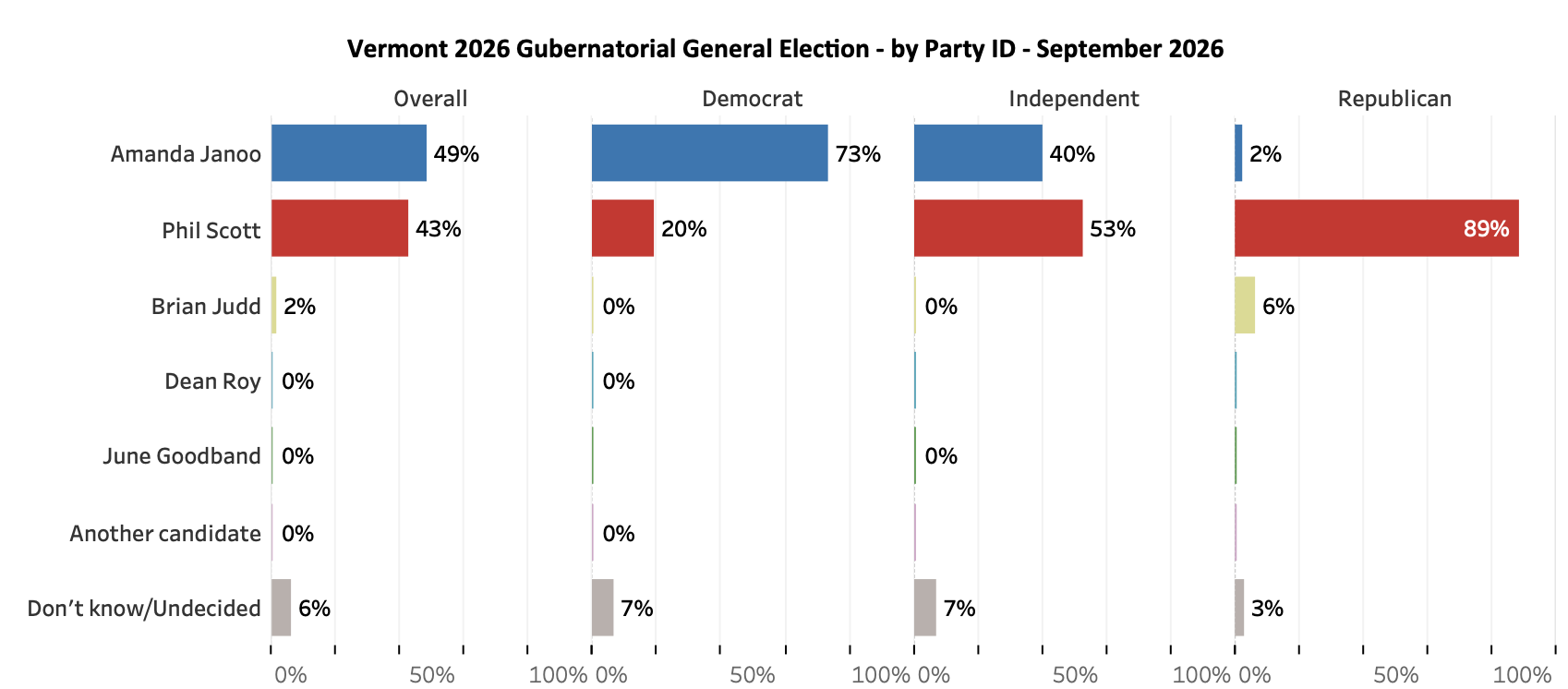
Well, we’ve got another one on our hands. Feast your eyes on the latest work from the University of New Hampshire Survey Center (full results downloadable here), which shows Democrat Amanda Janoo with a six-point lead over “unbeatable” Gov. Phil Scott, 49% to 43%. (The Survey Center labels the race a “statistical tie” because Janoo’s lead is within the poll’s margin of error.)
That’s right. No typo, no mistake. Janoo, who began this year a political unknown, seems to have the edge over our five-term governor.
Wow.
And before you cast doubt on the Survey Center’s reliability, three things. First, it’s been consistently right in Vermont this year. It foreshadowed Janoo’s win over fellow Democrat Aly Richards, Molly Gray’s mollywhopping of Ryan McLaren in the race for lieutenant governor, and Gerald Malloy’s trouncing of Mark Coester in the Republican Congressional primary.
Second, its methodology seems solid. This wasn’t one of your old-fashioned telephone surveys, which have become increasingly trouble-prone. Instead, UNHSC assembled a 2,700-person “probability-based web panel” used throughout this election year. About 40% of panel members responded to this poll. Data were weighted in a number of categories, including participation in the 2024 election. I’m not a statistician, but it looks reasonable to me.
Third, the gubernatorial result jibes closely with another survey finding: Scott’s job approval continues to slide. After sailing blissfully along in the 60s for several years, it’s been losing altitude since January 1. It’s now at 47% approve, 47% disapprove. Janoo’s showing also makes sense in light of a recent UNHSC poll showing that fully one-half of Vermont voters have a positive impression of socialism. Janoo doesn’t describe herself as a socialist, democratic or otherwise, but her ideas place her comfortably in the DSA neighborhood. And overall, the survey’s 2026 results suggest a swing to the left after 2024’s Republican wave.
I’m nowhere near ready to declare Janoo THE LEADER but I do put a lot of stock in the Survey Center’s work, and I think we need to take this seriously. Phil Scott is losing altitude, and Donald Trump is doing him no favors at all. (The survey shows widespread disapproval of Trump’s unprovoked trade war with Canada.) Janoo has a very real chance to win.
The poll indicates that Janoo has consolidated Democratic support since the primary and is making progress in closing the name recognition gap with Scott. Janoo’s numbers: 44% positive, 22% negative, 8% neutral, and 27% “don’t know.” That’s a net favorability of +22. Scott? 41% positive, 36% negative, 20% neutral, and only 3% “don’t know.” That’s a net favorability of only +5.
A few more notes about Scott’s standing with voters. After years of being the King of Popularity, he is now only the fourth most popular New England governor, trailing New Hampshire’s Kelly Ayotte, Massachusetts’ Maura Healey, and Connecticut’s Ned Lamont. And there are huge demographic splits in Scott’s popularity. Older voters still love him, while young’uns don’t care for him. Men and women are mirror images: 55% of men approve of Scott, while 56% of women disapprove. And the higher your educational level, the less you think of our guy.
The favorability numbers show the two candidates have different challenges ahead. Janoo needs to make herself familiar to more voters, not an easy task when she can’t afford a big TV ad buy. Scott needs to win back a chunk of those “neutrals,” who have cooled on him but may still be persuadable.
Janoo has to close the deal. If there’s doubt in voters’ minds, they’ll likely opt for the familiar over the unknown. This could turn out to be Janoo’s high water mark. But it ought to strap a rocket to her campaign, energize staff and volunteers, and encourage liberal donors to open their wallets.
Let’s turn to some other results. Molly Gray has a substantial lead over incumbent Lieutenant Governor John Rodgers, 54% to 35% with 11% undecided. Rodgers seems to possess a toxic combination of unlikability and unfamilarity; only 15% expressed a favorable opinion of him while 27% had unfavorable views, 20% were neutral, and a stunning 37% fell in the “don’t know” camp. I mean, he’s been our LG for the last two years and he’s twice as unknown as Gray, who hasn’t held elective office since 2022. Gray’s numbers aren’t anything to write home about, but Rodgers is worse across the board. Which might explain why the Barons of Burlington have largely abandoned him.
In news that will surprise no one, U.S. Rep. Becca Balint is poised to wipe the floor with Malloy, She has a 66% to 30% lead over her Republican opponent. Balint’s net favorability is at +36, while Malloy’s is at -19.
Finally, both of our ballot measures have comfortable leads. Prop 3, which would establish a constitutional right to join a labor organization, is at 65% yes to 22% no and 13% undecided. Prop 4, which would create an equal protection clause in our constitution, is even farther ahead: 69% yes, 21% no, 9% undecided.
Taken as a whole, the latest UNHSC survey sounds a lot like its other 2026 campaign polls. They all show a definite liberal slash progressive lean in the Vermont electorate and a definite souring on Phil Scott. Maybe there’s a reason no Vermont governor has ever been elected more than five times.
And hey, maybe it’ll turn out that Rural Vermont Rising isn’t really the Next Big Thing in #vtpoli.


One more time. 60% dems. 31% repubs. Do your home work. Also the Vermont baseline is considered 50 – 20. Although we all know there was a deep number of numbers and historically it’s be 32 dems and 25 repubs with about 440% being independent. Do your homework. But I agree journalists have gotten lazy although MyNBC. Tried
Sent from my cell on the bench in front of Depot Pizzeria, just north of the fountain on the common ________________________________
And yet the UNHSC polls have been dead-on so far this year. Weird.
I was shocked too when I saw this, though it’s still a long way before November. Anyway, the digger did a story on this and they had some interesting quotes from Dustin Degree, Scott’s campaign manager, who all but called the poll BS.
Of course that’s what Scott’s campaign manager is going to say!