
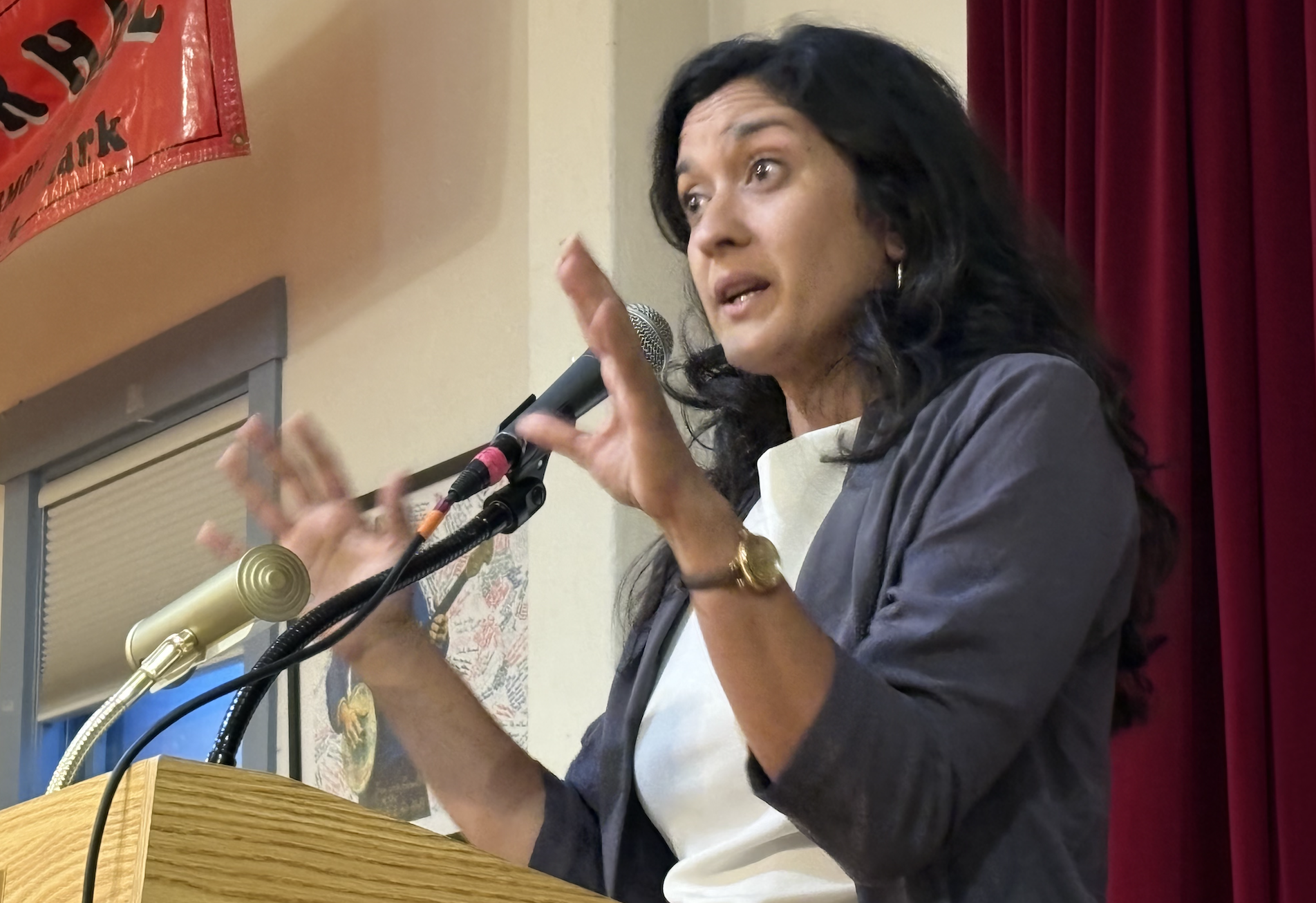
I spent my Sunday evening at the Old Labor Hall in Barre, where Democratic gubernatorial candidate Amanda Janoo appeared before a full house and held a campaign event that was unprecedented in my experience. Indeed, to call it “a campaign event” is to distort its message and purpose.
Well, I mean, it was an event held by a candidate during a political campaign, so anything a candidate does in public is part of the campaign, right?
But this one was fundamentally different. It wasn’t a rally. There were no applause lines, none of the delivery tricks designed to get people hootin’ and hollerin’. Janoo kept her tone conversational, as if her purpose was not to promote herself but to conduct an exchange of ideas.
One metric: The event began at 5:00 p.m. She didn’t mention her platform or policy ideas until 5:50. And throughout the event, she spent much more time interacting with the audience than promoting herself or attacking her opponent.
It was a full house at the Old Labor Hall, about 150 people by my estimate. (They’d originally set up 80-90 seats, but more chairs were rolled out as the crowd grew.) Not at all bad for a candidate who can’t afford to buy advertising and hasn’t gotten very much earned media coverage. There was plenty of enthusiasm, a buzz in the crowd if you will, and Janoo got a sustained standing ovation at the end of the night. It did underscore the notion that something is happening here, that the recent poll showing Janoo in the lead might reflect the developing reality of an expectation-shattering election.
Not that I’m drawing any such conclusion, far from it. But Janoo’s “town hall” is another data point in her favor. Could it be that she has tapped into a desire for politics as unusual, for something different from the cold oatmeal served daily by the Scott administration?
Perhaps the most remarkable thing about Janoo’s presentation is that she treated Vermont like a single entity capable of working together to advance common values and build a stronger state. Maybe it’s because she’s a native of a small town herself, but there was no trace of the usual construct: liberal city folk versus conservative rural people, central administration versus small town Vermont. Her message was that progressive policies work for the good of all, but only when they are built collaboratively, not delivered from the top downward. (Just to be clear, she never uttered the words “progressive” or “liberal” or “Democratic Socialist.” No labels.)
She began with brief opening remarks talking about her small-town upbringing and decrying the “deficit mindset,” instead declaring that we have the strength, resources, experience, and skill to create a thriving Vermont for all. Then came the first question for the audience: What are you most proud of in your community?
A volunteer carried a microphone around the crowd, and points of pride were shared: Caring for neighbors and helping those in need, “the kindness of strangers,” our small-town general stores, our libraries, our teachers and schools. “Creating community is not something we talk about very often in politics,” Janoo observed, “but it’s clearly the thing we value the most and the thing we should invest in right now.”
Janoo then delivered a brief overview of her adult career as an economist and consultant, working in other states and around the world to build economies that work for all. Then the focus again turned to the audience: “What is the Vermont you want for yourself, your children and grandchildren?” Responses included universal health care, strong schools, an investment in rural public transit, a thriving local food system, an end to “the criminalization of poverty,” more collaboration with Canada.
After all of that, 50 minutes into the event, Janoo spoke briefly about her platform, which boiled down to “Protect what we love and produce what we need.” She emphasized that “We have the resources, the generosity, the talents to build a better state.” She endorsed the “Fair Share” plan to impose taxes on wealthy residents proportionate to the federal tax breaks they received from Trump’s Big Ugly Bill. The revenue would pay for universal primary care service for all Vermonters. She also advocated for higher property taxes for homes owned by corporations or used as short-term rentals.
There were a couple of veiled criticisms of the Scott administration without naming names. She’s “not entirely convinced” that closing small schools and consolidating administration would actually save money or improve education. And she’s “horrified” by state policy on homelessness as both ethically problematic and financially irresponsible, calling for a “Housing First” approach: “For every $100 you spend on direct housing, you save $140 on costs for police, incarceration, and health care.”
She closed by declaring that “this is a moment in history when we have the power to change the course of the state,” but cautioning that “one political leader won’t change things. It takes all of us,” employing our “creativity, skill, passion, and experience” to forge a better Vermont. The crowd leaped to its feet.
Again, I’m not predicting a Janoo victory. But I came away hoping it could happen. That University of New Hampshire poll suggests that a lot of Vermonters feel the same way.
Is it really happening? Too soon to tell.

