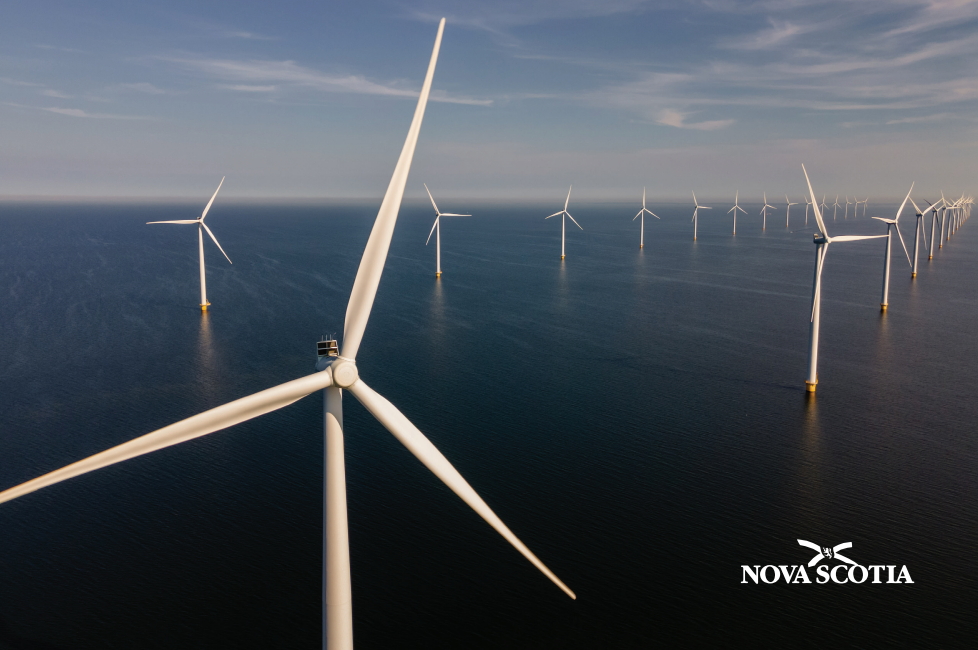
Gov. Phil Scott’s office has announced an energy partnership with Nova Scotia that could lead to Vermont getting a lot of its electricity from offshore wind farms planned for the ocean southeast of the Canadian province.
It’s a nice bit of pre-election publicity, seeking to rub some of the tarnish off Scott’s dismal record on renewables at a moment when he needs to shore up his centrist support. Doesn’t it sound great? A new source of cheap, clean power that doesn’t clutter up our own landscape? What could be better?
But there are spiders aplenty in this highly speculative attic, even if you leave aside the gross hypocrisy of Phil Scott advocating for wind power. To begin with, this is a three-year agreement concerning a development that will take at least twice that long to build — if it happens at all. And the press release itself, designed to put the best possible spin on this agreement, is heavily laden with qualifiers. Italics in the next paragraph are mine:
The headline touts the deal as “an agreement to explore bringing offshore wind power to New England through Vermont.” The agreement “establishes a framework for collaboration” on energy development. It “opens a path” to clean energy that “could help hold down electricity costs.” Access to New England markets “could support investment and jobs in the province.” The agreement “will support information sharing and explore opportunities” to bring wind energy “to New England through Vermont.”
Explore. Framework. Opens a path. Opportunities. Could. Could. All that from the office that’s doing its best to put the best face on this deal.
Now let’s do a quick map check. Yeah, “to New England through Vermont” makes no geographic sense at all. Distance from Halifax to Montpelier: 679 miles. From Halifax to Boston: 409 miles. The most direct line to New England is decidedly not through Vermont. And New England’s biggest electricity markets are in Massachusetts, Rhode Island, and Connecticut.That’s the shortest possible route for transmission lines and the most lucrative potential markets. Is Nova Scotia really going to bypass all of that to take a 270-mile detour through little ol’ Vermont?
We’re getting very close to “Aside from that, Mrs. Lincoln, how was the play?” territory. And that’s before we even get to the question of whether Nova Scotia will ever build a vast array of ocean-based turbines, not to mention how much the power would cost after considering the price tag for turbine construction and hundreds of miles of transmission lines.
Skepticism abounds in Canadian press coverage of Nova Scotia’s plan, which is depicted as having two goals: Make the province a clean energy powerhouse and supply massive amounts of electricity to mainland Canada. Not mentioned in the Canadian media: the idea of selling energy to New England, which seems to be something of a backup plan in case Nova Scotia’s dream of becoming Canada’s power plant falls through.
Global News quoted Progressive Conservative Premier Tim Houston as saying of his plan, “It’s a concept.” Well, that seems solid. He “wants to license” a massive number of turbines “over the next 10 years.” Houston foresees “hundreds” of turbines, although an energy expert told Global News it would take “more than 4,000.” A lawyer for a Canadian environmental group said Houston’s 10-year estimate “does not seem feasible,” and says the plan is “a vision that might be realized decades into the future.”
Over to you, Mrs. Lincoln. Well, actually, over to the Financial Post, where “significant challenges loom” and industry experts say “this is the most difficult time in more than a decade to launch new offshore wind projects, both politically and financially.” Even if the turbines are built, the FP reports, “the biggest challenge may be finding buyers for its electricity,” which would require “the construction of massive transmission infrastructure, which currently doesn’t exist.”
According to the FP, the plan carries a price tag of $60 billion Canadian, two-thirds for the turbines and one-third for the power lines. Those are the lines leading to Canada, not the Phil Scott hypothetical ones going to New England, which have been priced out at $30 billion. And those spectacularly scary figures don’t include related infrastructure needs including “serious upgrades to ports, infilling and dredging the seafloor.” (The port improvements would be needed in order to get all the turbine machinery and construction gear out to the build sites, so they’d have to happen before the first turbine is built.)
Are you feeling discouraged yet? Underwhelmed by the reality behind the governor’s bit of pre-election feel-goodery? We haven’t even gotten to the Vermont part of this swill pile yet.
Time out for a couple of necessary disclaimers. Some of the following information came from David Blittersdorf, renewable energy developer and generous donor to Democratic candidates and this here blog. He has lost business because of the Scott administration’s anti-renewable policies. But he also knows as much about energy as anybody in Vermont, and he’s in the renewable business because he believes it’s the future of a livable planet.
Also, you can discount his views, but there are still a sieve’s worth of holes in the Vermont/Nova Scotia plan-to-explore-creating-a-framework-to-do-something-that-might-provide-cheaper-energy-but-almost-certainly-won’t. Blittersdorf’s piece of this is a fraction of the whole.
“This is totally not real, totally impossible,” he told me, because “the physics of delivering electricity to New England at a reasonable price.” He estimates that electricity from Nova Scotia would cost about 24 cents per kilowatt hour. Right now, we’re paying six cents/kWh for power on the spot market, and about 6 1/2 cents for power from Hydro Quebec’s massive power plants.
You can quibble with Blittersdorf’s 24-cent estimate, but can you quibble all the way down to six cents? If you can’t, well, you can’t brag about cheaper power from Nova Scotian turbines.
Building wind power locally would eliminate the long-distance transmission issues, avoid the higher costs of offshore development, and pump the revenue back into the Vermont economy instead of sending it far away. That would put a few shekels into Blittersdorf’s pockets, but it would also be a boon to Vermont’s economy and energy future.
Which brings us to the cherry on this shit sundae. For decades we’ve been leaning heavily on Hydro Quebec for “renewable” electricity, leaving aside the ethical concerns about flooding vast areas of First Nations land. But our contracts with HQ will begin to expire in about five years, and there’s no guarantee that HQ will want to renew them or that we’ll be able to afford the inevitable price increases. Canadian markets are demanding more power, and Canada is under pressure to offset the climate-changing disaster of the Albertan oil fields — and the climate change-driven wildfires that annually devastate northern Canada and turn our air into pea soup.
What if HQ power becomes much more expensive, or we can’t continue to buy it at all?
Well, then, we’re screwed. We’ll be forced to buy large quantities of power on the spot market, with all its exposure to swings in fossil fuel costs.
Maybe now you understand why the governor is openly talking about bringing nuclear power back to a state that’s still suffering flashbacks from the managerial misadventures of Vermont Yankee, and why he’s floating this nonsensical Nova Scotia planny-plan-plan. He knows we’re facing a bleak energy future.
in closing, come with me on a trip to an alternate dimension where state government had sensible renewable policies for the past decade. We would have built reasonable quantities of large-scale solar and wind without significantly impacting our precious landscape. We’d have a robust portfolio of home-grown power at our disposal, lowering our exposure to fossil fuel markets and keeping the revenue in-state. We’d have much less trouble — if any — meeting the greenhouse gas targets in the Global Warming Solutions Act. We’d be a much better steward of our planet.
Enough dreamland. I’m sorry to say we don’t live in that dimension. We’re stuck here on Planet Phil. And we’ll be paying the price for his energy policies for decades to come. Even if this Nova Scotia pipe dream happens to become reality.

