Author Archives: John S. Walters

Unknown's avatar

About John S. Walters

Writer, editor, sometime radio personality, author of "Roads Less Traveled: Visionary New England Lives."

Honest government, if not honest elections

Now comes a brief spurt of outrage from the Kingdom, in the form of a belatedly-organized “group” (mainly one guy, William Round, with some money and a grudge) agitating for the election of Scott Milne as governor by the state legislature.

Newly-minted Seven Days political reporter Terri Hallenbeck says Round told her that “the group started over coffee among friends and includes more than 50 Vermonters he described as ordinary residents.”

Only one of the 50 shows up on the group’s FCC filing, and that would be Mr. Round. His filing asserts that VfHG has no officers, executive committee, or board of directors, so I have to assume that its organization and funding begin and end with William Round.

The lion’s share of the $30,000 ad buy is on WCAX. The ads will run from Dec. 30 through Jan. 7, the day before the legislature will hold its usually ceremonial election. Ad buys are targeted on WCAX and CBS news programming.

The ad says nothing about the close outcome of the November election; it simply recycles Republican complaints about Gov. Shumlin — high taxes, overspending, “broken promises,” etc.

VfHG’s emergence does give Milne the opportunity to deny the validity of the November vote:

“It points out to the people that we’ve got a constitution that essentially says we’ve had no election for governor. That happens on January 8,” Milne said.

Ah, so the votes cast by nearly 200,000 Vermonters? They don’t count. Sorry. We failed to cast them with sufficient clarity of purpose.

Well, it’s just more of Milne’s self-interested pseudo-logic, nothing new there.

As for Mr. Round and his willingness to spend $30,000 in a doomed effort to re-litigate the election? I fully support his Constitutional right to waste his money.

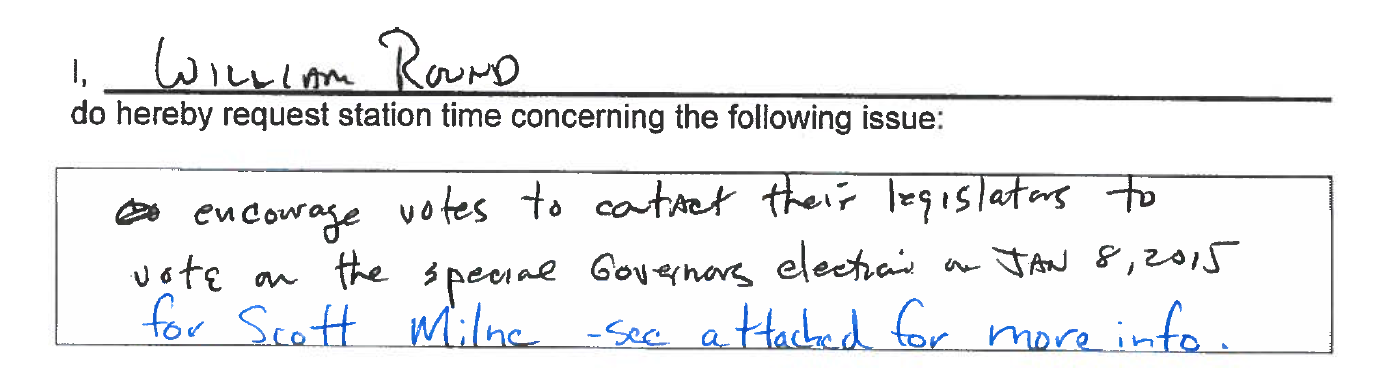
Finally, I suppose it would be churlish of me to reproduce the evidence of ungrammatical haste in filling out an official form? Yes, it probably would.

William Round FCC form


Closing time

Shoutout to my favorite one-hit wonder of all time…

So gather up your jackets, move it to the exits

I hope you have found a friend.

Closing time

Every new beginning comes from some other beginning’s end

And here we are, on The Last Day of Vermont Yankee. Or, as @GovPeterShumlin put it:

Yeah, well, as if.

Problem: today is not “the end of years of controversy.” It is, in the questionably immortal words of Semisonic, “some other beginning’s end.”

What ends today is the productive phase of Vermont Yankee’s history. What begins is the long slow wait for decommissioning. The chances of an accident will diminish, but we’ll still have a whole lot of hyper-toxic stuff SAFSTOR’d on the banks of the Connecticut River.

Look at it this way. The “lifespan” of Vermont Yankee was 42 years. The “deathspan,” if I may coin a word, will be AT LEAST 30 years. That’s the optimistic forecast for decommissioning. And that’s heavily dependent on the always-reliable, ha ha, stock market: Entergy’s decommissioning fund sits at $665 million, a little more than half the estimated cost of decom. Entergy says it won’t start decom until the fund grows to cover the entire (estimated) $1.24 billion price tag.

But hey, the markets always go up, right?

The way Entergy puts it, they’re doing us a big fat favor by planning the decom for the 2040s. By federal standards, they don’t have to do it until 2075.

Sixty years away.

In that scenario, the “deathspan” of the plant will have been 50% longer than the lifespan.

That’s the problem with nuclear energy. I’m not necessarily against nukes; if managed correctly, they do provide reliable carbon-free power. But there’s that long, lingering afterlife — and corporate America has never shown much dedication to long-term responsibilities.

Nor has public America, for that matter; we have yet to devise a long-term storage plan for all that nuclear waste.

Anyway, I suppose @GovPeterShumlin is only doing what a governor has to do: putting the best face on a decidedly mixed reality.

But I’d be very surprised if this was, in fact, “the end of controversy.”

And in the words of Semisonic, wherever they are today:

I know who I want to take me home,

and it ain’t Entergy.

BREAKING — Bernie Sanders Announces A Timetable For An Announzzzzzzzz…..

One of the things that makes me long for a parliamentary democracy is the blessed briefness of election seasons. Call an election, a couple months later you’re done.

America, on the other hand, suffers a severe case of Campaign Bloat, especially in the Presidential sweepstakes. I may be a politics nerdboy, but I couldn’t be more bored by the early maneuverings of would-be candidates and their dutiful swings through Iowa, New Hampshire, and other self-appointed bellwethers of national opinion.

The Collegiate Bernie. (From his own website.)

The Collegiate Bernie. (From his own website.)

Even the endless travels of our own Bernie Sanders bore me. I don’t care where he’s eating rubber chicken and giving the same speech he’s been giving throughout his career. I feel no desire to keep up with Seven Days’ attempt at journalistically justifiable clickbait, “Bernie Beat.”

And I don’t care about the latest Hot News (came out during my Xmas vacay), as reported by Dave “The Hat” Gram:

SANDERS: I’LL DECIDE ON PRESIDENTIAL RUN BY MARCH

“I don’t want to do it unless I can do it well,” he told The Associated Press. “I don’t want to do it unless we can win this thing.”

Yuh-huh. Well, if that’s the deciding factor, I think the decision is all but made. Especially when…

Sanders said he is weighing whether to run as an independent, as he has done in Vermont, or as a Democrat.

Oh yeah, running as an independent. That’ll work.

Now look, I appreciate Bernie’s dedication to his role as a progressive firebrand. I like the fact that he talks about issues in a way that connects with working Americans, unlike many of us who are too darn academic and literary for our own good. But he will never be a serious candidate for president.

He can be a useful part of a presidential campaign, focusing on issues and themes that “mainstream” Democrats often avoid. Roughly speaking, he’s the Ron Paul of the left: a true believer who attracts attention through the raw power of ideas boldly expressed.

As such, I’d welcome his candidacy, if only as a foil for Hillary Clinton. Which is about all he could reasonably hope to be.

Now, Elizabeth Warren, she’d have a chance. But in her absence, sure, Bernie, take a rip. Just don’t expect me to pay attention to your three-month-long Final Decision Tour. And don’t expect me to believe your insistence that you’d only be in it if you can win.

Another conveniently incomplete explanation from Art Woolf

Just in time for Christmas, Vermont’s Loudest Economist has left a flaming bag of conventional-wisdom poo on our doorsteps. (At least he didn’t try to come down the chimney.)

He’s scribbled out a column entitled “Explaining Demise of Single-Payer.” Which, of course, does virtually nothing to explain the demise of single-payer. I mean, this is Art Woolf we’re talking about here.

The good professor spends most of his time on a shallow meander down Memory Lane, explaining that despite the efforts of the last three Vermont Governors, our percentage of uninsured Vermonters has remained basically the same.

Of course, Woolf’s entire argument falls apart right there, because his beloved statistics end at 2013 — before the Affordable Care Act had gotten off the launchpad. So he’s telling us that Shumlin has failed to reduce the uninsured population, even though Shumlin’s reforms hadn’t begun to work.

Sheesh.

Woolf goes on to the only useful part of his “analysis.” In recent years there have been efforts to expand Medicaid eligibility, and they have worked. However, there’s been a corresponding decline in coverage through employers, so it all washes out.

Us liberals would blame this on a worldwide, concerted effort to drive down wages and benefits — the race to the bottom, as revealed in the stagnation of buying power for all but the very top earners, the persistent crappening of benefits such as employer-provided health insurance (and the steady cost-shifting to employees by way of worker contributions, high deductibles and copays) and the virtual disappearance of defined-benefit pension plans.

Woolf, good capitalist lackey that he is, blames the loss of employer health insurance on the expansion of Medicaid.

What apparently has happened during the past 15 to 20 years is that some employers who formerly provide insurance to their workers no longer provide that benefit. Most likely, it’s because their employees can get a better coverage plan at no or low cost from the state.

“What apparently has happened,” my ass. Woolf might be justified in making that evidence-free assumption, if not for all the other evidence that employers are squeezing their workers and transferring responsibility for their well-being to the government. (See: all the Walmart employees on some form of public assistance. I guess Woolf would blame that on welfare, not on a greedy corporation.)

The toxicity of Woolf’s presentation becomes clearer in th;e ensuing paragraph:

Their employers can therefore afford to pay their workers higher wages instead of providing health insurance benefits. This is one of the unintended consequences of government policies that are all-too-often overlooked by policymakers.

Well, sure, they CAN afford to pay higher wages. But they DON’T. And Woolf knows damn well that they don’t. He must be aware that working Americans’ wages have been stagnant for decades.

And he must be deliberately excluding that fact from his presentation so he can preserve his dubious conclusion: government largesse is to blame for private-sector miserliness. If not for Medicaid expansion, he is effectively saying, working Americans would still be getting health insurance from their employers.

Working Americans can only respond with a bitter laugh.

He also blames Medicaid for the rising cost of health care: because Medicaid offers low reimbursement rates to providers, they have to charge more to private insurance carriers. Which is true, but again, it leaves employers out of the equation.

Finally, in the last paragraph of Woolf’s column, we get to “Explaining the Demise of Single-Payer.” Sort of:

The state’s Medicaid expansion now provides a backstop for lower- and middle-income Vermonters who might lose their private health insurance. This means the third goal, the fear of becoming uninsured, might have lessened over time for many Vermonters.

Perhaps that’s one reason why there wasn’t greater support for single-payer in Vermont, and why there wasn’t more opposition to the governor’s recent announcement.

Oh, so we should blame the demise of single-payer on the patchwork success of Medicaid? Nothing else at play here, Art?

To be fair, Woolf doesn’t necessarily write the headlines, so maybe he’s not responsible for the vast overpromise of this one. But he is responsible for the incomplete, one-sided “logic” that resides beneath.

Art Woolf’s weekly words of wisdom usually come to us on Thursdays. This one was published on Wednesday. Perhaps tomorrow, on Christmas Day, Woolf will favor us with his reasoned defense of Ebenezer Scrooge, and how the government’s generous provision of prisons and workhouses helped drive down wages in Victorian England.

Every Coyne has two faces

So the Catholic Diocese of Burlington has a new bishop: Christopher Coyne, currently auxiliary bishop in Indianapolis. And let me welcome the Bish in my own inimitable way by pointing out a few of his qualifications for the job:

He knows how to lie with a straight face.

He knows how to subsume the interests of truth and justice to those of his institutional home.

He is willing to put a smiley face on some of the Church’s most abhorrent crimes in order to prop up its facade of morality.

You see, Coyne spent three tumultuous years as the media spokesman for the Roman Catholic Archdiocese of Boston. Those happened to be the years when the Archdiocese’s hidden history of cosseting pedophile priests came to light. And Coyne was right there on the front line, defending the purity of the Church and of his master, the disgraced Bernard Law, last seen scuttling into a Vatican spider hole.

On the other hand, he was appointed by Pope Francis, which is a mark in his favor. But it’s hard to overlook Coyne’s three years of defending the indefensible. Especially when he comes to a Diocese with its own sordid history of sex-abuse coverups and his predecessor Salvatore Matano’s all-out efforts to avoid being brought to account.

The new guy brings a lot of heavy baggage to the job. He’ll have to prove by his actions that he holds the best interests of “the least of these” above those of his ermine-wearing overlords.

They really oughta take away Mikey Pom-Poms’ smartphone on weekend nights

Hard times at the Burlington Free Press. Coming off a week in which Vermont’s Shrinkingest Newspaper failed to send a reporter to Gov. Shumlin’s epochal announcement on single-payer, posted a frankly embarrassing hit piece slamming the Shumlin administration for refusing to leak the subject of the presser in advance, failed to cover the release of a significant report on the Department for Children and Families, and “covered” Entergy’s new cost estimate for decommissioning Vermont Yankee by regurgitating a brief Associated Press newsbit, Executive Editor Michael Townsend has finally found something to brag about.

High school sports scores.

Okay now, I realize that local prep sports is an important service (and readership magnet) for newspapers. But “touchstone”? Yikes.

This is the kind of thing that drains all my sympathy for MIkey. I realize he’s in a tough spot, trying to keep his ship afloat with a skeleton crew and having to implement the oft-misguided diktats of Gannett Central. But when he pulls this kind of nonsense, he comes across as a gormless corporate cheerleader.

The Emily Post Guide to Gubernatorial Seating Arrangements

There’s one unobserved aspect of Gov. Shumlin’s white-flag presser on single payer health care that I’d like to mention before the event is any farther in our rear-view mirrors.

Because the Governor was announcing his single payer reversal not only to the media, but also to his two big Advisory Councils on health care reform, the event was moved from his ceremonial office to Room 11, one of the larger conference rooms in the Statehouse (which is notorious for small, cramped, unphotogenic rooms). Room 11 is on the first floor, to the left of the Abe Lincoln bust that dominates the central hallway.

It’s a long rectangle; the east and west walls are the long ones. There’s a big wooden conference table along the west wall. Directly in front of this table is a rather narrow open area; along the east wall are three long rows of chairs.

The south wall (closest to the front of the building) is kind of an open area. In front of the north wall are several rows of seats.

The lectern for the news conference was set up on the south end of the room. The seating area on the east wall was filled with members of Shumlin’s Business Advisory Council and miscellaneous others. The conference table opposite was where most of the media sat. (Yeah, we grabbed the comfy chairs.)

In the open area between east and west walls, the TV cameras were set up.

The seating area near the north wall was where Shumlin’s Consumer Advisory Council sat.

Now, it’s well known in government circles (and probably the private sector as well) that proximity equals influence. Presidential staffers clamor for space in the White House instead of the Executive Office Building, for instance.

Well, in this case the Business Advisory Council got the prime seats. The Consumer Advisory Council was in the Siberia of Room 11. Their view of the lectern was blocked by all the TV tripods.

You don’t think that was an accident, do you?

Oh, and also languishing in the cheap seats was a rather forlorn looking Mark Larson, who still holds the title (and draws the salary) of Vermont Health Access Commissioner, even though he was sidelined months ago in a staff shakeup. He may still be a top Shumlin health care executive, but he was nowhere near the front of the room where all his, ahem, colleagues hovered closely behind the governor.

After remarks from Shumlin and others, he opened it up for questions. He sought to go back and forth between the media and members of his two Councils.

Who do you think dominated the Q&A period? Well, the media did, but aside from that it was all Business Advisory Council. Only one voice emerged from the back of the room: CAC chair David Reynolds made a brief and forgettable statement about how much hard work had been done. Not a peep was heard from CAC members like Peter Sterling, James Haslam, and Dr. Deb Richter — three of Vermont’s leading advocates for single payer. Maybe they were in shock, or maybe they couldn’t be seen from the lectern because of all the TV guys.

Several members of the BAC spoke. All were vociferous in their praise for everyone’s hard work, and all credited Shumlin for his hard work and his wisdom in scuppering single payer. Yeah, right: some of these guys were against single payer from day one. A couple of them were harshly critical of the media for being mean to the governor, when in fact we were only doing our jobs, and Shumlin gets worse than that in his regular news conferences.

The business community, up close and with a clear view of the Powers That Be. The consumer representatives, exiled to the back of the room where they’d have to jump and shout to be recognized.

Given the content of Shumlin’s announcement, that all seems about right.

Single payer: a third party is heard from

I’ve been wondering when this would come. A statement, with the title in ALL CAPS, from the Progressive Party:

SHUMLIN’S DECISION TO SCRAP SINGLE PAYER A BETRAYAL OF VERMONT’S WORKING FAMILIES

And no, the Progs don’t usually go ALL CAPS.

The reaction is understandable; the Progs had put their statewide ambitions largely on hold for the sake of single payer.

The Vermont Progressive Party dis not run Progressive challenges against Governor Shumlin in the last three cycles, in large part because of his unwavering promise to lead on single payer.

If the Progs had run a candidate this year, no matter how perfunctory, we’d almost certainly be talking Governor-elect Milne right now.

The anger continues:

While we are outraged by Shumlin’s broken promises, we are not terribly surprised. … rather than work through [the] issues or scale back the project, Shumlin decided to scrap it entirely (and with it, many Vermonters’ hopes of a just and accessible healthcare system).

Indeed, it’s easy to conclude that the Governor put his thumb on the single payer scale in order to make it seem more unattainable than it already was. He opted for a top-level plan (94 Actuarial Value) instead of more modest coverage (80 AV), which increased costs. He insisted on a three-year phase-in of the payroll tax for small businesses, which slashed revenues. (His team also suddenly realized that those long-touted “administrative savings” weren’t going to happen.) Those may have been reasonable policy choices, but when you have Shumlin’s reputation for slickness and hippie-kicking, it’s not hard to assign the worst possible motive: the Governor wanted to squirm out of his promises, so he stacked the deck against single payer.

Governor Shumlin only seems concerned about the projected future economic burden to businesses, not the burden that working people are bearing right now.

Yup. His announcement was chock-full of references to financial realities and business concerns — and reminders of his own personal pain, awww — while conspicuous by their absence were any mentions of equity, accessibility, or the burdensome nature of the current system. And he sure as hell didn’t call health care a “human right.”

The Progs’ release includes a not-so-veiled threat of a Progressive candidate for Governor in 2016. Imagine, if you will, this scenario:

Shumlin has spent his third term tamping down expectations, cutting programs to balance the budget, pursuing incremental rather than transformational progress. The Republicans nominate Phil Scott, who doesn’t look much different ideologically than Shumlin, has a much more attractive personality, and can win back the business donors who’ve been backing Shumlin.  And the Progs challenge from the left.

In that scenario, Shumlin is well and truly screwed.

The gang that couldn’t dig straight

That was quite a heapin’ helpin’ o’ bad news served up by Vermont Gas this morning. It announced yet another big cost increase for Phase 1 of its pipeline project, and asked state regulators to put the case on hold.

Which is, if nothing else, a sign that they realize how bad their situation is. How bad?

Yeeeesh. Company officials insist the pipeline is still economically viable, but it’s a lot less viable than originally thought. That changes the cost/benefit equation — which should include the environmental questions — quite a bit. In other late-breaking realizations…

Mm-hmm, I’ll bet. As I wrote in early September, Vermont Gas has been its own worst enemy, coming across as bullies with landowners, and as questionable managers with state regulators.

Whether its bumblefuckery is enough to shelve the project remains to be seen. Today’s announcement is the beginning of a new phase in the history of this proposal. Up till now, the economic arguments in favor of the pipeline had been strong enough to overcome resistance from the environmental community and a small number of landowners.

Those arguments are a lot less strong today. Vermont Gas has given the state a big fat excuse to kill the project — at a time when Governor Shumlin (to be entirely political about it) desperately needs a high-profile issue on which he can pander to the left. Well, if he wants one, he’s got one.

Update. The Governor has released a statement, and yes, he sees an open door in front of him.

Although I am pleased that the new leadership at Vermont Gas is taking the time to reevaluate the proposed projects, this further cost increase is very troubling. In the coming weeks my administration will be evaluating all of this new information and looking at these projects as a whole to ensure that they remain in the best interest of Vermont. Meanwhile, I expect Vermont Gas to also reevaluate its communications and negotiations with affected landowners to help improve relations. I trust those steps will continue.

Bureaucracy to the rescue

It’s a story languishing in the shade of Governor Shumlin’s single-payer surrender, but on Thursday the Department for Children and Families released a third report on its effectiveness. This report pretty much echoed the first two, as VTDigger’s Laura Krantz reports:

The new report grouped its findings into five categories. The key items include better training, more social workers, more transparency and a stronger focus on opiate addiction’s impact on family dynamics.

DCF head Ken Schatz said the similar conclusions of the three reports was an affirmation that “We have a good road map now to go forward.”

Well, that’s nice, but is that sufficient justification for three separate reports plus a legislative review that’s still pending? How much money did we spend on all this investigation? Why didn’t we just commission one really good and thorough report instead of a bunch? Were DCF investigations on sale at Costco?

Beyond that, two things in Krantz’ account jumped out at me. First was the fact that the DCF news conference was “attended by only three reporters.”

That’s sad, and bad. DCF was one of the year’s highest-profile issues in state government. And, to be callous about it, the story was more clickbaity than most because it involved the deaths of two toddlers. Also, the presser was held not in Montpelier, but in Williston — a hop and a skip away for Burlington-based media outlets. Like the Free Press, which I’ve been told was not in attendance. (So far, its website does not provide any coverage of the event.)

If true, that’s pretty shameful, especially for a media outlet that has beaten the drum for greater transparency at DCF. They want transparency, but they’re not going to advance the cause by, oh, sending a reporter to a significant event. Nice.

The other thing that jumped out at me was this. The “road map” that Schatz referred to included a call for “more front-line workers [and] lower case loads.”

In response, Schatz and his boss, interim Human Services Secretary Harry Chen announced that DCF would hire ten more staffers.

Social workers, right? New troops to bring down the case loads, yes?

Er, no.

They include five management positions in the economic services division, two assistant attorneys general to help district offices with child protection cases and the family services division: an assistant district director in St. Albans, a assistant for the centralized call intake unit and a policy specialist.

By my count, that’s six middle management types, two prosecutors to help with cases that have gotten so far out of hand they’re headed for the courts, and two other functionaries, neither of which are on the front lines.

Bureaucracy to the rescue! Our troops are having trouble in the trenches, but never fear — we’re beefing up the staff at headquarters.

Maybe there are excellent reasons for these particular hires, but at a time when AHS is under heavy pressure to make deep cuts, it kinda leaves me scratching my head a little.

Speaking of tight budgets, you might wonder where they’re getting the money for these positions. The not entirely convincing answer is “through anticipated savings from the state’s Reach Up program, which helps poor families.”

Hmm. At the presser, DCF officials released some downright scary numbers on how their case loads have increased over the past year. And we’ve all been told over and over again that the sluggish economic recovery, with almost all its bounty going to the top one percent, is putting the squeeze on working Vermonters. But they’re confident they can save money on Reach Up?

They’re certainly more knowledgeable than me, but I have trouble seeing it.