Author Archives: John S. Walters

Unknown's avatar

About John S. Walters

Writer, editor, sometime radio personality, author of "Roads Less Traveled: Visionary New England Lives."

Unwarranted outrage from your Freeploid


(See also addendum below: the Free Press didn’t have a reporter at one of the biggest news events in recent history!) 

Regular readers of the Burlington Free Press (all six of us) know that transparency is one of its signature causes.

(Except when it comes to the Burlington Free Press itself; there, secrecy rules the day.)

Well, this preoccupation caused Vermont’s Saddest Newspaper to leap to an unwarranted conclusion yesterday.

In the morning, the media got notice of a gubernatorial press conference to be held at 2:15 p.m. There was no mention of the subject matter.

And this caused the Freeploid to throw a nutty. It posted a short piece entitled “Secrecy surrounds Shumlin’s news conference.”

Shumlin has led the fight for government transparency, but his new press secretary, Scott Coriell, has failed to respond to questions about the topic of the governor’s meeting with the media.

Well, son of a bitch. Of course he didn’t respond.

Most gubernatorial pressers include a bit of political business — a bill signing, a new initiative, a ribbon-cutting. In those cases, the media alert will tell us what’s coming up.

But when there’s an actual policy announcement of significant magnitude? Hell no. Shumlin’s people aren’t going to upstage the announcement by providing advance information. The Freeploid is basically demanding that the administration leak its own stuff.

Particularly in this case, when the announcement was made simultaneously to the media and to those who’d been involved in the single payer work.  If Coriell had disclosed the subject matter, do you think the Free Press wouldn’t have found a way to publish the “scoop”?

The Freeploid went on to complain about changes in the time and venue for the presser. Which, c’mon, grow up. It’s not that big a deal.

I suspect the Freeploid’s real problem is that it no longer has a Statehouse bureau, and the editors had to decide whether to send a staffer down from Burlington. That’s a big deal for a paper as understaffed as the Freeploid. But that’s not the governor’s problem. And Scott Coriell shouldn’t be raked over the coals for simply doing his f’n job.

The article was slightly updated after the presser, and can be viewed by anyone who hasn’t canceled their subscription yet. The updated version mostly changes the verb tenses; the misperceptions, self-entitlement, and aspersions on Coriell remain intact. One more signpost on the Burlington Free Press’ descent into irrelevance.

 Addendum. A loyal reader pointed out that the Free Press’ main article on Shumlin’s presser was not written by a Freeploid staffer, but by the Associated Press’ Dave Gram. That’s pretty awful for a “media company” that insists it hasn’t retreated from Statehouse coverage, and whose leader has publicly slammed “rumors and speculation that we are abandoning coverage in Montpelier.” Well, sir, your absence at yesterday’s announcement is not rumor or speculation, but fact.

Presumably what happened was: the Free Press tried to find out the subject of the presser and failed. The editors then made a calculated gamble not to send a reporter — although they did send their photographer Glenn Russell. Their gamble exploded in their faces. Dave Gram’s a fine reporter, but Vermont’s largest newspaper should not be depending on the AP for coverage of a huge news story.

Shumlin waves the white flag

The governor’s number-one public policy goal is no more.

At a news conference today, Governor Shumlin pulled single payer health care off the table, saying the numbers simply don’t add up. Instead, he promised a continued effort to improve access to, and lower the cost of, health care in Vermont.

“This is the greatest disappointment of my political life,” he said, and that nails it. Single payer was one of the foundations of his initial run for governor in 2010. His promise to push for single payer set him apart in a crowded Democratic field and helped overcome doubts about his liberal bona fides.  That promise kept the Progressive Party on the sidelines in 2012 and 2014.

And now, it’s not gonna happen.

Oh, he promised a continued fight for a fairer and more accessible system, starting with the 2015 legislative session. But single payer is out until further notice. When asked, “If not in 2017, when?” he only answered in generalities.

As for the timing of the announcement, only six weeks after the election, Shumlin claimed that his team had just finished working the numbers last Friday and confirmed the bad news on Monday.

The numbers were unacceptably bad. Morgan True of VTDigger had reported that the financing mechanism would be based on an 8% payroll tax and a consumer premium imposed on a sliding scale. But the way the numbers shook out, the actual payroll tax would have to be more like 11.5%, and the premiums would have to be higher than expected. The result could punish the economy and leave many Vermonters with higher health care costs.

He cited several factors that moved single payer out of reach. Federal subsidies were not going to be as generous as hoped. The sluggish economic recovery meant fewer dollars coming into the treasury. That had led to state cuts in Medicaid payments that reduced federal support.

Also, the administration had decided a three-year phase-in for small businesses that don’t currently provide insurance was necessary to cushion the shock of a payroll tax. That phase-in meant substantially lower payroll tax revenue for the first three years.

Shumlin was clearly sensitive to the concerns of the business community. That, and his woodshedding in the November election. He saw single payer as a huge gamble that he was unlikely to win, and now is not the time to stick his neck out.

He also acknowledged that the troubled rollout of Vermont Health Connect cost him credibility on building a new health care system. “We must show we can deliver,” he said. “Vermonters have reason to question us, given the troubles with Vermont Health Connect.”

He emphasized all the hard work that’s been done to create Vermont Health Connect, bend down the cost curve, and lay the groundwork for a better system. And he promised a continued, all-out effort to improve the system. But single payer was his signature deal, and now he’s had to forego it.

Even if the delay is relatively brief — say, two years — single payer is almost certainly unattainable during his tenure in office.  The failure of single payer will be a big part of his legacy, and will significantly hamstring his ability to win back liberal and Progressive voters who’ve been skeptical of him.

Fair or not, today’s announcement confirms that skepticism. Let’s accept that the numbers are honest and the timing was just the way things worked out. Even so, the optics are bad.

There are many liberals who never believed Shumlin was serious about single payer. They will see their cynicism as confirmed.

This retreat will also lend great comfort to the foes of health care reform. A determined Democratic governor, with all the resources he could want, spent three years researching single payer, only to conclude that it wouldn’t work. The revised cost estimate for single payer — $2.6 billion a year — is almost exactly what Wendy Wilton, then-Republican candidate for Treasurer, estimated two years ago.

And the abandonment of single payer strips the governor of his signature issue. Aside from Tropical Storm Irene, his administration has been marked by incremental gains on a number of issues and blocking tax hikes. There haven’t been any high-profile accomplishments — which is why one of Shumlin’s re-election ads focused on GMO labeling, an issue he didn’t support until the last minute. And why a recurring theme in other ads was Irene recovery, something that happened in his first term.

Now we can now look forward to more incremental gains and belt-tightening. His downsized proposals for the 2015 legislature on health care were purely incremental in nature. None will generate headlines or fuel a grassroots movement.

The governor’s gonna have to pull a rabbit out of a hat somewhere to restart his political career. And his biggest hat is now empty.

How deep is the Milne/VTGOP split?

Ever since the election, there’s been a clear oddity about the public relationship between gubernatorial candidate Scott Milne and top Republicans. Which is basically this: They’re never, ever seen in public together. Not even when said Republicans were advocating for Milne’s election by the legislature.

Both sides denied any rift, sometimes with a cutting subtext. Like this, from Milne:

I think I helped the Republicans statewide about as much as they helped me. I’m not indebted to them, they’re not indebted to me. …I don’t owe the Republican Party anything in the state of Vermont. I clearly don’t owe the national Republican Party anything.

Yeah, that’s real warm and friendly-like.

But now, here’s a choice bit of evidence for my theory, courtesy of VTDigger’s Laura Krantz.

Bartley in 2014 served as a field director for the Republican party. The Colchester resident worked part-time out of Milne’s South Burlington office, where Milne’s campaign manager said he rarely interacted with him.

“He was perceived as a spy by his own party’s candidate for governor,” said Milne campaign manager Scott Fletcher.

Bartley denied being a spy, natch. But whether or not he was a spy, Fletcher’s statement tells me all I need to know about the state of candidate/party relations. If the campaign manager believes that the party planted a spy in his organization, there’s clearly no love (or trust, or respect) lost between the two.

Is the VTGOP going forwards or backwards?

Or, possibly, both at the same time?

VTDigger’s Laura Krantz dug up (yes, I did it) quite a few tasty tidbits about recent changes in the Vermont Republican Party in a story posted on Monday. Most of which concern the installation of Jeff Bartley as VTGOP Executive Director.

Before I go on, I’d like to note that just as Bartley was getting the job, his father was rushed to the hospital with lung cancer, and things aren’t looking too good. (I’m not disclosing a secret here, because Bartley himself has been Tweeting about it.) That really and truly sucks for Bartley; on a personal level of course, but it’s gotta be taking his attention away from his new and very challenging position. I can’t say I respect Bartley’s political skills, but as a fellow human being, I feel for his plight.

Still, back in the salt mines of politics, life goes on. And, per Krantz, Bartley’s nomination created some hard feelings within the party.

Bartley was chosen in a last-minute election announced slightly more than 24 hours before the Dec. 1 meeting. Insiders say the decision was rushed to leave no time for other candidates to come forward or for a search process to take place.

Would this be the same party that often hits on Gov. Shumlin over transparency? Yeah, thought so.

Bartley’s nomination was met with ambivalence at best, hostility at worst, and led to an unusually close executive committee vote on his hiring: six votes in favor, four against. Not exactly a stirring mandate.

The four “no” votes included three very prominent conservative Republicans who have been openly skeptical of Phil Scott’s party-broadening initiatives: outgoing treasurer Mark Snelling, Wendy WIlton, and Randy Brock. The fourth, Kevin Beal, was last seen in the blogosphere in  November 2013 when he ran for the “Chair of chairs” post (basically, a liaison between county chairs and the state party) against… wait for it…

… Jeff Bartley.

Okay, then.

I don’t think I’m overreaching to interpret the 6-4 vote as a defeat for the conservative wing of the party. Especially in light of this note from True North Reports’ Robert Maynard in my comments section:

Jeff Bartley is not a conservative and it should come as no surprise that conservatives would not het (sic) behind him as their candidate for party chair. He burnt a lot of bridges with consertavives (sic) and Tea Party types during the Len Britton campaign by telling the that his model for a Republican office holder was Maine’s Senator Olympia Snowe. (At least that is what I am told by the Tea Party members who worked on the campaign)

And if we know anything about “consertavives,” it’s that they have long memories for political slights.

According to Krantz’ article, Bartley was seen as party chair “Super Dave” Sunderland’s pick for the job. As for the rushed and secretive nature of Bartley’s hiring, it looks designed to forestall organized opposition and perhaps even prompt a walkout by top conservatives. Like Snelling, for instance.

And even Bartley backers were, uh, kinda lukewarm about it. Jackie Barnett and Stephen Webster, who both supported the hire, basically laid it at the feet of Sunderland.

Barnett: “My personal feeling is the chair (David Sunderland) should have whomever they want working for them.”

Webster: “This is David’s choice, and I’ve been supportive of David.”

Neither committee members had anything to say about Bartley’s political acumen.

It’s not exactly an ideal situation. Bartley is taking the helm of a party that, November gains notwithstanding, still has a hell of a long way to go. Quite a few influential party members, and perhaps an entire wing of the party, view him with suspicion if not hostility. Given his record, there are legitimate questions about his preparedness for the job. And he’s doing it all while his dad is in the hospital with a life-threatening illness.

I can’t say I have high expectations for Bartley, but I wish him luck.

The need for SPEED

Vermont’s SPEED program is in the news again. And, as is usually the case, much of the coverage misses the point. As does all of the criticism.

SPEED, for those just joining us, is short for Sustainably Priced Energy Enterprise Development. It was enacted by the legislature in 2005; its aim was to encourage development of renewable energy, which at the time was in an embryonic stage and suffered from competitive disadvantages.

(It was more expensive than fossil fuels. Which, of course, benefit from tax credits and other forms of government largesse, and the harm they do to the environment is not factored into their pricing, so they are much cheaper than they ought to be.)

As I explained in a nice long 2013 thumbsucker on Green Mountain Daily:

SPEED was designed to surmount the chicken-or-egg problem with renewables: the upfront investment is relatively large, making renewables uncompetitive at the beginning. Over time, their costs drop dramatically because, well, they’re renewable: no need to keep on buying fuel. SPEED provided a market-based solution to the initial-investment problem by allowing utilities to sell long-term contracts for renewable power. Without SPEED, adoption of renewables in Vermont would have been much, much slower.

The program’s critics say the trading scheme means that our renewables are, in effect, enabling the use of dirty energy elsewhere. In particular, SPEED’s been used as a punching bag by opponents of wind and solar power.

Today, there are stories on VTDigger (pretty good) and VPR (not so good) about the Shumlin administration definitely (VTDigger) or possibly (VPR) planning to phase out SPEED in 2017.

Well, hell. That was the plan from the very beginning. SPEED was meant to goose the renewables market. And it’s worked: according to VTDigger, “The state has built wind, solar and other renewable power generation that could supply about 15 percent of the state’s electric retail sales.” That’s substantial progress.

Rep. Tony Klein, D-East Montpelier, displays some of his vast knowledge.

Rep. Tony Klein, D-East Montpelier, displays some of his vast knowledge.

SPEED was designed to be temporary, and was set to expire in 2017. It could have been extended, to be sure; but one of the House’s top energy people, my own state representative Tony Klein, has been saying for a long time that SPEED would sunset on time.

And on Saturday, Governor Shumlin told the House Democratic caucus that SPEED would be scuttled on schedule. VPR’s John Dillon somehow missed this; he has the administration merely considering a change to SPEED. (The VTDigger story has the administration “calling for an end” to SPEED, which is closer to the mark but not quite there.) In his story, Dillon gives extensive time to the Vermont Law School’s Kevin Jones, who’s had a bug up his butt about SPEED for a long time.

“For me, it’s at least a step in the right direction for the Public Service Department and the Shumlin administration for finally acknowledging that the SPEED program does not work in terms of providing any climate mitigation,” he said. “As a matter of fact, it has increased Vermont’s carbon footprint, by something, according to their analysis, like 70,000 tons in greenhouse gas emissions in 2013 alone.”

Jones’ interpretation is ignorant at best, disingenuous at worst. The DPS and administration are not “finally acknowledging” anything; they are letting SPEED expire on schedule.

And the purpose of SPEED was not to immediately mitigate Vermont’s carbon footprint; it was to hasten development of renewables so our longer-term footprint would decrease.

Also, SPEED may have “increased Vermont’s carbon footprint,” but only technically: the renewable credits were sold out of state, but the energy was still being produced, thus reducing the region’s carbon footprint while  — again, technically, and only in the short term — increasing our own.

Finally, a misperception from VTDigger’s article:

The state’s goal is to generate 20 percent [of electricity via renewables] by 2017, but there is no requirement in state law that this power is to be sold to Vermont customers.

This reflects a fundamental misunderstanding of electric markets. In the absence of large-scale storage technology, electricity is produced, transmitted, and consumed all at the same time. The power grid is a regional creature, networked to the national grid. There is no way to tease out which energy came from where and ensure its consumption within the state of origin. Such a “requirement in state law” would be technologically laughable.

Vermont’s power — renewable, dirty, Vermont Yankee, whatever the source — goes into the grid at the same time as power from out-of-state sources; it’s shunted around the grid to where it’s needed at that moment, and consumed. It’s like taking a cup of your tap water, pouring it into a bucket of water, and then wanting to take back your own water. Can’t be done.

Which is at the heart of the anti-SPEED absurdity. The renewable energy whose development was fostered by SPEED went into that big bucket. Whether or not it was immediately credited to Vermont’s account, it exists, and it helps reduce the region’s dependence on dirty energy.

The SPEED program has had a purpose. It has served that purpose well. Now it’s time to move on. And we will.

He labored mightily, produced a mouse, and looks on it with pride

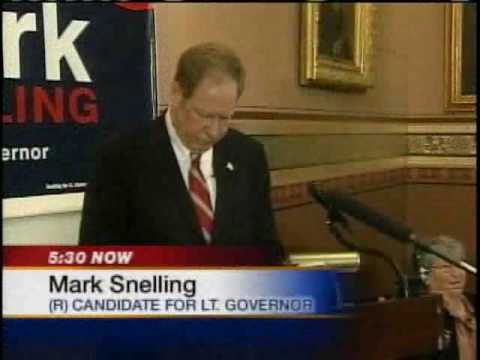
Mark Snelling, about to be mollywhopped by Phil Scott in 2010.

Mark Snelling, about to be mollywhomped by Phil Scott in 2010.

In a move likely to improve the financial condition of the Vermont Republican Party, Mark Snelling has stepped down as treasurer.

Okay, that first part was added by me. But Snelling’s four-year tenure has seen the party’s finances plunge from “healthy” to “dismal” and then slowly rise to “pathetic.”

And he’s proud of that.

During his time as treasurer, the party’s budget rose from a $50,000 deficit to a $50,000 surplus, Snelling said, adding that he does not take credit for that improvement.

Well, if that ain’t a big fat slice of humblebrag. He points out an improvement during his tenure, but good golly, he’s not claiming credit.

Beyond that bit of disingenuousness, there’s a bigger question: Accepting his numbers at face value, is improving a nearly bankrupt party’s finances by $100,000 in four years that much of an accomplishment? $25,000 per year? Really?

To be fair to Snelling, the treasurer isn’t in charge of fundraising; he keeps the books. But party officers do play a crucial role in beating the bushes for money, and Snelling is a (presumably) well-connected scion of one of Vermont Republicanism’s royal families.

His four-year cutoff is highly convenient. In the time just before he took office, the Republicans and Democrats were on more or less equal financial footing. The Dems had the electoral edge, but the GOP had the business community and other deep-pocketed denizens. In the 2010 Dubie/Shumlin gubernatorial campaign, the two men raised basically the same amount of money — in the range of $1.5 million.

Coincidence or not, while Snelling was party treasurer, the money shifted almost entirely to the Democrats. He wasn’t responsible for that, but he sure didn’t make it any better. And improving the fortunes of a major party by $25K per year, at a time when it had nowhere to go but up, is nothing to brag about.

The Shumlin conundrum

(Say it five times fast.)

Governor Shumlin delivered brief remarks to the House and Senate Democratic caucuses on Saturday. His message, basically: we’ve got big problems to deal with and no money, so let’s dig in and get going!

I can imagine him in a past existence, being a life coach for Roman gladiators.

He appeared in his Airwolf jacket, fresh off a helicopter (or, as he put it, “chopper,” what a man) tour of storm-damaged Vermont. Which caused much speculation on Press Row about who paid for the overflight.

The Shumlin Tour. Not exactly as pictured.

The Shumlin Tour. Not exactly as pictured.

Said speculation didn’t make it to their reports, and the stunt had its desired effect: lots of coverage on the teevee news, with the governor looking both manly and concerned.

Naturally he didn’t have time to change out of his flight gear before the caucuses, hahaha. Really, anybody weighing less than four bills could change clothes in the back of that Yukon SUV he rides around in.

He did use his chopper tour to make a pitch for his renewable energy agenda — “we didn’t use to see storms like this,” but now we got global warming. And then he turned to a series of talking points we can expect to hear again and again in the new year, all designed to diminish expectations and/or dash hopes.

He didn’t use Phil Scott’s phrase “affordability agenda,” but the substance seemed awfully similar. Vermonters are frustrated that their purchasing power is stagnant while costs (and property taxes) are rising.  State spending has to be reined in.

When he took office, he said, economists were forecasting a post-Recession return to 5% annual growth in the Northeast. Turns out, it’s more like 3%, and is likely to stay there for quite some time. But state spending was built on that 5% projection, and that’s led us to our current fiscal mess.

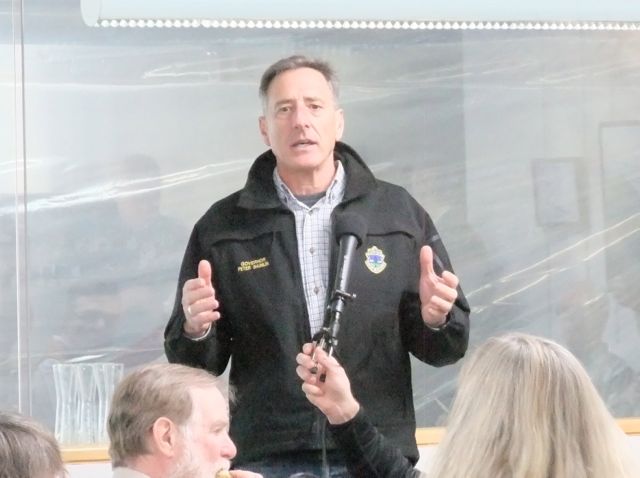
Stringfellow Hawke explains it all. (As the hand of VPR's Peter Hirschfeld gamely tries to keep a microphone within range.)

Stringfellow Hawke explains it all. (As the hand of VPR’s Peter Hirschfeld gamely tries to keep a microphone within range.)

The $100 million shortfall in next year’s budget, he said, is real. We’ve used up the federal recovery money and the one-time funds to balance past budgets. Now, “we’ve got to make tough choices.” We’ve got to bring down growth in state spending to match that seemingly endless 3% growth rate. Thus, he said, “anyone asking for more money had better think twice.”

He made a progressive plaint about the growing income gap between the very rich and the rest of us. He did not, however, connect the dots between that phenomenon and Vermont’s underperforming income tax revenues.

And he certainly did not connect the dots to a quirk in our current tax system that has an official top tax rate of 8.95%, which seems quite high — but the rate that top earners actually pay is not 8.95%, but 5.2%. Furthermore, if you add up all state and local taxes, it turns out that the top 20% pay a lower share of their income than the other 80%, and the top 1% pay the lowest share of them all. (Figures from the Institute for Taxation and Economic Policy.)

When I connect those dots, I think we ought to resurrect a bill that almost passed the House two years ago. It would have shifted more of the tax burden upward, and given modest tax cuts to middle and lower-tier working Vermonters. That bill died a sudden death because of Shumlin’s steadfast opposition.

So when he starts talking about income inequality, he needs to talk about our tax policy as well. Because these days, that’s where the money is. And our top earners are doing extremely well, thank you very much. They can pay their share.

Shumlin also rolled out his school funding argument: Our schools would perform better for less money if there was some kind of consolidation. Because studies show that very small class sizes are just as harmful to achievement as very large class sizes. So we’ve got to embiggen our schools, not to save money (although we would), but for the sake of the children.

Awww.

Surprisingly, there was no mention of single payer health care — or the slightly watered-down “universal health care” — except for a brief mention, in his Cavalcade of Calamities, of unacceptably fast-rising health care costs.

Okay, some realities of my own. I accept the notion that slow growth means an extremely tight state budget, and that we cannot tax our way out of it. We should tweak the tax system to make it more equitable, but that’s not going to bring in much money. We’ll need to make government more efficient if we want to preserve the level of services we’ve come to expect.

I believe that the number-one thing Governor Shumlin needs to do to restore his standing with voters is to re-establish his reputation for good governance. The policies, and I say this as a devout liberal with strong policy positions, are kind of secondary.

Shumlin gained a strong managerial reputation during the Irene recovery. He pretty much blew it in his second term, with the continuing difficulties of Vermont Health Connect, the problems in the Agency of Human Services, and all the budget shortfalls. If he can make state government work effectively, he’ll win back a lot of voters.

And this will be his biggest administrative challenge, not Irene. Authentic crises are difficult, but they get the adrenalin flowing, and everybody puts aside their differences and pitches in. Maintaining the day-to-day operation of a big bureaucracy is harder. It’s an unending slog. It challenges established procedures, and if there’s one thing we Vermonters love, it’s doing things the way we’ve always done them.

As a liberal, I expect to be disappointed repeatedly by Shumlin in the next two years. Clearly, between the realities of the fiscal situation and his own political instincts, there’s going to be a lot of governing from the center. Or even center-right. But if he can govern effectively… if he can actually create new efficiencies, saving money while maintaining services… he will restore his political reputation.

Is he up to that challenge? Two years ago I would have said a resounding “Yes.” Now, I’m not so sure. Flight jacket notwithstanding.

Plus c’est la même chose, plus c’est la même chose

If you’d been harboring any faint hopes for change in the State Senate leadership, you were quite reliably disappointed by Saturday’s Democratic caucus.

With only the tiniest hint of dissent, the status quo was maintained in Our Most Stagnant Deliberative Body. John Campbell? Yep, President Pro Tem again, along with Phil Baruth as majority leader, Claire Ayer as whip, and… the earth would tremble and the skies would be rent asunder if they failed to re-elect Dick Mazza as “third member” on the organizationally influential Committee on Committees, where he will rejoin the Phil Scott Fan Club with Campbell and Scott himself.

Maybe someday there’ll be a real Democrat on that panel.

Seven Days’ Paul Heintz, ever the pot-stirrer, introduced me to Mazza before the caucus convened. And the Eternal Member gave me a hearty greeting, making it clear that he knew what I’ve written about him and that it didn’t make a damn bit of difference. Baseball players used to refer to beat reporters as “flies,” and that’s how Mazza sees me: a fly buzzing around his shit. Didn’t even bother to flick me away.

So the fix was in. There were no competing nominees for any of the four posts, and there was only the slightest bit of dissent: Anthony Pollina voted “no” for Campbell and Mazza without explanation. Afterward, he spoke to Heintz:

“I would like to see the ability for more people to be involved in leadership, quite frankly, and I think that it would be more healthy for the caucus to have some conversation about who’s going to be the leader, and we don’t seem to have that conversation.”

Yeah, we certainly don’t. The organizational meeting was a hearty session of hands-around-the-campfire, we’re-all-friends-here. Any ill feelings were kept resolutely in check. In fact, there was one moment of unintentional gallows humor, when a senator who I didn’t recognize* nominated Mazza for “third member” by praising the past work of the Committee on Committees; he said that everyone had been happy with the committee assignments made by the CoC.

*Subsequently ID’d as Tim Ashe, putative Prog/Dem and studious ass-kisser to the Senate power structure. Gah. 

Somehow, Ginny Lyons and Ann Cummings didn’t scoff loudly. Both veteran lawmakers were screwed out of committee chairmanships by the CoC last time around. Lyons was replaced on Natural Resources by climate change skeptic Bob Hartwell, and Cummings was removed from Finance, presumably because she had the temerity to stage a brief challenge to Campbell’s leadership in 2012.

The CoC’s smackdown had its intended effect, as no one rose to challenge the same-old, same-old. The Three Kings will soon return to their secret undisclosed location to dole out the committee goodies. We’ll see if they behave themselves this time — but only after the fact, since Campbell has declared that the CoC is not subject to open meetings law. Paul Heintz, last February:

When Seven Days happened upon its three members — Lt. Gov Phil Scott, Senate President Pro Tem John Campbell (D-Windsor) and Sen. Dick Mazza (D-Grand Isle) — convening to discuss the matter last Thursday in Scott’s Statehouse office, Campbell declared, “It’s not a public meeting.”

“My understanding,” he elaborated, “is it’s a private, deliberative meeting of one of the committees of the Senate and therefore, you know, not open to the public.”

“So committees can just close the doors when they’re deliberating?” Seven Days asked.

“I believe this one, yeah,” Campbell said. “My opinion is that.”

Following that dismal exchange, the CoC held a closed-door confab with Senate Secretary John Bloomer and chief legislative counsel Luke Martland, who then produced a convenient bit of legal mumbo-jumbo to cover Campbell’s backside. When asked why Senate rules, which strictly limit closed committee meetings, don’t apply to the CoC, this laughable exchange took place:

Said Bloomer, “This, in my opinion, doesn’t apply because these are standing committees. The Committee on Committees has no function to take evidence.”

Added Campbell, “The Committee on Committees is totally different. It’s kind of a misnomer using that name, ‘committee.’”

The Committee on Committees isn’t a committee, eh?

Pardon me if I feel completely justified in my cynicism about the CoC.

Let me somewhat belatedly make clear that I have no beef with Ayer or Baruth, aside from their willingness to be part of a leadership team with an inconsistent record for upholding the principles (and candidates) of the Democratic Party. Baruth offered a tepid explanation for the lack of change, telling me that it was going to be a difficult session, so continuity of leadership would be a positive.

“We can’t change captains now,” said the First Mate. “The Exxon Valdez is in trouble.”

Campbell introduced his new aide, former Shumlin Administration functionary Erica Wolffing, fresh off her gig at the Democratic Governors Association.  And he made brief reference to his poor performance as Pro Tem in 2011, which led to Cummings’ challenge and the hiring of Rebecca Ramos as his top aide/nanny. Wolffing will now fill that role, helping him lift that big heavy gavel, and she’ll probably be very good. She’s likely to keep communication lines open between Campbell and the administration, and help keep things running smoothly in the Senate chamber.

After his re-election, Campbell gave a short speech laying out the top four priorities for the coming session, which he said would be “one of the most difficult bienniums in decades.” Which, he added, means “there’s a chance the work we do will be historic.”

Mm. The Hindenburg was historic.

Three of Campbell’s Big Four priorities were predictable:

— Health care. Trying to overcome his past public skepticism about single payer, he promised a full and open consideration of Shumlin’s plan. “We have an obligation to the administration to hear what they have to say, and to the public to deal with the rising cost of health care.”

There’s also that social-justice part of it, but Campbell didn’t mention that.

— The budget. He said the likely $100 million deficit was “not pie in the sky,” and lawmakers will have to look closely at revenues and state functions, prioritize services, and look for efficiencies and duplications. By funding too many “good ideas,” he said, “we’ve spread ourselves very thin.” He called for a tight focus on “what is our obligation to business and to citizens,” as opposed to what we’d like to do. (Yes, he said “business” first.)

In short, No New Taxes. And don’t expect any new money for anything.

— Education funding and governance. “We will have to look at what we need to educate our kids, and what we don’t.”

The fourth priority was a bit surprising:

— Lake Champlain, which he first called an “economic driver” and then called it “iconic.” Priorities.  “It’s not just because the EPA has said we must act; we have an obligation.” What that means remains to be seen, with all the talk of cutting government and focusing on the essentials and no new spending. It was nice to hear Campbell put Champlain at the top of the list, but I suspect we’re not going to get much more than lip service or possibly tokenism.

It’s looking like a dispiriting biennium for liberals. The Senate remains safely in the death grip of The Usual Suspects, now armed with what they see as an electoral mandate to cut and cut and cut. Shumlin himself, in remarks to the House and Senate caucuses, made it clear that his response to his near-defeat will be a predictable tack to the center. (More on that in an upcoming post.)

And so we beat on, boats against the current and all that.
A slight but perceptible bend in the glass ceiling

The House and Senate Democrats will caucus tomorrow (Saturday) in Montpelier to choose their nominees for leadership positions. It’s been radio silence on the Senate side, which I take as a bad sign, but some news has come out of the House.

And for gender equity fans, the news is good.

As you may recall, Vermont does very well on gender equity in the House, less well in the Senate, and very poorly in statewide elective office and Congressional seats. Like, for instance, we’ve never sent a woman to Congress. Which is, well, shameful.

Back to the House, where Shap Smith will return as Speaker; but the new House Majority Leader, according to Seven Days’ Paul Heintz, will be Sarah Copeland Hanzas of Bradford. What’s even better for equity’s sake is that the other candidate for the post was also female: Kesha Ram of Burlington. Having two women in line for the House’s number-2 slot is a very good sign.

Ram dropped out, per Heintz, citing the need for geographic balance. She will apparently fill a new post, “caucus election chair,” which is being created to sharpen Democratic messaging and lend a hand to House candidates.

Those developments, plus Kate Webb returning as Whip, mean that women will be heavily represented on the House leadership team. And whenever Shap gets tired of herding cats, the next Speaker may well be a woman.

Over in the Old Farts’ Club, er, I mean the Senate, I’m not feeling the gender-equity love. I’d be very happy to be proven wrong, but I’m expecting the leadership in Vermont’s Most Stagnant Deliberative Body to remain pretty much the same.

I love my little gavel, but this job is sooooo hard.

I love my little gavel, but this job is sooooo hard.

By all accounts, John Campbell will keep the job as President Pro Tem in spite of the fact that he isn’t very effective unless he has a nanny to keep him in line. After the disastrous 2012 session, he hired Rebecca Ramos as his chief of staff, and things improved. She’s now a lobbyist, and according (again) to Paul Heintz, Erika Wolffing will take the job.

Wolffing was a Shumlin administration fixture who went to the Democratic Governors Association when Shumlin became its chair. Now that Shumlin is out at the DGA, Wolffling will reportedly become the hand that rocks Campbell’s cradle.

Which leaves me wondering why we let him hang around when he (a) apparently can’t handle the job without a lot of help and (b) openly supported Republican Phil Scott and seized every opportunity to shit on Dean Corren. But maybe that’s just me.

I’m sure the status quo will remain in the Phil Scott Fan Club, er, I mean, the Committee on Committees, the body that makes all the committee assignments. Phil Scott himself is a member by law, as is Campbell. The third, elected by the full Senate, is, was, and ever shall be Dick Mazza, a putative Democrat who was extremely vociferous in his support for Phil Scott.

Which leaves me wondering why, when the Dems have a nearly 2-1 majority, we have to settle for nominal Democrats on that very powerful committee.

The Democratic caucus will see some change with the none-too-soon departures of Bob Hartwell and Peter Galbraith, but I’d be surprised to see much happen with the leadership. It’d be nice, but I ain’t holding my breath.

Finally, for those who think I’m too mean to Mr. Campbell, here’s a little tidbit from last March. Campbell had stuck his foot in his mouth by openly doubting the prospects for single payer health care and talking about pursuing some alternative plan. (Bear in mind that Shumlin was still riding high at that point.) This reportedly enraged the governor. And a few days later, Campbell appeared on WDEV”s Mark Johnson Show and tried to walk back his earlier statement.

It was a complete fiasco. At one point Johnson asked him this question: “You dropped something of a bombshell this week that you want to start pursuing an alternative to the Shumlin health care plan. Why?”

And here, really and truly, was his answer in all its obfuscatory glory.

First of all, I guess it’s a question of how you define what my “bombshell” is. I think some people have taken it to mean what they really, what they want to hear from what I said. And basically, my, uh, my position is this, is that we are headed right now as far as the Legislature, we are going to be focusing on making sure that we have a publicly-financed, universal access to health care in this state, and that’s known as Green Mountain Care. As far as I’m concerned, I consider it Green Mountain Care, it’s a universal access program. Um, um, I charged my, in fact we spoke about it here on this program at the beginning, I think at the beginning of the session, how I had asked all of my committees with jurisdiction to start doing their due diligence under Act 48, which was the, back in 2011, which actually started Green Mountain Care or our, ah, our, ah, move to that.  And so what I did was, I asked each one of the committees that would have jurisdiction, which were five of those committees, and they were to um look and see what exactly is in Act 48 and can we actually achieve what our goal is?

And if they found things that um, through their, uh, their research and through taking testimony, that could either change this into a direction and put us in a direction that we were going to uh have this Green Mountain Care would be sustainable, then I wanted to hear about it and I thought that’s really what the Senate is doing now. So uh the fact of the matter, uh, I believe there was a statement was, um, regarding the funding, and whether or not I believed that, I think I said that, uh, the $2.2 billion dollar package that’s been put on there right now, I said I do not think that that was sustainable or viable in this, uh, current legislative — uh, Legislature. And I stand by that.

And what it, what I’m talking about in that, and people always take that $2.2 billion dollar figure, and they believe that that’s all new money. And it’s not new money. What it is is partially savings that would be found, uh, by way of not having the premiums, um, by cost savings, and so I stand by the fact is that once we find out what this financing package is, which would also first identify what the product is gonna be, um, if we do not have sufficient — if that money, um, is new money, then there’s gonna be a problem. But if we show, and we’re able to demonstrate that the money in that $2.2 billion is currently already in the system, and that Vermonters are already paying, uh, and on top of that, that we find those costs for any new money that’s — cost savings for any new money that’s coming in, then we’re, we have, I think, ahh, what we envision, all of us envision, that is to make sure that every Vermonter has full access, or access to. uh, uh, to great health care here in the state.

Good God almighty. What a statesman.

Rob Roper’s Machiavellian fantasy

Oh, the Robster spun a tale, he did.

In a brief commentary on the Ethan Allen Institute’s occasionally-good-for-a-laugh website, Roper laid out a cunning plan to land Scott Milne in the corner office.

"I have a cunning plan," whispers Baldrick.

“I have a cunning plan,” whispers Baldrick.

Fasten your seat belts, it’s gonna be a bumpy ride.

First postulate: Gov. Shumlin’s “single payer healthcare system has been a disaster for Democrats,” which is quite a trick considering his system doesn’t exist yet. What he means is that initial reaction to a possible financing plan has been, as expected, a mixed bag, and that the Democrats lost seats in the Legislature due, so says the Robster, to disillusionment with health care reform.

Which sets the stage, so says the Robster, for Republican momentum leading into 2016. Further GOP gains and maybe a Republican governor.

But, he says, the Dems have a way out: Elect Scott Milne as governor.

That way, they rid themselves of Shumlin and single payer, and have a handy scapegoat for the death of single payer and anything else that goes wrong in the next two years. And since Milne would enter office as a political neophyte who hasn’t made any plans for an administration or a budget, the Legislature could walk all over him.

Quite a temptation for the Speaker (who many think is eyeing a run for governor in 2016 anyway, and this would clear an easier path) and the Senate President Pro Tem as well as the committee chairs.

A Milne governorship, if he does not rise to the occasion, could kill Republican momentum.

Roper finds a shred of “evidence” in support of his fantasy in the fact that “Democrats have not come out in full-throated support for Shumiln in the upcoming legislative vote.”

Well, there’s a much simpler explanation for that: the Democrats know the legislative vote is going to be over and done with very quickly, and there’s no need for them to “campaign” against Milne, who is certain to lose.

I realize that the Robster has to provide regular content to justify his salary at the EAI, but this is… well, it’s the kind of stuff I’d expect to hear from Baldrick.