
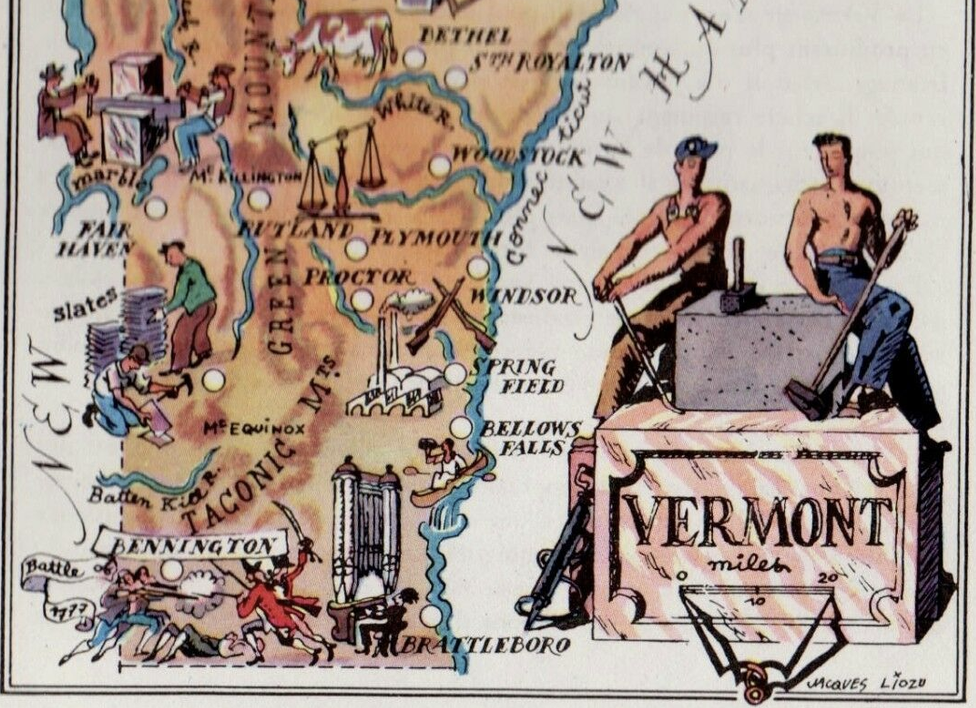
No, not THAT map. Although it’s fascinating in its own way; it seems that Vermont has been gay-friendly for a very long time. Ooh, strapping young men with powerful (ahem) tools!
But I digress, and right off the top too. I’m referring to a map prepared by VTDigger’s ace data reporter Erin Petenko which I dare not reproduce for copyright reasons. You’ll have to check it out in situ. Scroll down far enough in Digger’s recap of Amanda Janoo’s primary victory and you’ll see it.
The map shows how each Vermont city and town voted in the Democratic gubernatorial primary. You can see at a glance which candidate won where. (If you run your cursor over a town, the map shows you the winner’s name and their percentage of the vote. Also, for real nerds, the caption includes a link to the Secretary of State’s Excel spreadsheet containing all the results town-by-town.)
And the map is kind of a muddle with some really interesting features.
The first thing I noticed, because of my membership on the board of The Hardwick Gazette, is that Janoo did extremely well in The Gazette’s home turf. She took 72% of the vote in Greensboro, 68% in Hardwick, 67% in Stannard, 66% in Woodbury, 65% in Craftsbury, and 60% in Walden. She also did very well in nearby communities like Elmore, Barton, and Glover, hometown and legal nemesis of Lt. Gov. John Rodgers.
Indeed, Janoo scored well across a great swath of northern Vermont from Franklin County through Lamoille and Orleans and into the Northeast Kingdom. Just south of that you find a thinner band of Aly Richards strongpoints, from the Burlington suburbs through the Barre-Montpelier area and on to the upper Connecticut River Valley. And south of that is another Janoo band in Addison, Orange, and Windsor counties. Southern Vermont is a mixed bag, with Janoo scoring well in the southeast and south central, and getting a pocket of support along the New York border in places like Middletown Springs, Wells, and Pawlet. Richards dominated the rest of the southern tier below a line from Orwell to Norwich.
See what I mean? Make sense of that, will you?
It seems to indicate that the progressive, reform-minded Janoo found quite a bit of support in parts of rural Vermont that are supposedly lost to the Democratic Party. Republicans scored big wins in 2024 in many areas that went for Janoo over Richards on Tuesday. Could there possibly be an appetite for structural reform in the boonies? Is there a chance that a candidate with new ideas can appeal to folks who feel abandoned by Vermont politics?
Might it actually be that rural residents, who’ve seen neighbors’ homes bought up by affluent absentees, perceive a benefit in imposing new taxes on second homes and high earners? A lot of rural Vermonters are Bernie Sanders fans; maybe they’re becoming Amanda Janoo fans as well.
I’m speculating, of course, and many factors could be at play. But this map sure runs counter to received political wisdom — that liberalism is a big turnoff for rural voters, and the left can’t possibly do well outside of relatively populated places like Burlington, Winooski, Barre/Montpelier, the Upper Valley area, and Brattleboro. As it happened, Janoo did well in The Noosk, the UV and Brattleboro, but she lost Montpelier and managed only tiny majorities in Barre and Burlington.
She took 52% of the Queen City vote, which ought to have been a severe disappointment and a crushing blow. But it wasn’t because she pulled higher percentages in places like Hardwick, Glover, Waterville, Fairfax, Huntington, Starksboro, Bristol, Lincoln, Orwell, Rockingham, Readsboro, and Guilford. Just to name a few.
Some of those are rural pockets of progressive politics like Putney and Greensboro, but not all of ’em. To me, this primary map indicates that more of Vermont is potentially in play than conventional wisdom would suggest. It may not be as simple as Phil Scott’s dismissal of our larger communities as fatally out of touch. There might be something happening out there in the woods, and Amanda Janoo might be tapping into an unexpected source of strength. You may have your own interpretation of this map, but now you know what I see.


Back in 2008 during Anthony Pollina’s second gubernatorial as a Vermont Progressive Party candidate, a really fun thing happened – the Progressive out-polled the Democratic candidate, Gaye Symington. It was barely, but it was still out polled.
After that election cycle the Progressives decided they had to run as ProgDems or DemProgs or whatever they called themselves whenever it came to statewide office or Senate seats.
The immediate result of this label changing was the Progressives losing Vermont legislative seats outside of Burlington and hanging on to what they had inside the Queen City.
The really interesting thing to me was that the Progressive Party had picked up two very rural northern Vermont House seats prior to that. These seats came about because of a very short term aggressive push by the Progs to show they can win and lead.
I bring this up because what you see today is not the first time what we think of as conservative Vermont sat down with progressive (small P) politics and said “Yup!” Don’t thin that’s true? See Bernie Sanders for more evidence.
So I’m not surprised by the map you’re working with. Small ‘P’ progressive politics plays extremely well across the board, and progressive politics gets tons of local support when used to work though local issues.
Anyway – there’s a history behind those numbers.
This video by Morgan Gold has an analysis that seems possible. It makes sense that income could be a factor.
I love primary maps. They are more of an indication of what people are thinking. But I don’t understand your inferences here because the votes for Janoo (or for Richards) are Dem voters. In other words, because those right leaning areas went for Janoo, just means that she appeals to the Dems there, and we’d have to look at those numbers historically to see if this is a change, right?
The map, and my thoughts about it, are not the be-all and end-all. I did include a caveat: “I’m speculating, of course, and many factors could be at play.” In the absence of exit polls, it’d require a deep data analysis to try to tease out other factors. (Like, for instance, Vermont Daily Chronicle speculated that Republican voters might have voted for Janoo in the open primary because they thought she’d be the weaker general election candidate. That’s a common theme of lazy election analysis, but there’s no evidence that it ever happens in significant numbers.) And I don’t have the expertise to do a real deep dive. Maybe someone at the VDP or in the Janoo camp is doing that very thing right now.
Here in Addison County, methinks Janoo is at least partially riding the backlash against dog lover Steven Heffernan. Folks are so horrified he’s been our senator that they’re going to enthusiastically cast votes for his polar opposite.