Monthly Archives: March 2015

An obvious conflict of interest in the House

In January of last year, the supposedly nonpartisan Campaign for Vermont raised a stink about conflict of interest in the Vermont House. Specifically, it accused then-Rep. Mike McCarthy of same.

Then-CFV spokesflack Shawn Shouldice noted that McCarthy, an employee of SunCommon, had voted for a net-metering bill in the House… a bill that stood to benefit his employer. Shouldice accused McCarthy of breaking House rules by voting on the bill.

Fast forward to today, when the House approved a massive energy bill going under the name RESET. One provision was struck from the bill; it would have boosted funding for Efficiency Vermont. The charge to strike that provision was led by Independent Rep. Adam Greshin. All of this is chronicled very nicely by VPR’s Peter Hirschfeld. Except for one small fact:

Adam Greshin, looking suspiciously Photoshoppy.

Adam Greshin, looking suspiciously Photoshoppy.

Greshin is co-owner of the Sugarbush ski resort. Two more facts:

The ski industry is a voracious consumer of electricity.

Efficiency Vermont is funded by ratepayers, with rates approved by the Public Service Board.

Do I need to connect those dots?

The Efficiency Vermont cut would reduce utility rates; Greshin’s business would directly benefit. Not only did he vote for the measure, as in McCarthy’s case; he spearheaded it. He pushed strongly for it as a member of the House Ways and Means Committee, where his arguments carried the day.

In the interest of nonpartisanship, I ask Campaign for Vermont to raise the same kind of stink about Greshin that they did about McCarthy. Also, is to too much to ask our media to report obvious connections when a lawmaker sponsors legislation that would benefit his/her own interests?

Big Beverage can afford the very best hired guns

Almost two weeks ago (Feb. 26, to be precise), the House Health Care Committee held a hearing on the health impacts of sugar-sweetened beverages. There was an interesting name on the guest list: Lisa Katic, registered dietician.

Registered dietician speaking on behalf of the American Beverage Association, the trade group that includes Coke, Pepsi, and other mass-market sugar peddlers.

Seems like an odd juxtaposition: a professional dietician talking up sugary beverages.

Sold my soul for a Beltway consultancy.

Sold my soul for a Beltway consultancy.

Which led me to take a closer look at Lisa Katic. Basically, she’s the #1 dietician-for-pay for the food industry. She has her own DC-based consultancy firm, and her clients include the American Beverage Association, the Snack Food Association, and the Grocery Manufacturers Association.

Before she hung out her own shingle, she was on staff at some of the largest Big Food interest groups in the country. In short, she’s made a very lucrative career out of selling her professional credential to the highest bidders.

Further down the page, I’ll tell you about a fascinating talk she gave in 2009 before an industry group. But first, her testimony to our humble legislative committee, delivered by speakerphone.

Her carefully curated pitch: Obesity and diabetes need to be addressed, but taxing a single class of food will do nothing to prevent the twin scourges of the American way of eating. Which ignores a growing body of evidence that beverage taxes do, indeed, have a pronounced and immediate impact on consumption. See, for example, the first year’s returns from a beverage tax imposed in early 2014 by the Mexican government. (Katic brushed off a question about Mexico’s experience, claiming not to have “seen specific data.”)

Not to mention the obvious effects of tobacco taxes: price goes up, consumption goes down. It’s a pretty clear and direct link.

Her next pitch: Sugar-sweetened beverages are one small part of the problem, accounting for “only six percent of the calories in our diet.” Which may be true, but I’ll bet you dollars to (ahem) donuts that sugary drinks would figure much more prominently in the diets of our overweight population.

Katic also parroted the party line in saying that the real problem is the “severe imbalance between calories consumed and physical activity.” This is straight out of Big Beverage’s PR strategy. See its “Mixify” campaign, which touts a balanced approach to life including the occasional shot of sugary drinks. And which is full of buzzwords aimed at millennials: “the deets,” “#Realtalk,” “emoji,” “that bod of yours,” Mixify is your “balance wingman.”

Her point is true, but she undercuts her own argument by saying that a modest reduction in calorie intake, plus more activity, can make for a healthy lifestyle. For sure. But the flip side is that cutting out the soft drinks would have a modest effect per day and a massive impact over time.

Immediately following Katic’s testimony, the committee heard from Kelly Brownell, one of the nation’s leading experts on the subject, a former Yale prof who’s now a dean at Duke University. He hadn’t heard Katic, but he pretty much knocked her “facts” into the nearest trash bin. He pointed to “very strong scientific evidence tying added sugars to obesity and diabetes.” He said a beverage tax “makes all the sense in the world,” because “the largest percentage of added sugar comes from sugar-sweetened beverages.”

In other words, it might be only six percent, but that’s a huge part of the problem and a very simple fix.

Brownell also testified about research indicating that sugar may have the same effect on the brain as “traditional substances of abuse,” triggering increased tolerance and need for sugar, plus withdrawal symptoms.

And he cited economic projections showing that an increase in beverage prices would, indeed, reduce consumption.

And now, let’s close the Katic/Brownell circle.

In 2009, Lisa Katic gave a talk to the National Institute of Animal Agriculture, a subset of Big Agriculture. She was there to provide an overview — a sort of “know your enemy” briefing — of the top activists opposing the interests of Big Food. (Audio of her talk can be found on Swinecast, an appropriately named podcast service of the pork industry.)

One of her targets was Kelly Brownell. She said he’d been “instrumental… in drawing parallels between the food industry and the tobacco industry” in their response to rising health concerns. Deny, delay, and deflect, basically.

In discussing Brownell, Katic told her Big Ag audience that “there are people who want nothing more than to line up CEOs of food companies or commodity groups and haul them in front of Congress and be able to grill them like they did with the tobacco companies.” And, she concluded, “Kelly Brownell is one of those people.”

Which, in her mind, is a bad thing. You can draw your own conclusions.

Katic’s other targets included Marion Nestle, Michael Pollan, Alice Waters, and Eric Schlosser. She lamented the fact that Schlosser’s book “Fast Food Nation” is required reading in some college courses, “which is a problem.” In discussing Waters, she mispronounced the name of Waters’ groundbreaking restaurant — “Chez Panay.” And she even slammed the American Dietetic Association; of one of its subgroups, she said, “They’re not always talking about sound science.”

Katic’s definition of “sound science” is analogous to that of climate-change deniers. Nothing that threatens her clients’ interests is absolutely proven, the real problem lies elsewhere. She’s smart enough to acknowledge problems with the American diet, but she’s bought and paid for enough to try to deflect attention elsewhere.

When Katic testified before the Health Care Committee, she was billed as a representative of the American Beverage Association. But committee members seemed unaware of the depth of her ties to Big Food, or her career-long track record of defending the interests of her paymasters. She is a very well compensated mouthpiece for Big Food, Big Beverage, Big Snack, and Big Agriculture, and her testimony should be evaluated in that light.


McDonald’s tries to kill kale

Any kale with that?

Any kale with that?

Sad to say, but it looks like Vermont’s favorite vegetable may have jumped the shark.

McDonald’s will debut kale as an ingredient in the not-too distant future as the fast-food giant continues its efforts to adapt to changing consumer preferences, according to a recent note from Janney Capital Markets.

“Possibilities include kale for use in salads, or perhaps a kale smoothie,” wrote Janney analysts in a note to clients. “More generally, McDonald’s clearly aims to raise consumers’ perception of the quality of its food. Adding kale to the menu in some way could help be a step in this direction.”

See, Mickey D’s has a problem. More and more Americans are realizing its food is shit, so they need “to raise customers’ perception of the quality of its food.”

Please note: not necessarily the actual quality… just our perception of it. And McDonald’s has no idea what to do with kale; it just wants to do something.

Kale, thanks to Bo Muller-Moore and foodies everywhere, is a powerful image shaper. Sure, it’s nutritious and all that; but its most potent effect is on “customers’ perception.” You wouldn’t get the same bang for your buck from chard or arugula or collards.

One franchisee’s director of operations said adding kale was a good move for McDonald’s, which continues to battle negative trends domestically.

“We’re here to give what our customers want,” he said. “If that’s what our customers want, we’ll give it to them.”

I guess they’ve finally gotten sick of mystery meat. Maybe this kale stuff will help.

Dr. Dean dips toe into Beltway cesspool

Oh boy, oh boy, it’s a Tweetfight!

In this corner, former Vermont Governor and DNC chair Howard Dean!

In that corner, Ron Fournier, senior political columnist for the National Journal and longtime bete noire of liberal politicos. At the NJ and previously for the Associated Press, Fournier’s coverage has been notably harsh on Democrats and relatively soft on Republicans.

So, of course, a potential Hillary Clinton candidacy puts her firmly in the crosshairs. Fournier’s latest hack job: a gossipy, fact-free piece floating rumors that Hillary’s email practices may have been related to Clinton Foundation fundraising. Specifically, that she might have been using her pull as Secretary of State to induce fat contributions from foreign governments and potentates.

Fournier comes right out and says there is “no evidence of wrongdoing,” but that doesn’t stop him from filling his column with the kinds of leading questions you usually expect from Fox News or Darrell Issa:

Is the foundation clean? Is it corrupt? Or is the truth in the muddy middle, where we so often find the Clintons? … Without those emails, we may never be able to follow the money. Could that be why she hasn’t coughed up the server?

He even makes it clear he has a personal beef with the Clintons and what he calls “their entitlement, outsized victimization, and an aggravating belief in the ends justifying the means.”

Hmm, yeah, that sounds like a journalist to me.

Fournier, being a multi-platform content provider, dutifully Tweeted about his “scoop.”

This is where the good Dr. Dean stepped into Fournier’s cesspool.

Fournier’s self-satisfied response:

Now there’s Washington schmoozing at its grossest: “I’m right, you’re wrong, but hey, let’s do lunch! Have your people call my people.” Dean tries to pin him down:

Fournier, being a veteran of the Beltway game, is having none of it.

Good God, what a slimeball. If Fournier’s column is notable for anything, it’s for the complete lack of facts. It’s nothing but rumor and characters assassination. And he has the gall to top it off with “Be well.” I’m feeling the need for a shower. Dean’s redirect:

To which Fournier can offer nothing but a hasty exit:

“Gotta run,” indeed. Can’t stay and let himself be pinned down, can he? Dean closes with a dollop of sarcasm.

The two protagonists return to their respective corners.

Props to Dean for a noble effort. But Fournier has been a slime merchant for far too long to waste much time on a mere former governor, Presidential front-runner and major-party chair. Ron Fournier has bigger fish to fry, and a whole lot of grease to fry ’em in.

Why it’s important to proofread your press releases

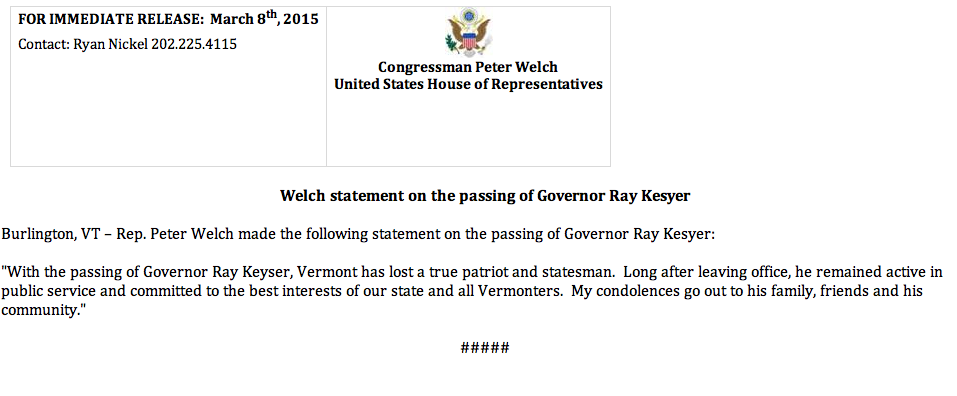
Vermont has lost one of its former governors. F. Ray Keyser, Jr., died yesterday. He served one term in the early 60s, and is most remembered for the end of his tenure. He lost his bid for re-election to Phil Hoff, the first Democrat to win the governorship since the founding of the Republican Party.

Standard operating procedure for politicians, when one of their own shuffles off this mortal coil, is the issuance of a press release. Congressman Peter Welch dutifully did so. Unfortunately, this being a weekend, the staff failed to give their full attention to the formality.

The result?

Welch.Keyser

Ehh, Keyser, Kesyer, whatevs.


Shap the Triangulator

“It’s probably better to have him inside the tent pissing out, than outside the tent pissing in.” 

                      –Lyndon B. Johnson

ICYMI, House Speaker Shap Smith has done something a bit unusual on two key issues, education funding and economic development. He solicited public input, and created special brainstorming committees to evaluate ideas.

Let's… Make… a Deal!

Let’s… Make… a Deal!

The existence of these committees is interesting enough; it smacks of a legislative leader angling for the bigger stage. This process amounts to an informal, back-office policy shop, and gives Smith  a very central role in crafting policy instead of, say, waiting for Governor Shumlin to initiate. His work with the committees also can’t help but endear him to some pretty prominent people.

More evidence of ambition can be found the makeup of the two groups. The education panel included ten current and former lawmakers: Democrats, Republicans, and independents. Good for building nonpartisan street cred.

The economy group included many of The Great And Good of Vermont’s business community, including Betsy Bishop of the Vermont Chamber of Commerce, Tom Torti of the Lake Champlain Regional Chamber of Commerce, and (Lord help us) Bruce Lisman of Campaign for Vermont Prosperity. The chair, Paul Ralston, is a former Democratic legislator who alienated many of his caucus mates during his single term*, and ended by partnering with Republican Rep. Heidi Scheuermann in Vision to Action Vermont, a PAC that’s just about as nonpartisan as Campaign for Vermont.

*I’ve heard him described as a junior-grade version of Peter Galbraith for his self-centered ways. Love his coffee, though.  

The group also includes a healthy share of relatively progressive businessfolks, like Andrew Savage of All Earth Renewables, Andrea Cohen of Vermont Businesses for Social Responsibility, and Cairn Cross of FreshTracks Capital. But there was no one from the labor movement, and no one from any progressive or environmental organization.

It smacks of triangulation, the favored strategery of upwardly mobile Democrats and the bane of liberals. And it smacks of building networks of support among the deep-pocketed donor class. Which tends to lead to centrist policymaking, not to mention one of Gov. Shumlin’s favorite pastime, kicking the hippies.

I’m not ready to call Smith a sellout. A recent report on VPR lists some ideas emerging from the job-creation committee, and they actually sound pretty good: identifying ways to unlock capital for small businesses and startups, matching technical-school curricula with the needs of Vermont tech companies. Also, Cross is quoted as saying that Vermont’s business climate has more to do with quality of life and a clean environment than the old bromides of tax breaks and deregulation.

That sounds like a relatively progressive approach to economic development. And truth be told, there’s a need for a strategy that cuts through the standard liberal/business debate — that encourages job growth without abandoning liberal principles.

For instance, there is probably room for — and please don’t shoot me — some modest reform in the permitting process. The very phrase “permit reform” has been uttered by so many Republicans for so many years, it raises immediate hackles in the liberal community. Can we find a way to ease the process for the kinds of enterprise that create good jobs and contribute to our economic vitality without simply greasing the skids for strip malls and subdivisions? We probably can, and maybe — just maybe — Smith is trying to break the usual pattern and find a third way.

I’m willing to wait and see what emerges before passing judgment on the process and on Smith’s motivations.

As for the political question: Is Shap Smith running for governor? I don’t know. And at this point, he probably doesn’t either. But he’s certainly developing relationships and laying the groundwork for a future run, should he decide to do so.

Gannett honors cashiered Free Press writer

Ohh, this is sad, even by Burlington Free Press standards.

Last Friday, the Gannett newspaper chain announced its “Best of Gannett” awards for the company’s best journalism in 2014. Among the big winners were the Arizona Republic, the Des Moines Register, the Palm Beach (CA) Desert Sun, and the Staunton (VA) News Leader.

This being a media awards thing, there were dozens upon dozens of winners. (Journalism awards are kinda like participation ribbons. I speak as a past winner of dozens myself.)

So where, oh where, can the Freeploid be?

Scroll down. Keep scrolling. More. More. Keep going. Further. Go on.

Okay, there. The Free Press’ one and only prize is a Third Place award in the category of “Narrative Writing/Voice,” which aims to honor “powerful and tightly written news and feature stories… and any examples of evocative writing regardless of platform.”

And your winner? Oh, this is embarrassing.

Tim Johnson. 

Yes, the Tim Johnson who was abruptly fired last fall after 16 years on the job.

Gee, somehow the Free Press never bothered to report this great victory. And it’s usually so quick to brag about any honor it wins, no matter how trumped-up.

Here’s a final indignity: The awards come with cash prizes. Unfortunately for Tim, the money goes not to the writers, but to their employers. Or, in Tim’s case, ex-employer.

That’s Gannett for ya, giving the prizes to itself and screwing the talent. *Correction; see second Postscript below.

Postscript. I’ve heard through the grapevine that Johnson learned of his award through this blog. Nobody at the Free Press or Gannett bothered to inform him. That’s not just sad; it’s shameful. Even if the Free Press was going to keep the check, they could have at least given him a certificate or something. 

Post-postscriptA commenter notes that I made a mistake in reading the Gannett press release. The newspapers do pocket the cash for the Public Service awards, but the writing and reporting prizes are supposed to go to the individual staff. Presumably the Free Press will be scheduling a nice presentation ceremony for Johnson. Hahahaha.

Who watches the watcher?

Under our system of government, the legislature enacts laws and the executive implements and enforces them. But what happens when a law targets the state itself, and the state fails to obey the law?

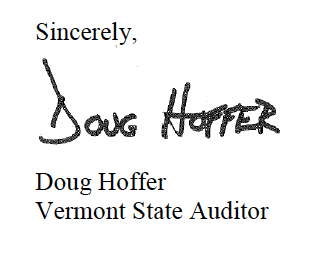
Don't mess with the Hoffer.

Don’t mess with the Hoffer.

This existential question arises from a new report from Auditor Doug Hoffer (who has an appropriately awesome, take-no-prisoners signature) brings us an example of a self-inflicted U.M. It involves Act 40, a bill that became law during Peter Shumlin’s first year in office. Act 40 was a nobly-intentioned piece of legislation that required each state entity to cut its energy consumption by five percent per year.


Great, no? The state leads the way on energy efficiency, providing an example for us all. Except that, according to Hoffer, Act 40 is nothing but an empty shell, its efficacy unknown and unknowable.

A few key findings:

— The state ” had limited information regarding whether, and the extent to which, its focus on reducing energy consumption resulted in reductions consistent with its goals.”

— The state government’s energy plan “failed to establish a systematic mechanism to evaluate progress toward reducing energy consumption.”

— Not all state agencies prepared energy-reduction plans required by the law.

— Key terms in the law were left unclear. For instance, Act 40 called for “right-sizing” state vehicles, but “right-sizing was not defined” and no criteria were established.

— Energy use in leased space was not included in evaluating Act 40 performance. In 2012, leased space accounted for 20% of building space managed by the Department of Buildings and General Services. There’s a big loophole.

And the kicker:

— “State government energy consumption has not been reported since 2011, and the results reported prior to 2011… contained data and formula errors and had methodological flaws…”

Put it all together, and we seem to have a clear picture of administrative failure that undermined a very good piece of legislation.

Buildings and General Services Commissioner Michael Obuchowski acknowledged many failings in his formal response to Hoffer’s audit. He pleaded, surprise surprise, poverty. He says that the state needs an energy management division to implement Act 40 but there’s no money for such an entity. In the meantime, he says, “BGS will continue to provide these services to the best of its ability.”

Judging by past performance, there seems to be an ability gap.

Obuchowski and Hoffer both say that some improvements are already underway. But why did it take an audit to make the state’s energy management system even attempt to follow the law?

If this was a private entity flouting the law, we’d be going after them guns a-blazing. But how do we hold the state to account for ignoring its own statute?

(And, once again, what does this say about the administrative competence of the Shumlin administration?)

A self-selected “champion”?

Now that we’ve caught up with Campaign for Vermont’s effort to co-opt our town clerks, let’s check in with CFV founder and funder Bruce Lisman.

Well, Bruce is doing pretty much what he’s been doing — just on his own platform, the humbly named “brucelismanvt.com.” Same faux-centrist pro-business rhetoric, same slightly constipated looking smile on his face.

Bruce is blogging now, but you can’t just click over and read it; you have to “subscribe.” I’d rather die.

It’s not a paid subscription; all you have to do is provide Lisman with your contact information. Yep, he’s building a mailing list.

Running for Governor? I’ve said it before and I’ll say it again: Bruce Lisman will never be Governor of Vermont. He’s not terribly well known, in spite of his travels around the state; he’s a lousy campaigner and public speaker; and most importantly of all, Phil Scott stands squarely in his path. Scott is a much better advocate of pretty much the same policy ideas. He’s far better known, he’s a more effective speaker and a proven fundraiser, and he has a major party structure behind him.

Lisman is also Tweeting, occasionally. His latest 120-character opus:

Oh, so we need a “champion,” do we? Got someone in mind, Bruce?

Advocacy Group Seeks Public-Sector Proxies

Campaign for Vermont, the Bruce Lisman-funded public policy organization, recently sent out an interesting email blast.

The missive, dated February 25, was sent to all of Vermont’s town clerks; it asked the clerks to use their public standing on behalf of CFV:

As a staple within your community, you have the unique vantage point to facilitate the exchange of ideas. Additionally, because of your role in local government, you have the chance to experience and therefore critique many policies. To this end, Campaign for Vermont (CFV) would like to share the attached economic position paper and our newly released economic indicators report.

Ah, the generosity of these folks, freely sharing the fruits of their labor. And what do they want the clerks to do in return?

…we are excited to have you read our ideas, use your community connections to evaluate the effectiveness and legitimacy of our proposals, as well as provide feedback to Campaign for Vermont. We encourage you to share this document with business leaders in your community.

Oh. Hm. So CFV wants our publicly-elected, publicly-paid clerks to become unpaid shills for its flackery.

I doubt that CFV will get much out of this; most clerks, I imagine, simply trashed the message. As they should; this smells a bit funny to me, asking an officeholder who is supposed to be an objective arbiter of elections to become an advocate. Even if the request comes from a “nonpartisan” group.

I asked Secretary of State Jim Condos for his reaction. “It’s not illegal but it may put a clerk in a difficult position,” he wrote in an email. “It’s not something we would recommend that the clerk do, in the interest of maintaining an appearance of impartiality.” He further suggested that such a request “would be better for selectboard and city council members.”

For all I know, CFV did send the same request to those officials. I happened to receive the clerks’ email.

So, not illegal but unwise. And, it seems to me, just a little bit desperate. CFV is trying to establish broad visibility without Lisman and ease its dependence on the mighty Lisman wallet. Its executive director Cyrus Patten has been busily roaming the halls of the Statehouse, which is good, but it looks like he may have taken a step too far in trying to connect with the general public.