The news of the day: Vermont Public Radio and Vermont Public Television are merging. Let me guess. the combined entity will be called “Vermont Public Media,” amirite?
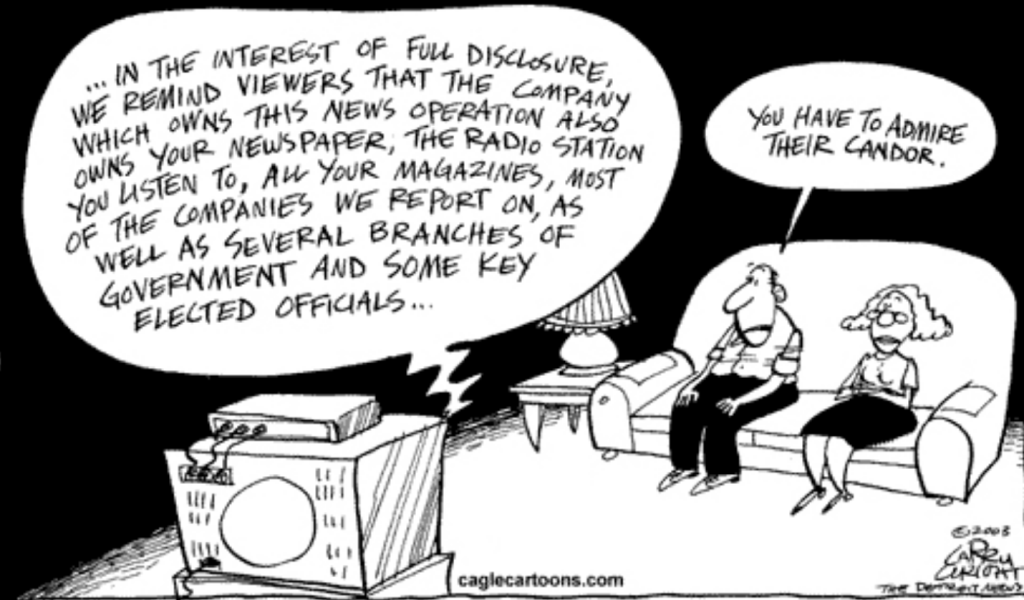
In a time of media consolidation and droopy revenues, this move makes a lot of sense, but it also sets off alarm bells in my mind. The merger means one less independent entity in the Vermont media landscape, and the creation of a player with the resources to dominate the reporting of news — and the nonprofit world.
The latter is not my area of expertise, but I know that VPR has long been seen as a nonprofit monster that makes it harder for other organizations to raise the money they need.
And if you’ve followed my writing about VPR over the years, you know what I think. It’s an organization that does a lot of good work, but falls short in fulfilling its potential and maximizing its use of available resources. Or, in the words of Peter Parker’s Uncle Ben, “With great power comes great responsibility.”
After the merger, you can double that. If there’s any organization that’s played it safer than VPR, it’s VTPBS. I realize it’s harder and costlier to produce video programming than audio, but c’mon, Vermont PBS doesn’t do much to enhance our understanding of our state, ourselves, or current events.
For the new entity to serve us as it must, it’s going to need a significant injection of fearlessness. And generally speaking, the bigger an organization, the more self-protective it becomes.
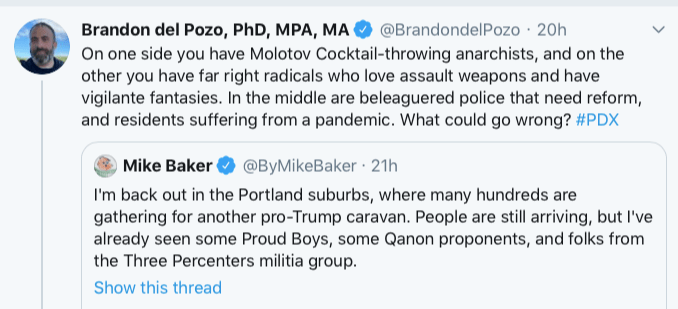
In recent days, we’ve seen defensive protestations from two separate former Burlington police chiefs. The above comes from former chief and now rebranded 21st Century policing expert Brandon del Pozo. The second is in the resignation announcement of Jennifer Morrison, who tied her departure to the too-tough oversight by the busybodies on City Council.
In some ways I can sympathize. Burlington is a tough city for policing, never more so than right now. Progressives on City Council and community advocates often go over the top in their demands and their tactics. And as del Pozo noted in another tweet, many of the top cops who’ve resigned or been forced out across the country are among the more progressive members of that breed. To be sure, life is easier for the George Merkels and Paul Doucettes of the world, who rule the roost in communities that let the cops have their way.
For purposes of this blogpost, I am not questioning the good intentions of del Pozo or Morrison. But here’s the problem: Much like the Roman Catholic Church, the policing profession has forfeited the benefit of the doubt. There are far too many bad apples — and you know the real truth about bad apples is that unless they are removed, they spoil the barrel. In both professions, the bad apples have been allowed to remain.
The vast majority of Catholic priests and, for the sake of argument, top Church administrators operate faithfully, with good intentions. But the bad apples were protected, and the Church continues to pay a price. Who can take the Church seriously as a moral arbiter?
Winning back the lost trust will take several decades of good behavior and strict adherence to moral principles and the law. The same is now true of the policing profession — except they are still racking up fresh deficits.
Today I’ll tell you a tale of how Vermont Democrats owned themselves into a Phil Scott Senatorship.
We pick it up from the present day, when the Dems have clearly waved the white flag on the 2020 gubernatorial race. In fact, many of them believe Scott deserves a third term because of how he’s handled the pandemic.
They are entitled to their opinion. But they may not like the consequences headed their way.
Let’s assume that Scott wins re-election by double digits, further cementing his reputation as a moderate who can win elections in solid blue Vermont — enhancing his unique value to national Republican forces looking to pick off a safe blue Senate seat.
At the same time, Joe Biden wins the presidency and the Democrats take a majority in the U.S. Senate. Biden opens the floodgates of federal assistance for fighting Covid-19 and rebuilding the economy. Pat Leahy becomes chair of Senate Appropriations, where he can make sure Vermont gets a healthy slice of the pie.
This makes Scott’s third term much easier, as he doesn’t have to close massive budget gaps. But he decides against seeking a fourth term in 2022, and departs the scene as a noble figure who steered the Good Ship Vermont through stormy seas.
After the jump: Governor Donovan, Dem disunity, Bernie the retiree, and Senator Phil Scott.
Welp, the air is out of the bouncy house. Sad to say, here we are on September 2, and there’s pretty much nothing in this woebegone Vermont campaign season to speculate about or prognosticate or even stir up the slightest semblance of interest.
That’s my big takeaway from the September 1 campaign finance reports. It’s all over but the whimpering.
Unless something huge happens, none of the statewide races look competitive. There will be, at best, only minor shifts in the makeup of the Legislature. We’ll head into a new biennium full of financial hardships and across-the-board policy challenges — with the same crew that’s given us a whole lot of status quo for the last four years.
Can you feel the excitement?
The two financial disclosures that tell the story weren’t even filed by candidates, or Vermonters. They came from the Vermont-specific political action committees funded by the Republican and Democratic Governors Associations.
The DGA’s “Our Vermont” has yet to lift a finger or spend a dime this year.
The RGA’s “A Stronger Vermont” has spent some $94,000 on a pair of polls, one in February and another in August. Otherwise, they spent a few thousand bucks on a bit of online advertising. Which tells you all you need to know about the results of those surveys: The RGA is so confident that Gov. Phil Scott will win a third term that they aren’t bothering to spend money.
Point of comparison: In the six weeks between Primary Day 2016 and October 1, 2016, the RGA spent $929,000 in support of Scott’s campaign. There was a poll in there, but the vast majority — $664,000 — bought a TV ad blitz that put Dem Sue Minter on the ropes. She never got back into the race. If the RGA saw Zuckerman as a threat, they’d be doing the same thing right now.
Election Day is still two months away, and the dynamics of the race could change. And a meteor could strike the earth. But there is no sign of a game-changing event.
The battle against Black Lives Matter is being massively escalated by the day. We’ve gone from Kyle RIttenhouse straight-up gunning people down, to pimped-out pickup trucks with pepper spray super soakers (and Trump flags) driving through crowds of peaceful protesters. (General Motors must be so proud of that product placement.)
I’m old enough to have witnessed some of the carnage of the 50s and 60s, when civil rights finally came to the Old South — and the South fought back with all its might. And this is same song, new verse, except the deadly force has been privatized. If anyone thought we’d made progress since 1965, or somehow become a post-racial society, explain this.
I can only imagine how any of my Black contemporaries feels about this, seeing those old fuzzy video images come back to life in the starkest possible way.
Being born Black don’t make us any more resilient than anyone else. We ain’t stronger. We ain’t tougher. We’ve just been given more shit to carry. Our kinship with resilience is just us convincing ourselves we can hold that weight, and them justifying how heavy they pack our bags.
This is why Doc Rivers was moved to tears. This is why our best athletes are questioning whether they can go on playing the games they love. They are hurting in a deep and real way that us white folks can’t even imagine. They aren’t volunteering to share their pain, nor should be feel any obligation to do so, because it involves opening the wounds once again. That’s not something you do unless have no choice, because the pain is so great.
The President of the United States is acting like George Wallace, the O.G. segregationist who was willing to foment racial violence for the sake of his political benefit. Donald Trump shows that there are still plenty of white folks racist enough that all they need is a signal. Trump is blowing all the dog whistles as hard as he can, and will keep on doing it until Election Day.
Every day, every dog whistle, every act of racism, will cut to the bone. We can only hope it ends on Election Day with an unambiguous rejection of Trumpism. It’ll be bad enough when, as seems very likely, a majority of white voters choose Trump despite all of it.
W.E.B. DuB — wait, Frederick Dou — no, he had a beard. James Baldwi — nah, he’s the skinny one. I got it! Zora Neale Hurston.
The late British author Joanna Russ wrote a truly excellent book called “How to Suppress Women’s Writing,” which is the slam-dunk answer to those who say “If female authors are equal to men, why didn’t they write more Great Books?” (Ditto music, art, or any other form of expression.) Russ goes through the eleven-stage process that prevents women from writing and, if they manage to get published, minimizes their accomplishments.
It’s a quick and eye-opening read. Or if you’re strapped for time, the eleven points are summarized on the book’s Wikipedia page. Which, unlike Scots Wiki, appears to be legit.
An identical book could be written called “How to Suppress Black People’s Writing” or, well, insert your ethnic group or subcategory here. This hit me like a two-by-four — as I confessed earlier, very much belatedly — while I was reading Stamped From the Beginning by Ibram X. Kendi. He organizes his chronicle of racist thought in America around the lives of five people: Cotton Mather, Thomas Jefferson, William Lloyd Garrison, W.E.B. DuBois and Angela Davis.
One thing I never knew: How long and distinguished the careers of DuBois and Davis were. I’d always thought of DuBois as a figure of the distant past, specifically the late 19th Century and the first couple decades of the 20th. But as I learned from reading Kendi’s book, DuBois was a respected figure and a widely published author through nearly two-thirds of the 20th Century. He died on August 27, 1963, on the eve of the March on Washington.
(Many of you, I’m sure, are thinking “No shit, Sherlock.” But as I wrote previously, I am a reasonably well-educated and well-read person who tries to explore important issues and think clearly about them, and yet my knowledge is embarrassingly limited. I suspect I am representative of many well-intentioned wypipo.)
I’m 66 years old. And I’ve learned more about racism this year from reading three books than I’d managed to learn in my entire lifetime before.
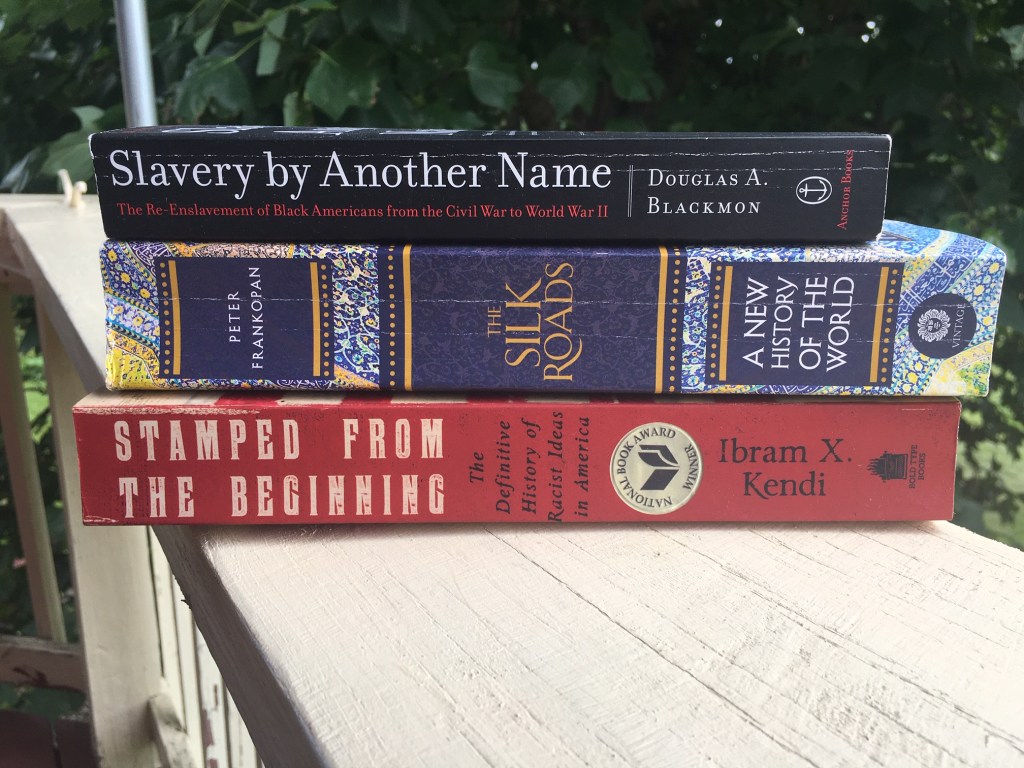
The books, pictured above, read in this order: Slavery By Another Name by Douglas Blackmon, The Silk Roads by Peter Frankopan, and Stamped From the Beginning by Ibram X. Kendi.
Before I explain what these books have taught me, I need to write about how I got here in the first place. I’m a white guy from the suburbs of Detroit. I went to a very good public school system and a top-notch university. I’ve been a voracious reader my whole life. I’ve been aware of racism as an issue. I’ve tried my best to not be a racist. I’ve tried to be an ally.
But there are huge gaps in my knowledge of American and world history that kept me from realizing the true depth and impact of racism in my country. I am embarrassed by my own ignorance, and I’m doing my best to rectify the situation.
Up to a point, I can blame my education. “World History” as it was taught in school and college was a joke; it basically included European history plus a Euro-centric view of Middle Eastern history. When I was in college, Black Studies was starting to be a thing — but I never thought it relevant to me, since I was already a good white liberal who marched in Open Housing protests in my lily-white suburb.
Since I graduated (in 1978), I’ve been responsible for my own intellectual diet. I’ve read tons of books and thought myself well-educated, but I’ve never consciously chosen to read anything about race relations. Offhand, I can’t think of a single book I’ve ever read by a Black author. I’ve likely read one or two, but nothing that’s ever left a mark on my thick skull.
No W.E.B. DuBois, no James Baldwin, no Ralph Ellison, no Richard Wright, no Toni Morrison or Zora Neale Hurston or Octavia Butler or Angela Davis or bell hooks, no Martin Luther King Jr. or Malcolm X. No Ta-Nehisi Coates, not even his run on Black Panther. I’ve never read a biography of a Black person, or anything focused on African history. My leisure reading is mainly sci-fi and mystery, but never have I ever read Samuel Delany or Octavia Butler or N.K. Jemisin or Walter Moseley.
And I’ll bet I’m far from alone among the ranks of NPR-listening, New Yorker-reading*, comfortable, well-meaning white folks. My lack of knowledge and perspective have severely hampered my ability to see the world clearly or to be an effective ally.
*I let my subscription lapse a couple years ago and made a deliberate decision to read more books. I’ve never regretted it.
In the least shocking news of the year, Vermont Police are still being racist about their traffic stops.
The same research team that found racial disparities in traffic stops and searches two years ago, has updated its report to reflect two more years of data. And while there’s been some incremental improvement, things “are getting worse or staying the same,” according to lead researcher (and UVM prof) Stephanie Seguino.
Topline takeaways: You’re much more likely to be pulled over if you’re black or Hispanic in Vermont. If you’re pulled over, you’re much more likely to be searched — even though searches of white drivers are much more likely to uncover illegal activity.
The cherry on top: Despite a 2014 law mandating that police report the apparent race of each driver stopped, plenty of cops are flouting the law. Take, for example, Bennington’s racist PD, which is omitting the data more frequently than ever. And the Rutland PD, which has a specific problem with including racial data: “…for the 457 stops where race of the driver is not known, less than 1% of those stops had any other missing information about the stop.”
So now what? More sensitivity training? “Tough conversations”? Earnest promises to do better?
Yeah, a lot of that — although some can’t even be bothered to pretend to care. Bennington chief Paul Doucette lamely offered that he needed more time to look at the report before commenting. (The report notes that the volume of traffic stops in Bennington increased by 65% between 2015 and 2019. If Doucette has had any second thoughts about his minions’ racist performance, the word hasn’t filtered down through the ranks.)
And, judging by his track record, he probably hung up the phone and tossed the report into the circular file.
Which is not to say that we should place all the blame at the feet of a few cops and chiefs. After all, the thing about “bad apples” is that they spoil the barrel.
Or maybe the whole barrel was spoiled to begin with.
Rarely do you see something so perfect that you wonder if it can possibly be real.
Submitted for your consideration: The above Craigslist ad from a rebel wannabe right here in Vermont. If you needed any evidence that we’ve got people like that just like every other state, here it is.
Now, I can’t swear to the authenticity of this thing. You’ll pardon me if I’m not anxious to get in touch with the self-described vendor. But let us take just a moment to marvel at this piece of artfully rancid Americana.
Confederate flag? Of course.
Random articles of militaria hanging on the wall? Yuh-huh.
Symbol of anti-American rebellion proudly displayed by someone selling U.S. military — pardon me, “millatery” — supplies? Oh the irony.
Only the vaguest acquaintance with the fineries of one’s native language? F’sho.
Prepper wannabe? Mmm-hmm.
Couldn’t resist sampling the goods? That freeze-dried SOS was calling to him.
Hoping to land a pickup truck worth $720? Definitely transport-challenged.
But if you’re in the market for 118 yummy-in-the-tummy military-grade meals that can be served hot or — eeeewwwww — cold, don’t let me stop you. I’d hate for you to be left Un prepaired.
Get a load of this mook, all tac’d up like he patrols the Mean Streets of Detroit or summat
The tiny city of Vergennes is in an uproar, largely due to disagreements over its police department, which is led by George Merkel, the guy pictured above. Dude does love him some tactical gear, doesn’t he?
You wouldn’t know from his outlandish getup that he keeps the peace in a city of only 2,601 with vanishingly small rates of violent crime. You wouldn’t know that the vast majority of police calls are for things like noise complaints. I bet all that gear comes in handy when there’s a cat up a tree, eh, Chief?
You probably could guess that Merkel has come under fire for unapologetically regressive policing. I mean, he looks like he’s about one second away from Tasing the cameraman.
It’s bad enough that Addison County Sheriff Peter Newton filed a report accusing Merkel of multiple misdeeds, to wit: (1) signing official documents with “patently false information,” (2) knowingly failing to report demographic data on VPD traffic stops, and (3) falsely reporting work time and collecting double pay as a result.
(Newton’s report originated in a February meeting that included then-Vergennes mayor Jeff Fritz, an unnamed city alderman, and a sheriff’s officer who formerly served under Merkel. The four, according to VTDigger, “described Merkel as being out of control.”)
Never fear! Attorney General TJ Donovan, the persistent protector of law enforcement, has reviewed a Vermont State Police probe of Newton’s report and concluded — you’ll be shocked, I know — that “there is no evidence to suggest that Chief Merkel acted with intent to defraud” in reporting his work time, and that this concludes concludes “all ongoing investigations regarding Chief Merkel.”
Donovan’s press release — a Friday afternoon newsdump — made no mention of the other two allegations against Merkel. The most serious, to me, is the failure to report demographic data on traffic stops. The Vergennes PD, after all, has a record of racial bias in traffic policing that’s among the worst in Vermont. So there’s a real bad odor around Merkel’s failure to report pertinent data on nearly two-thirds of all his force’s traffic stops in a two-year period.
I guess Donovan, or the VSP, ignored that? The press release is silent.
Donovan’s inaction leaves the city of Vergennes a broken place. Some residents fear the police and want Merkel gone; others support their longtime chief to the hilt.
This may seem outlandish, and uncharacteristic of small-town Vermont society with its vaunted community ties and cherished slash fetishized Town Meeting Day traditions. But there are other Merkels out there. The only questions are, how many? And, since nobody in officialdom seems willing to face this issue, what do we do about it?
Keeping in mind that every unjustified, race-inspired traffic stop is a stab in the heart to our BIPOC neighbors, a disincentive for people to relocate to Vermont, and a stain on our state’s reputation.