
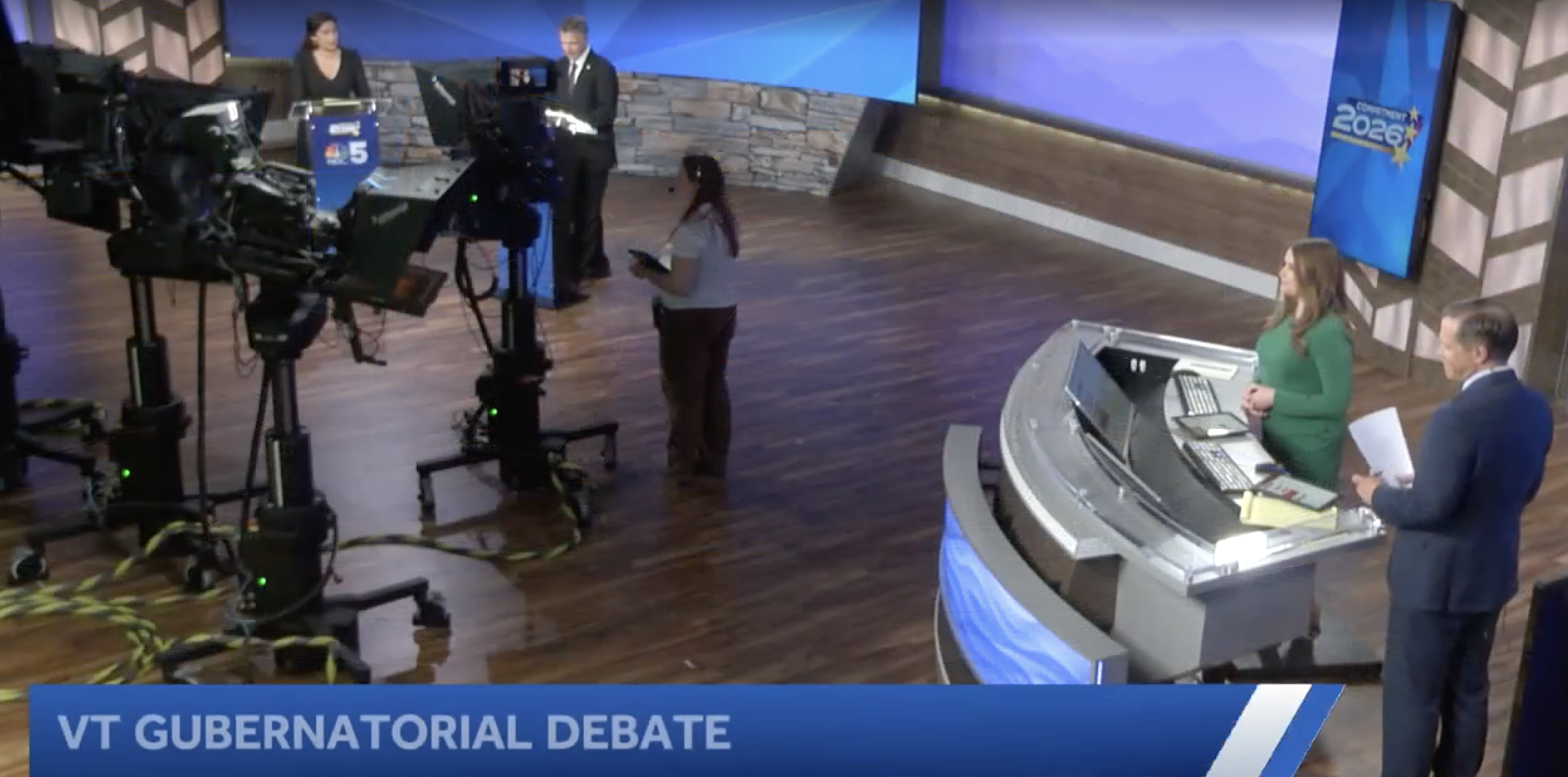
Big ups to WPTZ-TV for designing the most uncomfortable debate setting I’ve ever seen. I believe this image, seen very briefly just after the mid-show break, was the only establishing shot in the entire one-hour presentation (broadcast live Thursday night, now viewable on the YouTube), and no wonder. It’s just bizarre.
And clearly it affected the quality of the debate. Both candidates appeared uncomfortable and didn’t really know where to look, although Amanda Janoo handled it better than Gov. Phil Scott. His eyes were constantly meandering around. He looked a bit flustered. At first I thought it was fatigue, but then I saw what the studio looked like and realized that flusteration was a perfectly normal response to the setting.
Both candidates came off much better in the previous night’s debate hosted by Vermont Public, using the same studio it uses for “Vermont This Week.” It features a circular setup that allows each participant clear lines of sight to everyone else. Camera placement is designed to be unobtrusive. The room fostered conversation, where WPTZ’s mess fostered alienation.
As you may have gathered by now, this post will be vibes-based rather than a recitation of The Candidates’ Contrasting Views On The Issues. That’s partly because other outlets have weighed in on the substance, and also because the substance is the least impactful aspect of a debate.
Much as we’d like to believe that voters enter campaigns with open minds and make informed decisions based on the issues, that’s not how it works. Most voters’ minds are made up from jump, and nothing that happens in a debate (or anywhere else) could induce them to switch sides. The relative few who can be persuaded will do so not because one candidate has a more detailed health care plan, but because of comfort level: The old Bush/Gore “Who would you rather have a beer with?” test, and the related but more relevant “Who seems capable of handling the job?” That’s less about policy than the appearance of competence.
In a word, vibes.
Scott and Janoo entered the arena with different goals. For Scott, the job was simple: Remind voters why they’ve always supported him in the past. Project that comforting next-door-neighbor persona: the Governor Nice Guy who will work with anyone to make Vermont a better place. Get in some digs at Democrats, but don’t be a prick about it.
He largely succeeded in the Vermont Public debate. Sure, he told a few whoppers and occasionally got lost in the weeds, but he kept things on an even keel. He did less well in the WPTZ debate, which can be attributed to the clunky staging — although I wonder if the now 68-year-old governor had a harder time with debates on consecutive nights than Janoo, who’s more than a full generation younger. Overall, Scott did well enough to avoid significant damage to his cause. He may have convinced some undecideds to stick with a sure thing. Scott’s ceiling is lower, but the perceived floor is higher.
Janoo had a much harder and more complicated task to accomplish. This was her introduction to a lot of voters. She had to present herself as a solid, responsible adult capable of managing state government. She had to seem a bit more mature than her 39 years. She had to roll out an ambitious, progressive agenda and make it seem achievable, inclusive, and not at all scary. And she had to share a stage with Vermont’s winningest politician and not come across as second best.
And she did all of that. It wasn’t flawless, but it was damn close.
Which brings me to the (nonpartisan) elephant in the room: the absence of attacks on Scott’s record. Goodness knows there’s plenty of scope for attacks. She didn’t take advantage, even when Scott opened the door by telling some obvious lies. Hell, when each candidate was asked to name a person from the opposite party they admire, Janoo picked… Phil Scott. (The governor named the safely-retired Pat Leahy.)
It’s not what I would have done. It’s not what a conventional Svengali would have had her do. She willingly gave away quite a few debate points. But I can see why she avoided direct attacks — and largely avoided implicit attacks.
From day one, Janoo’s campaign has defied conventional wisdom. It’s been inclusive, not divisive. She doesn’t make distinctions between rural Vermont and its more urban precincts. Her events are based around audience participation and the sharing of ideas. If she becomes governor, she wants to lay out the welcome mat for people who voted against her. She sees inclusiveness as the best way to fashion successful policies and build support for them. So of course she didn’t go on the offensive. It’s not in her nature or the nature of her campaign.
Over and over again, Scott grooved a changeup down the middle and Janoo refused to swing. At one point Scott said, in his endearingly ungrammatical manner, “There is not going to be a data center in Vermont.” To which the obvious rejoinder was, then why did you veto a bill that would have banned data centers? Janoo didn’t take the bait.
Scott: “I don’t think my style is confrontational.” Which opens the door to, “Well then, why the dozens and dozens of vetoes?” Janoo smiled and moved on.
There was much talk of health care and Janoo’s plan to create a universal primary care system. More than once, Scott cited his Democratic predecessor Peter Shumlin’s abandonment of single-payer health care as a reason to oppose Janoo’s idea. But her proposal is NOT single-payer health care. Her plan would cost much less than single-payer, and could be scaled to match available resources. She advocated for her plan but didn’t point out Scott’s misdirected attack.
Scott also floated a proposal I’d never heard before to address rural Vermont’s relative lack of political heft. He would remake the Senate, assigning two seats to each of Vermont’s 14 counties. The results would be a mockery of one person, one vote. Chittenden County would get one senator per 85,000 residents; Essex County would get one for every 3,000 and Grand Isle one per 3,750. Reminder that the Vermont House used to include one representative per city, town, or hamlet, but that system was thrown out by the U.S. Supreme Court back in the Sixties.
I realize the U.S. Senate operates on the same principle (and Vermont is one of its biggest beneficiaries), but really, if we were reinventing the federal government from scratch, would each state get two senators apiece? I doubt it.
Once again, Janoo didn’t take the bait. She stuck to her friendly, competent, non-confrontational persona. You know, the one that’s taken her from political obscurity to the doorstep of Vermont’s most powerful office in a matter of months.
I wouldn’t have been able to resist exposing the flaws in Scott’s record and his political presentation. But Janoo has gotten this far by sticking to her very unconventional game plan. I’m not inclined to give her any contrary advice. She should see it through. And I’m sure that’s what she will do.
She comes away from the first two debates as a credible alternative. She didn’t scare the horses. Well, I’m sure she scares the conservative base but they wouldn’t vote for any Democrat, even the most benign centrist. She gave undecided voters every reason to seriously consider her candidacy, and no grounds to reject her outright.
Phil Scott remains the favorite to win another term. But Janoo cemented her position as his first serious threat since Sue Minter in 2016. Which is why the Republican Governors Association is suddenly spending a million bucks to knock her down.

