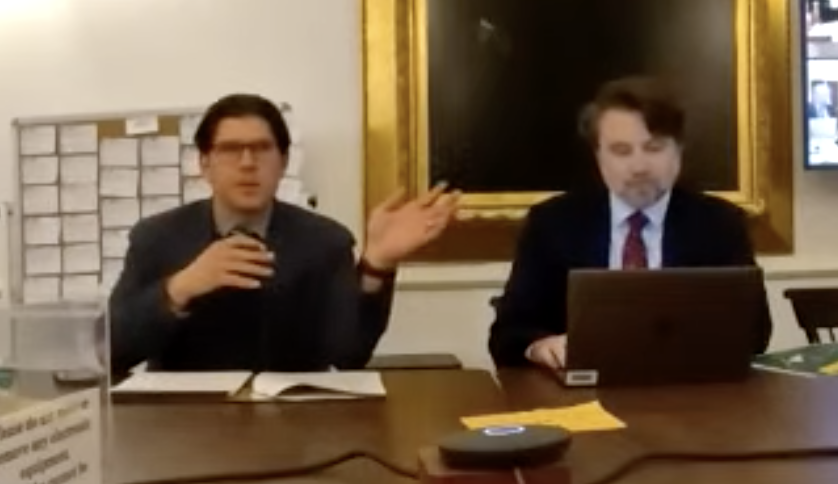
Oh, those smiling happy faces. At left: Everybody’s Favorite Governor. At right: the boy genius formerly known as Phil Scott’s Financial Regulation Commissioner Mike Pieciak, now State Treasurer and presumptive future Democratic candidate for governor.
Yeah, they were chummy back in the day. Funny thing: Even though they now reside on opposite sides of the metaphorical aisle, they still seem to be awfully simpatico. Yesterday, the two of them announced something of a superhero team-up to address climate change and resiliency issues.
Talk about things that make you go hmmm. A top Democratic elected official joining up with the Republican governor to tackle an existential issue on which the Democrats are often at odds with the governor? All I can say is…
Two crises. Both involve the concept of “housing,” but they are not the same and we should not confuse the two. Which seems to be the willful intent of the Scott administration heading into a legislative session in which housing will be near the top of everyone’s priority list.
Remember the administration’s big presentation to the Joint Fiscal Committee in November? The one I called “a gloomy overview that has to rank as one of the most depressing events I’ve experienced in my 12-ish years following #vtpoli”? The whole intent of that presentation was to conflate the two crises and, well, subtly shift the focus toward housing and away from homelessness.
Administration officials have continued on that track ever since. The starkest example of this was the opinion piece co-authored by Human Services Secretary Jenney Samuelson and Commerce Secretary Lindsay Kurrle that focused almost entirely on housing policy and virtually ignored the rolling humanitarian crisis of unsheltered homelessness that state policy is creating.
I suspect we’ll get a heavy dose of the same in Gov. Scott’s state of the state address on Thursday. And we shouldn’t fall for it.
The available evidence points to one dispiriting conclusion: We are about to experience another substantial wave of Covid-19. Both state and federal data (the two are drawn from different testing regimens) show that our wastewater is full of the virus. The Centers for Disease Control says that nationally, wastewater levels are Very High, and the worst levels in the country are in the Northeast. Case counts in Vermont, although still classified as “Low” by the state Health Department, are on the rise. Nationally, according to the CDC, Covid-related emergency room visits, hospitalizations and deaths are all heading upward.
Dr. Michael Hoerger of the Pandemic Mitigation Collaborative is projecting that “Nearly one in three Americans will get infected during the peak two months of this winter surge. That’s 105 million infections & more than five million resulting Long Covid cases.” The PMC says we could be headed into the second highest peak for Covid transmission ever. Including those times when we avoided exposure as much as possible and wore masks whenever we ventured outside.
Yeah, well, I’m sure it’ll be just fine. At least that seems to be the foundation of Gov. Phil Scott’s post-pandemic policy. Because his administration isn’t doing a damn thing about it. Not even to “protect the most vulnerable,” which he says is one of the three pillars of his governorship.
Note: This post has been updated with comment from the Progressive Party, see below.
This fall, Vermont’s political parties have undertaken their biennial obligation to reorganize themselves. It’s quite the task. The parties have to encourage members across the state to take part in town caucuses and establish town committees.
The process Is now over and the results are in. The Vermont Democratic Party had the biggest success, organizing town committees in more than 170 communities (they’re still totting up a few stragglers). The same process two years ago resulted in 150 Democratic town committees. That’s a nice bump, considering (a) they had less room to grow than the Republicans or Progressives, and (b) given the flood and all, it wasn’t the best year for encouraging turnout at political meetings.
The Vermont Republican Party lost a bit of ground, falling from 132 town committees in the 2021 reorg to 120 this time around. The Progs saw a modest increase from 44 towns in 2021 to 48 this year.
Behold, tidings of great joy. Just in time for the holidays, the Scott administration is forcing jobless Vermonters to jump through hoops and navigate needless obstacles because the Labor Department can’t seem to keep the unemployment system working. The above messages are what you see when you visit the Department’s Unemployment Insurance webpage.
I mean, seriously. Each claimant is required to file every week. But the UI Claimant Portal is on the fritz, and the call center is so overwhelmed that people are being urged NOT to call. If I were of a conspiratorial bent, I’d suggest that this is a nice way to try to keep costs down — by making it very difficult for claimants to comply with the terms of the UI program.
But really, given the Labor Department’s recent track record, the explanation is more likely a combination of incompetence and underfunding.
Yep, it seems impossible, but the latest Morning Consult poll of gubernatorial popularity (Mississippi’s Tate Reeves bringing up the rear) shows that our very own Phil Scott actually improved his top-of-the-nation standing from his customary perch in the high 70s to… 84 percent. In a state where Democrats have a nearly 30-point edge over Republicans.
The poll was received with applause from Scott fans and many of those who draw paychecks from him. One of the gov’s top Democratic boosters, Ed Adrian, suggested I try to blog my way through this. Because, as what Dorothy Parker would call my Tonstant Weaders are aware, I’m not exactly on Team Phil.
For many reasons I find him an underwhelming leader. He’s not a creative thinker. He’s been in office for nearly seven years, and I can’t think of a single bold policy idea he’s put his weight behind. Well, he used to claim that he could reinvent state government and save tens of millions a year, but that was a complete bust. He took strong action that one time on gun legislation, following a credible threat of a mass shooting at a Vermont high school (which inspired one of the best columns I ever wrote, so don’t say I won’t give him credit where it’s due).
Otherwise his tenure has seen Vermont’s most intractable problems get worse: Housing, opioid addiction, workforce, demographics, climate instability, and more. He himself cites these issues at every turn. And yet his proposed solutions tend to be lukewarm. He nibbles at the margins instead of sinking his teeth into the issues.
So why is he so overwhelmingly popular?
Well, let’s start with this: Popularity is not a measure of quality. Bud Light is popular. Potato chips are popular. “The Macarena” was popular in its day. Indeed, I will argue that broad popularity requires a fundamental inoffensiveness. A song or foodstuff or bestselling book can’t be difficult or challenging. It has to be accessible, first and foremost. And boy oh boy, from an ideological perspective, Phil Scott is nothing but accessible.
The Vermont Republican Party held its biannual, or possibly biennual, convention on Saturday. (Above screenshot from the VTGOP’s own website, although they might get around to fixing it after they read this post.) They actually had kind of an impressive speaker lineup, including Reagan-era anti-tax activist Grover Norquist (who must have been wondering how the hell his career descended to the point where he was sharing breakfast with a few dozen graybeards in frickin’ Burlington), Scott Brown, who’s gotten an incredible amount of mileage out of one lucky victory thirteen years ago, and Georgia state Rep. Mesha Mainor, who switched her affiliation from Democratic to Republican after differing with her former party’s caucus on some high-profile issues.
All of which makes me think that there are some conservative deep pockets underwriting the travel schedules of far-right figures, because ain’t no way the VTGOP could have pulled this level of “star” power in the past. But anyway…
Speakers also included professional troll Scott Presler, a gay conservative dudebro who was touted as a get-out-the-vote activist. Not mentioned in your convention program: His stint as a lead organizer for an anti-Muslim hate group, his description of the January 6 “Stop the Steal” election denial gathering as “a civil rights protest,” and his promotion of false claims that the 2020 election was stolen.
Oh, and his version of GOTV includes the all-out promotion of “ballot harvesting,” a common conservative complaint about Democrats collecting and delivering ballots en masse. If you’re unfortunately enough to remember the film “2,000 Mules,” which focused on unsubstantiated claims that liberal activists were harvesting huge numbers of questionable ballots, well, Presler wants to take that idea up to 11: “”I don’t want 2,000 mules. I want 2 million mules,” he told a GOP voter training session in Pennsylvania.
I can’t tell you whether he brought the same message to the Waterfront Hilton, but it seems likely.
It’s a good thing that Vermont’s left-leaning advocacy organizations are so inured to disappointment, because it’s about to happen again.
On Thursday, a coalition of groups announced they are banding together to promote a surtax on the wealthiest Vermonters. The Public Assets Institute estimates that a 3% surcharge on incomes over $500,000 would raise about $100 million to help meet Vermont’s needs, a substantial boost to the bottom line at a moment when we need serious public investment across a number of fronts.
Nice thought, but it ain’t gonna happen.
Gov. Phil Scott is against it. The Democratic Legislature has a long and storied history of aversion to broad-based tax increases for one or more of the following reasons: They’re afraid of being labeled as tax-and-spenders, which is a laugh because Republicans beat that drum constantly anyway; the fat cats who’d usually support Republicans are open to the Democrats because the VTGOP is so batshit; and/or their bloated caucuses include a substantial number of centrists who wouldn’t back a wealth tax.
This proposal might get a polite hearing in 2024, but that’s about all.
If the above image looks a little fuzzy, thank the limitations of the Legislature’s system for recording and livestreaming its hearings. But it reflects the situation we face on housing: Our public leaders seem small and indistinct when discussing the enormity of Vermont’s housing shortage, and their explication of the crisis was long on broad pronouncements and short on specifics.
The Scott administration’s A-team, pictured above, appeared before the Legislature’s Joint Fiscal Committee and delivered a gloomy overview that has to rank as one of the most depressing events I’ve experienced in my 12-ish years following #vtpoli. Doesn’t quite top Peter Shumlin’s surrender on health care reform or his near defeat at the hands of Scott Milne, but it’s not far behind.
The big takeaway: The housing crisis is even worse than we thought. From top to bottom, end to end, from the most basic of living spaces to the most extravagant, we don’t have nearly enough. Oh, and the epidemic of unsheltered homelessness that Our Leaders assured us was all taken care of last winter? That’s going to get even worse before it has a hope of getting better. And the “getting better” is going to take years.
And the interim solution, if they can manage to pull it off, is a massive increase in emergency shelters, most likely of the congregate variety. That, for a population ill-suited for such arrangements.
Back in 2019, the Vermont Legislature adopted a bill imposing penalties on those who didn’t have health insurance. But the bill included an exemption for those enrolled in so-called health care sharing ministries instead of actual health insurance. That same year, the Scott administration and the Attorney General’s Office issued a consumer warning about the perils of choosing an HCSM over insurance.
Now it’s 2023, and there are almost certainly more Vermonters in HCSMs now than there were four years ago. (HCSM participation grew dramatically during the Covid pandemic as many lost their insurance coverage due to unemployment, and were desperate for any cheaper option.) And we haven’t done much about it at all.
This issue came to my attention when I was writing up former health care reform opponent and former Trump administration appointee Darcie Johnston’s employment with the Alliance of Health Care Sharing Ministries. I didn’t include Vermont’s own sad little history because (1) I needed to do more research and (2) I do try to keep these posts from getting painfully long. But now it’s time to tell Vermont’s part of the story.