So the Tunbridge Fair — err, the Tunbridge World’s Fair — happened last week. And as is its tradition, WDEV Radio broadcast live from the Fair’s gazebo and conducted debates for the top statewide offices. It’s been an early and quasi-obligatory stop on the campaign trail for many a year.
Well, WDEV was there, but many top politicians were no-shows. Gov. Phil Scott, for instance. Also U.S. Rep. Becca Balint and U.S. Senator Bernie Sanders. The only actual debate featured the two candidates for lieutenant governor, incumbent Progressive/Democrat David Zuckerman and Republican John Rodgers. (It was reportedly a spirited affair; you can listen here. The LG debate is in the second hour of the show.)
Otherwise, empty chairs abounded. Instead of debates, we got long interviews with the candidates who bothered to attend.
The fine fellow above, pictured with a fish he caught last year on Shadow Lake, is former state senator John Rodgers, Republican candidate for lieutenant governor. I know about the fish because it’s featured in one of a series of low-budget official campaign videos in which Rodgers is interviewed by one Rick Lafayette, a.k.a. the lead singer of Kikker, a Vermont metal cover band. Yeah, this guy:
Hey, I didn’t even wait to start digressing this time, I did it right off the top.
Anyway, Rodgers is running against Progressive/Democratic incumbent David Zuckerman. As most of you know, in Vermont we elect the governor and LG separately. And throughout Phil Scott’s seven-plus years in the corner office, a Republican has never been lieutenant governor. This doesn’t matter at all because the LG has no actual, uh, power or authority — except for one big thing, which ought to keep Scott and his allies awake at night.
The LG is in the line of succession. If something were to happen to the govrnor, then good ol’ Progressive Farmer Dave would succeed him. You’d think, then, that Scott would be going all-out to make sure Zuckerman is out of the way. You know, secure the Phil Scott political legacy.
The September 1 campaign finance reports crystallized something we already knew: This is shaping up to be an unsurprising political season because there’s such a deep divide between those on top and those trying to get a leg up. The former include Gov. Phil Scott and a whole bunch of Democrats; the latter include every other Republican minus a few who’ve been blessed by the patronage of Burlington’s business elite.
The exception to the Democratic rule: Esther Charlestin, who entered September financially underwater in her long-odds (and getting longer every day) gubernatorial campaign. Somehow, the financial gap between Scott and Charlestin managed to grow in August.
This isn’t a typo: Charlestin has raised only $21,137 and spent $22,309. On primary night, Charlestin told VTDigger she would “go hard” in the general campaign, which meant knocking on doors, seeking endorsements, and “raising a lot more money.”
But she didn’t do that. For the entire month of August, Charlestin raised $4,505, which isn’t anywhere close to “a lot more money.” I can’t say how much of this is her doing and how much is Democratic donors turning their backs; Charlestin didn’t score any donations above $250, and that came from longtime Progressive stalwart Martha Abbott. Hey, Dems: Do you like your candidate or don’t you?
Meanwhile, Scott continues to raise far more money than he needs, and spend money like he’s got an actual battle on his hands instead of an almost certain walkover.
Tuesday’s primary election turned out to be a snooze. The most interesting development was how much money was wasted trying to unseat a small number of Democratic incumbents. They all won, as far as I can tell.
Firmly atop the Futility Rankings is former TV anchor Stewart Ledbetter, who finished fourth in the race for three state Senate seats in the Chittenden Central district. He raised almost $60,000 and spent a bit under $40,000 (tentative). He “earned” 3,159 votes, which cost him and his well-heeled donors about $12.56 apiece. Bargain!
Elsewhere in the “beat the Democrats” game, House Ways & Means Chair Emilie Kornheiser brushed off a challenge from business-backed Dem Amanda Ellis-Thurber, while the Waterbury duo of Reps. Tom Stevens and Theresa Wood defeated “affordability” Dem Elizabeth Brown, who spent gobs of cash and didn’t really come close to pulling off an upset.
Two quick takeaways: If there’s an anti-tax revolution brewing in the hinterlands, it did not show itself in the results. At all. And those allegedly smart business leaders just squandered a whole lot of money trying to push the Democratic caucuses toward the center. They might have scored one small victory, as Danforth Pewter chief Bram Kleppner took a Democratic nomination for House in Burlington. But that’s about it.
August 1 was another campaign finance deadline, the last before our August 13 state primary. As usual, there was plenty of interesting stuff to be found. And as usual, there was a dearth of coverage in our sadly diminished media ecosystem. VTDigger waited a few days to put together a solid campaign finance database helmed by its longtime (by Digger standards) data reporter Erin Petenko. But any effort, by anyone, to identify trends or develop insights? Haven’t seen any.
Meanwhile, those who follow me on Elon’s Hellscape know why I’m late to the party. After doing a fair bit of spadework around the deadline, I came down with Covid. It was a pretty severe case for a few days and I’m still on the mend, but I feel able to put words on the screen for the first time since last Thursday.
Anyway, got some things to say. Let’s do the toplines first and then get to the details.
While the vast majority of candidates have trouble scratching a few bucks together, there are a few who have more money than they know what to do with. The primary’s one week away, early voting as been going on for roughly a month, and they’re sitting on large quantities of unspent cash.
Many of these hopefuls have been generously funded by a cadre of Burlington-area business types, who may look at their investments post-primary and despair at the improvidence of their strategery.
Two candidates got a rocket strapped to their backs by those business leaders in July. John Rodgers, running for lieutenant governor, and Rep. Pat Brennan, running for state Senate. They went from near zero on July 1 to huge, nigh unspendable hauls on August 1. Congrats, I guess?
Gov. Phil Scott’s campaign has far outstripped Democrat Esther Charlestin. Why his people are bothering to beat the bushes, I don’t know. I remain convinced that he’d be better advised to mothball his campaign and start a PAC — or a Super PAC — and spread his influence around.
The oddities around Thomas Renner’s campaign for lieutenant governor continue to proliferate. His fundraising slowed to a trickle in July, but he spent very little and has a sizeable unspent reserve. I still don’t know what his campaign is about. Or who’s running it, for that matter.
One week ago, I wrote about former senator John Rodgers’ five-figure spend for ads on WDEV radio plus other candidates’ investments in mass media. Several candidates have since reported mass media expenditures; here’s a look at the highlights.
Reminder: The next campaign finance reporting deadline is August 1, but candidates are required to promptly report mass media buys of $500 or more when they occur close to an election.
Let’s start with Rodgers. I noted that if his WDEV buy was part of a broader strategy it could pay off, but by itself it’s a questionable move. It’s a lot of money to spend on a diminished medium and an outlet that only reaches a fraction of Vermont. Well, so far it stands alone: Rodgers has not reported any more mass media spending.
The biggest mass media report from the past week comes not from a candidate, but from the Child Care Victory Fund, a political action committee affiliated with Let’s Grow Kids Vermont. The Fund is apparently trying to protect incumbent lawmakers who supported Act 76, the 2023 bill that made a “quantum leap” in child care investments, and now face primary opposition.
Well, well, well. Former Democratic state senator John Rodgers, now running for lieutenant governor as a Republican, seems to have searched for loose change in the sofa cushions and maybe the console of his (guessing here) pickup truck. Because after reporting no campaign activity whatsoever on July 1, he has now gone and spent a cool $10,400 on advertising with Radio Vermont, a.k.a. WDEV Radio.
We won’t know where the money came from until August 1, the next campaign finance deadline, but candidates are required to promptly report mass media expenditures of $500 or more when they occur close to an election. Rodgers filed his mass media report on July 11.
There are some other mass media filings of note, but let’s stick with Rodgers for the moment. I have to think — in a perverse way, I hope — he’s got some serious money behind him and that this big expenditure is part of a broader plan, because spending $10K on radio ads in central Vermont, by itself, is kind of a headscratcher. And I say that as a veteran radio guy whose brain still conjures up the radio version of the naked-in-public nightmare. (Which basically involves every possible interruption or technical problem sabotaging a live broadcast while I’m sitting at the microphone. Yep, radio in the blood.)
Previously we looked at the dire financial straits of Esther Charlestin’s candidacy for governor, where she barely cleared $12,000 in a race that calls for, by Howard Dean’s reckoning, at least 164 times that much money. Now it’s time to look at the Republican side of the ledger, where pretty much everybody can rightly cry poverty.
With one notable exception.
That would be state Rep. Scott Beck, running for the Northeast Kingdom Senate seat currently occupied by retiring Democrat Jane Kitchel. Beck has raised a rather stunning $35,565. (His likely Democratic opponent, Amanda Cochrane, has raised a respectable $7,165 and enjoys Kitchel’s active support.) Beck appears to be the only Republican candidate who has raised more than enough money to run a respectable race. Besides, of course, Gov. Phil Scott, The Exception To Every Republican Rule,
More to the point, Beck and the governor are about the only two Republicans who aren’t complete embarrassments when it comes to fundraising. Which shows you just how desperate the party’s situation is.
The VTGOP ought to be in a position for a nice little comeback in the Legislature, threatening to end the Dem/Prog supermajorities that imperil every single one of Scott’s many, many, many vetoes. And they’re not.
Instead, the wistful eyes of the donor class have largely turned to putative Democrat Stewart Ledbetter’s bid to wrest away a Senate seat from liberal Democrat Martine Gulick or Progressive firebrand Tanya Vyhovsky. Ledbetter has amassed the largest campaign kitty of any Statehouse candidate thanks primarily to Burlington-area business leaders. You know, the very people who would historically be bankrolling Republicans.
With all due respect to John Nance Garner, seen above conducting one of the essential duties of the Vice Presidency, the #2 spot in an executive branch is the appendix of the American political system. Garner called accepting the VP nomination “the worst damn fool mistake I ever made.” Harry Truman said the vice president “is about as useful as a cow’s fifth teat.” Our first VP, John Adams, called it “the most insignificant office that ever the invention of man contrived or his imagination conceived.”
And yet, here in Vermont, we’re seeing a relative land rush for our equivalent of the vice presidency. There will be, mirabile dictu, contested primaries for lieutenant governor on the Democratic and Republican ballots in August. Despite the hollowness of the actual office, the two primaries and the general election to follow offer a rare hint of intrigue in what promises to be a suspense-free campaign season as far as the statewide ballot is concerned.
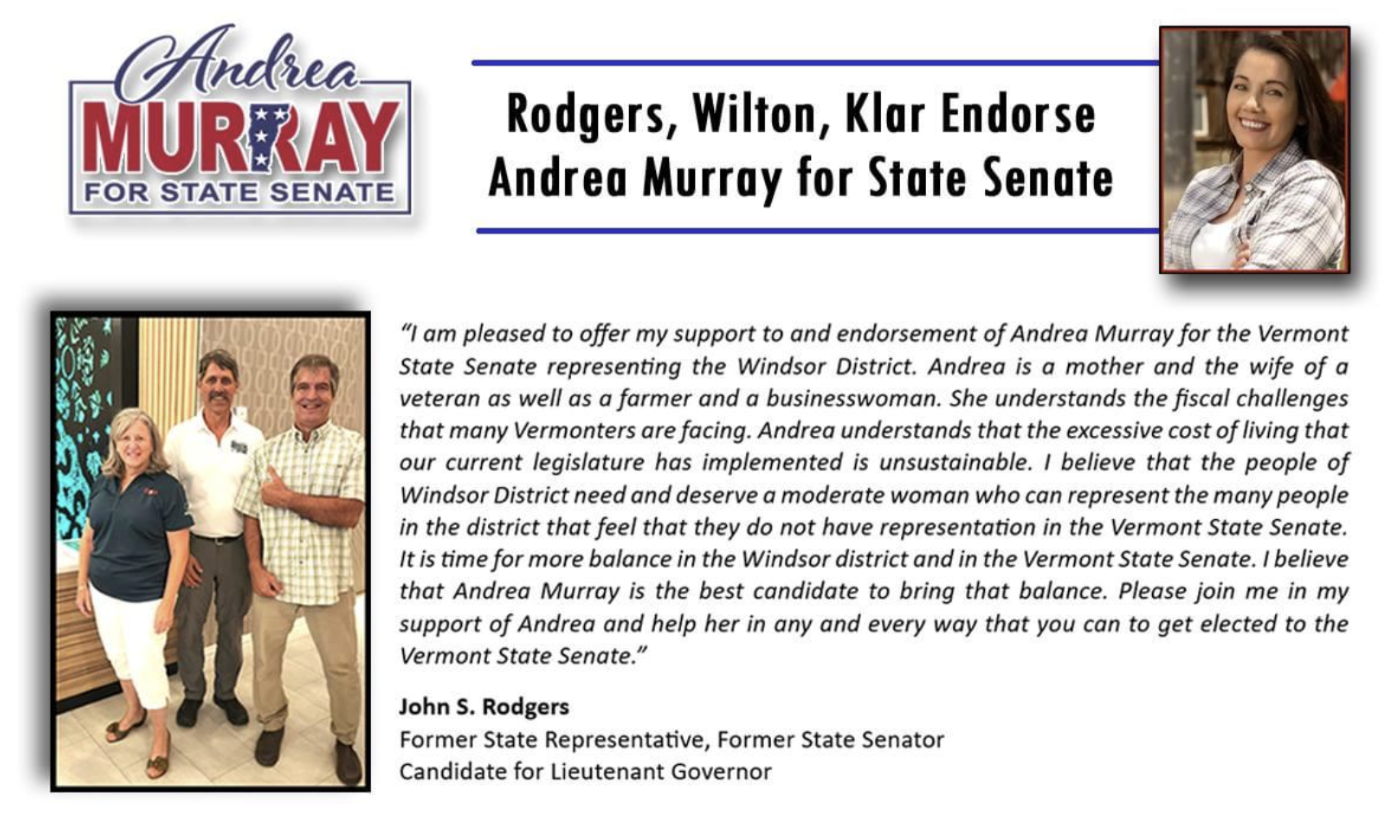
I’ve covered the Democratic contest previously. But now we have two announced candidates on the Republican side, an embarrassment of riches for a party that has given multiple nominations to H. Brooke Paige in recent years. Rutland accountant, January 6 field trip organizer, and multiple-time loser Gregory Thayer has been in the race for months, not that anyone has noticed. He has now been joined by former Democratic state senator John Rodgers, last seen biffing his re-election bid to the Senate by failing to get his nominating petitions in on time.
Time for some way-too-early speculation about what kind of state Senate we will have in the new biennium. To date, Sens. Jane Kitchel, Bobby Starr, Dick McCormack and Brian Campion have announced they are not seeking re-election. Sen. Dick Mazza resigned last month for health reasons, which brings us to five senior solons — in terms of lifespan and/or tenure — who won’t be there next January.
Disclaimer: The following post is based entirely on my own observations. There is not a lick of insider information at play. I do NOT have sources in Senate leadership.
By my math, the five retirees have lived a combined 372 years (average “only” 74.4 years, thanks to that 53-year-old whipper-snapper Campion, PULL UP YER PANTS young man) and legislative service totaling 158 years. That’s right, one hundred and fifty-eight, more than 31 years apiece under the Golden Dome. Also, three of the five are committee chairs.
This round of departures follows the seismic 2022 election season, when 10 senators — fully one-third of the chamber — did not return. That means fully half of the 2025 Senate will have, at most, two years of experience. In 2020, four senators stepped away (three by choice; John Rodgers came a cropper thanks to his own inattentiveness to the niceties of candidate filing law), which means that 19 members of the new Senate will have no more than four years of experience.
This, in a body that values age and seniority above all else, and normally consigns junior members to purely decorative status. It’s gonna be interesting.