The Free Press Did Not Censor Doonesbury. The Truth is Much Sadder.

A couple Sundays ago, the Doonesbury comic strip took us to an imaginary Florida high school classroom where a teacher was sharing some uncomfortable truths about the Civil War as some of her students pondered reporting her apostasy to the authorities.

The strip did not appear in Gannett newspapers across the country, including the Burlington Free Press. Which raised a kerfuffle about censorship: Did our biggest national newspaper chain remove the strip out of concern for the tender sensibilities of southern readers? Were Free Press editors on board with the decision or were they forced to go along with a corporate kill order?

Well, no. The truth is a lot less scandalous, and a lot more depressing about the fallen state of print journalism in general and the comics in particular.

Truth is, Gannett canceled a whole bunch of comics including Doonesbury six months ago, almost certainly for budgetary reasons. The Free Press hadn’t run Doonesbury since last September. Nobody noticed. And that’s just sad.

Continue reading →

Nikki Haley Organizes Vermont Team

A few days ago, the Nikki Haley campaign announced the formation of a Vermont State Leadership Team. I didn’t take much notice at the time because it’s not going to make the least bit of difference. Donald Trump is going to steamroll his way to probably all of Vermont’s 17 delegates as he grinds along to his inevitable nomination.

The only things that can stop him are (a) a quick and decisive criminal conviction or (b) a clear and obvious slide into dementia. Haley’s not going to do it, and her newly formed Vermont committee doesn’t have a prayer of carrying her to a primary win.

I wasn’t going to bother covering it at all until a Haley supporter took to The Formerly Robust Platform Formerly Known as Twitter to complain that there had been no coverage of the Vermont announcement. “Shameful that press has not covered this news in Vermont — it’s a big deal,” wrote Court Mattison. “Haley would help win down ballot and bring balance to #montp.”

Well, okay, your wish is my command. But be careful what you wish for.

Continue reading →

Shouldn’t We Be Thinking Big on Housing?

As the Legislature pursues an actual housing policy in the absence of Gov. Phil Scott, who is focused solely on regulatory reform, there’s my question.

Shouldn’t we be thinking big?

Like “a record-breaking bond issue to jumpstart our supply of affordable housing” big.

Back in 2017 the Legislature and governor approved a $37 million affordable housing bond. In the ensuing two years, then-senator Michael Sirotkin, then chair of the Senate Economic Development Committee, proposed a second bond of $35 million (2019) or $50 million (2020). His efforts fell short, in part because then-treasurer Beth Pearce expressed concern about Vermont’s total indebtedness,

Well, it’s more than time to reopen that question and, honestly, push it as far as we possibly can. I’d aim high, maybe $250 million, and see what I could get. Why not? If we have a housing crisis, shouldn’t the response be proportionate?

Continue reading →

The Administration Does Have a Housing Plan But It’s Incomplete and, So Far, Mainly Hypothetical

Earlier this week I gave Gov. Phil Scott’s plan to address the housing crisis a failing grade. Today, two of his top officials briefed the House Appropriations Committee on a report (downloadable here) prepared by the administration’s Council on Housing & Homelessness.

It was useful and informative. A lot of good work has been done, and a lot of good ideas are included in the report. Which is not to say I was wrong in my earlier assessment; the report is lacking in two crucial ways.

First, it does little to address our current explosion of homelessness. Its focus is on “prevention,” which seems to mean preventing future unhousings while doing not much for those already without a dependable roof over their heads.

Second, virtually none of it is in Scott’s FY2025 budget, which means that all its recommendations are just that. Recommendations. There’s been no commitment to implementation, not even an actual proposal. That doesn’t mean the report will be memory-holed, but there’s no proof that it won’t be.

Continue reading →

Trying to Remove One Hand from Our Health Care Pocket

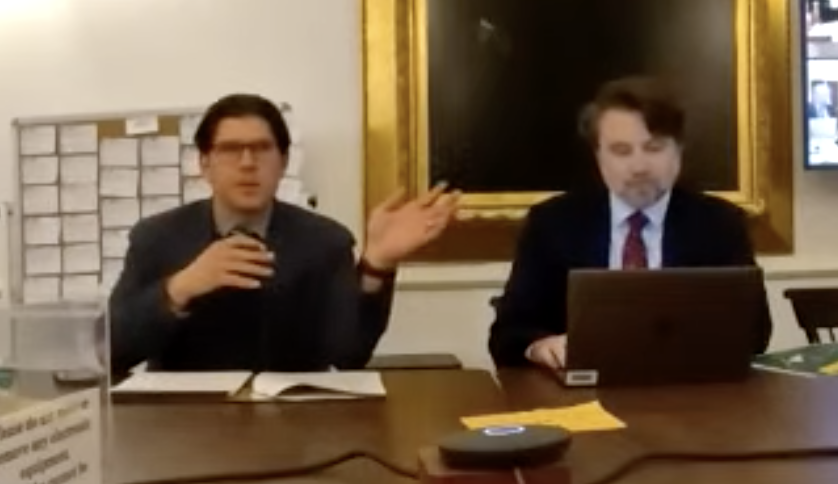
If you’re unfamiliar with the term, you might think “pharmacy benefit manager” is a job title for some anonymous mid-level health insurance executive. Like, say, the guy pictured above. But no, a pharmacy benefit manager is a corporation that sticks its big fat nose into the middle of America’s misbegotten prescription drug system and snorts up all the loose cash it can.

That’s my definition anyway. If you’re a high-priced lobbyist for the national PBM trade association, things look a little different. “Pharmacy benefit managers exist for one purpose: to drive down cost of prescription drugs,” said Sam Hallemeier of the Pharmaceutical Care Management Association (PCMA). PBMs, he continued, “reduce costs for insurers and consumers, reduce waste, and improve patient care.”

Wow, I hadn’t realized that PBMs are charitable enterprises that simply want to make the world a better place.

Oh wait, they’re not. The PBM marketplace is dominated by three large firms that are owned by three of America’s largest for-profit health care firms: Caremark, operated by drugstore chain CVS; Express Scripts, operated by insurance giant Cigna; and OptumRx, brought to you by insurance giant (and sworn foe of spaces between words) UnitedHealth. These mega-corporations are in business to make profits. If their PBMs are holding down costs, you can bet your life they’re doing it for their own benefit, not yours or mine.

You may wonder when I’m going to get to the Vermont political point of this. Well, the Legislature is considering a bill, H.233, that would impose substantial new restrictions on PBMs. And while our state has a track record of disappointment when it comes to health care, this thing might actually stick.

Continue reading →

So Why Isn’t “Lived Experience” Part of Every Legislative Process?

The House Human Services Committee did it again Friday. They went and injected the experiences of homeless Vermonters into the normally dispassionate exercise of lawmaking. The results were, as usual, breathtaking, heartbreaking, and disruptive.

Which begs the question, why is this such an unusual event in the halls of government? Why do we rarely hear from those directly impacted by policy decisions made on high? Modest Proposal: Require every policy committee to hear “lived experience” testimony, especially those that deal with our tattered, inadequate, often cruel, social safety net. (Credit to End Homelessness Now, which has helped these folks remain housed and enabled their testimony in the Statehouse.)

Hey, maybe even we could establish “lived experience” advisory committees for the Agency of Human Services (including the Department of Corrections, you betcha). Not now, of course; it’ll have to wait until sometime after Phil Scott’s disembodied head in a jar loses its bid for a twenty-seventh term in office.

Those pesky “lived experiences” do inject a sometimes brutal dose of reality into the proceedings, making it more difficult to justify byzantine social service policies that are seemingly designed to punish participants and limit demand more than to actually address a real, tangible need.

Then again, they also display the indomitability of the human spirit, the intelligence and resourcefulness of those who live their lives on the edge. Giving them a seat at the table wouldn’t be an act of pity; it would be taking advantage of an underutilized resource.

Continue reading →

Phil Scott’s Big Fat Housing FAIL

Hey, remember last fall, when the Scott administration delivered a grim assessment of Vermont’s housing crisis? Top officials outlined a dire situation with shortages in all sectors of the housing market, from shelters and subsidized rentals to single-family homes to top-end residences. In response, the administration convened an informal task force to confront Vermont’s housing crisis. A multiagency group was going to gather once a week throughout the fall to come up with big, comprehensive solutions.

Well, whatever has become of that?

Two things, and only two things, both of which completely fail to meet the moment. First, we have a joke of a temporary shelter expansion that might net a couple hundred beds for a few months. Second, we have a push for regulatory reform.

And… that’s it. No significant public investment in housing. Phil Scott is failing to address the crisis. He is failing to lead on the issue that he himself spotlighted as the state’s biggest challenge.

This has been obvious for a while, but it was hammered home during a brief legislative hearing on Friday afternoon that wasn’t even on the schedule.

Continue reading →

Shameless Mendacity Seems to Have Earned a Page in the Phil Scott Playbook

I don’t know exactly when it happened, but the administration of Governor Nice Guy has developed a habit of lying. I know, I know, some of you are saying “So, what’s new, John?” But this isn’t just run-of-the-mill fudging the truth. It’s more like easily checkable whoppers emerging from the fifth floor and associated precincts with disturbing frequency.

We first take you back to mid-December, on the eve of a session in which the Legislature was set to consider a bill banning neonicotinoid pesticides. The Agency of Agriculture issued a report boasting that the number of honeybee colonies in Vermont had risen by 43% between 2016 and 2023.

Great news, right? Colony collapse might not be a problem anymore. Maybe we don’t need the ban after all.

Except that Vermont beekeepers completely disagreed. They say the report lumped together stationary and migratory hives. The latter are imported from elsewhere for the warm months. That 43% increase is due to a dramatic rise in migratory hives. Vermont’s own bees are still in trouble.

Continue reading →

Shock, Dismay Over Completely Predictable Consequence

Well, it’s looking like the Legislature’s plan for extending the emergency housing program is in danger of falling apart for reasons that were pretty obvious from jump. As I put it at the time, “I’ll be pleasantly surprised if this thing actually works.”

As Carly Berlin, Designated Homelessness Correspondent for both Vermont Public and VTDigger, reports, motel owners are balking at a proposed $75 or $80 per night cap on GA housing vouchers. The former figure is in the House plan; the latter is in the version passed last week by the Senate.

As a reminder, the current average nightly voucher is $132 per night. And that figure was achieved after months and months of bargaining by the state, which was directed by the Legislature to negotiate lower rates for vouchers.

And hey, extra bonus fail points: The new cap would take effect on March 1 — a mere 15 days from now.

That bit hadn’t been reported before. Top marks to Ms. Berlin for catching it.

Continue reading →

The Tragedy of Stenger, Prince of Newport, As Related By Himself

I must return to Mark Johnson’s epic interview slash psychodrama with convicted EB-5 fraudster Bill Stenger, seen here standing next to a gent whose name I cannot quite recall. This time, let’s take a look at how Stenger explains himself as a naive, trusting soul whose biggest sin was that he wanted so desperately for the projects to work that he ignored some very obvious signs of trouble.

Johnson did his level best to hold Stenger’s feet to the fire, and Stenger repeatedly responded by steering down what John Ehrlichman called the “modified limited hangout route.” Stenger admitted complicity but not criminality, depicting himself simultaneously as perpetrator and victim. Neat trick, that.

The problem is, even if you believe Stenger’s account — which would be a dangerous thing to do — he seems to be guilty of gross negligence instead of overt criminality. That’s not a great consolation prize. Neither does it make me feel sorry for him that he had to serve a short sentence in a relatively comfortable federal facility.

Which he describes, as often as not, in the second person, a subtle way of deflecting the fact that this happened to his own self. “You” reported for prison. “You” were welcomed by fellow inmates. “You” got time off for attending courses. And so on.

But that’s a minor point. Time for a deeper dive on how he describes his role in the EB-5 scandal and his timeline, which serves to make his own story less believable.

Continue reading →