In my Election Night post, I pointed out the parallels between Vermont’s elections in 2014 and 2024. Both were rebukes of Democratic officeholders; the former, Peter Shumlin; the latter, a couple dozen or so members of the Legislature.
There are parallels, to be sure but they end here: 2014 was largely aimed at Shumlin, while the entire Democratic establishment found itself in the crosshairs this year. And each and every one of them had better be prepared to do some real soul-searching. Because they didn’t see this coming, not at all. They believed the Democratic base was solidly in their corner. Some slippage was expected, but nothing like this.
Behind their misperception of the electorate is a more serious disconnect: Over the last two years, they completely lost touch with the people. They pursued an ambitious legislative agenda and, thanks to House and Senate supermajorities, they enacted an unprecedented number of bills despite gubernatorial objection.
They believed in their agenda. They believed they had a mandate to deliver on the promises of 2022. They believed they were moving Vermont toward a more prosperous and equitable future. One of two things is true: They got the agenda badly wrong, or they completely failed to connect it with the hopes, fears and concerns of the voters, especially outside the cities and suburbs.
Well, there’s a third factor: They made mistakes in crafting legislation. The most impactful was whatever they did to school funding that led to the unintended consequence of substantial property tax hikes for many Vermonters. It’s not easy to make sweeping changes in complex systems. The Legislature has precious few resources of its own, and was operating without any help from Phil Scott’s executive branch.
It’s still kind of early on Election Night, but I can’t stand watching the national seesaw and the trends in Vermont seem awfully clear. It’s a great night for Gov. Phil Scott and pretty much a disaster for the Democrats.
And Progressives, who are on the verge of losing their most prominent political figure. Lt. Gov. David Zuckerman has been running narrowly but consistently behind former state senator John Rodgers since the polls closed.
But that race pales in importance to the outcome in the House and Senate, where the Dem/Prog supermajorities are bound for the dustbin of history. Republicans are on track to flip at least five Senate seats, so the Dem/Prog caucus is likely to be a couple votes or more shy of a the 20 needed to override a gubernatorial veto. I haven’t done a count in the House, but it sure looks like the Republicans will win enough seats to knock the Dem/Prog majority below the two-thirds mark.
The next biennium will be a whole new ballgame. There will be no more veto overrides. Legislative leaders will have to try to find common ground with the governor if we’re going to take action of any sort on the many challenges we face.
So, why did this happen, and what does it say about Vermont politics moving forward? And why didn’t I see it coming?
The last pre-election round of campaign finance reports is in, not that anyone in the media noticed. To me, the single biggest note is that the Barons of Burlington and their allies are continuing to throw big money at John Rodgers, Republican candidate for lieutenant governor and alleged rural populist. In the first half of October, Rodgers raised $20,250; in the second half, he took in an extraordinary $69,259, almost erasing the cash advantage held by incumbent Prog/Dem David Zuckerman throughout the campaign. Not quite, but almost.
Of that $69,259, a full $58,199 was in increments of $1,000 or more.
That’s more than 83% of Rodgers’ total takings between October 16 and 31.
Son of the soil, my Aunt Fanny.
Here’s another way to slice the bologna. During the period, Rodgers took in a scant $2,560 in gifts of $100 or less. That’s a mere 3.7% of his total.
Which is S.O.P. for Rodgers’ campaign as a whole. He’s raised $212,443 so far, but only $8,809 in gifts of $100 or less. That’s only 4.1% of his total.
After months of inaction that led to a mass unsheltering of close to 1,500 vulnerable Vermonters, the Scott administration today took a step toward addressing the crisis. A step so insultingly small that the governor might as well have slapped a homeless person across the face.
The administration opened two shelters with space for 17 families. That’s 17 out of close to 1,000 unsheltered since mid-September, when new caps on state-paid motel vouchers took effect. For those unprepared for a bit of higher math, that works out to 1.7% of the need. Want another appalling statistic or two? According to the state, 343 children have been unsheltered since mid-September. These shelters will house maybe a couple dozen or so kids. The rest can go hang.
Actually, as of the orchestrated press tour on Friday morning, only one shelter (in WIlliston) had opened for business. Hasty preparations were still underway at the Waterbury Armory and reporters were not allowed to enter, according to VTDigger. The Waterbury space reportedly features partitioned areas for families, with the partitions not reaching the ceiling. The Williston facility looked a bit more inviting.
As I have noted previously, 2024 has been a barn-burner of a time for state Senate fundraising. Thanks largely to the Barons of Burlington writing bushels of four-figure checks and Democratic donors striving to keep pace, a lot of money has gone into some potentially close Senate races.
Some candidates were clearly taken by surprise at the amounts raised, because they’ve got a lot left with precious little time to spend it. The result: Senate hopefuls have made a blizzard of mass media buys in the second half of October, even as statewide campaigns have seemingly ended major expenditures. (Since Phil Scott and John Rodgers made their big radio splurge on October 28, there have only been two mass media filings by statewide candidates, and they add up to less than $2,000.)
But the Senate, that’s a different story. The mass media reports continue to come flying in. Mostly. There have been no late spends in Franklin or Windham, where the incumbents are safe as houses. (Lamoille’s Richard Westman just rolled in on October 31 with $7,303 spent on postcards and online ads.)
At the other end of the scale we find two districts not known for high rollers: Caledonia and Orleans, where longtime Democrats Jane Kitchel and Bobby Starr are retiring and every major-party candidate has spent tens of thousands of dollars. The number-one late spender on our list: Rep. Katherine Sims of Orleans, with $16,417 spent on mass media since October 15. Her Republican counterpart, Samuel Douglass, has spent $4,705, so late spending in Orleans totals more than $21,000. In Caledonia, Democrat Amanda Cochrane has spent $11,242 while Republican Rep. Scott Beck has laid out $6,603, for a district total of nearly $18,000.
I guess there’s at least one economic sector booming in the Kingdom.
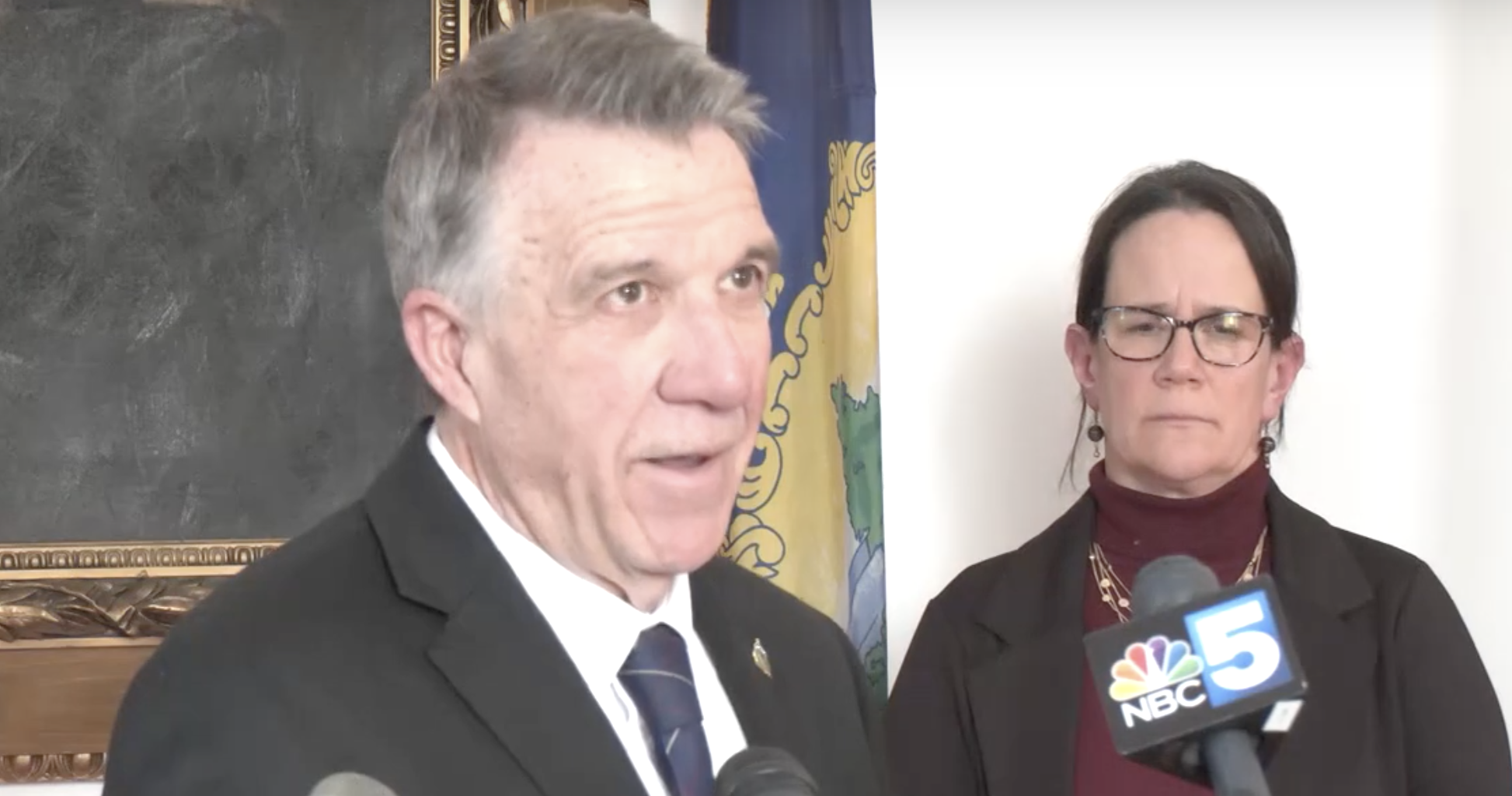
Aww, look at that admiring gaze. You’d never guess that these two people are on opposite sides of a campaign in its closing stage.
Seriously, it’s bad enough anytime when top Democrats share a platform with Republican Gov. Phil Scott. But one week before Election Day? After months and months of the governor shitting on the Democrats every time he gets a chance?
Look, I realize this was one of those sicky-sweet “We Vermonters Are Special” events in which Our Leaders pay homage to our most cherished myths about ourselves. But did anyone give a thought to the political implications of this? I mean, you can be a True Vermonter and still believe that your party is better than the other one. You can still act like your party might be seriously trying to defeat the person you chose to favor with an admiring gaze.
For those tuning in late, Democratic Secretary of State Sarah Copeland Hanzas held a joint press conference Tuesday with Republican Gov. Phil Scott to talk about election security and the importance of civility in our politics. Great, fine, I agree. Civility is a good thing, and it’s nice anytime any Republican deigns to acknowledge the integrity of our electoral system. But let’s not pretend this isn’t a serious contest in which the other guy is trying to beat the pants off you. Because he is.
Seeing this made me wonder, has Copeland Hanzas ever made an appearance with her party’s actual nominee, Esther Charlestin? And I don’t mean sharing a stage with the entire ticket at the state party convention. I mean an event where you say nice things about her and make a public show of support. Maybe she has, I don’t know. But there’s been damn little from the VDP’s most prominent members, even by their dismal standards of giving lip service to their party’s gubernatorial nominees.
Update. I’ve been told that Copeland Hanzas has, indeed, done her share of campaigning with Charlestin — or perhaps even more. Good on her. I still think it’s unseemly to validate Scott’s image so close to Election Day.
In fact, Copeland Hanzas may have given more aid and comfort to Phil Scott at yesterday’s event than she’s provided for Charlestin through the length of the campaign. The presser got widespread positive coverage in our print, digital and electronic media — definitely more coverage than any event in Charlestin’s campaign. And it underscored Scott’s selling point to non-Republican voters: that he’s an acceptable choice for governor even if he plays for the other team.
It’s almost as if Copeland Hanzas is one of those Democrats who’s biding their time until Scott leaves the stage and wants to be at the front of the line for her party’s nomination the next time she thinks it’s a prize worth possessing. It’s almost as if Copeland Hanzas wants to maintain some kind of relationship with Scott, even as he routinely trashes everyone else in her party — and largely ignores his actual opponent in the race.
It’s almost as if her own political future is more important than her party’s.
That’s harsh, but really now. In taking part in that joint presser, Copeland Hanzas was basically saying “It’s okay to vote for Phil Scott because NICE GUY” when he’s spent the whole campaign showing that He. Is. Not. A. Nice. Guy.
Coincidentally, several hours after the presser, VTDigger published a profile of the governor in which he acknowledged that things are not better in Vermont than they were when he took office — and heaped all the blame on legislative Democrats and the laws they’ve enacted over his vetoes. “After the last two years, the answer is no. We’re moving in the wrong direction,” he said.
So what he’s saying is that Vermont was better off during the pandemic than it is now, and it’s all because of those damn Democrats. That’s the Phil Scott definition of civility, of showing respect to your opposition. And Sarah Copeland Hanzas just took a big ol’ scrubby and did her best to whitewash that guy’s political reputation.
In the closing weeks of a campaign, candidates and other political actors are required to report mass media expenditures of $500 or more to the Secretary of State within 48 hours. This is designed to publicly expose any large-scale floods of money in a campaign’s closing days. Of course, this depends on somebody in the press paying attention to mass media filings, and so far nobody has. Well, nobody but Your Obedient Serpent.
The most interesting note from recent filings is that Gov. Phil Scott and his ticketmate, Republican LG nominee John Rodgers, filed a total of 17 separate mass media reports on a single day, Monday October 28. Fourteen of them reported major buys of radio ad time, all conducted jointly and with the expenses split evenly between the two campaigns. Two others reported a joint $4,390 TV buy carried out by the Vermont production firm Hen House Media. The 17th filing reported a $2,740 Scott-only TV buy through Hen House which, pardon the pun, is chicken feed for a gubernatorial campaign.
The other 14 reports add up to $36,855 spent on commercial radio. The big winner was VOX AM-FM, which sold an impressive $11,460 in Scott/Rodgers spots on its Burlington-area stations. The rest: $8,000 to the Radio Vermont Group (primarily WDEV), $6,000 to Rutland-based Catamount Radio (105.3 Cat Country, Z97.1 et al), $5,000 to Great Eastern Radio (Frank, Froggy, and the Penguin), $1,006 to Yankee Kingdom Media of Wells River, and $1,000 to Sugar River Radio.
A couple of notes. First, and it pains me to say this as a longtime radio voice, but the medium is dying. I’m old and I worked for decades in radio, and if I don’t listen anymore, then who does? (The only radio I regularly consume is content made available in podcast form.) So why are Scott and Rodgers going so big into radio for their big closing push? It’s a media strategy from a generation ago.
Second, why wait until now? All those ads are going to clutter the airwaves and severely test the patience of those who still listen. Why not start the ads a couple weeks ago?
Third, why is Scott making such an effort to boost Rodgers when the stakes are so much higher in the Legislature?
This is a screenshot from the ballot in Berkshire, Vermont, a small, rural community in Franklin County near the Canadian border. There are a total of six candidates listed for six openings for Justice of the Peace so, absenting a vigorous write-in campaign, all six are going to win.
And that’s a damn shame for the good folks of Berkshire, because the last name on the list should be familiar for some unpleasant reasons. Republican nominee Ryan Roy has a past that would make him appear uniquely unqualified for any position that involves “justice” or “peace.”
*UPDATE. Roy appears on the Secretary of State’s 2023-24 list of Justices of the Peace for Berkshire, so apparently he’s running for… re-election? I’m seeking confirmation of 2022 election results. If he’s a sitting J.P., this is even worse.
Roy has received extensive coverage in the press for, among other things, being identified as a member of the neo-Nazi Patriot Front and having been an active participant in the infamous 2017 “Unite the Right” rally in Charlottesville, Virginia. Here he is holding a torch and lookin’ big mad in a Vice News documentary about the rally.
Yeah, well, okay then. Justice of the Peace, got it.
Vermonters are responding in large numbers to the opportunity to cast their votes before Election Day via universal mail-in balloting. According to the Secretary of State’s office, town and city clerks have received, and accepted for processing, a total of 125,904 ballots as of the latest count, issued this (Thursday) morning. (Another 18,088 ballots have been returned by voters but not yet officially accepted. It’s a thing.)
Which means, for one, that candidates spending money between now and Election Day are already too late to influence approximately one-third of the electorate. Something to bear in mind for future campaigns. Universal mailed ballots are here to stay, and more and more people will get familiar with the slightly discomfiting process. (Okay, the ballot goes in this envelope, which then gets stuffed in this other envelope, and then I sign that envelope, and somehow the whole process identifies me as the voter but not who I voted for. I think.)
But the main point for my purposes is that one hell of a lot of Vermonters have already participated, and all signs point to a record high vote total. Indeed, the old record might be completely obliterated.
The current standard of 370,968 was set in 2020, which featured a high-stakes presidential election and the debut of universal mail-in balloting — one of the few nice things we got out of the pandemic. Well, we are already one-third of the way to matching that turnout record.
This vaguely mobsterish-lookin’ guy is Joe Luneau, St. Albans auto dealer and Republican candidate for House in the Franklin-3 district currently repped by Democrat Mike McCarthy. This is the photo he chose to plaster on at least two of the many mailers he’s sent to district voters. Seems like there might have been better choices in his collection, but then some people just don’t photograph well. (See also: Kenney, Ted.)
Someone in Franklin-3 shared scans of the Luneau oeuvre with me, and if the Republicans fail to make significant gains in the Legislature this November, the mindset that produced this stuff will be partly to blame. Luneau’s pitch is that Vermont is a hellscape featuring out-of-control drugs and crime, Soviet-level taxation, and prices so high that everyone’s running for the border. (Narrator: No, they’re not.)
(Not mentioned, at all, is the one thing that could make Vermont an unlivable hellscape, and already has for many: climate change-related natural disasters. Recall that Vermont finished near the top among the 50 states in federally-declared disasters between 2011 and 2023.)
Here’s the problem. The message surely resonates with the Republican base, but does it help reach voters across the divide? Because it’ll have to; Luneau ran against McCarthy in 2022 and lost by 15 percentage points. The same challenge faces Republicans across the state — the need to convince lots of people who voted Democratic in the past — and they seem to be approaching it in the same ham-fisted way as Luneau.
I feel safe in saying that because Luneau had his postcards designed, printed and mailed by NH-based Spectrum Marketing, which has done the same work for dozens of Republican legislative candidates around the state. It’s safe to conclude that Luneau’s bumpf is representative of the effort as a whole.