
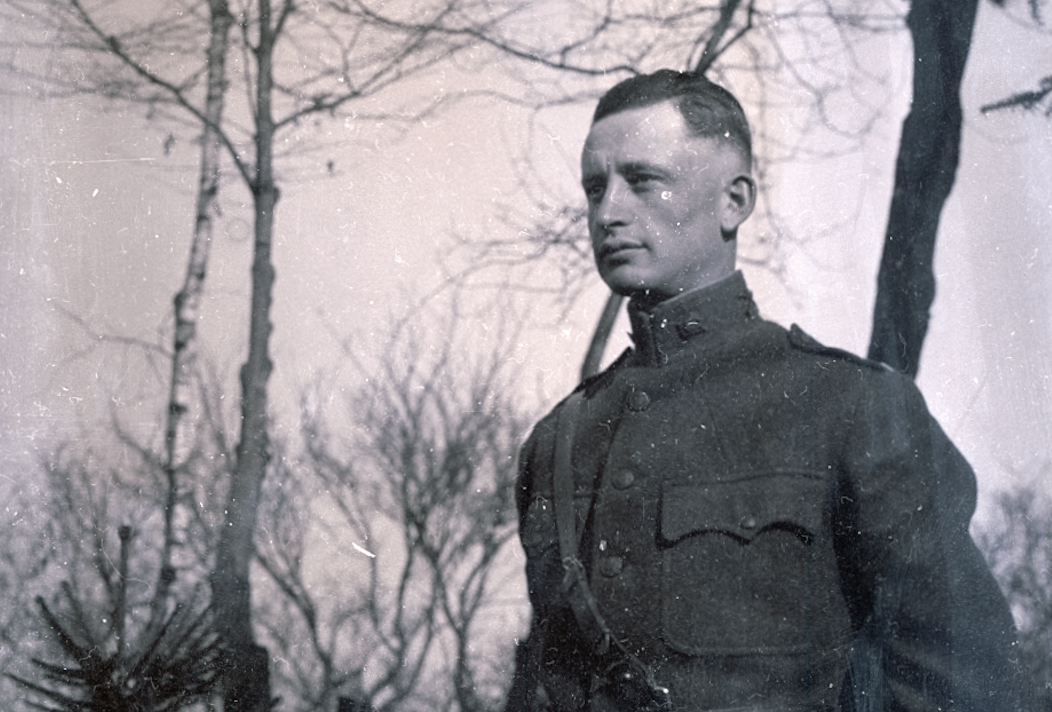
My father-in-law died in 2018 at age 100. He’d been born in the spring of 1918, and he never knew his father, who is pictured above. I’ll call him William; he was a second lieutenant in the Rainbow Division, which had been hastily assembled from multiple states’ national guards when the United States entered World War I.
William served with distinction in Black Jack Pershing’s American Expeditionary Force. But he didn’t live to see the Armistice; he died in August 1918 when his son (also named William) was about four months old.
Donald Trump, I’m sure, would call him a sucker and a loser. He turned down opportunities to avoid serving in the War, choosing instead to fight alongside his fellow Rainbows. In honor of Armistice Day, here’s a short version of his remarkable story.
William was a young executive with a bright future at the Goodyear Tire and Rubber Company. He got married in the spring of 1917. In July, he was called to active duty with the newly-formed 42nd Army Division, the Rainbows.
Historical background: The Allies and Germans had been in a stalemate since 1914, and the Western Front had become a hellscape of mud, corpses, and ruined cities and towns. In March 1917, the Tsarist Russian government fell apart. This allowed Germany to concentrate its forces on the Western Front and threaten to turn the tide of the war. The U.S. was the counterbalance the Allies needed, but was completely unprepared to enter a global conflict. The pressure was on to get a fighting army into the field as quickly as possible.
After a summer of training in northern Ohio and Long Island, the Rainbows departed for Europe on a hastily converted cargo ship — because the U.S. had nothing like an actual Navy either. It was an unimaginably rough crossing that took two weeks; the Rainbows disembarked at a French port city in early November.
The ensuing months involved no battle but many hardships. The Americans were shuffled around central and northern France, being transported in train cars meant for horses, marching long distances (sometimes with no clear goal in mind), and endured battle training in one of the coldest winters in years. Their sleeping quarters were, more often than not, in rural barns not meant for human habitation. An unknown doughboy wrote a long poem about the accommodations; here’s a sample.
I’ve slept with horse and sad-eyed cow,
I’ve dreamed in peace with bearded goat,
I’ve laid my head on the rusty plow,
And with the pig shared table d’hote.
I’ve chased the supple, leaping flea
As o’er my outstretched form he sped,
And heard the sneering rooster’s crow
When I chased the rabbit from my bed.…And when morning, damp and raw,
Arrived at least as if by chance,
I’ve crawled from out the rancid straw
And cursed the stable barns of France.
The Rainbows finally entered the Front in the spring of 1918. Life in the trenches consisted of long stretches of tedium punctuated by random bursts of deadly peril, and the kind of living conditions William described in a letter to his wife back home:
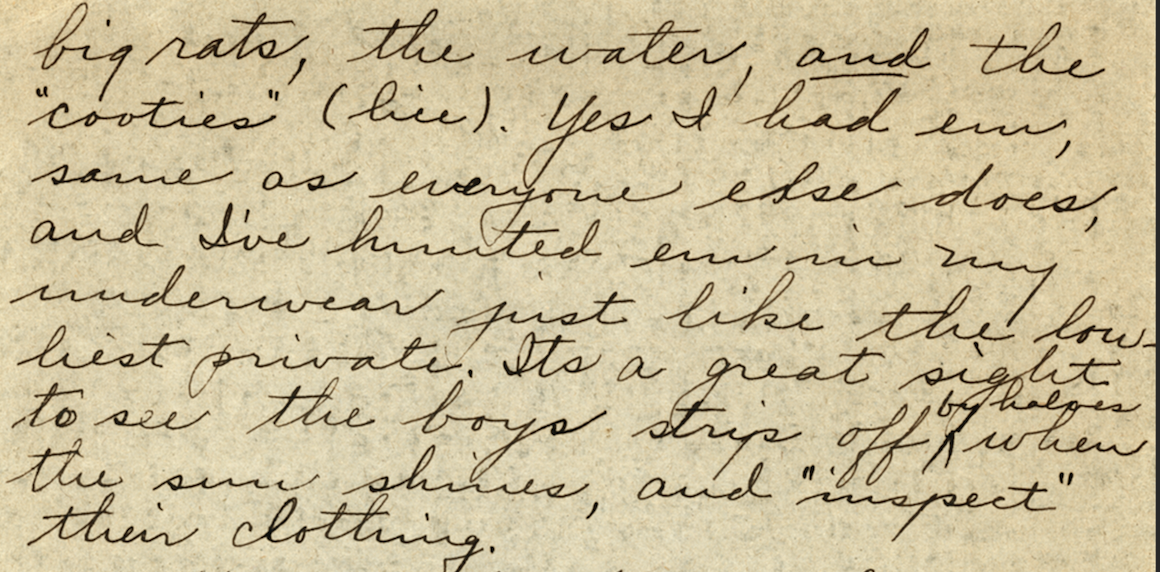
The result of all these hardships: The AEF lost far more duty time to illness than to battle injuries.
In May, WIlliam received letters from home with news of his son’s birth and pictures of the newborn. Also that spring, the AEF offered William the chance to return stateside and become a teacher/trainer for the military. They thought that highly of his intelligence and leadership skills. He turned down the offer, preferring to stay and fight alongside his comrades.
Spring turned to summer, and the AEF entered active fighting for the first time. Initially, the Allied effort was aimed at rebuffing a last-ditch German offensive. Then came a long series of deadly battles, slowly pushing the Germans out of the front lines and through well-prepared defensive positions to the north and east.
At this point the end was inevitable; the Germans were low on food and had no reserve troops to speak of. But they fought for every inch, and the fighting raged on for months.
In late July, the Rainbows entered the action in the Aisne-Marne Offensive, along a 12-mile front through the villages, fields, and forests of northern France. The Americans slowly beat back the Germans, but every inch was gained at great cost.
On August 2, William — who’d received a battlefield promotion to first lieutenant — led his men through a field north of the village of Seringes-et-Nesles, which had been the site of fierce house-to-house fighting. As they crested a slight ridge, they came under fire from prepared German positions in the town of Mareuil-en-Dôle. William was killed by a German shell; he was buried temporarily in a nearby forest, and eventually moved to the Oise-Aisne American Cemetery.
We have visited his grave. In fact, thanks to an amateur historian based in Château-Thierry, we have followed the path of William’s final days, stood on the ridge where he died, and walked through the forest where he was initially buried.
Before and after our trip to northern France, I did a lot of research into William’s service. It was an incredibly rewarding experience, which I would recommend to anyone whose forbears have served our country. It does give you a real, human sense of the sacrifices that have been made on behalf of the rest of us — and a taste of real patriotism, not the lapel-pin-and-pocket-Constitution variety characteristic of today’s leaders and politicians, many of whom did their level best to avoid any personal commitment to preserving America.


John –
What a moving story – thank you for sharing on Veteran’s Day 2024.
My grandfather served in the WWI balloon corps and was shot down close to where your William was fighting. My grandfather survived but his surveillance partner, Ross, died as his parachute caught fire. Ross is buried in the same graveyard as your William.
Alison
Alison Clarkson
Vermont State Senator, Majority Leader
Windsor County District