Category Archives: Economy

Mr. Empty Suit steps to the mic

“I’ve got plenty of great ideas.”

So said Republican Scott Milne during Saturday’s gubernatorial debate. His comment came after Governor Shumlin repeatedly slammed his failure to give “us one single plan” on a variety of issues.

And then Milne, predictably, failed to name any ideas.

Well, he did have one: a two-year cap on property taxes, which would put public school into a dire budget situation because many of their costs will continue to rise. It’d force spending cuts from the top down, the very opposite of his claim to be in favor of local decision-making. But hey, at least it was an idea.

Otherwise, nothing much. At another point he said “I’ve got two ideas.” The first was that the Governor had spent too much time out of state. Which is not an idea; it’s an attack.. The second was the property tax cap.

Sigh.

As I said in an earlier comment, Milne managed to exceed the minimal standard of competence, e.g. he didn’t poop his pants. Shows you how dismal his campaign has been, that keeping his shorts clean seems like an accomplishment.

As for actually putting forward an inspiring message, nope. Not at all. He hammered repeatedly on the same old attack lines he’s used since launching his campaign: Shumlin is “the most progressive, radical Governor” who insists on pursing single-payer health care. Milne’s idea for health care reform?

“I will be working very hard with people to get something figured out.”

That is, word for word, what Scott Milne actually said.

On trying to keep young people in Vermont, his only contribution was to assert that the Shumlin Administration “has not been business friendly,” and Vermont needs “a new tone” in its dealings with business. F-sharp, perhaps?

When asked about problems at the Agency for Human Services, he pivoted back to his attack on the troubled rollout of Vermont Health Connect, and cited it as an example of poor management. When he actually addressed AHS, he said we need an agency that “puts the family first.” How imaginative.

When asked about cutting state spending, he gave a halfhearted shoutout to the discredited Challenges for Change initiative, then said “I’m not into cutting,” and then said property taxes are too high.

Confused?

In his closing statement, Milne referenced his late mother Marion’s run for State House in 1994 when, as Milne tells it, a local politico gave her no chance to win. But she ran anyway and won. And so can Scott Milne, if people only believe. And he closed with a bombshell: “Vermont needs a different path. I believe it needs a more moderate path.”

Having, once again, failed to give any real hint of his preferred path for Vermont. It’s been defined almost entirely in the negative: He wouldn’t repeat the alleged mistakes of Governor Shumlin.

And, as I reported earlier, he’s postponed a meeting with VTDigger’s editorial board because his platform isn’t ready yet.

Scott MIlne’s campaign is very close to flat broke. Its campaign manager just resigned. The best you can say about Milne’s debate performance is that he didn’t flame out. But he did nothing to advance his campaign, to provide a substantive option to Shumlin. Or to Dan Feliciano, for that matter.

He did okay by his standards, but that’s not nearly good enough.

Scott v. Corren, round one: a spirited, informative debate

The two major-party candidates for Lieutenant Governor stood their ground and clearly articulated their positions in their first debate this morning. Incumbent Republican Phil Scott and Prog/Dem Dean Corren debated on WDEVs Mark Johnson Show, broadcasting from a windy, chilly Tunbridge World’s Fair.

(Johnson has posted the audio as a podcast for your listening pleasure. Also, the video is available here, thanks to CCTV.)

Scott and Corren provided the voters with a clear choice… although the Scott option involves his usual bobbing and weaving on the issues. But that’s Phil Scott, and he said as much in his closing statement: if you like the job I’ve been doing, I promise two more years of the same. Corren made a strong, understandable case for his progressive agenda, particularly single-payer health care.

Neither candidate made any notable stumbles. If you went in a Phil Scott fan, you almost certainly left as one. Ditto Dean Corren. Undecideds were given a lot to think about, and a clear choice between two contrasting styles and philosophies.

I also have to say a word on behalf of host/moderator Mark Johnson. He conducted the proceedings without a hard-and-fast format, which often results in a stilted faux-conversation; instead, Johnson was able to maintain a flow and pursue follow-up questions as he saw fit.

The first half of the debate was dominated by health care reform, and especially whether to

Dean & Pete: Best buds

Dean & Pete: Best buds

pursue single-payer. That was to Corren’s advantage; since he has a clear position.

He began with the fiscal case for single-payer. He argued that single-payer would be simpler than the former or current system, and far better for controlling health care costs. It will require new taxes, he acknowledged, but the current system is extremely burdensome; single-payer will reduce the overall burden. As Lieutenant Governor, he would be an advocate for single-payer, communicating its virtues and being a “watchdog” to ensure that the details are done correctly.

Cost control efforts have failed, Corren argued, because no one entity has full control over all the costs. If a reform cuts costs in one area, those costs are actually shifted to an unregulated area. Single-payer would allow for a unified effort to cut costs.

Phil & Pete: Best buds

Phil & Pete: Best buds

Scott remains “skeptical” — his favorite word, as he himself admitted. He wants to see the details before making a decision on single-payer, but he clearly prefers to stick with the current system instead. Which involved a bit of tortured logic: he said that the rollout of Vermont Health Connect has been “disastrous,” but that nonetheless, having a health care exchange “makes sense.”

He also said that reform may be difficult because Vermont is such a small state, and offered the idea of a tri-state insurance “coalition” involving Vermont, New Hampshire, and Maine.  Not sure he articulated the advantage of such an approach, but there you go.

Personality and approach: Scott kinda tried to have it both ways — but hey, that’s the way he is. He played up the advantage of his “collaborative” approach but also claimed that “I stick to my guns.” When asked to cite an example of an issue he feels strongly about, he offered the environment and growing the economy. Not a convincing display of passion or principle; everybody is in favor of both. The devil is in the details.

Corren portrayed himself as a strong progressive voice on the issues. As such, he’d be a valuable part of Governor Shumlin’s team. But at the same time, he’d be independent enough to take stands when he sees fit. As such, he argued, he’d be a better “watchdog” over health care reform than Scott because he truly wants it to be successful: “We need a Lieutenant Governor who will work for reform, not be skeptical.”

Party problems: When asked about past differences between Progs and Dems, including his own criticism of the Dems, he said that was all behind him, and asserted that the Democratic Party and the electorate in general have moved to the left, making a better fit between D and P. “I feel very comfortable working with the Democrats,” he said. “I’m proud of what the Democratic majority has done.”

Scott was asked why the Republican Party struggled so much in Vermont. He blamed perceptions of the national party’s stands, especially on social issues. He said the “core of Vermont Republlicanism” was embodied by leaders like George Aiken, Bob Stafford, and Jim Jeffords, and said “We lost that, and we need to refocus.”

Property taxes and school funding: Scott said he was “disappointed in the Legislature” for failing to tackle the issue this year. He said “we need to do it,” but acknowledged that “it’s difficult.” He said that education costs need to be brought under control and acknowledged that might require some school consolidation. But he said it should be on a “case by case basis” instead of an overall mandate.

Corren said the school funding system has hurt the middle class more than anyone; the wealthy pay a smaller proportion on a per capita basis, and income sensitivity eases the burden on poor and working Vermonters. He advocated expanding income sensitivity to the entire populace — which would presumably shift some of the burden upward. He also pointed out that health care is perhaps the biggest driver of school cost increases, and again stumped for single-payer.

Energy. Corren is a strong proponent of developing renewables, including wind. He referred to the “imagined horrors” of living near wind farms, which won’t make him any friends in the Annette Smith camp. He did say that the state should have a clear plan that includes specific areas where wind should be developed and where it should not.

Scott is, to use his favorite word, a wind power “skeptic.” He declared himself a “big proponent of renewable energy,” but emphasized solar power over wind. He repeated his earlier support for a moratorium on new wind projects.

On the Vermont Gas pipeline, Scott tried to have it both ways, expressing his support for the project as a “bridge to the future,” but also supporting a second look at the project by the Public Service Board. Corren declared himself a “skeptic,” saying the economic and environmental benefits of the pipeline are “not proven.”

Children and DCF: Neither candidate had much to offer. Corren said that “problems persist” but acknowledged that he’s “not sure what to do.” Scott said that the Department of Children and Families is full of “good people doing good work,” and wondered if they needed more resources without committing to it. And he returned to his hobby-horse of economic development, arguing that the “affordability crisis” puts more “stress on families.”

Top priorities: As a closing question, Johnson asked each man what they would pledge to do in the next two years.

Corren: He would “work on the details of health care reform, and make sure we have a sustainable plan.” He also promised to work on jobs and development, particularly in the renewable energy sector. He sees that as a major growth opportunity for Vermont.

Scott promised “the same thing as in the past. A collaborative effort to bring people together as a team to move Vermont forward.”

And then, given the last word, he fired a shot at the Democrats. In the last legislative session, he said, there were hundreds of bills, but only about 20 of them had to do with growing the economy. And most of those, he added, failed to pass.

The truth of that assertion probably depends on your definition of bills that have to do with the economy. But Corren didn’t have the chance to respond.

With that, the debate was over. I have to say that, thanks to Johnson’s stellar work as moderator and two candidates who can articulate their positions well, it was one of the more informative debates I’ve ever heard. Too bad there will only be three more, thanks to Phil Scott’s reluctance.

Still a publicity stunt

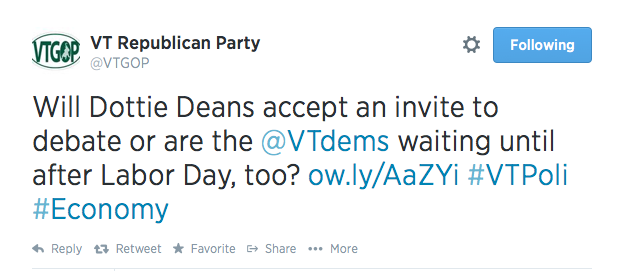
VTGOP Chair “Super Dave” Sunderland continues to push his hokey “challenge” to meet his Dem counterpart, Dottie Deans, for a debate on the Vermont economy. He first threw down the gauntlet in a letter dated July 10, and has occasionally refreshed it via Twitter ever since. Last night, for instance:

Screen Shot 2014-08-12 at 8.30.24 AM

Funny, it hasn’t drawn a reply from Deans, nor has it attracted the slightest interest from the Vermont media. Pretty sure I’m the only person who’s reported it (outside of GOP circles), and that’s only been to make fun of it.

Because it’s a publicity stunt, and Super Dave knows it. He knew from the start that Deans wouldn’t respond. He was just hoping for a little free publicity, or simply for the chance to call Deans a coward.

Which she isn’t, not at all. She’s kinda busy these days, having a strong party apparatus and a robust staff to manage. I realize that Super Dave is just kinda rattling around in his largely empty VTGOP headquarters (paid staff: TWO, and both probably part time*) and thus has time to issue bogus challenges. And I realize that he’s grasping at straws for free media. But he knows that it’s not the party chair’s job to engage in public debates.

*Considering that “Victory Coordinator” Jeff Bartley is still on staff at the Tarrant family firm MyWebGrocer and, per his Twitter feed, recently took a trip to Disney World, I doubt that he’s got his shoulder to the campaign wheel 24/7. 

The party chair is responsible for the organization, administration, and growth of a party’s infrastructure. It’s a big job, and it’s primarily done behind the scenes. Dottie Deans knows what her job is, and what it isn’t. You’ll note that, as reflected in the above Tweet, she doesn’t even have a Twitter account of her own. If Super Dave hasn’t achieved a similar level of clarity about his own responsibilities, well, that’s his lookout.

Besides, there’d be little public interest in a debate between two party chairs. The vast majority of voters see high-profile candidates as a party’s public face, not some internal functionary. Voters will pay attention to the Shumlin/Milne debates this fall. They would have no reason to watch a debate between two people who are not running for any office where they might actually affect public policy. 

So it’s a publicity stunt, then, now, and forever.

Art Woolf spews numbers, provides zero insight

In the past, I’ve given UVM economist Art Woolf two nicknames: Vermont’s Loudest Economist, for his inescapable media presence; and Vermont’s Laziest Economist, for his thoroughly conventional views. Well, now I’ve got a new one: The Human Almanac.

In addition to (Lord help us) educating the next generation of UVM students, Woolf also does a lot of corporate consulting, publishes a costly newsletter, and writes a weekly column in the Burlington Free Press. The latter is where I see his work, and it’s consistently unimpressive. The typical Woolf column includes an oversized chart or graph (to fill space), a shallow review of statistics, and/or a bit of thoroughly conventional wisdom, all served up in a few hundred words.

In his last two columns, he didn’t even bother injecting a bit o’ the old C.W. They were just bland overviews, free of any context or insight.

This week’s entry is “Vermont Fertility Rate 15% Lower Than U.S.” And, well, that title just about covers it. The column is full of shameless padding, like this:

The average Vermont woman will have 1.6 babies over her lifetime. …Of course, no one has six-tenths of a baby, but when we’re dealing with large numbers of women, and large numbers of babies, fractions and decimals do play a role.

Do tell, Art. I was picturing a landscape littered with partial baby corpses. Glad you set me straight.

He also stretches the content with a parade of irrelevant, or marginally relevant, statistics:

The fertility rate for the U.S. as a whole is 1.9 babies per woman over her lifetime, so Vermont’s fertility rate is about 15 percent below the U.S. average. By contrast, Utah, the state with the highest fertility rate, is 25 percent above the national average.

It’s like a high school student writing a five-page paper.

The “bulk” of the column is given over to a recitation of current and past numbers from the US and the world, followed by one paragraph listing possible reasons why Vermont might have a low fertility rate. That paragraph ends with:

We really don’t know the full reasons.

For this, we need an expert?

Woolf wraps things up with this thrilling conclusion: low fertility has consequences for the economy.

Last week’s entry in the Woolf oeuvre was even less meaty “Vermont Immigration patterns Differ From U.S.

Stop the presses!!!!!

Do you mean to tell me that Vermont has fewer immigrants from Latin America than, say, Florida or Texas? I am shocked, shocked.

But yes, that’s the knowledge bombshell Woolf drops on our heads: Vermont gets relatively few immigrants, and most of ’em are from Canada or Europe. No shit, Sherlock.

Woolf doesn’t even try to contextualize this nothingburger of a column. The big conclusion reads like this:

Sometimes it’s hard for Vermonters to understand why the concerns and passions about immigration run so deep. One reason is that our immigrant population, and our experience with immigrants, is very different than it is in the rest of the United States.

I really, really hope that Woolf’s own ($150 per year plus tax) newsletter has more to offer than his Freeploid blurts. For that matter, I hope he’s doing some more substantive academic work to justify his UVM sinecure. Because judging by his newspaper columns, Art Woolf is a man without substance.

Essex Junction’s negative equity

Oh, here’s some good news on IBM’s facility in Essex, courtesy of Bloomberg. 

IBM was willing to pay Globalfoundries Inc. to take on IBM’s money-losing chip-manufacturing operations, according to a person familiar with the process.

IBM was offering about $1 billion to persuade Globalfoundries to take the unit, said the person, who asked not to be identified because the negotiations were private. Globalfoundries wanted to be paid about $2 billion, enough to offset the division’s losses, the person said.

Okay, first we’ll posit that IBM’s chip division includes other plants besides Essex, so we can’t blame that plant alone for IBM’s negative equity. But it is a stark reminder that Essex and IBM’s other chip operations are basically dead weight. And now that Globafoundries has withdrawn from the bidding, IBM is desperate to unload the division:

IBM’s willingness to pay underscores the urgency for Chief Executive Officer Ginni Rometty to get less profitable businesses off the books.

Rometty’s top priority is to reverse recent losses, and hit very ambitious earnings targets by 2015. Er, that’s five months from now.

To stay competitive in manufacturing, IBM may have to invest billions of dollars to keep its plants up to date with newer chip technology. IBM’s East Fishkill location cost $2.5 billion to build.

We’re talkin’ billions of losses and/or risky investments in a market that IBM has basically lost to Intel. When you compare that awful reality to Vermont’s potential offer of a few million bucks in incentives, you see the scope of the problem and the almost complete inability of li’l ol’ Vermont to make a difference. Somehow I don’t think resurrecting the Circumferential Highway or another cut in electricity rates will save this sinking ship. Nor would the more business-friendly “tone” that Scott Milne keeps promising. And it’s hard to see what the Shumlin Administration, or any other administration, could possibly do in the face of such dismal market realities.

The Milne Transcripts, part 6: The supreme importance of tone

Yet another installment in my reports on Scott Milne’s rather disastrous July 25 appearance on WDEV Radio’s Mark Johnson Show. It was his first in-depth interview since formally launching his campaign for Governor. As such, it provides a window on the motivations, priorities, and political skills of the likely Republican nominee. 

Vermont Yankee wasn’t on Mark Johnson’s agenda. After all, it’s a fait accompli; Entergy stopped fighting to keep VY open when low natural-gas prices made it a financial loser, and a closing date has been announced. But Milne brought it up unbidden while trying to deflect attention away from a very unflattering discussion of health care reform, in which he appeared to confuse Vermont Health Connect with single-payer health care. (The former is operational, albeit troubled; the latter is Governor Shumlin’s yet-unattained Holy Grail.)

Milne was critical, not necessarily of the shutdown itself — he remained carefully neutral on that — but on the Shumlin Administration’s “tone.” Which, it seems, is one of the biggest bones Milne has to pick with his prospective opponent.

The tone and the style with which the Shumlin Administration went forward with that… we’re going to end up with a nuclear toxic slum on the banks of the CT River for probably 65 years or whatever the maximum decommissioning time is.

…Iif we had a Governor who was much more, in tone, business-friendly and working cooperatively to fix problems even with people that you disagree with, we could have given them a license extension. In exchange, gotten them to pony up the money for the rapid decommissioning.

Mmm, yeah, a couple problems with that. First, Entergy has never shown any willingness to adequately fund VY’s decommissioning; they’ve always played for the maximum amount of time. Given Entergy’s track record, it’s extremely doubtful that a different “tone” would have induced them to agree to a very costly proposition.

Second, Entergy stopped fighting for VY because it had become a financial drain. Why would they agree to commit hundreds of millions of dollars to the decommissioning find at a time when VY was already hurting their bottom line?

For Scott Milne to believe he could have convinced them otherwise reveals a dangerous combination of naivete and unfamiliarity with the issue.

Speaking of naivete, MIlne apparently believes that a different “tone” is all we need to make Vermont a growing, prosperous economic miracle. He’s harshly critical of Shumlin’s economic record, but when asked how he’d do things differently, this is what he comes up with:

Our primary, um, fix that we’re going to offer to Vermont is, uh, a much better tone and friendly tone towards business, and then some specific plans about how to attract business and keep business in Vermont.

His “primary fix” is a “better tone.” He’s vaguely promising “some specific plans” somewhere down the road, but his #1 solution to our economic troubles is a “better tone.”

I dunno. To me, and to many liberals and progressives, Governor Shumlin is awfully solicitous of the business community. He seeks their input, he listens to them, someties he shapes his policies to accommodate their concerns… and he’s certainly attracted more than a Democrat’s usual share of donations from Vermont businesspeople. Indeed, perhaps the biggest reason for the Republicans’ financial woes is that Shumlin has co-opted many of their usual big-money donors. If Shumlin is such a negative for business, why aren’t businesspeople trying harder to unseat him?

Besides, “tone” by itself is nothing. The “tone” makes a difference only as it affects your policies — say, kneecapping Act 250 or otherwise easing regulatory processes. For Milne to call for a new “tone” as the “primary fix” strikes me as disingenuous. He’s presenting himself as a moderate, so the last thing he wants to do is offer detailed pro-business policies. That’d give away the game. Instead, he talks of “tone,” and sounds a bit like a fool in doing so.

The Milne Transcripts, part 5: I’m not telling you

The latest in my series of posts about Scott Milne’s epically bad July 25 appearance on WDEV’s Mark Johnson Show. Not only is he not ready for prime time, he’s not ready for 9 a.m. on a weekday. 

If the late Fred Tuttle was the Man With A Plan, then Scott Milne, Republican candidate for Governor, seems to be the Man Without A Plan. Time after time during the interview, he refused to take positions on important issues. He deferred until September or even until after the election; he said issues were too complicated for him to immediately answer.

His usual excuse was that he’s only been running for a short time. “I’m new to this game,” he told Johnson at one point, “I should get 30 days.” This is a reference to his campaign strategy: August is for attacking the Shumlin Administration, and September is for unveiling his own policies.

Well, I can sympathize with a candidate who’s just getting started — but whose fault is that? Which inexperienced candidate waited until the last possible moment to launch his campaign?

Er, that would be Scott Milne.

It’s like an actor who agrees on short notice to step into the lead role in a play, but when the curtain rises on Opening Night, he tells the audience he needs more time to learn the part because “I’m new to this game.” You think the audience would walk out?

Sorry, Mr. Milne. You signed up for this. You knew the calendar. The lights are up, the curtain is drawn, and you’re on.

Let’s look at his platform of procrastination, shall we?

— On health care reform, he refused to take a stand on the concept of single-payer (although he also called single-payer “reckless” more than once, so take your pick):

The single-payer is clearly something that we’ll be continuing to look at, and talk to the folks that I’m talking closely with now, and we’ll have some more specific ideas on that before the election.

— He calls Vermont’s economy his top priority. What will he do? “We’ll have a plan for fixing the economy” before Election Day. But he did offer a hint about his plan — albeit a useless one:

Our primary, um, fix that we’re going to offer to Vermont is, uh, a much better tone and friendly tone towards business, and then some specific plans about how to attract business and keep business in Vermont.

Aha. His “primary fix” is a better “tone.” Which makes sense; his primary criticism of Shumlin is the “unfriendly tone” toward business. If we just adopted a better “tone,” our economy would shoot through the roof.

— At one point, a caller asked about the then-extant possibility that Vermont would temporarily house some of the immigrant chlldren who have crossed into the US. He began with some good hemming and hawing:

The, um, situation of, ah, folks coming into, ah, Vermont from Central America is, is a really tough one.

After that inarticulate start, detoured into a standard Republican attack on President Obama, filled with ums, ahs, awkward pauses, and even a “Holy Shamoley,” before Johnson prompted him to answer the actual question.

Uh, I don’t know yet. I mean, I’m not going to jump up and down and say no. … I think it’s a complicated decision that deserves a lot of thought.

And then he patted himself on the back for having no opinion on the issue — because taking a stand would be the easy thing to do. Uh-huh. Also the leaderly thing to do.

— On the vexing subject of reforming public-school funding and organization, Milne plans an even bigger dose of delay:

I don’t think we’re going to have a specific plan before the election. What I’ve promised is, there’ll be a plan from the Milne Administration in the House and Senate in the first half of the biennium.

I can understand why he doesn’t want to stake a position during the campaign; the issue’s a toughie, and he’d be alienating some voters no matter what he said. But again, not exactly Leadership in Action.

All this deferral makes Scott Milne look weak. It’s even worse when he sounds weak as well: his voice hesitant, his sentences often incomplete and littered with “ums” and “ahs.”

Scott Milne posits his procrastination as The Big Plan: the “August Strategy” of attacking, the “September Strategy” of revealing his own ideas. I would argue that this is completely ass-backward: Now is the time when Scott Milne has the stage to himself, because Governor Shumlin won’t formally start the campaign until after Labor Day. Milne should be rolling out his proposals this month, and engage the Governor in September and October, when the two men will be sharing the stage.

Of course, the September Strategy is a convenient rationale for a candidate who’s just getting his feet wet and hasn’t worked his way through the issues. He said so himself, frequently referring to “the people I’m talking to” as he formulates his own views.

Not a good look for a man claiming to offer “leadership.”

Best get crackin’, Mr. Milne. You’re on stage, you’re fumbling it, and you’re losing the audience.

The Milne Transcripts, part 1: An inauspicious beginning

On Friday July 25, Scott Milne sat down for his first extensive media interview since launching his Republican candidacy for Governor. He was a guest on The Mark Johnson Show on WDEV Radio; Mark has archived the interview as a podcast. 

It’s a rich vein of material, and I’ll be rolling it out in sections over the next couple of days. I’ve transcribed the first 15 minutes so far, working my way through dense overgrowths of verbiage and sudden shifts of topic, delivered in a quick, stumbly, nervous monotone.

Let me pause here and say that I have a lot of respect for Scott Milne the businessman, and I appreciate his courage in taking on the thankless task of challenging Governor Shumlin. And just as he doesn’t mean to “vilify” Shumlin by referring to him as brazen, bullying, headstrong, radical, and ultra-progressive, I don’t mean to vilify Milne when I say that his performance was so inept as to be almost unlistenable, or that his campaign is off to a terrible, horrible, really bad start, or that any chance he had of mounting a serious challenge to the Governor has already evaporated like the mist of a midsummer morning. Nor when I call him the political equivalent to the 1962 Mets.

Nope, no vilification here.

He came across as a — well, here’s a choice quote:

I’m more interested in the campaign, making sure I’m out meeting Vermonters and reconfirming the reason I got into the race, which is a real fear of the direction the Shumlin Administration is taking the state, and the need for a, hopefully what the people will judge me as an articulate voice of opposition to that. 

Emphasis mine. “Articulate voice of opposition,” my Aunt Fanny.

Milne is a novice to the big political stage, and it may seem unfair to criticize his first sally. But good grief, he put himself in this position by jumping into the race at the last minute. He has no time for missteps, and he surely has no time for on-the-job training. He needed to hit the ground running with a coherent, convincing narrative. Instead, he’s hit the ground face first.

Want more? Oh Lord, there’s more.

There are some real problems with the economy in Vermont, there’s some real lack of leadership from the Shumlin Administration over the last four, or I would argue six years, ’cause he spent his last two years as President Pro Tem of the Senate really running for Governor. So he’s got six years into this, he still can’t even tell us too much about how he’s going to pay for VHC, to say nothing about taking accountability for the total mismanagement of it.

“Six years.”

Peter Shumlin’s been Governor since January 2011. Three and a half years. I don’t know what Milne is hoping to pull off with this six-year bit — which he also hammered home in a media scrum after his campaign launch. It’s transparently phony and unconvincing.

Milne then pivoted to another talking point, delivered with the same skill and grace.

Secondly, we’ve got this big problem with the school system, and we’ve got a Governor who, between vacations in Bimini or wherever his Caribbean vacation home is, and flyin’ all over the country to raise money from special interest groups, he found all kinds of time to do that during the Legislative session, but didn’t find the time or the need to roll up his shirtsleeves, walk across from the Pavilion fifth floor to the Capitol, sit down with House and Senate leaders and get something on the table that’s going to restructure property taxes so that, you know, you’re talking about my announcement in Barre, I stopped at Central Market, which has been there for at least two generations, I stopped in there for a coffee on my way over to my announcement on Wednesday at the Aldrich Public Library, ran into three people all of whom supported me emotionally, all of whom live in Florida and don’t live in Vermont anymore.

You can practically smell the smoke when he shifts mental gears from one talking point to another. He sounds like he’s been stuffed full of briefing notes and hasn’t had time to digest them. They just come spewing out in raggedy chunks whenever he opens his mouth.

Again, I am not vilifying Scott Milne, whom I respect as a person and businessman.

That’s enough for part 1. Coming up in the second installment: Milne makes a striking accusation against Governor Shumlin, the man he is not at all vilifying. And he provides not a speck of evidence.

Stay tuned, and getcha popcorn ready.