Tag Archives: Peter Shumlin

You never know what’s gonna stick

Funny thing about blogging. You put a lot of stuff out there, and you have no idea what will make a lasting impact and what will sink like a stone. I’ve had my share of stories I thought were important, but saw them vanish without a trace. My cogent analyses of current politics? In one collective ear and out the other.

And then there’s a little offhand thing I posted in January 2013 after a gubernatorial news conference. At the time, Governor Shumlin had just proposed a tax on break-open tickets — those small-stakes lotteries you can find at fraternal societies and many bars around Vermont. A little meaningless chat about bars and beer ensued, featuring Shumlin, Seven Days’ Paul Heintz, and Admininstration Secretary Jeb Spaulding…

Heintz: Do you ever play the break-open tickets?

Shumlin: Oh yeah, anyone who drinks beer has played break-open tickets.

Heintz: I drink a lot of beer, and I haven’t played any.

Shumlin: Oh yeah? Well, you’re not drinkin’ in the right place.

Jeb Spaulding: You’re drinking those five-dollar beers.

Heintz: Where do you buy them?

Shumlin: Oh, you can get ’em at any club or bar in Vermont. I’m a Windham County boy, so I’ve played ’em in Windham County. Rockingham, the Elks, the Brattleboro Legion. I can take you there if you want, I’ll even buy you a beer. But you’re not gettin’ that Gucci beer. We’re drinkin’, you know, Budweiser.

Okay, I knew the Governor didn’t really mean it. When he starts droppin’ his G’s, he’s putting on his Good Old Vermonter Boy persona, painting himself as a Man of the People. I, however, seizing the opportunity to stir up a teapot tempest, wrote it up on Green Mountain Daily under the title: BREAKING… URGENT… Shumlin Disses Vermont Beer!!!

Hahaha, very funny. Got a few sideways glances from the Governor after that went viral.

Well, apparently my little jape has legs. Today, the Governor has been putting out a series of Tweets about the honestly impressive Vermont brewing sector, which is not only an artistic success but a growing part of our economy. And Neal Goswami, chief State House scribe for the Mitchell Family Organs, replied thusly…

Screen Shot 2014-07-17 at 2.29.02 PM

I am honored, sir, by my apparent inclusion in the Vermont political lexicon. It was one of the least meaningful things I ever wrote, and it’s had a larger ripple effect than any of my meaty, weighty, serious works of commentary. If I died tomorrow, they might just put “Gucci Beer Guy” on my headstone.

And the Governor might happily toss a shovelful of dirt on the casket.


Shumlination

Might seem like an oxymoron, but a radio guy has created the second-best visual representation of Governor Shumlin’s fundraising power. (VPR’s Taylor Dobbs by name.) It’s a simple bar graph: Shumlin’s money totals are indicated by two impressively erect columns reaching for the sky; Scott Milne’s are two thin smears on the bottom line.

I say “second-best” because the best comes from the legendary cartoon “Bambi Meets Godzilla.”

BambiGodzilla

There are a couple of big takeaways from the size of Shumlin’s warchest: (1) He came into 2014 with enough money to virtually guarantee re-election. He’ll exit 2014 with enough money to virtually guarantee victory in any race he chooses to enter for at least the next four years. And (2) It’s not Lenore Broughton who’s responsible for bringing big money into Vermont politics. It’s Peter Shumlin. And Peter Welch and Patrick Leahy and Bernie Sanders.

Oh, and (3) a very interesting collision is shaping up for the 2015 legislative session, with VPIRG focusing its energy on campaign finance reform and our top Democrats greatly benefiting from the system as it is.

Let’s go deeper, shall we?

First point: Shumlin departed the 2012 campaign having spent only $346,000 to beat Randy Brock. He had a surplus of $915,000. Which meant he started 2014 with basically a million-dollar head start. That’s more than had ever been spent in any state-level campaign in Vermont with, I believe, three exceptions: Jim Douglas in 2008, and Brian Dubie and Peter Shumlin in 2010.

He had a huge lead. And he has continued to raise money. And to spend very little of it. Chances are, he’ll exit 2014 with an even larger kitty — it wouldn’t surprise me if he has $1.5 million in the bank on December 31. If he tries at all, he could make it $2 million or more.

(Scott Milne has talked of Vermonters becoming fatigued by campaigns that cost $2-3 million. Which misses the point because while Shumlin’s campaign might possibly raise that much, it’ll spend only a tiny fraction of that. This will not be anything like a $2 million campaign. It may not even top a half mill.)

Which gives him an even bigger edge next time around, and ensures that he will be a prohibitive favorite for re-election in 2016 and beyond — or, if he decides to run for something else, he will be the prohibitive favorite for that race.

Unless, of course, he has to run against Peter Welch for any Senate seat that might open up between now and 2020. (Safe to assume Shumlin wouldn’t challenge Pat Leahy or Bernie Sanders, right?) Because Welch has even more money on hand, and even less reason to spend any of it.

My conclusion: the only reason Shumlin is raising money at all is to (a) make it prohibitive for anyone to run for Governor as long as he’s in office and (b) block out any potential competition for a future Senate race.

Bringing me to point #2. Lenore Broughton did her best to influence the 2012 election by spending a million bucks on Vermonters First. It was a complete flopperoo, and if her latest finance filing is any indication, she has no plans to repeat the experiment. Her case is incessantly cited by top Democrats as a rationale for campaign finance reform, but she was an outlier. And a failed outlier at that.

The real, structural change to the financing of Vermont politics is that our Governor and our members of Congress have taken fundraising to a whole new level. They are drawing from the bottomless pool of money at the national level, while everyone else in Vermont is still playing at the state level.

This fact hit home for me when I looked at the latest filing from the Coca-Cola Nonpartisan PAC for Good Government. It’s 29 pages long! The typical filing by a state-level PAC is more like five or six pages. In terms of money, it’s the difference between the Vermont Lake Monstera and the New York Yankees. And, to stretch the analogy further, that’s the field Shumlin et al. are playing on.

So if you want to complain about the influx of money into Vermont politics, don’t complain about Lenore Broughton; complain about Peter Shumlin, Pat Leahy, Peter Welch, and yes, Bernie Sanders. No one, Republican, Democrat, or Progressive, could hope to mount a competitive race when the incumbents have such an overwhelming advantage.

Third, VPIRG’s annual summer outreach program is about campaign finance reform. Last summer’s was about GMO foods, and it set the stage for easy passage of a GMO labeling bill this year. If you read the polls, campaign finance reform is a popular cause, just as GMO was. How will Shumlin and the Dems react when VPIRG drums up a groundswell of public support for a ban on contributions by corporations and lobbyists? Should be an interesting legislative battle in the new biennium.

Unlike many of my friends on the left, I don’t see many signs that the money is having a corrupting effect on the Administration. But it sure does look bad, especially when the Governor does something like strongly opposing a tax on soft drinks and then rakes in thousands of dollars from Coca-Cola, as the Burlington Free Press’ Terri Hallenbeck Tweeted today. I will say this: if you believe Shumlin is being corrupted by big money, what about Pat Leahy and Peter Welch? (I’ll give Bernie a pass on corporate donations, since he’s gotten most of his money in small amounts from individuals. But he’s still playing with millions, while most Vermont politicians get by with a few thousand at most.)

Nanobrew wishes and maple syrup dreams

Ah, Vermont. Home of picturesque farms, covered bridges, general stores, and…

…private estates with their own tennis courts.

Vermont had the largest percentage of single-family home listings boasting a residential tennis court on the real-estate website Trulia.com as of May 30.

… The percentages in every state were small: In Vermont, 0.77% of single-family home listings mentioned a tennis court. In New Mexico, it was only 0.17%. And only 0.23% of the combined listings in the 50 states included a court.

So, Vermont, yay?

This is the Other Vermont, the one concealed at the end of long private driveways behind locked gates and groves of mature trees. The one that, according to Governor Shumlin, pays more than its share of our tax burden. It was only a little more than a year ago that Shumlin was hell-bent on cutting the Earned Income Tax Credit for the working poor, while insisting that the wealthiest Vermonters were ’bout ready to flee the state if they had to pay a penny more in taxes.

You could take this surprising tennis-court factoid two ways: On the one hand, it’d be awfully hard to pack up a tennis court and take it with you. On the other, hey, if there are a lot of tennis court-laden properties on the market, perhaps the Great And Good Of Vermont are already on their way out the door. Hard to tell.

Anyway, as I reported during last spring’s tax kerfuffle, Vermont imposes a relatively high 8.95% tax rate on top earners — but because of the way we calculate taxable income, wealthy Vermonters actually pay only 5.2%. Which explains why they can afford to maintain all those expanses of carefully-manicured lawn.

That “unconventional” Milne campaign is beginning to look awfully typical

When Scott “Mr. Bunny” Milne first announced his candidacy for Governor, I had some hope that he could be a different kind of candidate: exemplifying the new, more inclusive VTGOP, and also just providing a breath of fresh air in the stale provinces of same-ol’, same-ol’ campaign tactics and rhetoric.

Welp,things aren’t looking so good.

First of all, he dipped into the VTGOP’s “talent pool” — more like a puddle, really — for his campaign manager. Brent Burns, who barely managed to last a year on the party staff, will head the Milne campaign for a reported fee of $5,000 per month. It’s cheap by Darcie Johnston standards, anyway.

And if this week’s public statements are any indication, Milne is being dragged back into a standard-issue, kneejerk negative kind of campaign. He keeps this up for a few weeks, we won’t be able to tell him from Randy Brock. Blergh.

Today, VTDigger posted an opinion piece by Milne, outlining the rationale for his candidacy. It’s full of Republican blather about restoring balance to government, even as he fires wild volleys at the Democrats which, if true, ought to disqualify them from any leadership role whatsoever. He talks of the Dems’ “headling march into the unknown,” their effort to make Vermont “the most radical state in the union every day,” and their “wild dreams” as opposed to Milne’s level-headed, “common sense” approach. “Common sense” being a patented dog whistle for Vermont Republicans, basically meaning “let’s not do anything, and let’s do it slowly.”

And then he pines for the days when he “could comfortably sleep at night, knowing that the ship of state was stable.” So, we’re supposed to believe that Shumlin’s irresponsibility has turned Milne into an insomniac, like a passenger on the Titanic whose slumber is shattered by visions of giant icebergs? That kind of rhetoric might warm the cockles of Jack Lindley’s tiny heart, but it won’t do anything to win moderates and independents to Milne’s cause.

Milne also promises that most ancient of conservative canards, “a business approach to government.” As I’ve written before, over and over again, business and government are two different things. Every time a conservative, or rich man turned politician, tries to run government like a business, he discovers that it’s impossible. Businesses are responsible to shareholders and/or customers; governments are responsible to everybody, and have to do a lot of things the private sector would never do. So please, put that tired bit of rhetoric to bed.

Today also brought another installment of the Burlington Free Press’ breathless coverage of What Will IBM Do? The Freeploid gave plenty of space to Milne’s off-the-rack criticism of Governor Shumlin for allegedly chasing Big Blue away. Milne claimed that Shumlin was a big meanie who once dared confront an IBM executive over Vermont Yankee — in 2008! But that wasn’t enough exhumation for Mr. Bunny; he also dug up the dead horse of the Circumferential Highway, for God’s sake, and beat it around some more.

He also slammed the Governor for spending his time on the GMO bill “while thousands of families’ livelihoods are at risk.” As if the Governor can’t walk and chew gum at the same time. I’m just surprised Milne didn’t bring up Shumlin’s recent four-day vacation.

It’s all typical Republican nonsense; IBM’s decisions are being made on a global level with an eye toward maximizing profit. No amount of deal-cutting or road-building or smiley faces will have the least effect on the future of the Essex Junction facility.

And of course, Milne isn’t offering any solutions profounder than a smiley face: “My tone would have been a more business-friendly tone.”

Ah yes. A friendlier tone. That’d make all the difference.

Your VTGOP: sacrificing integrity for a tired talking point

No, I didn’t seriously think the Vermont Republican Party would retract their latest news release, even after I showed it was completely without foundation. But I was a little bit hopeful that the Republicans would quietly drop the issue, rather than making fools of themselves.

But they can’t help it. In spite of my most recent blogpost (and I know a lot of top Republicans read this site), VTGOP chair “Super Dave” Sunderland continues to tout his baseless claims about Vermont’s poor showing in this year’s survey. When, in fact, Vermont hasn’t been included in the last two years’ editions due to a lack of response from Vermont business owners. The “F” came out of the 2012 survey. It’s two years old, and who knows how much has changed since then.

Plus, recall that the spring of 2012 was smack in the middle of the Tropical Storm Irene recovery. Governor Shumlin’s first-term agenda had been kicked over and strewn about like so much debris. If he’d had any plans to improve Vermont’s small business climate, he certainly hadn’t had time to implement them by spring 2012.

In fact, if you think about the timeline, you’d have to conclude that Vermont’s small business atmosphere was much more the responsibility of Shumlin’s Republican predecessor, the sainted Jim Douglas, than the current Democratic administration.

But I don’t expect Super Dave, the guy who’s allegedly making the VTGOP more inclusive and broad-based, to have a sudden attack of conscience. It’s his job, I guess, to ignore the still small voice within, and loudly publicize any possible campaign issue.

Whether or not there’s a shred of truth to his claims.

Dear @VTGOP: Please retract your most recent press release.

Vermont Republicans have been making quite a bit of hay from a recently-released survey of American small businesspeople, rating their home state’s friendliness to small business. The survey got a writeup in The Economist, which reported that Vermont got a grade of “F”. The VTGOP has been braying about this, repeatedly, on Twitter, and party chair “Super Dave” Sunderland issued a press release slamming Governor Shumlin for creating such a strongly anti-business climate.

Problem is, no such grade was ever given. The surveyors received too few responses from Vermont, so they omitted the state entirely from their 2014 report. And if the VTGOP has any integrity, it should retract the press release immediately.

Let’s start from the beginning.

Every year, a small-business online services company called Thumbtack.com conducts a Small Business Friendliness Survey, in partnership with the Ewing Marion Kauffman Foundation. It’s an unscientific poll compiling the opinions of small business owners from across the country. The idea is to hear from businesspeople themselves, the pluses and minuses of their home state’s business environment.

The Economist published a story about this year’s survey in its July 5 issue. Accompanying the story was a map of the US,with each state getting a color code related to its grade. Vermont was deep orange, signifying an “F”.

After reading this, I went to Thumbtack’s own summary, which also had a map of the US. And if you click on a state, you’re linked to a rundown of its results. On Thumbtack’s map, Vermont was light gray. And when you try to click on Vermont, nothing happens.

That’s odd, I thought. At the bottom of the page, Thumbtack offered the email address of its staff economist, Jon Lieber. So I sent him an email asking why I couldn’t access the Vermont results. His reply?

Vermont didn’t receive a grade this year because we didn’t receive enough responses from the state to credibly compare it to other states. We set a minimum response level so that we weren’t just judging noise from a handful of very happy or unhappy business owners. 2012 is the only year we were able to provide a grade for Vermont.

Which explains why no clicky-click on its map. But it doesn’t explain why The Economist, normally a reputable (if pro-business) publication, reported an “F” for Vermont. I asked Lieber about that.

It looks like they took the grades from previous years and mingled them in with grades from this year. Not exactly on point but does help provide some context for states that we were missing this year.

And indeed, in the year 2012 Vermont received an overall grade of “F”. Which is misleading, because Vermont’s overall grades ranged from “A” to “F”, with quite a few high marks. I don’t know how that averages out to an “F”, but that’s beside the point.

Which is, Vermont hasn’t received a grade in the Thumbtack survey for two years. It didn’t get an “F” or any other mark in 2014.

The error was not the Republicans’ fault. They saw the Economist writeup, and assumed (reasonably) that it was accurate. But it’s not, and now they know.

The VTGOP should immediately stop claiming otherwise and issue a clarification.

Postscript. I’ve sent an email to The Economist’s media office asking for an explanation. This seems to be very sloppy journalism. Lieber’s estimation of “Not exactly on point” is, shall we say, very charitable. If The Economist wanted to eliminate gaps by commingling this year’s survey with others, it should — at the very least — told readers what they were doing. I’ll let you know if I get a response.

Postscript II. There was one fascinating result of the survey that went entirely unmentioned by Republicans. The national survey found that two-thirds of small business owners are pretty much unconcerned with their tax burden. In fact, they believe they’re paying about the right amount. They do have concerns with government’s effect on their enterprises in other areas, but taxes? Not a problem. Kinda flies in the face of Republican dogma, doesn’t it?


There’s no need to fear. WonderBoy is here!

Semi-random thoughts upon the hiring of former Douglas Administration stalwart Neale Lunderville, who served as Governor Shumlin’s Irene Recovery Czar, as the interim GM of the Burlington Electric Department… 

— When did Lunderville become Mr. Fix-It for Democratic administrations? Is there not a single Democrat with administrative chops who could be called upon to fill a leadership void in the public sector?

— Between his two government gigs, Lunderville was co-founder of NG Advantage, a firm that deals in compressed natural gas. He was there for less than two years. When and why did he leave?

— Since the Douglas Administration came to its merciful end, Lunderville has held (if I’m counting correctly) at least four jobs. Coincidence, or is there a reason he keeps moving around? (Yes, I know the Irene gig was a short-termer from the gitgo. But even so, there seems to be a pattern here.)

— Lunderville was one of the more notable head-crackers in the Douglas Administration. How committed is he to the ideals of a publicly-owned utility? Especially one with a strong commitment to renewable energy?

— The above question is even more crucial when, according to the Burlington Free Press, “Lunderville will conduct a strategic review of BED operations.” Will his ideological bent inform his strategic review, and shape his conclusions? Hard to see how it wouldn’t.

— He is said to be BED’s interim head, with a six-to-nine-month appointment. At the same time, though, Mayor Weinberger “temporarily suspended” the search for a permanent GM. Seems an odd decision; it often takes more than nine months to fill a top administrative position. Why wait? It seems likely that either Lunderville will stay longer than expected, or BED will soon be searching for another interim GM. Are the skids being greased for Lunderville’s permanent appointment?

Just askin’. Maybe some enterprising member of our paid political media could seek answers to some of these fairly obvious questions.

One further observation. The thing I don’t like about Shumlin and Weinberger hiring a Republican for a tough management task is the same reason I don’t like it when a Democratic President hires a Republican for Defense Secretary, or a military man for a non-military administrative post. It feeds into the stereotype that liberals can’t be effective, tough-minded leaders, and can’t be trusted with critical security and military issues.

Which is nonsense on both sides: there’s no guarantee a Republican will be a good manager, there’s no guarantee a general without the protections of rank and uniform will be an effective leader, and there’s no reason to think a Democrat, or even a Progressive, couldn’t handle a critical managerial challenge or keep our country safe. When Democratic officeholders hire somone like Lunderville, leaving aside the question of his qualifications, it feeds into those stereotypes. And that, in itself, is not a good thing.


Holy moly, are Dick Mazza’s knickers in a twist

Crossposted at Green Mountain Daily.

Apparently the race for Lieutenant Governor won’t entirely be the Prog/Dem kumbaya sing that seemed likely when Governor Shumlin endorsed Progressive Dean Corren. Because here comes Dick Mazza, putative Democrat and close friend of Phil Scott, pissing in the communal punchbowl.  Peter “Mr. Microphone” Hirschfeld:

Among Corren’s Democratic detractors is state Sen. Dick Mazza, a political power broker from Grand Isle who will attempt to use his sway to thwart Corren’s bid for the nomination.

… After Democratic Gov. Peter Shumlin expressed support for Corren’s candidacy last week, Mazza says he was flooded with calls from angry pro-Scott Democrats. The result is a newly sprouted coalition of Democrats that Mazza says will work hard to deliver Scott to a third term.

Mazza is talking about an active organization to raise money for Scott and even write him in on the Democratic primary ballot.

Which would be an absolute disgrace.

I detect two strains of thought behind Democrats’ prospective betrayal. First, and relatively understandable, is that some moderate Dems would feel more ideologically at home with Phil Scott than Dean Corren. I can accept that.

What I can’t stomach is the other thing: that some Dems just hate the thought of supporting a Prog, even if there’s broad agreement on the issues.

Look, I realize I’m not a member of this Mutual Aggravation Society that some Dems and some Progs are part of. Because of past slights, real or imagined, they just can’t stand the other guys. A couple years ago a local Democrat wrote a letter to the Times Argus complaining that Shumlin had had the gall to appoint a Progressive to some state commission, and that this Dem would never again vote for Shumlin.

That kind of attitude astounds me.

Maybe if I were part of the long history of the Dem/Prog competitive coexistence I’d get it. But in this day and age, when the two parties work closely together on many issues — and many campaigns — it seems remarkably retrograde. Which is as good an adjective as any to describe Dick Mazza, Senator For Life and Friend Of Phil.


All right, who asked Tommy One-Note for an encore?

It’s been awhile since Tom Pelham, self-proclaimed prophet of fiscal restraint, graced us with one of his interchangeable opinion pieces. But here he comes again, with yet another screed on Vermont’s impending financial doom.

Hey, you keep repeating it, it’s gotta be right sometime, no?

The latest installment, entitled “Inevitable Consequences,” is all about the same stuff as every other Tom Pelham wheeze: the state is on the edge of the abyss because we (by which he means profligate Democrats) are spending beyond our means.

Republicans have, of course, been singing this identical tune for several years now. We are still waiting for the cataclysm to arrive. But hey, they keep repeating it, they’ve gotta be right sometime, no?

Tommy One-Note begins with his one and only guiding principle of governance: “sustainable spending requires that growth in government spending reasonably equate to growth in the underlying economy.” Which is an absurdly dogmatic approach to government, or anything else. But more on that later.

He cites an array of statistics in support of his case that Vermont’s population is stagnant, while public sector spending continues to grow. He sees the gap growing wider and wider until it becomes an unbridgeable chasm.

And you’ll never guess what his solution is.

That’s right, Challenges for Change, the discredited Douglas Administration initiative for which Tom Pelham is the sole remaining cheerleader. There’s good reason for that: Challenges for Change was a bust. 

Before he became Governor, Peter Shumlin was a notable proponent of CFC, touting it as “a great success.” But when he was actually running the joint, he discovered that CFC was a hollow shell, whose projected savings “may not likely be realized.” CFC had fallen far short of its goal in FY 2011, and there was no evidence it would suddenly kick into gear.

“It was a big disappointment and a failure,” Sen. Vince Illuzzi, the Republican chairman of the Senate Committee on Economic Development said last week. “We would have saved time and money if we had simply trimmed all departments’ budgets by 2 to 3 percent.”

And a top House Republican, Patti Komline, called CFC “smoke and mirrors” and “a dismal failure.”

In short, the abandonment of CFC was not, as Pelham claims, due to a lack of fiscal restraint by governing liberals; it was a bipartisan dismissal of a failed experiment. And yet, Pelham still clings to those savings estimates that had lost credibility among virtually everyone not named Tom Pelham.

That’s not the end of Pelham’s myopic approach to budgeting. He says that state spending has risen in spite of a shrinking workforce and a sluggish economic recovery. His reasoning includes the  unstated assumption that, if the state had spent less money, the Vermont economy would have performed exactly the same.

Which is nonsense. Many states fell into the trap of cutting spending in mid-recession, and were rewarded with even slower growth in jobs, production, and tax revenue. Pelham appears to believe that the “extra” money spent by Shumlin & Co. might as well have been tossed into a bonfire — when, in fact, public-sector spending has a beneficial impact on the economy. Just about every state program — transportation, human services, education, corrections, etc., etc. — puts money into the economy. The Keynesian approach mandates accelerated spending in bad economic times, in order to get the engine going at full speed again.

Also, many areas of public sector spending make our economy stronger, and our people safer, healthier, and better educated. That equals progress. And most of those investments would never be made by the private sector. If government doesn’t act, shit don’t get done. Within his own definition of fiscal restraint, Governor Shumlin is making wise investments in clean energy, education, and other areas that will strengthen Vermont in the future.

I’m certainly not saying we should waste money. Indeed, as a liberal, I feel strongly that the public sector should operate as efficiently as possible. And in fact, far from completely abandoning Challenges for Change, the Shumlin Administration has used some of its principles and process in writing budgets and managing the government. Which is another Pelhamian fallacy: some of the relatively meager savings promised in CFC have, in fact, been realized.

It’s just that the Governor has chosen not to bank the savings, but rather to invest them in Vermont’s people and economy. That’s why the financial doomsday predicted by Pelham and others has stubbornly refused to materialize: if Shumlin’s policies work, the economy will improve and revenues will increase. It’s worked very well so far, to the tune of a historically low unemployment rate and an economy that weathered the Great Recession far better than most.

In short, what I’m saying is, Tom Pelham can shut up now. He is wrong, and no amount of repetition will make him less wrong.

When cold comfort is the only comfort you’ve got

Ah, the sweet stench of desperation is emanating from the Vermont conservative camp.

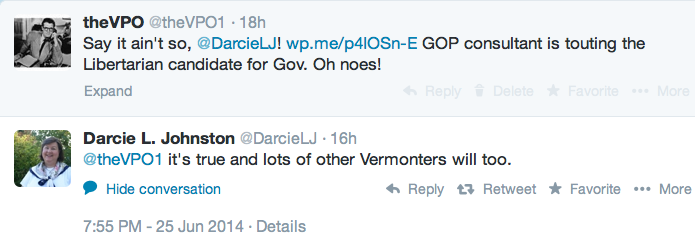
First, the political consultant who hasn’t won anything since unhitching her wagon from Jim Jeffords more than a decade ago, Darcie “Hack” Johnston has responded to my previous post about her Tweets supporting Dan Feliciano, the Libertarian candidate for Governor. He of the typo-riddled website.

Well, I Tweeted about the post, and the Hack replied:

Screen Shot 2014-06-26 at 3.31.05 PM

First of all, let me say I am humbled and honored that the Hackster has taken notice of my existence on this earth. Second, yuh-huh, sure, tons of Vermonters will be joining the Feliciano parade. About the time there’s a snowball fight in Hell. And third, if Feliciano’s campaign had the tiniest hint of hope about it, Johnston has officially given him the kiss of death.

Now let us turn to “Super Dave” Sunderland, occupier of the most thankless job in Vermont, chair of the Vermont Republican Party. With virtually no reason to think his party can unseat Governor Shumlin, he’s resorted to touting the results of a new “poll” indicating widespread dissatisfaction with the Guv:

Screen Shot 2014-06-26 at 3.30.19 PM

Mmmm, about that “poll.” First, it was an online survey, and we all know how useless those things are. And second, it was posted on the Vermont Business Journal website, and we all know which way the VBJ’s readership leans politically. Also, while the “poll” was in progress, Sunderland was touting it on Twitter, which further skewed the results. Actually, it’s surprising how many “A” grades the Governor got.

But hey, Vermont conservatives find themselves with nothing but a big basket of sow’s ears, so I can’t really blame them for trying to make a silk purse.