Phil Scott’s Cunning Primary Day Plan

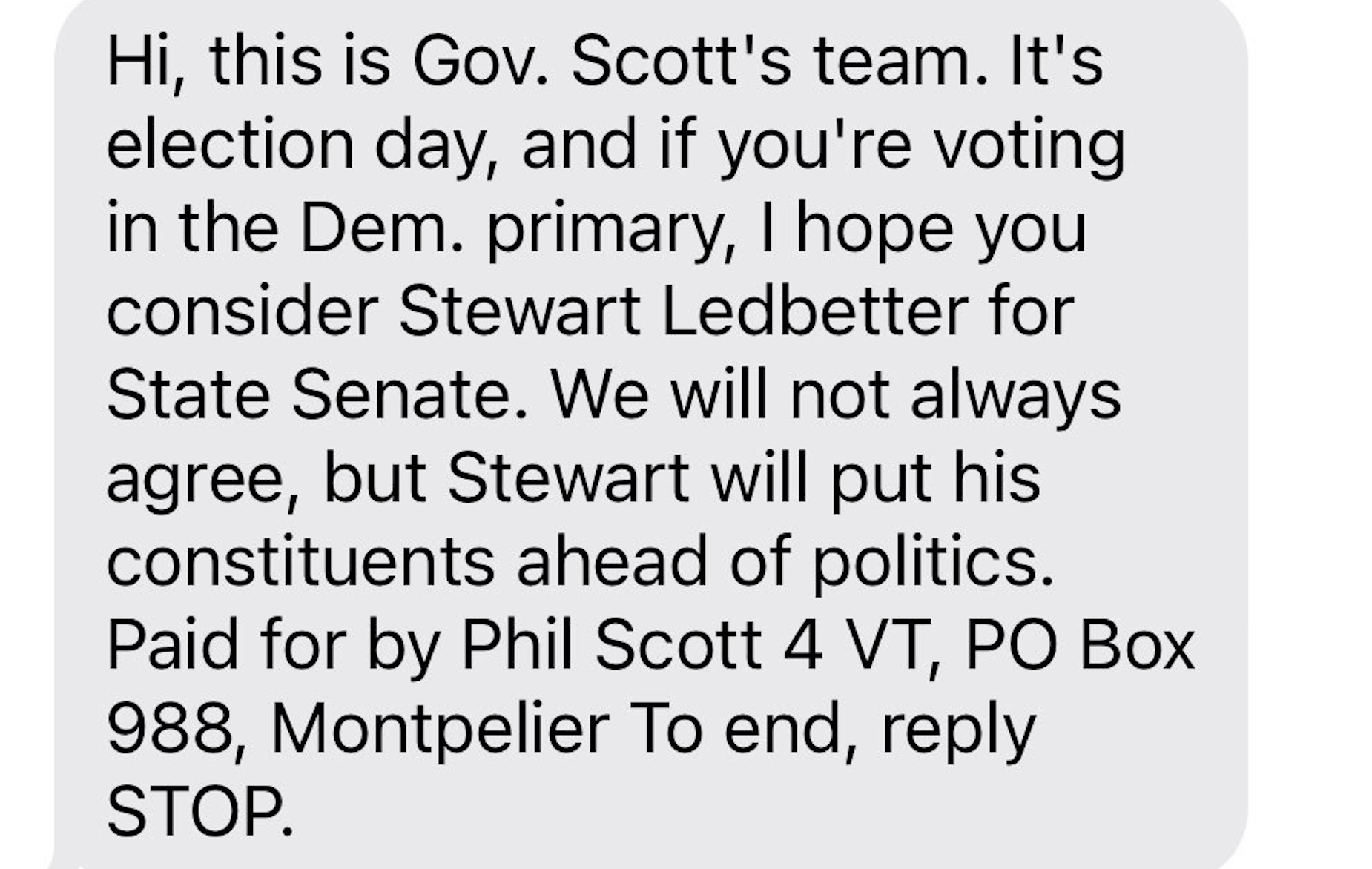
It’s been years since Gov. Phil Scott has had to run a competitive race, and maybe his political team has gotten soft or something. Because when it comes to shooting oneself in the foot, it’s hard to top a Republican governor texting voters in Vermont’s most progressive Senate district on behalf of the centrist candidate. Who, spoiler alert, lost.

I mean, who’s in charge over there? Baldrick?

This wasn’t the governor’s only ill-considered stomp into Democratic primary turf. His team also sent texts on behalf of Elizabeth Brown, faux-Dem challenger to incumbents Tom Stevens and Theresa Wood. Both are committee chairs and influential members of the House Democratic caucus. Ya think they’ll remember this little misadventure with gratitude? Ya think the admin’s relationship with the Legislature just took a small but discernible turn for the worse?

My guess? Either Team Scott is just desperate to move the needle on legislative races or they’ve got too much time on their hands, what with a snoozer of a contest against Dem nominee Esther Charlestin their biggest “challenge.” Maybe they should just take the rest of the year off.

Continue reading

A Happy Little Primary Night Cash Fire

Tuesday’s primary election turned out to be a snooze. The most interesting development was how much money was wasted trying to unseat a small number of Democratic incumbents. They all won, as far as I can tell.

Firmly atop the Futility Rankings is former TV anchor Stewart Ledbetter, who finished fourth in the race for three state Senate seats in the Chittenden Central district. He raised almost $60,000 and spent a bit under $40,000 (tentative). He “earned” 3,159 votes, which cost him and his well-heeled donors about $12.56 apiece. Bargain!

Elsewhere in the “beat the Democrats” game, House Ways & Means Chair Emilie Kornheiser brushed off a challenge from business-backed Dem Amanda Ellis-Thurber, while the Waterbury duo of Reps. Tom Stevens and Theresa Wood defeated “affordability” Dem Elizabeth Brown, who spent gobs of cash and didn’t really come close to pulling off an upset.

Two quick takeaways: If there’s an anti-tax revolution brewing in the hinterlands, it did not show itself in the results. At all. And those allegedly smart business leaders just squandered a whole lot of money trying to push the Democratic caucuses toward the center. They might have scored one small victory, as Danforth Pewter chief Bram Kleppner took a Democratic nomination for House in Burlington. But that’s about it.

Continue reading

One Neat Trick for Concealing the Reach of Your Political Donations (CORRECTION)

Correction. I got a crucial detail wrong in this post. Donors do not file information. The donor info is gleaned from candidate filings. Misspellings and carelessness with donor names and addresses is their fault, not the donors’. The broader point remains, that the blizzard of typos makes it extremely difficult to track donor activity, but that’s not the result of their malfeasance, deliberate or otherwise. Also, my apologies for the delay in correcting; I’ve still got Covid and have precious little energy at all.

In what’s generally been an underwhelming primary season to date, one of the biggest developments has been the outpouring of support going from a bunch of Burlington-area business leaders to a relative handful of candidates. Look at the donor lists of the top earners and you see a bunch of the same guys (well, almost entirely guys) giving four-figure checks to the same people: Stewart Ledbetter, Scott Beck, Elizabeth Brown, John Rodgers, Pat Brennan, etc.

It would be highly instructive to track how much each of these minor tycoons is investing in political centrism and where they’re putting down their markers. And it’s almost impossible to do so, thanks to how the Secretary of State’s campaign finance portal processes donor reports and how the donors seem to be taking full advantage of a loophole on offer.

What’s happening is that donors submit reports with slightly different iterations of their names and addresses. When you search for donors, each report shows up as if it’s a separate person. For instance, if you search for “Lisman, B,” you get not one, but 30 separate matches. If you search for “Broughton, L,” you get 40.

Forty.

And most of them have few if any donations listed. If you want to find out how much Lenore Broughton has given to whom, you’ll have to open each and every one of those 40 in turn. It’s maddening.

Continue reading

More Money Than Sense, and Other Notes from the Latest Round of Campaign Finance Reports

August 1 was another campaign finance deadline, the last before our August 13 state primary. As usual, there was plenty of interesting stuff to be found. And as usual, there was a dearth of coverage in our sadly diminished media ecosystem. VTDigger waited a few days to put together a solid campaign finance database helmed by its longtime (by Digger standards) data reporter Erin Petenko. But any effort, by anyone, to identify trends or develop insights? Haven’t seen any.

Meanwhile, those who follow me on Elon’s Hellscape know why I’m late to the party. After doing a fair bit of spadework around the deadline, I came down with Covid. It was a pretty severe case for a few days and I’m still on the mend, but I feel able to put words on the screen for the first time since last Thursday.

Anyway, got some things to say. Let’s do the toplines first and then get to the details.

  • While the vast majority of candidates have trouble scratching a few bucks together, there are a few who have more money than they know what to do with. The primary’s one week away, early voting as been going on for roughly a month, and they’re sitting on large quantities of unspent cash.
  • Many of these hopefuls have been generously funded by a cadre of Burlington-area business types, who may look at their investments post-primary and despair at the improvidence of their strategery.
  • Two candidates got a rocket strapped to their backs by those business leaders in July. John Rodgers, running for lieutenant governor, and Rep. Pat Brennan, running for state Senate. They went from near zero on July 1 to huge, nigh unspendable hauls on August 1. Congrats, I guess?
  • Gov. Phil Scott’s campaign has far outstripped Democrat Esther Charlestin. Why his people are bothering to beat the bushes, I don’t know. I remain convinced that he’d be better advised to mothball his campaign and start a PAC — or a Super PAC — and spread his influence around.
  • The oddities around Thomas Renner’s campaign for lieutenant governor continue to proliferate. His fundraising slowed to a trickle in July, but he spent very little and has a sizeable unspent reserve. I still don’t know what his campaign is about. Or who’s running it, for that matter.
Continue reading

The Scott Administration Would Very Much Like to Convince You That It Cares About Education

I remember a moment, long ago in a much simpler time, when the Shumlin administration came under scrutiny for hiring communications staffers for multiple state agencies. In fact, hey, here’s the story from Seven Days way back in 2012, reporting that while candidate Peter Shumlin had vowed to cut communications people from state agencies, his administration eventually tried to hire even more of ’em.

Well, now we have a job listing from Gov. Phil Scott’s Agency of Education seeking a “Director of Policy, Strategy, and Communications” at an hourly rate of $40.83, which amounts to an annual salary in the $80,000 range.

Okay, so the idea that comms people are a luxury seems kind of quaint nowadays. But wait, there’s more!

The Director, according to the job description, “will oversee a team of three digital communications and policy specialists.”

Yep, that’s right. The Education Agency doesn’t just need a flack. It needs a gaggle of flacks to handle both external and internal communications. This “team” would not only handle the press, legislative relations and interagency communications — it would also serve as a middleman between AOE leadership and its own people.

Continue reading

Mother Nature’s Punching Bag

I can remember a time, not that long ago, when we believed the worst effect of climate change on Vermont would be a potential influx of climate refugees — people from coastal areas looking for safe havens in the hills and mountains of our state.

Yeah, about that.

We’re getting hit, very hard and very often, by the consequences of climate change in ways that outstrip all those places we used to look at with more than a touch of Green Mountain smugness. I’ve certainly wondered why people even live in the lowlands of Florida or Louisiana or Texas or why they hold onto beachfront property that’s being eroded away. Don’t they know better? Can’t they see the signs? And why should they expect the rest of us to underwrite their bad decisions?

Yeah, about that.

Rarely, if ever, have I seen a bunch of bad news on any subject to compare with what we’ve seen lately about how Vermont is in the crosshairs of climate change. It all adds up to one conclusion: Far from being immune, Vermont is in many ways uniquely vulnerable. We are at risk. And we’re repeatedly seeking help from others, who could understandably ask why they should bail us out when we insist on living in disaster-prone places like flood plains, riverside communities, or out in the countryside along dirt roads and unpaved driveways that can easily wash away. (Above image: Horn of the Moon Road in East Montpelier, washed out earlier this month.)

Continue reading

One Neat Trick Phil Scott Could Use to Amplify His Influence

I’ve written ad nauseam about Gov. Phil Scott’s complete withdrawal from the Vermont Republican Party and how it’s inhibited his ability to govern. Absent his influence the VTGOP has drifted far to the right, it’s so bereft of resources it hasn’t had a single paid staffer in years, its recruitment efforts are laughably poor, and its candidates largely consist of unelectable Trumpers. The result: Substantial supermajorities in the House and Senate, and a flood tide of veto overrides.

But really, I can’t say I blame him. It would be a Herculean task to clean out the VTGOP, and both party leadership and the rank-and-file would not be receptive to his approach. It would be a hell of a lot of work, and would be very likely to fail.

However. There is something the governor could do. It wouldn’t involve dirtying his hands in party affairs. Hell, he could even farm out the real work to people in his inner circle. It’s so obvious that (1) I’m surprised it didn’t occur to me sooner and (2) I’d be afraid to suggest it except that there’s no way Team Scott would ever listen to me.

It’s this: Start a political action committee focused on electing centrists and fiscally conservative but socially moderate Republicans. Let’s call it, for the sake of argument, the Phil Scott Leadership PAC. Or if he’s feeling shy, the Common Sense Leadership PAC.

Continue reading

Our Political Betters Are Strangling Vermont State University

A tremendous piece of reporting by VTDigger’s Theo Wells-Spackman lays out the dire situation facing Vermont State University and, although it sticks to the cautious, both-sides nature of modern journalism, it pretty much points the finger at the real culprits: Gov. Phil Scott and the Legislature.

It’s not a pretty picture. Falling admissions, leadership turmoil, cutbacks across the board, more cuts coming down the pike, half-empty (or worse) campuses, morale in the toilet. In short, something that looks just like a death spiral. And barring a sudden influx of resources from a state that has always shortchanged higher education, it’s hard to see how VSU pulls out of it. I’m sure it will survive in some form, but there’s no way it can become the robust, lower-cost, in-state alternative to the University of Vermont that we need it to be.

The situation would be bad enough, but the real killer is the state’s insistence that VSU maintain operations at all five of its campuses while implementing a painful series of state-mandated budget cuts.

Continue reading

Who’s Spending: Another Look at Mass Media Filings

One week ago, I wrote about former senator John Rodgers’ five-figure spend for ads on WDEV radio plus other candidates’ investments in mass media. Several candidates have since reported mass media expenditures; here’s a look at the highlights.

Reminder: The next campaign finance reporting deadline is August 1, but candidates are required to promptly report mass media buys of $500 or more when they occur close to an election.

Let’s start with Rodgers. I noted that if his WDEV buy was part of a broader strategy it could pay off, but by itself it’s a questionable move. It’s a lot of money to spend on a diminished medium and an outlet that only reaches a fraction of Vermont. Well, so far it stands alone: Rodgers has not reported any more mass media spending.

The biggest mass media report from the past week comes not from a candidate, but from the Child Care Victory Fund, a political action committee affiliated with Let’s Grow Kids Vermont. The Fund is apparently trying to protect incumbent lawmakers who supported Act 76, the 2023 bill that made a “quantum leap” in child care investments, and now face primary opposition.

Continue reading

Well, Now They’d All Better Know What They’re Doing

Going to abandon my usual policy of sticking to Vermont politics. Perhaps I can be permitted an exception for one of the most consequential events in our nation’s history — the decision of President Joe Biden to abandon his bid for re-election.

When Sen. Peter Welch came out in favor of Biden’s withdrawal on July 10, I wrote that he had better know what he’s doing. In the wake of Biden’s decision, that sentiment now applies to everyone in Democratic Party circles, up to and including the President himself. They’d damn well better know what they’re doing. And they’d damn well better not screw this up, which seems to be the default setting for the Democrats going all the way back (at least) to 1968, when I was a teenager staring down the barrel of the Vietnam War and the party tore itself apart. And still nearly won the election. (Probably should have, if not for Richard Nixon making back-door deals with South Vietnamese leadership. As reported in Garrett Graff’s Watergate.)

1968 was the last time a sitting Democratic President voluntarily relinquished the position. I’m not drawing comparisons beyond that, because the circumstances were wildly different. They were, in fact, much more fraught, much direr, than the current situation. And yes, the Democrats nearly won that election.

I am saying that the process of choosing Biden’s replacement has got to be cleaner than the trainwreck that happened after LBJ’s withdrawal, or the Dems risk handing control of the country to Donald Trump.

Continue reading