Dick-swinging time

Apologies for the crass title, but it seems singularly appropriate for the early returns on this campaign finance deadline day. Particularly when it comes to Governor Peter Shumlin and, to a lesser extent, Lieutenant Governor Phil Scott.

Shumlin maintained his frenzied fundraising pace during September, and his campaign spending went straight through the roof. He raised a total of $100,875 during the month — three thousand dollars a day, including weekends and Labor Day — which is insane enough, but then you get to the Expenditures line:

$234,898.90.

Congratulations, Governor, for holding the line under $235,000.

The lion’s share of that money went to TV advertising: $215,147.

I recall Scott Milne castigating the Governor for spending $20,000 a week on TV ads. Well, Mahatma was wrong: Shumlin spent twice as much. More than $40,000 a week. Yikes. 

Later Note: That was a mental leap too far. Shumlin’s campaign spent $215,147 on TV in September, but some of that money — perhaps most of it — may have been prepaid for ad time in the coming weeks. So I can’t say how much Shumlin is spending per week. 

At this time two years ago, Shumlin hadn’t even begun to advertise. And he faced a stronger opponent — well, a less sickly opponent, anyway. As of October 15, 2012 (there wasn’t an October 1 report that year), he had spent a total of $160,387. For his entire campaign.

He spent more than that on TV ads alone. In the past month alone.

And he’s got enough cash on hand to keep up the pace through Election Day even if he doesn’t raise another dime, which, ha ha. His campaign fund has a positive balance of just over $400,000. Add in the money left over from his Hulk-Smash victory over Randy Brock in 2012, he’s got more than a million bucks in the bank.

Scott Milne, who hadn’t filed as of 2:30 pm, has told VPR’s Peter Hirschfeld that he’d raised over $80,000 in the past month. Which is impressive by his standards, but still nothing compared to Shumlin’s stash.

Libertarian Dan Feliciano, as I reported earlier today, raised about $3500 in the past month and $17,000 for the entire campaign. And his bottom line is actually underwater. Or it would be if he hadn’t donated $10,000 to his own campaign.

Money-wise, the Governor has nothing to worry about. So, given the fact that his challengers are woefully underfunded and undertalented, why is he spending like a drunken sailor in a state liquor store?

My theory is that he really, really wants to get a pure majority of the vote. And hopefully approach the 57% he received two years ago. If he wins with a mere plurality against puny competition, he’ll enter the big push for single-payer health care a diminished political figure. He doesn’t want that. So expect to keep on seeing plenty of Shumlin for Governor ads on your TV screen.

Phil Scott’s package is nothing like Shumlin’s, but he’s doing just fine by the standards of the Lieutanant Governorship. He did crack the $200,000 mark in total donations, which was his stated goal — to raise as much money the traditional way as Prog/Dem Dean Corren would receive in public financing. And Scott still has more time to raise more money.

And more space, too. He’s getting plenty of money from business groups and PACs, but he’s getting a goodly share of smaller donations as well. Uniquely among Vermont Republicans, Phil Scott actually has something of a base.

He’ll need to keep fundraising if he wants to maintain his spending pace. He’s managed to spend over $150,000 so far. He did enter this cycle with over $42,000 left over from 2012, so he’s up around $100K in cash on hand. But if he’s spent $150K so far, he’s likely to spend a lot more by November 4. The Governor won’t break any campaign spending records, which were set in 2010’s Shumlin/Dubie contest. But Phil Scott must be shattering the previous campaign spending marks for his office. His ceremonial office.

If only he had time left over for his alleged VTGOP-rebuilding project.
Two ships that pass in the night

Today, via Neal Goswami of the Mitchell Family Organ:

A report released Wednesday based on an internal review of the Department for Children and Families does not recommend restructuring the agency, but does seek immediate boosts to staffing, additional staff training and better collaboration between the department and its partners.

Yesterday, via them damn commies at the Public Assets Institute:

A month after announcing a 2 percent cut to the current year’s budget, the Shumlin Administration is signaling its intention to make additional cuts of as much as 5 percent and possibly more next year (fiscal 2016).

Well, that looks like a conundrum in the making.

Human Services Secretary Harry Chen, the presumably more loyal and/or pliable replacement for the cashiered Doug Racine, now has a report that says his agency needs more resources. Which probably induces a rueful chuckle from Mr. Racine.

And now this report will duke it out with the Administration’s budget instructions reportedly given to its top managers:

The administration laid out two scenarios for fiscal 2016:

— Level funding—the same amount appropriated for this fiscal year after the cuts adopted in August.

— Five percent cut from fiscal 2015 levels—again after the August cuts.

As PAI notes, the best-case scenario — level funding — would mean cutbacks, since there are built-in cost increases: “cost of living increases for state employees, caseload increases, contractual increases, loss of federal funding, inflation, and other new demands…”

The AHS/DCF review was initiated by then-Secretary Racine. Will Dr. Chen back up the report’s conclusions? Or will he bend to the apparent belt-tightening mandate from above? According to the PAI report, he’s got about two weeks to turn in his budget recommendations.

This should go well.

Hey, what’s this on my Twitter feed?

Now, there’s big news. Dan the Libertarian Man wants to raise $100,000 in two days.

Ahem. As it happens, today is campaign finance filing day, and Dan — being the efficiency maven that he is — filed his report early. And it says here that in the past month, he’s raised a massive $3,528. Which brings his campaign total to $17,014.

So… in 48 hours, he’s going to beat his total for the entire campaign by a factor of six.

Yeah, let me know how that goes for ya.

Unless he’s got a whole buncha Sugar Daddies waiting in the weeds, he won’t raise 100 G’s or anything like it. But with a bit of luck, he might raise enough to get his campaign out of debt. Expenditures to date: $28,505.59. He’s only been able to pay the bills and keep the lights on because he donated $10,000 to his own campaign.

So much for #Felicianomentum. If a grassroots movement is afoot, it sure doesn’t show up in his finances. In the past month he received a mere 15 donations, or roughly one every two days. Seven were less than $100 apiece. Of the other eight, six came from outside of Vermont. And for the campaign to date, only 32 people have opened their wallets on Dan’s behalf. For those unfamiliar with campaign finance, let’s just say those are really small numbers.

In his situation, any little boost he can get from this fundraising blitz will help. But he’s certain to fall embarrassingly short of his extremely large goal. (Again, unless he’s got a lot of Ayn Rand fans on his “In Case Of Campaign Emergency, Break Glass” list.) Why not aim for $20,000? He might possibly, maybe, achieve that. Or get close enough to plausibly declare victory.

The short answer is, he needs $100,000 to build #Felicianomentum toward Election Day. But no matter how much he actually raises, it’s going to look small compared to his stated goal.

Oh well, I wish him luck.

p.s. The Grammar Lady in me can’t resist noting that “& etc” is redundant. Use your characters wisely, Dan; you only get 140 at a time. 

Sometimes, no matter what the cost, you just gotta make a stand

In the course of human events, there comes a time for a single heroic action that can spell the difference between ruination and glory. At moments like these, great figures arise, making statements that ring true across the centuries, imspiring new heroes with the sheer power of their words.

“I regret that I have but one life to give for my country.” — Nathan Hale

“Don’t give up the ship!”  — James Lawrence

“Damn the torpedoes, full speed ahead!”  — David Farragut

“I shall return!” — Douglas MacArthur

“We will bury you!” — Nikita Khruschchev

Oops, I don’t know how that last one got in there. Sorry. But you get my drift.

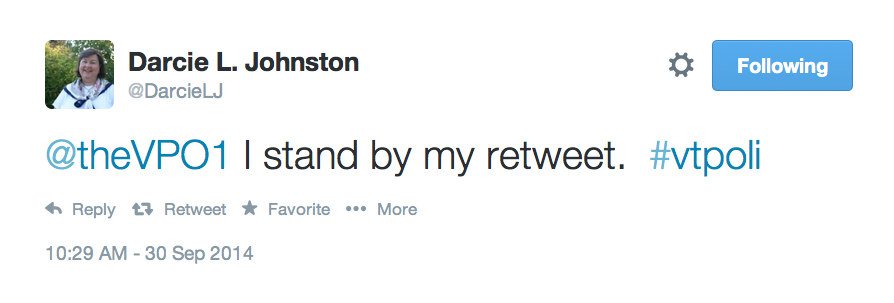
And today, in the midst of desperate times, another hero strode forth:

Screen Shot 2014-09-30 at 4.55.42 PM

“I stand by my retweet.” George S. Patton couldn’t have said it any better.

Really, I’m glad I wasn’t drinking coffee when I read that, because I would have had hot java up my nose and down my shirt.

A bit of context, for those just joining us. Earlier today, I wrote about a fatally flawed essay by James Conca of Forbes Magazine, which blamed rising energy prices in New England on “Vermont’s choice” to close the Vermont Yankee nuclear plant.

Which is nonsense; the plant’s owner pulled the plug for financial reasons. But that didn’t stop Vermont conservatives, who should know better, from latching on to the erroneous column. One of the guilty was Darcie “Hack” Johnston, hapless campaign consultant, who eagerly retweeted a link to the Concatenation. And when I noted the duplicity of glomming onto a fundamentally flawed essay, Johnston issued her broadside.

“I stand by my retweet.”

That’s gotta be one of the most ridiculous attempts at inspirational rhetoric I’ve ever seen.

Go ahead, @DarcieLJ. Stand by your tiny evanescent masterpiece.

When a crucial omission becomes a Big Lie

On Monday, the Forbes website posted a piece by columnist James Conca entitled “Closing Vermont Nuclear Bad Business For Everyone.” Judging by Conca’s oeuvre, he is a complete apologist for nuclear energy… but that’s not my point here.

My point is the fundamental dishonesty of his column, based upon one crucial omission. And I quote:

Two electricity distribution companies in Massachusetts and New Hampshire announced electricity rate increases for this winter. This collateral damage results from Vermont’s choice last year to close the Vermont Yankee nuclear power plant. That choice has hurt rate-payers in their neighboring states.

Catch it? “Vermont’s choice.”

As anyone with the most glancing exposure to the facts could tell him, it was not Vermont’s choice to close Vermont Yankee. It was plant owner Entergy’s choice, For financial reasons having to do with changing market forces, not with Vermont’s overzealous radical socialist hippie-dippie hatred of Big Nuke.

Sure, Vermont had a more skeptical regulatory eye than other host states. Completely justified, IMO, because of Entergy’s terrible track record as plant operator. But Entergy made the decision to close VY on its own. It was a surprise to everyone in Vermont, because it came in the midst of Entergy’s full-court-press legal battle to keep VY open. Indeed, by all indications, Entergy was very likely to win the case and a 20-year license extension.

Mr. Conca is either criminally uninformed for an energy columnist at a major publication, or he’s ignoring the facts to suit his argument. In short, he’s either stupid or a liar.

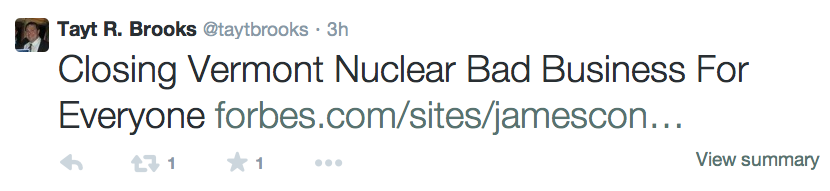
All that is bad enough. But now, at least three members of Vermont’s terminally frustrated conservative minority have picked it up.Screen Shot 2014-09-30 at 10.58.34 AMScreen Shot 2014-09-30 at 11.20.05 AM

Ah, the immortal Tayt Brooks, former Douglas Administration functionary, former secretive head of the very secretive Lenore Broughton’s failed SuperPAC, Vermonters First, now the Vermont rep for American Majority, part of the Koch Brothers’ far-flung empire of innocuously-branded nonprofit organizations.

And then there’s Brian Keefe, bagman for Central Vermont Public Service. Retweeted by serially failed campaign consultant Darcie “Hack” Johnston, currently serving as unpaid consultant to the Dan Feliciano campaign.

As an outsider, James Conca may have the slightest figleaf of deniability for basing his argument on a canard. But Brooks, Keefe, and Johnston cannot possibly claim ignorance.

No, they’re spreading this column around because it suits their political interests, regardless of how it misrepresents the real situation.

I’m sure this is just the beginning of Vermont conservatives’ efforts to trumpet Conca’s essay as more proof of the evil Democrats’ anti-business agenda. Even though they know full well that the entire column is built on a foundation of quicksand.

Rob Roper? El Jefe General John McClaughry? “Super Dave” Sunderland? Scott Milne? Dan Feliciano? I’m lookin’ at you.

Dan, the man whose outer shell of principle conceals a melty nougat center

My man Mark Johnson hosted Dan Feliciano, Libertarian candidate for Governor, on his eponymous radio show Monday morning. And I have to say, it was a puzzling and underwhelming performance.

Feliciano proclaims himself as the candidate of principles. Those rock-solid beliefs include pulling the plug on single-payer health care, cutting state spending, and opening the public school system to competition and choice. Feliciano articulated those points clearly.

…………. But then, when it came down to details, Dan Feliciano revealed himself to be almost as soft and squishy as Scott Milne. On issue after issue, Feliciano punted on specifics. The details would be worked out later on, or he’d have to consult with these people or those people, or a new policy would be crafted through a collaborative process. It seemed to me that Feliciano was trying to preserve ties to his Libertarian/conservative base without closing the door to any centrist or independent voters.

A prime example: His two-faced response to a listener question about marijuana legalization. Feliciano began by saying “If a bill came across my desk, I would sign it.” But then he raised public-safety questions, claiming that there was no “appropriate test” for driving under the influence of marijuana.

So, he’d acquiesce to a bill that he sees as a threat to public safety. Hmm. How principled.

The question of legalizing heroin came up. This is a Libertarian principle, decriminalizing any “victimless crime.” Feliciano dodged, lamely offering that such a bill “wouldn’t pass the Legislature” and there are many other things higher on the priority list.

I am shocked, shocked, to hear such weasel words coming from a Libertarian.

Feliciano’s approach to health care reform didn’t stand up under scrutiny either. He wants to ease state regulations to entice more insurers to enter the marketplace, with the ensuing competition working its usual magic. But he’s surprisingly vague on how he’d attack the regulatory burden. He doesn’t call for the dismantling of the Green Mountain Care Board; he just wants it to be  “more of an overseer, less of a policymaker,” and that it needs to be “more accountable to the people.”

Including, perhaps, the popular election of its members.

That goes beyond lame, all the way to harebrained.

Feliciano was boxed into a corner on what regulations to cut, because he’s already been burned by questioning the community-rating system, which bars insurers from charging inflated prices to the old, sick, and high-risk. It’s a bete noire of the far right, but it’d be political poison to call for its repeal. So instead, he offers only the vague “our regulatory environment is too restrictive” and says he will “talk to insurance companies about what makes Vermont so onerous.”

Now, that’s right out of the Scott Milne playbook.

Johnson then reminded Feliciano that community rating was the single factor in driving many insurers out of Vermont. Feliciano’s response: if Vermonters want community rating we’ll keep it, but “I think there’s still opportunity — there must be something else that drove the companies out of the state.”

Oh, Dan, Dan. I thought you were a man of principle.

Later on, when the subject of health care returned, Feliciano tossed out a weak appeal to price advertising for medical services. He actually mentioned laser eye surgery as an example.

Do I have to enumerate the problems with that example? Perhaps I do. Well, laser eye surgery is a very specific and highly automated process. Unlike most medical procedures, your choice of practitioner doesn’t markedly change the odds of success.

When you get into the trenches of medical work, it’s not a matter of specific identifiable procedures; it’s a course of treatment, it’s an educated response to complications. It’s seeing the patient through to recovery. For many patients, it’s a multidisciplinary effort to combat a variety of different conditions in a single body. You can’t post that stuff on a billboard.

And Feliciano ought to know this. He’s got a special-needs daughter, and during the interview he talked about his family’s struggles to get her the best possible treatment. He praised his high-quality insurance coverage that allowed, among other things, a course of care at Johns Hopkins.

But when it comes to health care reform, he wants up-front pricing. And if you don’t want to settle for the cheapest provider, then he says, “If you want to pay a little more, you’ll have to pay something.” If I interpret that correctly, he means “you’ll pay for everything extra.”

Which doesn’t fit my definition of universal coverage, but I guess I’m just an old radical progressive softy. And to ask a hard-hearted question, if Feliciano had been seeking specialized care for his daughter under a Dan Feliciano health care system, would he have been willing to pay the extra freight? Including her treatment, fully covered by his insurance, at Johns Hopkins? That’d cost him a pretty penny under FelicianoCare.

There was also a dismal exchange on cutting the state budget. Johnson asked Feliciano for two or three examples of specific cuts.

Feliciano didn’t come up with any. He began by noting that the lion’s share of general fund spending is on Human Services and Education,  so that’s where he’d look for the biggest savings. But no specifics; just a call for a refocusing on “our core services.” As opposed to the Truffles ‘N Premium Cable Package we currently offer our welfare recipients.

And then he fell back on a truism from his days as a business turnaround specialist: “In my experience, in the private and public sectors, we can cut five to ten percent easily.”

Oh, really? He can’t offer a single line item, but it’d be easy to cut ten percent. Wow.

Things also got weird on school reform. Feliciano trotted out the school choice/voucher idea, in which “class sizes will get larger and outcomes will get bigger.” I think he meant “better,” but… how do larger class sizes, by themselves, lead to better outcomes?

But the real topper was when he said he’d “get everybody together to design a system, and if it didn’t work, we’d need an exit strategy.”

“If it didn’t work”?? You’re going to upend the entire public education system and you don’t know if it’s going to work? Good God.

In his closing response, Feliciano made a belated return to Libertarian dogma. Johnson asked him why the Democrats are so dominant in Vermont. After an unsettling series of nervous chuckles, he credited the Dems for “framing issues in terms of social problems, not individual responsibility,” and relying on “scare tactics” to induce a sense of “learned helplessness” in the hearts of We, The Sheeple.

Well, I, for one, am insulted. Am I a liberal because I’ve been brainwashed by the Democrats?  Have I abdicated my personal responsibility for some false promise of social equality?

Sorry, but no way, Jose. I am a liberal because I see the inequities and shortcomings of the free market system. And I see in government, as imperfect as it is, the only real counterweight to the raw power of capitalism. I don’t want to end capitalism, I just want to rein in its excesses. And there are lots of those.

So no, Dan, I am not a sheep. I am a person who, out of my own experience and knowledge, has freely chosen to believe in a robust role for government in our society. I’ll thank you to stop insulting me and all the other Vermonters who share my beliefs.

But I digress. Let’s just say that Dan Feliciano does best in small doses. When he has to talk at greater length, the many holes in his game become obvious. And the biggest one of all is that, when push comes to shove, he’s got the same basic ideas as Scott Milne: Elect me, and we’ll figure out the policies later.

Hey, I think we finally found a conspiracy theory too nutty for Vermont

Saturday was a big day for a certain group of Internet-based nutbars. Namely, the Chemtrail folks — the ones who believe the water-vapor contrails emitted by jet planes are actually “chemtrails” meant to control the weather and make us sick. Or something like that.

Well, it would’ve been a big day if anybody had showed up. It was promoted online as the Global March Against Chemtrail and Geoengineering. Its webpage showed a map with dozens of protest sites around the planet… including one in Montpelier, Vermont!

Problem is, the actual turnout at the marches was so underwhelming as to be positively comical. Each city’s “march” had its own Facebook page, and some of the post-event comments are downright sad.

Some poor sap in Rhode Island was the only one who showed up for his “mass protest.” The ringleader in Philadelphia posted some photos that show no more than a handful there. Louisville had four. A dutiful correspondent in Denver plaintively inquired, “Am I missing something? I saw no one here.” A similar “Nobody showed” from Hartford, Connecticut.

The diligent nutbars in Omaha posted a brief video of their march — featuring four protesters.

The NYC organizer posted a photo of three people leaning on a railing — but he had perhaps the ultimate conspiracy theorist’s explanation for the dud turnout: the sky was clear. CLEAR, do you understand??? “They” called off the Chemtrail spraying for the day “which, of course, portrayed protesters as ‘fringe crackpots’ in an attempt to take the wind out of our sails.”

Ohhhhh. I see. No vapor trails in the sky for one day, so all your thousands upon thousands of invisible NYC supporters stayed home. Uh-huh. Don’t let nothin’ stand in the way of your pet theory.

Nice, professional-looking logo anyway.

Nice, professional-looking logo anyway.

Anyhoo, the alleged Montpelier event apparently didn’t happen. No sign of anyone posting on its Facebook page — not before, not during, and not after. Most of the Facebook pages had at least a smattering of people promising to attend — and then not doing so. And the plaintive wails of the few who did.

But in Montpelier? Not a whisper.

I didn’t think it was possible for there to be a fringey cause beyond the pale of us quirky Vermonters, but I guess I was wrong. Congratulations, Vermont: your annoying streak of crazy has its limits.

We eagerly await good tidings from the VTGOP

As you might know, although they did little to publicize the fact, the Vermont Republican Party had its fall fundraising dinner last Friday. The guest of “honor” was Islamophobic national-security nutbag Peter King, undistinguished Congressman from New York.

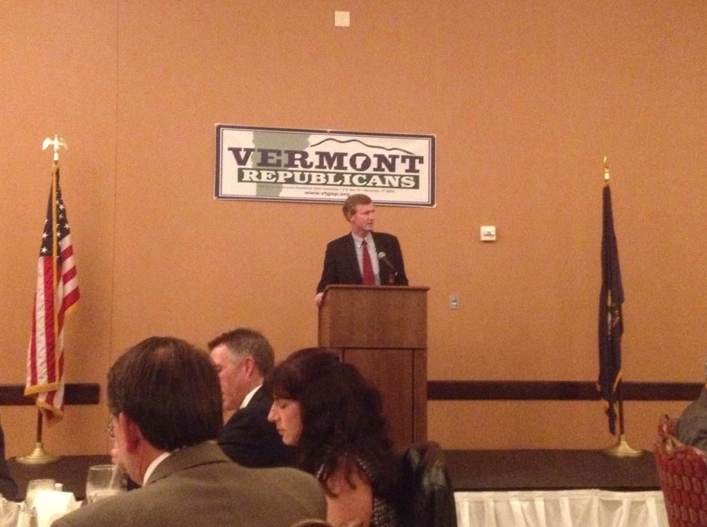
During the course of the evening, the operator of the VTGOP Twitter account posted four photos form the event. All four showed one of the evening’s speakers at the podium; all four were taken from angles that showed very little of the crowd. One example:

Screen Shot 2014-09-29 at 1.29.38 PM

Okay, so we know there were at least three people in the audience. Which is more of the crowd than you can see in any of the other photos, all of ’em focused on the podium.

No crowd shots, VTGOP?

What, too embarrassing? In my mind’s eye, I’m picturing a few dozen people crowded around the front tables, with plenty of empty seats farther away.

You may think my surmise unfair, just another example of theVPO’s liberal bias. But riddle me this, Batman:

— Right up to the day of the event, the VTGOP was sending out reminders that tickets were still available. The last one was sent at 10:43 a.m. Friday, less than seven hours before go-time.

— Since the Twitter posting of those four photographs, we’ve heard not a peep from the VTGOP about the success of the fundraiser. Or anything else, for that matter.

— This, in spite of the fact that I’ve been sending them gentle reminders via Twitter:

Screen Shot 2014-09-29 at 1.38.41 PM

And still no response.

I see a pattern. Last December, the VTGOP was very free with very generous pre-event estimates for its Chris Christie fundraiser. After the event, not a peep. Then in the spring, the Vermont Democrats hosted Sen. Elizabeth Warren; shortly after the event, the Dems announced attendance and fundraising totals.

Now another Republican event comes along, and once again, they’re being tight-lipped about the actual results.

As I said in one of my subsequent Tweets to @VTGOP, “I’ll take that as bad news.”

If the Vermont Republican Party does release totals for tickets sold and dollars raised, I’ll be happy to report them in this space, with whatever comments they provide. And if the totals are respectable or better, I’ll be happy to retract my cynicism and congratulate them on a successful event.

I’m not holding my breath.

Why state IT projects fail: a much-overlooked factor

Oliver Olsen, the once and (perhaps) future State Representative from southern Vermont, recently wrote an essay entitled “Why IT projects fail.” It was, more specifically, about why state-contracted IT projects fail.

Olsen began with the question, why can’t we bulid a software system when we manage to build large-scale complicated stuff like highways, bridges, and suchlike. His explanation: while the basics of civil engineering have been in place for quite a while, the world of high technology is young and ever-changing. And it’s harder to deal with the intangible world of IT than with the steel-and-concrete world of construction.

Good enough, as far as it goes, and I recommend reading the piece.

But I’d add one big factor that no one else seems to have noticed.

One of the problems throughout the history of the Affordable Care Act and Vermont Health Connect is a lack of competition for IT contracts. CGI was the big dog, by a long shot. Vermont chose CGI in large part because it had won so many other ACA contracts that it seemed the clear choice. Turned out, of course, that CGI wasn’t really up to the job. And when Vermont went to find a replacement, the only real choice was Optum, upon which our hopes are now pinned.

So the question: Computers and software are huge growth industries, and the US excels at both. Why can’t we get more, and smarter, companies to bid for health care exchange contracts?

I’d turn that question around: why are so many high-tech companies staying away?

Could it be because public-sector projects are complicated, fraught with peril, and more likely to yield failure than success?

Just looking at how the market moves, I have to conclude that it’s a lot more profitable to build newfangled gadgets, computer games, and smartphone apps. And the cost of failure is a whole lot lower: you put out a device or a game or an app. If it fails, you move on to the next one and write off the development costs. If you’re trying to build a health care exchange, you’d better damn well get it right. You can’t just walk away in the middle, and you can’t unilaterally postpone the launch.

Also, whereas a game or an app is pretty much a stand-alone item (as long as it plays nice with the operating system), public-sector IT projects are complicated systems that have to interface with other complicated systems.

There are lots of things IT experts can do that are higher-return and lower-risk than public-sector IT projects. Which is why most of them stay away from the business, and the public sector is left with a relative handful of bidders.

And somehow I doubt that those bidders represent the best and the brightest of the IT world.

Shumlin’s second TV ad: nice, but…

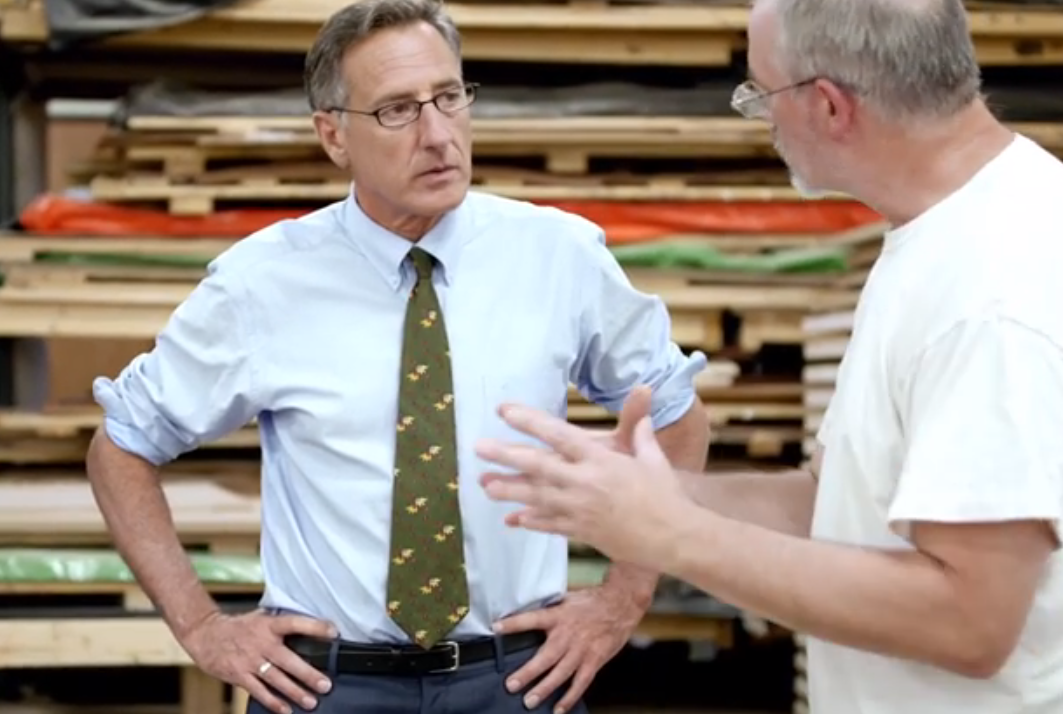
The Governor’s first ad featured a number of Vermonters talking about Shumlin initiatives that had helped their lives. The second spot connects two themes: post-Irene recovery and helping Vermont businesses survive and thrive.

Nice glasses, Gov.

Nice glasses, Gov.

The spot is narrated by John Wall of WallGoldfinger, a furniture maker located in Randolph. Wall tells how his factory was hit hard by Tropical Storm Irene, and how the Administration responded “within a week,” facilitating loans to keep the company afloat.

“It was the difference between life and death,” says Wall. Now, he says, the company is poised for further growth.

It’s a good story, and having it told first-person gives the spot instant impact and credibility.

My only qualm?

I hope we’re not leaning too much on Irene.

It did, after all, happen three years ago, during the first year of Shumlin’s governorship. He deserves full credit for pushing the recovery forward… but I hope he doesn’t lean too heavily on Irene.

In the first ad, one of the four brief testimonies was about Irene; it’s the dominant subject of the second. More are on the way, I’m sure; and if other spots focus on other issues, I’ll be fine with the overall balance. Irene deserves to be part of the story, but let’s have some more recent stuff as well.