
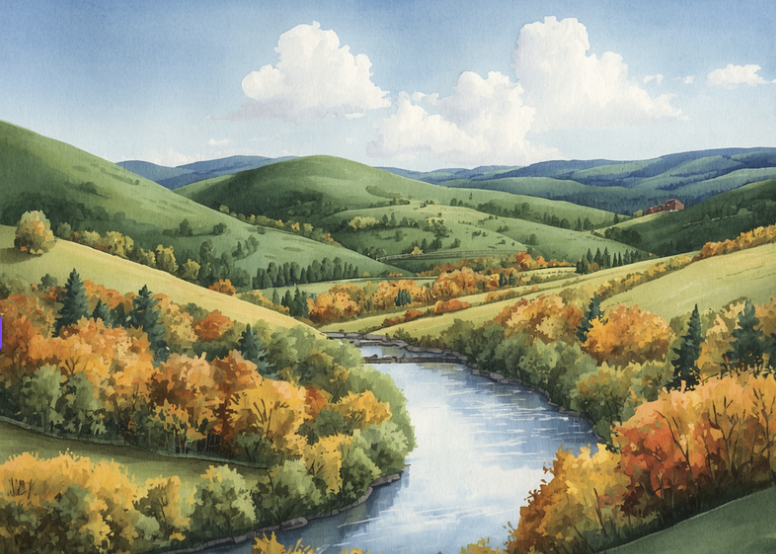
This, my friends, is what you get when you ask Canva’s AI illustration tool to render “Vermont landscape.” And it’s a great example of the stuff you see when you visit websites or social media feeds for conservative candidates or causes.There’s a lot of AI usage; there are also things like tech bros defending rural Vermont and sudden-onset farmers with possibly inoperative staycation programs. In short, there’s a hell of a lot of astroturf in the conservative ideosphere.
These groups and individuals allegedly believe that rural Vermont is a precious resource, central to our very identity, and the people who live there are the true, authentic Vermonters, not those miserable lefty masses huddled in our “urban” communities. And yet these people present themselves with an inauthentic feel that makes you wonder what the hell is going on.
With AI maybe it’s a rights issue, not wanting to pay for copyrighted photography. Or maybe it’s just too haaaaaaaaard to do a DuckDuckGo image search. Or possibly, spitballin’ here, these color-saturated simulacra reveal something about the fakeness of the message itself. Because the Golden Age of the “real Vermont” — you know, the time before the unkempt flatlander rabble of hippies and Bernie Sanders fans descended upon the Green Mountain State — never actually existed.
So, when Sen. Russ Ingalls’ The Vermont Party posts a(n AI image of a) lapel pin saying “Make Vermont Vermont Again,” what year or time period does he have in mind?
I’m guessing it’s before the construction of the interstate freeway system, the development ranked by longtime journalist Chris Graff as the most consequential in recent Vermont history*. Before the freeways came, Vermont was a sleepy backwater that was difficult to navigate, so hardly anybody bothered to try. The freeways made our state much more accessible, enabling the arrival of those damn hippies and progressive types who eventually staged a hostile takeover of Vermont’s social order. (Never forget, Romain Tenney died for your sins.)
*Census data confirms Graff’s hypothesis. Our population grew extremely slowly from 1900 to 1960. The freeways triggered three decades of double-digit growth, sending our population from 360,000 to 563,000.
The problem with MVVA and the astroturf advocacy of our simple, pure past is that pre-freeway Vermont was not an unspoiled paradise but a place of desperate, grinding poverty, where hard work was an absolute necessity for — but no guarantee of — survival. The economy was weak and undeveloped. The state government was tiny, under-resourced, and couldn’t have possibly cared for the needs of its population even if the political will to do so existed, which it did not. Agriculture faced some different challenges back then, but farming was never a picnic. The old Vermont was the Mississippi of the north, minus those uppity black folks.
Enough of the general, let’s get to specifics.
Ingalls’ hobby horse, The Vermont Party, is ground zero for the proliferation of AI-generated fake Vermont landscapes, including the party’s calling card:
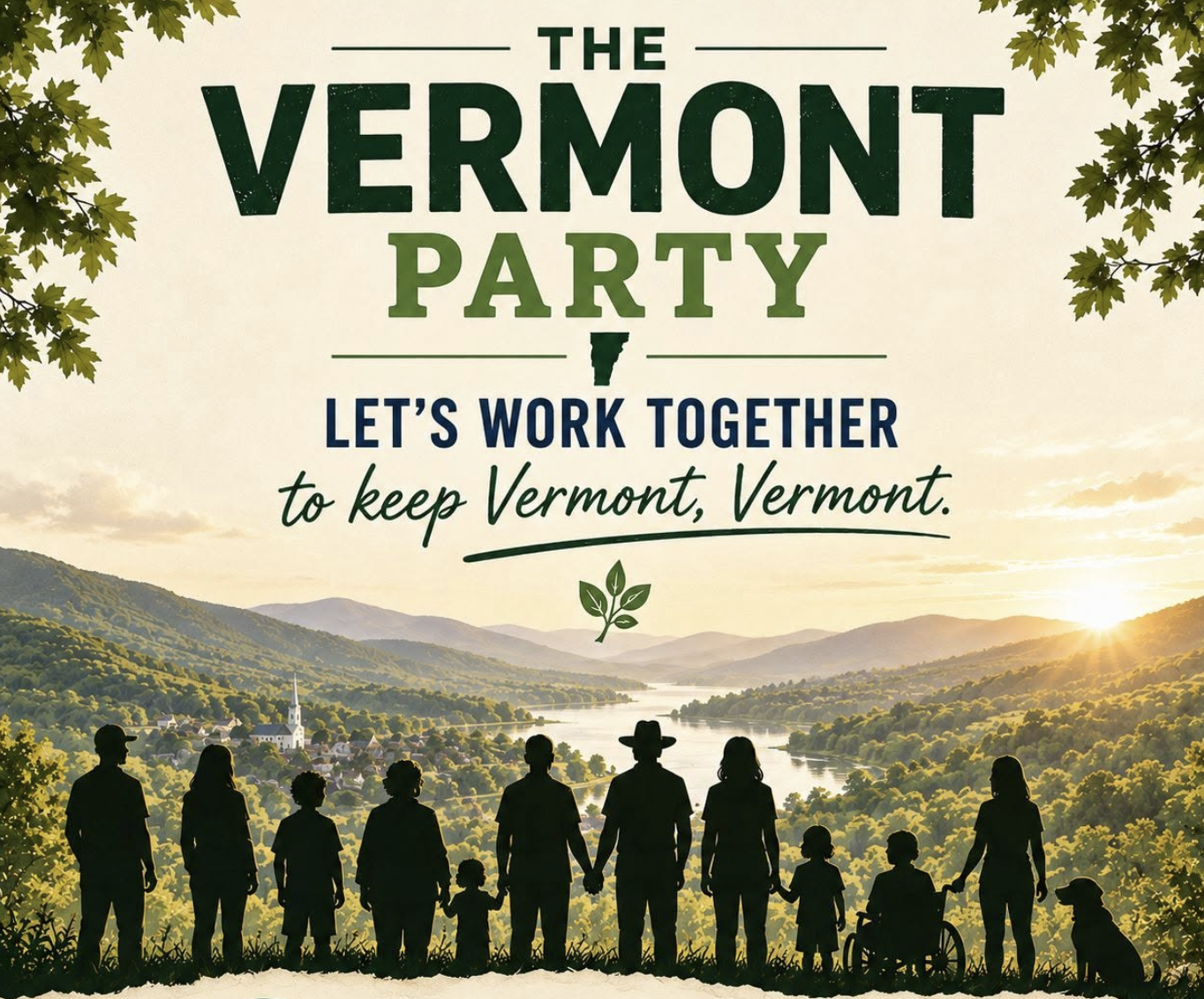
The un-party’s Facebook page is loaded with AI images. Follow the link if you want to see more. Those anti-Becca Balint videos trumpeted by Republican Congressional hopeful Mark Coester are 100% AI fabrications. And then there’s this image from Coester’s Facebook page, which doesn’t exactly scream “Protect Our Rural Traditions.”
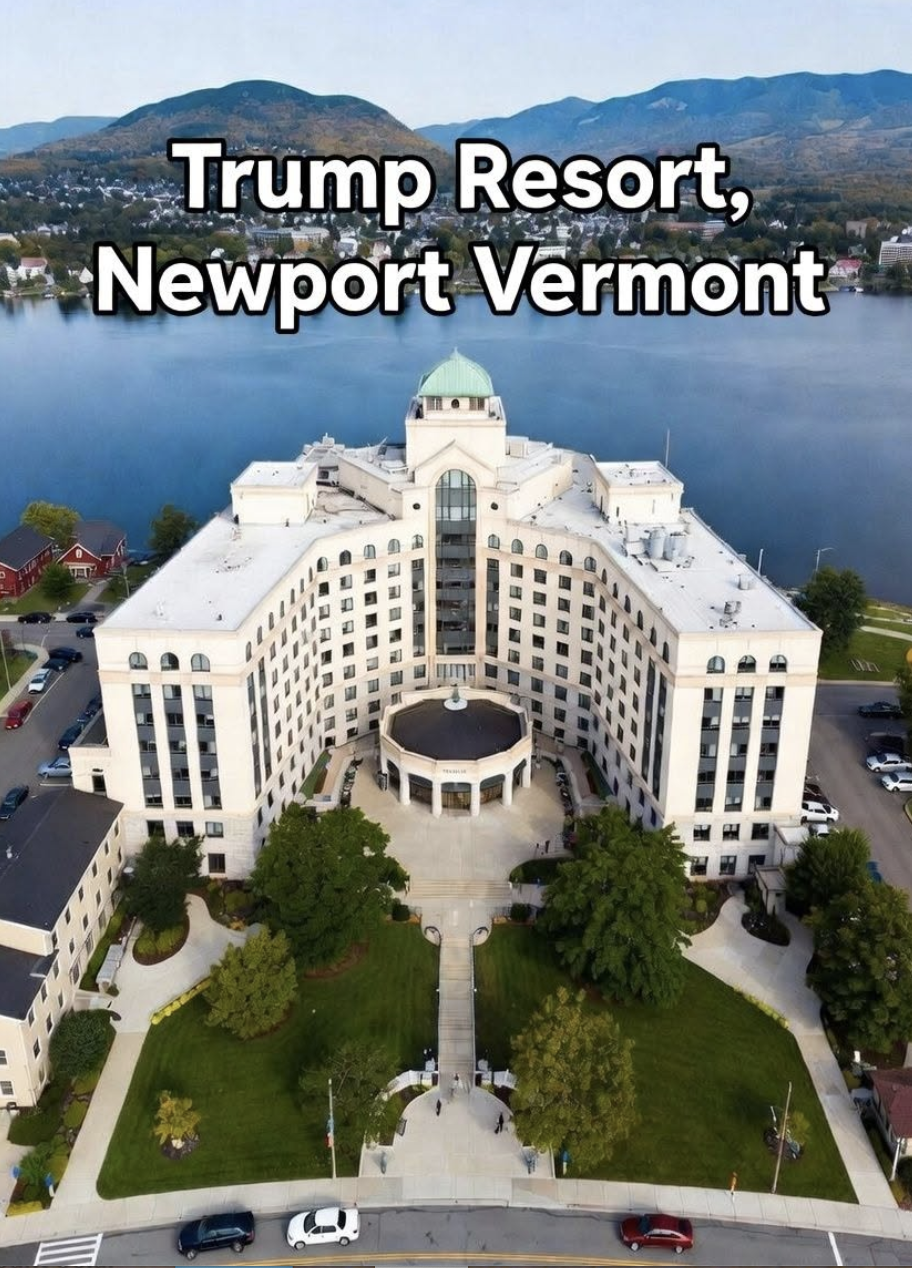
I guess, in Coester’s mind, despoliation of our landscape is okay if Trump does it.
There are more subtle varieties of astroturf to be sniffed out. Take, for example, Neil Ryan, the apparent brains behind “Rural Vermont Rising,” an advocacy group that’s either leading the charge against Act 181 or trying to cash in on the movement, your choice. The RVR website is slickly produced, which isn’t a surprise when you learn that Ryan is a marketing professional and business consultant. His business was, until very recently, based in Paris, France. (It’s still listed on his LinkedIn page as being located in Paris.) He apparently moved to Vermont earlier this year, almost immediately launched RVR, and started writing overwrought opinion pieces about how rural Vermont is being betrayed by liberal elites.
Ryan is also the owner/operator of MacIsaac Highland, “A Remote Hill Farm in Vermont’s Yankee Highlands” where he purports to raise Highland cattle. The website offers farmstand lodging, although one VPO reader who tried to schedule a stay never got a response from their inquiry.
And while MacIsaac depicts itself as a traditional Vermont farm of long standing, the business was only registered with the Secretary of State’s office in February of this year — less than two weeks before Ryan launched RVR and started cranking out the op-eds.
Another new entrant in the sterile fields of opinionatin’ is one Matt Swenson, fervent defender of rural Vermont who [checks notes] operates a vaguely techy-sounding business called Omnidex Solutions. Read its description of itself, and please tell me what the hell it actually does.
Omnidex Solutions is a lean diagnostics firm focused on identifying overlooked risks in complex, evolving environments. We support decision-makers by providing structured observation, comparative analysis, and interpretive insight where conventional approaches often fall short.
… Omnidex Solutions operates at the intersection of perception, pattern, and context. Our services are intentionally limited to conceptual and analytical domains.
There’s more, so much more, it’s exhausting to wade through. But I think it’s safe to say he’s not farming or logging or sugaring or any of that. If he wears a flannel shirt and ballcap to work, he does so ironically.
I should also mention that Omnidex was registered with the Secretary of State on April 15 of this year. Its “designated office” is an apartment in Shelburne that’s made a previous appearance in these pages as the listed address of a number of unrelated enterprises. Its mailing address is in Wyoming — a state whose lax regulations make it a very popular address of convenience for corporations. Astroturf, I tell ya.
Although his business may be brand spankin’ new, Swenson has been around for a while. One of his older VTDigger opinion pieces identifies him as a resident of Montpelier and an independent candidate for House in 2016. (He finished fourth in the East Montpelier district with a robust 8% of the vote.) His latest offerings simply say he “lives in Vermont.” Perhaps that’s because his essays depict Montpelier as the fount of all evil. It wouldn’t do for him to live in the shadow of the accursed Statehouse, would it now?
Ryan and Swenson’s overwrought op-eds could have been written by the same person. They both attack Vermont’s “governing class” (Swenson) and media organizations whose coverage of rural Vermont is “perfunctory” (Ryan). “The people who built this place…are being pushed out” (Swenson). Environmental advocacy groups ignore rural folk as they steer “money and influence toward institutional and corporate stakeholders” (Ryan). Law enforcement “has been gutted” and Vermont’s modest limits on guns have led to a rise in crime (Swenson). Vermont’s “prime agricultural land [has been] given over to solar installations” (Ryan).
That last statement is a flat-out lie. The amount of farmland, prime or otherwise, given over to solar arrays is a vanishingly tiny percentage of total farm acreage. General development — housing, office, retail — is a much bigger threat to Vermont agriculture.
These guys are peddling a narrative not far removed from the ravings of Mark Coester and his ilk. And for all his faults and foibles, Coester is a hell of a lot more authentic than Ryan or Swenson.
The bigger underlying question is, why is it happening now? Why is astroturf popping out all over? Where is this coming from, and who’s paying the bills? Somebody must be making it possible to crank out professional-grade AI fakery, start “grassroots” organizations, and write opinion essays. As my high school football coach once told me, “It don’t happen through osmosis, Walters.”
(Speaking of essays, please, Messrs. Ryan and Swenson, keep on writing those op-eds. It’s by far the least read portion of any news offering. The few who frequent the opinion pages are deeply interested in politics and most have already made up their minds. Writing an op-ed and seeing it on VTDigger or in your local newspaper is a great way to make you feel real smart. It’s a lousy way to influence the course of political debate.)
Hopefully we will find out some answers at the next campaign finance filing deadline of July 1. It’s a deadline for candidates themselves, but also for organizations spending on political advocacy or donating to favored causes or candidates. As always, follow the money.


“As always, follow the money.”
Thanks for ferreting these people out. You’re right in that someone with big bucks is obviously pushing this narrative for some financial gain that they can glean from it and these hacks see this as a way up the ladder of power.
Can’t wait for the obvious answer. Please, by all means, broadcast loudly if it turns out to be something other than what you expect.
Once again, your words rarely fail to amuse, alarm and educate. Thanks so much for keeping on top of such things, and keeping us informed about them. (And once again: Not for publication, just private kudos to you for your good work.)
Barry from Brattleboro (VIM/Commons, and other)
Hm. If it’s so obvious…why can’t you name it? You can imply all you want…but actual substance? Until you have that, you’re just, as our Mississippi friends would say, whistling Dixie.
No idea what you’re trying to say here.
” Somebody must be making it possible to crank out professional-grade AI fakery, start “grassroots” organizations, and write opinion essays. As my high school football coach once told me, “It don’t happen through osmosis, Walters.” “
Feel free to identify who this “somebody” is at any time. Evidence, not innuendo. That’s what real journalism does.
And if you can’t provide evidence…well, that’s evidence itself, isn’t it?
Oh looky, an anonymous commenter ranting about integrity and journalistic standards. My blog is clearly identified as commentary, bucko.
I first encountered Neil Ryan in the early days of the Act 181 reaction. He had a substack piece that was frankly, disgusting. It compared Act 181 to the literal Trail of Tears, and called it a collective history of displacement. Coming in a state like Vermont which literally genocided it’s own natives to make space for the ‘ jeffersonian farmers republic’, it should be enough to delegitmize anything this guy says or does.
https://macisaachighland.substack.com/p/what-are-rural-vermonters-for
What brought you to Vermont, Mr. Walters? And do you have the integrity to retract your lies-by-implication when presented with evidence that they are clearly, provably false?
An anonymous commenter posting as “integritymatters” and lecturing me on integrity? Impressive.
Great work, I worry that Balint has created a Streisand effect with this video, because no one outside of you, me, and the right-wing cesspool knew who he was.
It also weird that it seems that the OOS money is going to Coester and not Malloy, the much more polished of the two candidates.
Neil’s new farm web site:
https://macisaachighland.com/#stays
HIs wife’s linkedin
https://www.linkedin.com/in/ahn-lee-55035a29/
His farm motto: Am fear a chuiridh a chorrag ‘am shùil, chuirinn mo ghlùn ‘n a chliabh
translation: The man who puts his finger in my eye, I would put my knee in his chest.
Neil’s maternal grandma
https://www.naplesnews.com/obituaries/ndn026392
Neil’s latest speech
Veterans, vanity and vultures
https://us06web.zoom.us/rec/share/z_pxD9cfvDTLXWjroflG-0g0nBrwYMvy-jQP8uNpq3R40OWCu_6-IM5OObVGUvgt.aY4Q46iT-2zQzTBA?startTime=1785362401000