People of Essex, be forewarned. The man who uses this as his social media image is Ethan Lawrence, candidate for Selectboard. In fact, Ethan Lawrence is the only name on the ballot for the office he seeks. But he’d be such a disaster that town Democratic Party chair Brian Shelden has stepped forward as a write-in candidate in hopes of derailing Lawrence’s bid for office.
Lawrence is an anti-vaxxer, anti-masker, and angry despiser of all things liberal. But he’s presenting himself as a thoughtful moderate in hopes of sneaking into office as Liz Cady did last year in her bid for Essex-Westford school board. Now, Lawrence has every right to be a candidate, but the voters deserve to be informed about his views and his character.
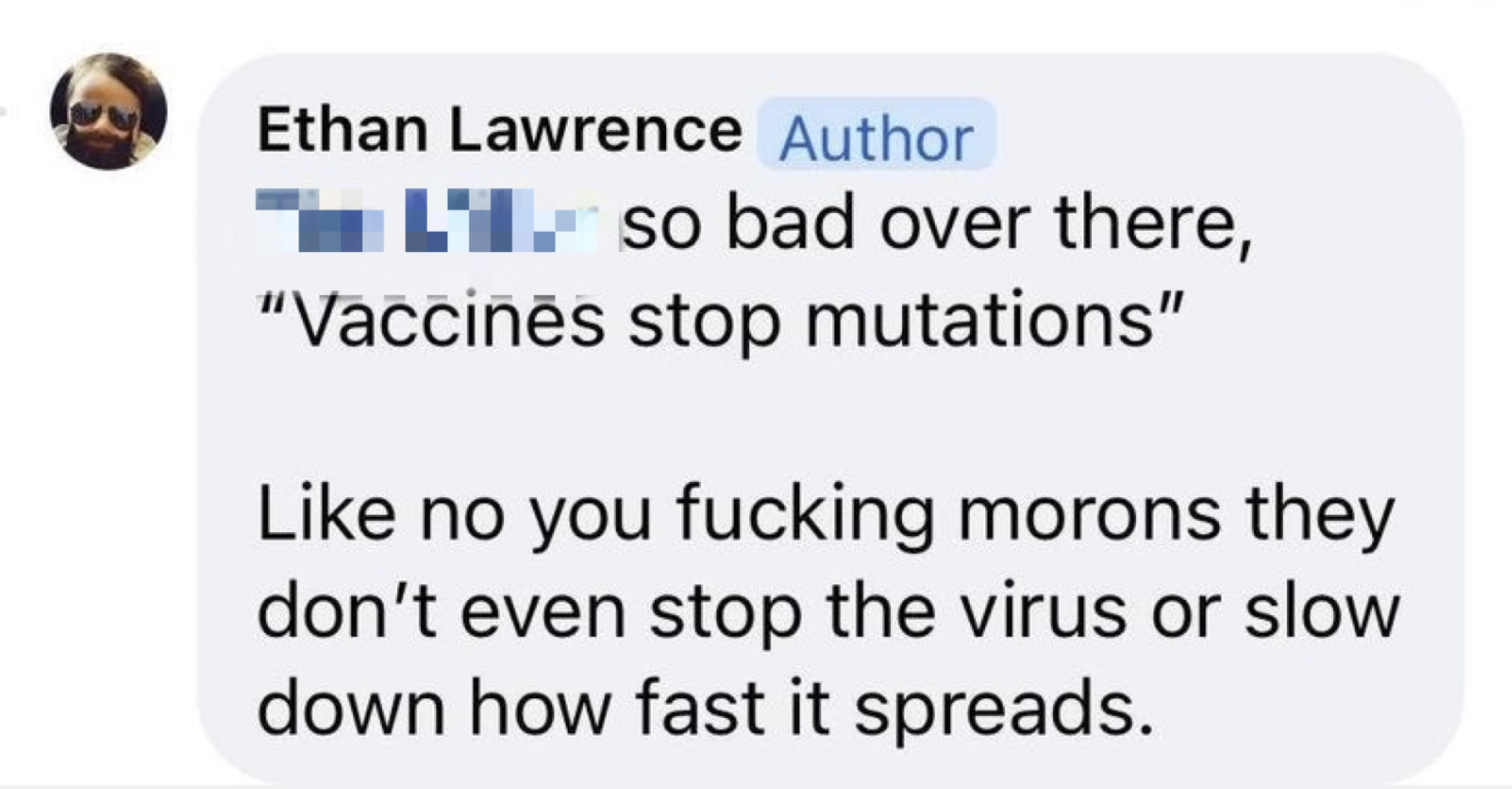
Until very recently, Lawrence maintained a lively, vulgar, conspiratorialist presence on social media. Now that he’s presenting as a moderate, he’s tried to hide his tracks. But hey, this is why God invented screenshots. Here’s a pretty typical example.
Ericka Redic, ultraconservative wannabe YouTube star, is running for office again. In fact, she’s running for two offices at once! That might pose a problem if she stood the slightest chance of winning either one.
Redic is on the Burlington city ballot as a Fourth Ward candidate for school board. She’s challenging board member Martine Laroque Gulick and, unless something truly weird happens, she’ll be nothing more than a speedbump for the incumbent. But Fourth Ward voters should know exactly what kind of choice they’re being offered. To judge from her general worldview, it’s safe to expect she’ll oppose mask mandates, beat the critical race theory drum and call for inquisitions of teachers and school librarians. Just what the voters of Burlington are looking for.
Meanwhile, Redic has filed campaign papers with the Federal Elections Commission as “Ericka Redic for Congress.”
The campaign committee is a model of streamlining. The treasurer of the organization is “Redic, Ericka L., Mrs.” T designated agent is “Redic, Ericka L., Mrs.” And the Custodian of Records is “Redic, Ericka L., Mrs.” As far as can be told, Ericka Redic for Congress is a one-person operation. Cozy!
This week brought the first glimpse of the money race for the Congressional seat being vacated by Senator-in-Waiting Peter Welch, as candidates were required to report fundraising and spending for the fourth quarter of 2021. The headlines predictably focused on the bottom line: “Gray Outpaces Balint in Early Fundraising,” said Seven Days. VTDigger, which threw in Welch’s total for good measure, topped its story with “Welch led 2021 fundraising in Senate race, Gray in House campaign.”
The accompanying reports were the usual surface-scratch that follows filing deadlines. Lead with the totals, list corporate contributions if any, tick off a few notable donors, and call it a day. Not blaming any reporters for this; it’s part of the job, and nobody in the political press has enough knowledge (or time) to dig deep into the numbers.
Including myself, I hasten to add. I’ve been following this game for more than a decade, and I’m still largely ignorant about the backstage world of state politics. But I can tell you what I think I think.
First, while Gray did raise substantially more than Senate President Pro Tem Becca Balint, the latter raised more than enough to be competitive. Plus, we won’t have a marker for Sen. Kesha Ram Hinsdale’s campaign until April because she didn’t launch her campaign until after the close of the fourth quarter. So the real headline, the politically meaningful headline, is that it’s too soon to tell much of anything. But that doesn’t exactly drive the ol’ SEO, does it?
Bear in mind also that fundraising is only one indicator of a healthy campaign. If Balint’s got more volunteers or a stronger staff or a deeper statewide network, then she’s the true early leader. But campaign finance is the factor that’s visible from the outside, so it becomes the standard measure of a campaign’s success.
Toto, I have a feeling we’re not in Vermont anymore
When last we considered Brock Pierce, former child actor, cryptocurrency skillionaire and newly-declared independent candidate for Pat Leahy’s seat in the Senate, we were comparing him to Rich Tarrant, another rich dude who thought he could waltz on in and grab an election all on his own.
Well, turns out there’s another parallel between the two tycoons. Like Tarrant, Pierce’s candidacy raises serious questions about legal residency.
Let us turn to the always reliable pages of the New York Post and an article about crypto fat cats who’ve adopted Puerto Rico as a tax haven. And there, right there, in front of his schmancy Caribbean pied à terre, is none other than Brock Pierce, “the de facto head of [Puerto Rico’s] crypto-championing movement.”
Why has the Isla del Encanto become a haven for newly-minted moneybags? Because of highly favorable tax laws that allow you to basically skirt American taxes without giving up your U.S. passport.
When last we checked in with Senate President Pro Tem (and Congressional hopeful) Becca Balint, she was deep-sixing a mask mandate bill because Gov. Phil Scott would just veto it, thus making further action a pointless “performative act.”
Apparently she’s changed her mind because on Monday, she put on a performative act of her own.
The occasion was a press conference in support of ranked choice voting, a concept that was introduced in both the House and Senate in early 2021 and went absolutely nowhere in either chamber.
Well, it’s back this year, and those endorsing RCV included two of the three Democratic candidates for Congress: Balint herself and Sen. Kesha Ram Hinsdale, the two hopefuls actively competing for the progressive slash Progressive vote. RCV is a high priority for the Progs, so their support for RCV is no surprise.
But Balint’s endorsement was a performative act, plain and simple. Two points.
I’ve read a lot of damaging political reportage in my time, but rarely have I seen a single piece as devastating as this.
In the latest installment of VTDigger’s ever-unfolding saga of EB-5 corruption, Anne Galloway and Paul Heintz have poured gasoline on the tattered remains of former governor Peter Shumlin’s reputation, tossed in a match, and stood back to watch the flames soar to the sky.
The story, based on FBI interview notes released by a federal judge, shows that Shumlin acted recklessly, flouted ethical standards, ignored the rising tide of evidence that the investment projects run by Ariel Quiros and Bill Stenger were deeply fraudulent, and ignored the counsel of close advisors that he was flying far too close to the EB-5 sun.
I have said before that Shumlin must have been either “complicit or stupid” about the scandal and I’m not sure which would be worse. Well, it’s looking more and more like complicity driven by the unmediated gall of the man.
The story is so rich with damning detail that it’s tough to know where to start. I’ll hit a few high points, but I urge you to go and read the whole thing.
This week’s Covid briefing was devoted to moving the conversation toward that long-sought-after pivot from pandemic to endemic. There were the usual rote reports of vaccination, school policy, forecasting, mask and test distribution &c., but the administration’s heart wasn’t in it.
The big tell came right at the beginning, when Gov. Phil Scott announced he had nothing to say about Covid-19. Instead, he pivoted to a brief repetition of his favorite policy points — workforce, technical training, how to spend federal Covid relief money and the surplus in the Education Fund (TL;DR: “not on public schools”).
I realize the numbers are coming down, as they inevitably had to. But isn’t it just a little bit early to start the George Aiken process of declaring victory and going home? After all, ICU admissions have yet to decline and deaths are still on the increase. Perhaps the briefest of pauses would be wise.
Of course, it’s almost certain that hospitalizations and deaths will decline within a few weeks. But let’s not get carried away. We’re returning to a decidedly unhealthy baseline. The positive view of our numbers is that we are getting back to, ahem, the bad old days of the Delta variant. That’s no cause for celebration.
The Legislature is once again trying to move forward with a bill to mandate lifetime medical monitoring coverage to Vermonters who may have been exposed to toxic chemicals such as the PFAS family of hazardous greeblies. Lawmakers passed such a bill in 2018 and 2019, only to see it vetoed by Gov. Phil Scott both times for his usual weak-ass reasons.
Well, now we know exactly how closely the administration was coordinating its stance with big corporate interests. Short version: Hand in glove. Or footsie under the table, if you prefer.
This revelation doesn’t come from Vermont’s sadly diminished political press, but from The Hill in faraway Washington, D.C. On January 26, The Hill posted the second in a four-part series on efforts to defeat such legislation in multiple states. The opening paragraph lays out the thesis:
State-level efforts to help victims of “forever chemical” exposure get compensation have met resistance from both governments and industry — and this pushback has been particularly effective in Republican-led states.
Like for instance, Vermont, which is the focus of the 1/26 story. It draws on public records requests that uncovered how “an official in the governor’s office coordinated with a lobbyist in ‘watering down'” the bill.
The official was Ethan Latour, then assistant spokesflack for Scott and now Deputy Finance Commissioner (because flackery is such good preparation for a high-level fiscal management post). The most telling moment: Latour sent an email to Warren Coleman of MMR, the top black-hat lobby shop in Montpelier, in which he shared a draft of a policy memo to the governor. Yep, Latour was making sure his memo danced to Coleman’s tune.
But that’s not the most telling part! In the email, Latour made reference to “his/our proposal,” meaning a weakened version of the bill which was a joint effort between the administration and Coleman’s corporate paymasters.
One more snuggly little detail: Before Latour joined the Scott administration, he worked for…. wait for it… MMR.
Update. Latour doesn’t work for the state anymore. He’s on the Secretary of State’s Lobbyist registry as a lobbyist employed by… wait for it… MMR. Isn’t that special!





 The Vermont Political Observer.