Monthly Archives: October 2014

Fear and Loathing in the State Senate

Really well-reported piece by VTDigger’s Laura Krantz on the fact that more Democratic state senators have endorsed Republican Lt. Gov. Phil Scott than his Prog/Dem challenger Dean Corren. (Current tally is 7 Scott, 5 Corren, and 9 hiding under their desks. Including fellow Prog/Dem Tim Ashe, who should be ashamed of himself.)

The thesis, as provided by Prog/Dem Dave Zuckerman, is that Senators are afraid to cross the entrenched Senate leadership, particularly the three-man Committee on Committees. (And I do mean “man.”) The Committee has one pivotal function: making committee assignments, including chairmanships. The Committee, by law, consists of (1) the Lieutenant Governor, (2) the Senate President Pro Tem, and (3) one other Senator, chosen by the entire Senate.

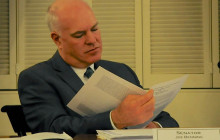
The Three Wise Guys, plus Peter Galbraith's good side. Photo borrowed from the collection of Paul "Shutterbug" Heintz.

The Three Wise Guys, plus Peter Galbraith’s good side. Photo borrowed from the collection of Paul “Shutterbug” Heintz.

#1 is Phil Scott. #2 is John Campbell, a self-described Democrat who loudly supports Scott. #3 is the apparently untouchable Dick Mazza, a nominal Democrat who openly supports Scott, hosted a Scott fundraiser, and made a hefty donation to Scott’s campaign. (And who, earlier this week, delivered a gratuitous slap to Governor Shumlin at a ceremonial event. The balls on that guy.)

As Zuckerman put it:

“The maneuvering for committee assignments is a big deal … and all three members have publicly supported Scott,” Zuckerman said. One senator told him he or she was not endorsing anyone because of committee assignments, Zuckerman said.

Loyal readers (Hi, Mom) know that I’m no fan of the State Senate’s entrenched power structure and its impenetrable air of clubbiness. I am particularly not a fan of John Campbell, who brings a unique combination of arrogance and passivity to the role.

But boy-o-boy, he’s full of fire when it comes to Dean Corren, who maybe spat in Campbell’s oatmeal in the State House cafeteria.

Campbell called Corren a “one-issue candidate” and disingenuous for seeking the Democratic nomination for lieutenant governor even though he had hard feelings for Democrats when he served in the House from 1993 to 2000.

Yeah, well, Corren has campaigned strongly and consistently on at least FOUR issues — health care, climate change, renewable energy, and encouraging entrepreneurialism — so Campbell is wrong there. As for things Corren said more than 15 years ago, Jeezum, can’t a guy learn from his mistakes?  Nobody batted an eye over Vince Illuzzi’s campaign for Attorney General, in spite of an extremely spotty ethics record in the 80s and 90s.

Back to the main point, which is fear of being banished to the Committee on Mumblety-Peg and Other Childhood Pastimes. No one is admitting to a fear-based endorsement (or non-endorsement), but several Senators offered Krantz some truly unconvincing reasons for their stands on the Lite-Gov race.

Ginny Lyons is not endorsing. She says it’s because she “believes in a two-party system.”

“As much as we support the Progressive concepts and ideas, when you’ve got three people running it splits parties up,” she said.

Yeah, except in this race, you don’t HAVE three people running. In fact, you have a candidate who won the Democratic primary fair and square, and won the endorsement of the state party committee, which you’d think would be as interested as Ginny Lyons in maintaining Democratic primacy.

Of course, Lyons has first-hand experience with the Committee on Committees: she chaired the Natural Resources Committee for an entire decade, but was removed without explanation in 2012 in favor of Good Old Boy Bob Hartwell. Now she’d like to win back her former post, but she’ll have to earn the favor of Campbell, Mazzas and Scott to do so.

Michael Sirotkin, the Senate’s junior member, begged off because he is “too fixated on his own race to endorse.” As if it would occupy more than five minutes to make an endorsement.

The same excuse sounds even more transparent coming from Jeanette “I’m focusing on my race” White, whose re-election is a virtual certainty because there are no Republicans or Progressives on the ballot in her district. 

Profiles in courage.

Oh, and Peter “The Slummin’ Solon” Galbraith, still firing shots on his way out the door, slammed Corren for not being a Democrat (as though Galbraith was any kind of example of party loyalty):

“If you’re not going to run as a Democrat, you’re not going to get the Democratic endorsement,” he said.

Well, actually, Pete, he IS running as a Democrat, and he DID get the Democratic endorsement. He just didn’t get yours. And besides, didn’t you just endorse Republican Roger Allbee for a Democratic nomination in your district? That didn’t seem to bother you.

As a liberal who wants to see small-P progressive policies,and wants the Democrats to use their well-earned political muscle to move the state to the left (just as George W. Bush and Ronald Reagan used their muscle to move the nation to the right), the State Senate’s combination of stasis, timidity, and self-satisfaction makes me ill.

There are plenty of good people in that chamber, I know for a fact. But the institution as a whole needs to be turned upside down and shaken until all the junk falls out. We should begin by dumping Dick Mazza from the Committee on Committees, and while we’re at it, finding a new President Pro Tem.


Phil Scott: the Zelig of Vermont Politics

And there he is again!

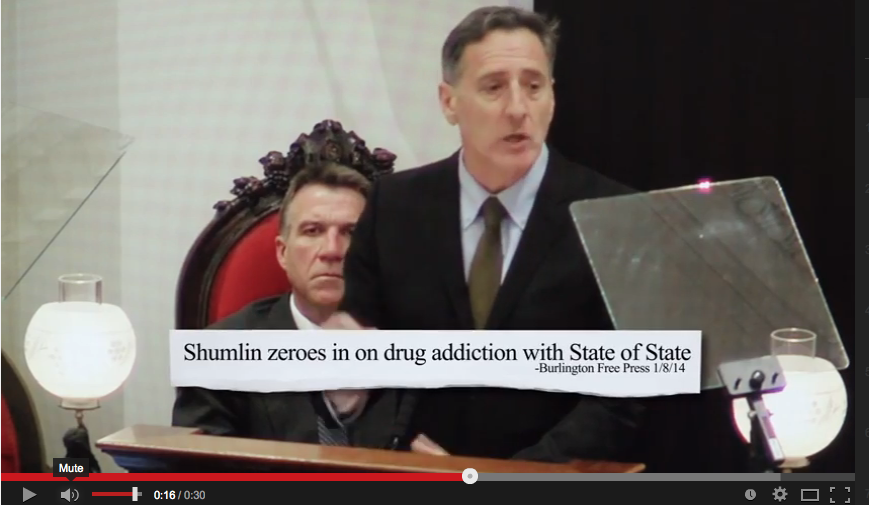
Governor Shumlin just released his fifth TV ad. This one is narrated by none other than St. Patrick Leahy, which is good solid politics. The Senator extols Shumlin’s “hard work” on items like Irene recovery, fighting opiate addiction, and promoting renewable energy.

But who’s that guy over the Governor’s right shoulder, right in the middle of the ad?

Yep.

Joined at the hip?

Joined at the hip?

Republican Lt. Gov. Phil Scott, with his Serious Policy Face on.

It’s only a couple seconds of airtime, but these images are chosen with great care. There must have been another camera angle of the speech that didn’t include Phil Scott. I have to assume it’s no accident that Scott gets a cameo in the ad, just like he got to appear at Shumlin’s side in Monday’s IBM presser.

My take?

Shumlin realizes that Scott’s going to win, and he’s going to have to work with the guy. And after his early endorsement of Dean Corren, he’s doing a bit of Lieutenant Gubernatorial apple-polishing.

It’s smart politics, if not exactly party loyalty.

RSLC strikes again; dollar count approaches $300K

The Republican State Leadership Committee, a national PAC devoted to boosting state-level candidates around the country, has dipped into its nearly bottomless wallet once again, dumping another $48,000 into Vermont politics. That brings their campaign-to-date total to more than $291,000.

This time, it’s on behalf of Republican candidates in the Legislature, including the VTGOP’s handful of authentic hopefuls in contested districts. The RSLC’s latest buy is “Postcards” for such worthies as Corey Parent, Scot Shumski, Michael Ly, Valerie Mullin, Joey Purvis, and Janssen Willhoit. The PAC’s official filing lists a total of 25 candidates “mentioned” in the material.

(For those interested in gender equity, that’s five women and 20 men.)

Earlier, I’d compared RSLC’s initial outlay to tossing money on a bonfire. And I still don’t think RSLC’s spending will have much effect on this campaign — especially with a lot of the money going to old-media tactics that don’t seem to work all that well. But RSLC’s continued spending could signal that it’s in Vermont for the long haul. And by RSLC standards, it wouldn’t take much money to tip the scales here. These bastards are definitely worth keeping an eye on.

I’d be more worried if they weren’t spending their money on the aerial-bombardment approach: ad buys and mailers. As Lenore Broughton discovered two years ago, a top-down, traditional-media campaign unconnected from a strong ground effort is a good way to waste money. If RSLC really wanted to have an impact, it’d pump some funds into the financially-starved VTGOP and help develop a political infrastructure.

Of course, if RSLC did that, it’d be subject to tougher restrictions on gifts to political parties. And it’d have less control over the process, which is anathema to the corporate high-rollers who dominate the RSLC donor list.

Postscript. Republicans might well argue that liberals don’t have much room for complaint, considering Gov. Shumlin’s big-dollar campaign, much of which comes from outside Vermont. And they have a point; there is a bit of hypocrisy at play. (Hypocrisy in politics??? I am shocked, shocked!) But there is a distinction between a Vermont candidate raising money wherever s/he can and controlling its use, and a big national organization parachuting into Vermont and making a power play. 

Foto Follies with Corry Bliss

Here’s a dispatch from the heartland, where longtime Republican Senator Pat Roberts is in the fight of his political life against independent Greg Orman, even though Kansas is just about the reddest of red states.

The national Republicans, seeing an unexpected threat, “cleaned out the Roberts campaign and started over with their own people,” and pumping a lotta cash money into the race.

This photo appears in the dictionary next to the definition of "douchenozzle."

This photo appears in the dictionary next to the definition of “douchenozzle.”

Those “people” included Corry Bliss, best known in these parts for driving Brian Dubie’s gubernatorial candidacy over a cliff with streetfight tactics that dented Dubie’s dubious image as a Jim Douglas-style conciliator. It was business as usual for Bliss, who somehow manages to keep getting campaign gigs in spite of the fact that he’s never, ever, not even once, been on the winning side.

Upon parachuting into Kansas, Bliss and Co. immediately turned Roberts to the right:

Roberts… has raised the specter of “national socialism” on the campaign trail and stumped with tea party stalwarts like Sens. Rand Paul (R-KY) and Ted Cruz (R-TX), as well as former Alaska Gov. Sarah Palin.

So far, it’s worked: recent polls indicate that Roberts has shored up support among hard-core conservatives. So maybe Bliss will finally break into the win column.

But not if he does stupid shit like this: 

The national website Buzzfeed has revealed that the Pat Roberts for Senate campaign has been using stock photos of sunflowers from the Ukraine, not Kansas, for its public-relations materials.

The photos, traced back to Ukrainian photographer Mykola Velychko, appear at the top of Roberts’ campaign Web page, his Facebook page and campaign news releases.

Kansas is, ICYMI, the Sunflower State. This is like a Vermont candidate pouring Mrs. Butterworth’s on his pancakes.

Bliss, naturally, “sought to downplay the ‘oops’ factor.”

“Is this a joke?” Bliss told Buzzfeed. “It’s obviously a stock image used by our digital firm to reflect that Kansas is the Sunflower State. But given the many serious issues facing our country right now, I doubt voters care about this silly line of attack by Greg Orman and his liberal allies.”

To be fair, Bliss has a point. The use of stock photos is almost universal, and there’s no evidence that the voters care about it. But… Corry Bliss himself does, when it’s convenient:

Managing Republican Senate hopeful Linda McMahon in Connecticut two years ago, Bliss made political hay of a similar mistake by opponent Chris Murphy, who used pictures of a Norwegian submarine in a campaign ad instead of one from a shipyard in Groton.

In the 2012 flap, Bliss told Hearst media: “Our campaign received several phone calls from both workers at Electric Boat and veterans who served on submarines, both of which were amazed that Congressman Murphy would feature a Norwegian sub in a television ad claiming it was from Groton.”

I’ll bet he wishes the Internet had never been invented. Because thanks to The Google, it’s quite simple to follow the trail of wreckage that Corry Bliss leaves in his wake.

Dear Mr. Feliciano: You are cordially invited to bug the hell out.

Nice little scoop hauled in by Paul Heintz in his “Fair Game” column this week. No, not the lead story about the IBM reverse-sale to GlobalFoundries; but the second item, about a Sooper Secret Meeting (that managed to stay secret for less than a week) at which Dan the Libertarian Man was asked by State Sen. Joe Benning to exit the race and endorse Republican Scott Milne.

According to Heintz, “participants pledged to keep the confab confidential,” which ha ha ha. I think we can assume that Benning didn’t send Paul a press release; the more likely scenario is that somebody else in the meeting, or who knew about the meeting, leaked a few details to Heintz, who then gave Benning a call.

At which point, Benning could have issued a denial. But, in this scenario, he apparently thought to himself “What the heck,” and acknowledged the whole “confidential” thing:

The Fixer. )Image pilfered from VTDigger.)

The Fixer. (Image pilfered from VTDigger.)

“I went through the pros and cons of [Feliciano’s] being in the race,” Benning recalled. “I suggested to him that the poll numbers were not in his favor and that if he stayed in the race, the only thing for sure that would happen is Peter Shumlin would walk back in without any kind of contest.”

… “I said that even if he left the race at this stage, it’s still an uphill battle for Scott Milne,” Benning continued. “But in the event that he had any interest in a future in Republican politics, I would imagine folks on our side of the aisle would be a lot happier if there was no split in the ticket in this race.”

Well, if he had dropped out, he’d have had no choice but to pursue “a future in Republican politics,” because he’d be dead to the Libertarian Party, who would have been justifiably outraged to lose their candidate to a GOP power play.

Ethically speaking (ha ha ha), this was an iffy move. It takes guts, or gall, to call another party’s candidate into a meeting and urge him to bug out.

Politically speaking, however, Benning was right.

Remember when Feliciano looked like he was going to steal the right wing away from Milne? When his write-in bid for the Republican nomination was taken seriously, was endorsed by two of the VTGOP’s four statewide officers, and Milne actually bought TV ads to fend off the “threat”?

When there was open speculation about Milne withdrawing in favor of Feliciano?

Believed to be Dan Feliciano at his campaign headquarters.

Believed to be Dan Feliciano at his campaign headquarters.

Well, that ship sailed long ago. Feliciano has done nothing to show he’s captured anything more than a single-digit sliver of the right wing: he’s way down in the poll that actually included him, and more importantly, his fundraising performance makes Scott Milne look like George W. Bush.

Which leaves us with this. If Milne exited the race and endorsed Feliciano, the latter would get the dead-ender vote but Milne would still be on the ballot, in the Republican slot, and would still garner a whole lot of votes from loyal Republicans. Feliciano’s best case: he’d be this year’s Tony Pollina, managing to outpoll a very weak major party candidate (Gaye Symington) but getting nowhere close to the winner. His worst case: he’d get into the low double digits, pulling Milne down to about 30% and making Governor Shumlin look like a landslide winner.

There’s no way Feliciano could pull very many centrist, “sick of Shumlin” votes; his views are too far from the middle.

Milne, on the other hand, has the inherent — and substantial — advantage of carrying the Republican standard. Even though he’s run an awful campaign, he still gets a solid 35% in the polls. He hasn’t convinced very many undecideds, but he’s retained virtually all of the Republican base.

So here’s how it looks to This Political Observer: Shumlin gets in the low-to-mid 50s either way. If Milne is the active opponent, he gets into the low 40s, with Feliciano retaining most of his meager support even if he stops campaigning. (He’s still on the ballot.)

But if Feliciano is Shumlin’s active challenger, then Milne gets about 30% and Feliciano maybe 15. Or Milne 25 and Feliciano 20. Whatever. And the difference is mainly a matter of style points — of how your party will look in the history books.

Of course, this whole kerfuffle is not really about November 4. It’s about what comes after: a potential relitigation of last fall’s intra-party battle for control of the VTGOP. Last year, Phil Scott’s Moderator faction won a narrow victory. Clearly, there are those within the party who’d like a second bite of that wormy, bruised apple.

In this context, Benning’s acknowledgment makes sense. In the short run, he’s trying to further establish Feliciano as a fringer. But beyond the election, it’s a message to the True Believer faction of the VTGOP: backing Feliciano was a mistake, and we’re still in charge.

As usual, this is all speculation on my part. I certainly haven’t gotten any leaks from Benning or any other Republicans. But it makes sense to me. And this is my damn blog.

@VTGOP plays a sad little game of “gotcha”

I knew the Republicans were desperate for material, but this is ridiculous. From the official @VTGOP Twitter feed:

Ooooooh, BURN!

Okay, here’s the thing. Well, two things.

1. It’s highly doubtful that Sirotkin himself put up those three signs. That’s the work of harried volunteers.

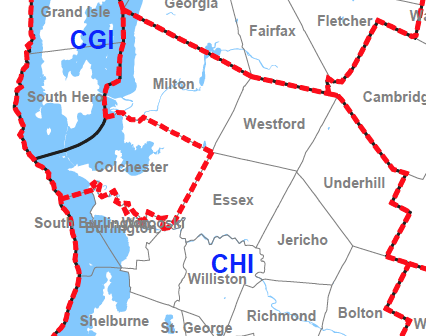
2. Colchester is the only community in Chittenden County* that’s not part of Sirotkin’s district. As you can see from this map, Colchester is an electoral cul-de-sac, surrounded on three sides by Sirotkin territory. (*Correction: Buels Gore and Huntington are also outside the district.)

Screen Shot 2014-10-22 at 10.30.43 AM

Here’s a thought for the bright boys @VTGOP: stop playing little gotcha games and focus on making your party relevant again.

Now that’s a burn. I’m out.

Profiles in Courage, Lieutenant Governor Edition

Fresh in from the Twitterverse:

Hmm.

To make this even worse, the debate is in Barre. Not like he had a long way to go. In the words of fellow Tweeter Shay Totten, “I always thought Phil was a fast driver.”

I guess he can drive slow when given the proper motivation. LIke a capable challenger waiting to engage him on the issues.

Wow! Scott Milne puts an ad on TV!

He must have thoroughly scoured the sofa cushions, because he’s finally taken to the airwaves with a paid 30-second ad. Either that, or he spent some time on Ancestry.com searching for more Milnes and Boieses to fund his (very) late-blooming media effort. This is his first ad buy since the August primary, when he put out a single ad to help him fend off the “challenge” of Emily Peyton and Dan Feliciano.

Anyway, he managed to pay whatever it cost to produce the thing, plus $78,825 on ad time. And shockingly, he didn’t spend most of his money on WCAX:

Screen Shot 2014-10-21 at 5.44.30 PM

As for the ad itself, well, it’s exactly what you’d expect. It’s a rehash of Milne’s attacks on Governor Shumlin delivered in a downcast voice by a female narrator — how many days he’s been out of state, slow economy, high taxes, Vermont Health Connect — with creepy music in the background.

Then, as it always does, the music shifts to a happy, mellow tune and the camera focuses on Our Hero, Scott Milne, standing outside somewhere on a sunny day, promising to cap property taxes, enact new incentives for education, and end “Peter Shumlin’s failed health care experiment.”

And then, just before the video cuts away, this strange lopsided smirk spreads across his face:

Screen Shot 2014-10-21 at 5.40.05 PM

Eeeesh. Looks like a bad used car salesman.

Shoulda tightened up the edit just a bit, boys.

The ad ends with a slo-mo video of Milne in profile with the suddenly-upbeat female narrator saying, “Scott Milne for Governor. Focused on solutions… full-time.”

Just a touch of snide in her voice on the “full-time.”

So yeah, typical stuff. Probably came out of some Generic Political Ad Generator from some Generic Political Production Company.

Nothing wrong with it. It’s just utterly predictable.

Well, except for the smirk.

‘Tis the season for hyping politically convenient survey results

This time, it’s a survey from the completely unbiased HAHAHAHA CNBC comparing the business climates of the 50 states. Here’s a shocker: Vermont didn’t do very well, coming in 42nd in the nation.

One clue that there might be something funky with this survey is the fact that all the Northeastern states were clustered at the bottom: New York 40, New Jersey 43, Pennsylvania 44, Maine 45, Connecticut 46, and Rhode Island dead last.

The only Northeastern states to get out of the doldrums were New Hampshire, tied with Arkansas for 30th, and that business-hating socialist hotbed of Massachusetts at 25.

Right off the bat, I’ve got to believe there’s some sort of built-in regional bias. And with Massachusetts the star performer of the region, it’s hard to see how much of an impact Vermont’s liberal tax-spend-and-regulate environment would have; we can’t be that much worse than Massachusetts. Indeed, the rankings are such a mixed bag that it’s hard to identify useful trends: some factors favor robust social investment (infrastructure, education), some have a clear geographic bias (availability of transportation), some favor large states, some small.

Of course, that didn’t stop VTGOP Chair “Super Dave” Sunderland from glomming onto the survey like Paula Deen on a stick of butter.

Well, there’s the VTGOP analysis, in its full 140-character glory. What say we take a closer look at this survey?

Vermont’s rankings tended toward the extremes. There were ten categories in all. We were near the top in Quality of Life and Education. We were in the middle on a few things (including the oft-criticized Business Friendliness, #31), but right near the bottom on Cost of Doing Business, Cost of Living, Infrastructure & Transportation, and Workforce.

All right, so we’ll take credit for Quality of Life and the excellent education system that the Republicans would like to undercut (gubernatorial candidate Scott MIlne calls for as much as a 30% slash in public school funding). But let’s see why we fare so poorly in those four major categories. CNBC lists the criteria in each category, although there’s no explanation of how the criteria are evaluated and weighted, so it’s only of limited utility.

Cost of doing business. Criteria include state and local tax burden (income, property, business, gasoline), utility costs, wage rates, and rental costs for commercial space.

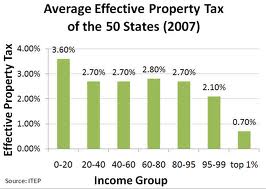
Why I don't feel sorry for the overburdened rich. From the Institute on Taxation and Economic Policy.

Why I don’t feel sorry for the overburdened rich. From the Institute on Taxation and Economic Policy.

Regarding taxes, first of all I’d note the absence of sales tax, which hits middle- and lower-class residents hardest. For included taxes, CNBC used the official tax rates. However, some of our tax rates are artificially high compared to taxes actually paid. This is especially true for top income earners. Vermont’s official top income tax rate is 8.95%, which is on the high side; but because of generous rules on eligible income, top earners pay an effective rate of only 5.2%. And when you combine all taxes, the top 20% pay a smaller share than any other group.

As for utility costs, yes, they’re relatively high. That’s partly because of Vermont’s relatively aggressive adoption of renewables, but also because of our relative lack of home-grown sources. We don’t have any of our own coal, oil, or natural gas.

On wage rates, well, I’d just as soon have better wage rates than some “business-friendly” states like Texas and Utah and Nebraska. Ditto rental costs: I’m glad we put reasonable limits on commercial development. It’s part of the price we pay to keep our “Quality of Life” score high. (If, like Scott Milne, you’d like to see Vermont look more like the West Lebanon, NH commercial strip, then you’re entitled to your opinion. I guess.)

Cost of Living. A fairly straightforward category. Some of the low ranking is due to social choices (energy and development, see above) and some is inherent in being a small, rural, cold place (food, heat).

Infrastructure & Transportation. This category is a little funky. “Quality of roads and bridges” is only a small part of it. CNBC’s top criteria:

We measure the vitality of each state’s transportation system by the value of goods shipped by air, waterways, roads and rail. We look at the availability of air travel in each state, the quality of the roads and bridges, the time it takes to commute to work and the supply of safe drinking water.

Well, hell. Vermont’s never going to score well on most of that. We don’t produce a lot of goods, so we don’t transport much. We don’t have much of a transportation infrastructure because we’re so small: only a couple freeways, a lot of winding two-lane roads, very little rail or air. And our commute time is long because we’re rural.

Workforce. This is another funky one. Along with education level of employees and number of available workers (we struggle on that one), CNBC puts a lot of stock in right-to-work laws and toothless labor unions. Again, if that makes us a bad place to do business, it’s a trade-off I’m more than willing to make.

There’s one more crucial piece you need to understand about the CNBC ranking. Not every category gets equal weight. In fact, the most heavily weighted category, Cost of Doing Business, is worth 450 points, while Education is worth only 150 points and Cost of Living only 50.

CNBC’s weighting system pushes Vermont farther down the rankings because we generally score worse on the heavily-weighted categories than on others.

Some of the weighting is reasonable, and some of it is standard fiscal-conservative dogma. Education, in particular, seems to be very important to a lot of Vermont businesses, and yet it carries little weight in CNBC’s rankings.

But then, it’s depressingly normal for the business world to focus on the immediate and short-term, instead of the long-term. You’d think that businesses would be smart enough to realize that a little short-term pain (enough tax revenue to support infrastructure, education, and social services) is more than justified by the longer-term gain of doing business in a strong, stable environment rich in social capital.

The survey is somewhat useful if you look beyond the mere rankings and use it to evaluate your state’s strengths and weaknesses. And if you make thoughtful decisions on which factors are worth improving, and which things you’d like to keep the way they are. Even if they don’t absolutely maximize the business climate.


Shocker: Realtor-commissioned survey finds property taxes too high

In the category of Not At All Motivated By Self-Interest, No Sirree, comes an opinion poll from Vermont Realtors on the subject of property taxes.

Surprise: they’re too high.

According to the survey, 76 percent of respondents say that property taxes are too high. The poll also demonstrates that this is a non-partisan issue, with two-thirds of Democrats, 78 percent of independents and 85 percent of Republicans sharing the belief that property taxes are too high.

The first thought with stuff like this is: Well, of course. It fits the Realtors’ preconceived political narrative. But the methodology — fully explained in the news release, thank you — is reasonably solid. And there’s no doubt that a lot of Vermonters think the property tax system is out of whack.

But let’s look a bit deeper. The key question in the survey was “Do you believe property taxes are too high, too low, or about right for the services you receive?”

When you start out asking taxpayers if their taxes are too high, you’ve invited a positive response. How many people are going to volunteer that their taxes are too low?

And the consensus rapidly dissolves when people were asked what to do about it.

 According to the poll, 49 percent of respondents say there is a great need [to reform the way public schools are funded], while 26 percent believe that there is “some” need. Just nine percent say there is little need and only eight percent see no need.

To which VR President Donna Cusson noted, “The intensity on the need for change is striking.”

Actually, I kinda thought the opposite. 76% say their property taxes are too high, but only 49% say there is a “great need” for change. That’s a lot of people complaining about property taxes but lukewarm on change. Probably because, as everybody knows, the devil is in the details. And, as everybody knows, it we lessen the property tax burden, we either have to cut spending on our high-performing and well-loved public schools OR we have to raise taxes somewhere else.

Here's another reason to reform the system. From the Institute on Taxation and Economic Policy.

Here’s another reason to reform the system. From the Institute on Taxation and Economic Policy.

In its press release, VR described the results of two questions. There were other questions, and VR is not releasing those numbers. It says it “has shared the results of the survey directly with candidates for office in an effort to initiate a dialogue about the need for property tax reform…”

So… it wants to tell candidates what the voters think, but it doesn’t want to let the voters know? That’s a bit curious.

I suspect that some of the other survey results were perhaps less forceful. If, say, respondents were asked how best to fix the system, I’m guessing there wouldn’t be any real consensus. Because all the alternatives are unpalatable. And that’s why it’s been so difficult for the Legislature to tackle the issue.

One other oddity: The VR release is dated September 29. At the time, apparently, it got zero attention in the media. This morning, VTDigger posted the release in its ever-popular “Press Releases” section, which is where I noticed it.