Looks like a real contest is developing in the Chittenden Central state Senate district, where three seats will be up for grabs in 2026. The three sitting solons, who seem likely to run for re-election, may find as many as four other names on the Democratic primary ballot next August.
In other words, Donkey Race!
Chittenden-Central is, geographically speaking, the smallest Senate district by a longshot. On a map it resembles Nepal after encontering an old-fashioned laundry mangle. It includes much of northern and central Burlington, the city of Winooski, a bit of Colchester, the city of Essex Junction, and part of the town of Essex. Politically speaking, it may be the most liberal Senate district in the state. The incumbents are Senate President Pro Tem Phil Baruth, listed on the ballot as a D/P, Democratic Sen. Martine Laroque Gulick, and P/D Sen. Tanya Vyhovsky.
Throughout the campaign season I wrote about the Barons of Burlington, a bunch of well-heeled men — well, almost entirely men — and their obviously coordinated effort to buy a bunch of state Senate seats. They wrote fistfuls of four-figure checks to six Republican candidates for Senate plus their choice for lieutenant governor, Democrat-turned-Republican John Rodgers.
So, now that the dust has settled and the campaign finance reports are nearly complete*, it’s time to answer the musical question: Did the Barons buy the election?
*Final reports are due December 19, but the bulk of the money has been accounted for by now.
The obvious straight-line answer is yes. Their seven chosen candidates swept the field, reducing the Democratic/Progressive majority from 23 seats to 17 with the tie-breaking LG vote going to the Republicans.
The less obvious answer is, well, not really. There is abundant evidence that their money didn’t swing the election — that the Republican gains would have happened anyway.
The September 1 campaign finance deadline has come and gone. There will be plenty to report on, but we must begin with the final numbers for ex-TV anchor Stewart Ledbetter’s failed bid for state Senate. It’s one for the history books. Ledbetter managed to turn his broadcasting fame and an immense pile of cash into a fourth-place finish in a race for three Democratic nominations.
The carnage: Ledbetter’s campaign raised a total of $68,557, including $10,518 between August 1 and primary day. That has got to be an all-time record for a Vermont legislative campaign. If anyone can think of a more costly effort, I’ll amend this post*. And Ledbetter raised all that money for a primary. He didn’t even make it to the general.
*VPO reader and Middlebury College professor Jason Mittell points out that although Ledbetter had the biggest campaign fund, he was actually “bested” in spending per vote. By Mittell’s reckoning, Elizabeth Brown, business-backed Democratic candidate in the two-seat Waterbury district, spent an incredible $35 per vote received**.
**And we have a winner! Reader David Ellenbogen points out gas station magnate and G.W. Bush megadonor turned ambassador Skip Vallee. He ran for state Senate in 2000 and finished eighth in a race for six seats despite spending (according to Seven Days) an incredible $123,000, including $60,000 of his own money. Vallee remains unchallenged as running the most expensive campaign for a legislative seat in Vermont history. Unlike Ledbetter, however, Vallee at least advanced to the general and spent his wad over the full campaign season, not just the primary.
He spent a total of $58,495 on his campaign, including an amazing $28,962 after the end of July. He was spending money at a frantic pace when many voters had already cast their ballots. It’s understandable, since there must have been a desperate scramble to shovel cash into any available furnace. Even so, he managed to leave more than $10,000unspent.
Ledbetter got 3,159 votes in the primary. Which meant he spent $18.51 per vote.
Apologies for all the italics, but the numbers are simply astounding. And not in a good way.
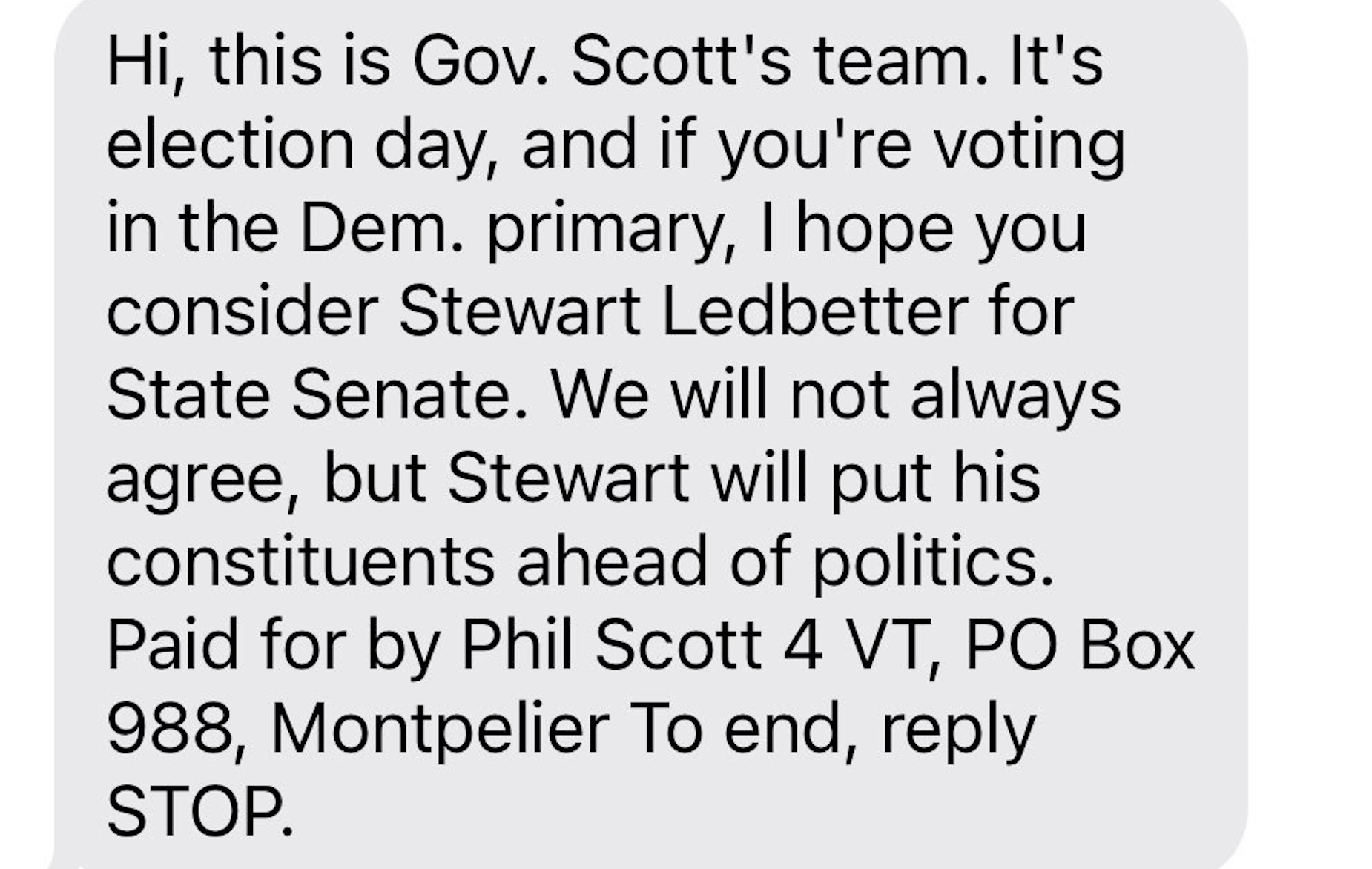
It’s been years since Gov. Phil Scott has had to run a competitive race, and maybe his political team has gotten soft or something. Because when it comes to shooting oneself in the foot, it’s hard to top a Republican governor texting voters in Vermont’s most progressive Senate district on behalf of the centrist candidate. Who, spoiler alert, lost.
I mean, who’s in charge over there? Baldrick?
This wasn’t the governor’s only ill-considered stomp into Democratic primary turf. His team also sent texts on behalf of Elizabeth Brown, faux-Dem challenger to incumbents Tom Stevens and Theresa Wood. Both are committee chairs and influential members of the House Democratic caucus. Ya think they’ll remember this little misadventure with gratitude? Ya think the admin’s relationship with the Legislature just took a small but discernible turn for the worse?
My guess? Either Team Scott is just desperate to move the needle on legislative races or they’ve got too much time on their hands, what with a snoozer of a contest against Dem nominee Esther Charlestin their biggest “challenge.” Maybe they should just take the rest of the year off.
Tuesday’s primary election turned out to be a snooze. The most interesting development was how much money was wasted trying to unseat a small number of Democratic incumbents. They all won, as far as I can tell.
Firmly atop the Futility Rankings is former TV anchor Stewart Ledbetter, who finished fourth in the race for three state Senate seats in the Chittenden Central district. He raised almost $60,000 and spent a bit under $40,000 (tentative). He “earned” 3,159 votes, which cost him and his well-heeled donors about $12.56 apiece. Bargain!
Elsewhere in the “beat the Democrats” game, House Ways & Means Chair Emilie Kornheiser brushed off a challenge from business-backed Dem Amanda Ellis-Thurber, while the Waterbury duo of Reps. Tom Stevens and Theresa Wood defeated “affordability” Dem Elizabeth Brown, who spent gobs of cash and didn’t really come close to pulling off an upset.
Two quick takeaways: If there’s an anti-tax revolution brewing in the hinterlands, it did not show itself in the results. At all. And those allegedly smart business leaders just squandered a whole lot of money trying to push the Democratic caucuses toward the center. They might have scored one small victory, as Danforth Pewter chief Bram Kleppner took a Democratic nomination for House in Burlington. But that’s about it.
August 1 was another campaign finance deadline, the last before our August 13 state primary. As usual, there was plenty of interesting stuff to be found. And as usual, there was a dearth of coverage in our sadly diminished media ecosystem. VTDigger waited a few days to put together a solid campaign finance database helmed by its longtime (by Digger standards) data reporter Erin Petenko. But any effort, by anyone, to identify trends or develop insights? Haven’t seen any.
Meanwhile, those who follow me on Elon’s Hellscape know why I’m late to the party. After doing a fair bit of spadework around the deadline, I came down with Covid. It was a pretty severe case for a few days and I’m still on the mend, but I feel able to put words on the screen for the first time since last Thursday.
Anyway, got some things to say. Let’s do the toplines first and then get to the details.
While the vast majority of candidates have trouble scratching a few bucks together, there are a few who have more money than they know what to do with. The primary’s one week away, early voting as been going on for roughly a month, and they’re sitting on large quantities of unspent cash.
Many of these hopefuls have been generously funded by a cadre of Burlington-area business types, who may look at their investments post-primary and despair at the improvidence of their strategery.
Two candidates got a rocket strapped to their backs by those business leaders in July. John Rodgers, running for lieutenant governor, and Rep. Pat Brennan, running for state Senate. They went from near zero on July 1 to huge, nigh unspendable hauls on August 1. Congrats, I guess?
Gov. Phil Scott’s campaign has far outstripped Democrat Esther Charlestin. Why his people are bothering to beat the bushes, I don’t know. I remain convinced that he’d be better advised to mothball his campaign and start a PAC — or a Super PAC — and spread his influence around.
The oddities around Thomas Renner’s campaign for lieutenant governor continue to proliferate. His fundraising slowed to a trickle in July, but he spent very little and has a sizeable unspent reserve. I still don’t know what his campaign is about. Or who’s running it, for that matter.
One week ago, I wrote about former senator John Rodgers’ five-figure spend for ads on WDEV radio plus other candidates’ investments in mass media. Several candidates have since reported mass media expenditures; here’s a look at the highlights.
Reminder: The next campaign finance reporting deadline is August 1, but candidates are required to promptly report mass media buys of $500 or more when they occur close to an election.
Let’s start with Rodgers. I noted that if his WDEV buy was part of a broader strategy it could pay off, but by itself it’s a questionable move. It’s a lot of money to spend on a diminished medium and an outlet that only reaches a fraction of Vermont. Well, so far it stands alone: Rodgers has not reported any more mass media spending.
The biggest mass media report from the past week comes not from a candidate, but from the Child Care Victory Fund, a political action committee affiliated with Let’s Grow Kids Vermont. The Fund is apparently trying to protect incumbent lawmakers who supported Act 76, the 2023 bill that made a “quantum leap” in child care investments, and now face primary opposition.
Well, I didn’t really want to wade through all the campaign finance reports filed by House candidates on July 1. But there were questions I wanted to answer, so wade through them I did.
Actually, not all. I didn’t pay much attention to incumbents. I was mainly interested in new candidates. What follows is a daunting amount of detail, so let me give you some topline findings right away.
A lot of candidates, both new and incumbent, are having trouble complying with campaign finance law. Fortunately for them, the penalties for noncompliance are minimal to nonexistent.
There’s been a lot of talk about centrists running as Democrats with financial backing from rich folks and business leaders. What I found, to my mild surprise, is that there aren’t really that many of ’em. Hardly enough to qualify as a trend. But it is worth focusing attention on those trying to poach Democratic seats.
The Republican field of new House candidates is pretty much a financial wasteland. With a few exceptions. Emphasis on “few.”
One of the most successful funders of Republican House candidates is the Rutland GOPAC. But they operate on a modest scale, and aren’t likely to move the needle appreciably.
Okay, on to the details, whether you want them or not. But hey, this is a place for political sickos, so on we go.
Well, well, well. Former Democratic state senator John Rodgers, now running for lieutenant governor as a Republican, seems to have searched for loose change in the sofa cushions and maybe the console of his (guessing here) pickup truck. Because after reporting no campaign activity whatsoever on July 1, he has now gone and spent a cool $10,400 on advertising with Radio Vermont, a.k.a. WDEV Radio.
We won’t know where the money came from until August 1, the next campaign finance deadline, but candidates are required to promptly report mass media expenditures of $500 or more when they occur close to an election. Rodgers filed his mass media report on July 11.
There are some other mass media filings of note, but let’s stick with Rodgers for the moment. I have to think — in a perverse way, I hope — he’s got some serious money behind him and that this big expenditure is part of a broader plan, because spending $10K on radio ads in central Vermont, by itself, is kind of a headscratcher. And I say that as a veteran radio guy whose brain still conjures up the radio version of the naked-in-public nightmare. (Which basically involves every possible interruption or technical problem sabotaging a live broadcast while I’m sitting at the microphone. Yep, radio in the blood.)
Previously we looked at the dire financial straits of Esther Charlestin’s candidacy for governor, where she barely cleared $12,000 in a race that calls for, by Howard Dean’s reckoning, at least 164 times that much money. Now it’s time to look at the Republican side of the ledger, where pretty much everybody can rightly cry poverty.
With one notable exception.
That would be state Rep. Scott Beck, running for the Northeast Kingdom Senate seat currently occupied by retiring Democrat Jane Kitchel. Beck has raised a rather stunning $35,565. (His likely Democratic opponent, Amanda Cochrane, has raised a respectable $7,165 and enjoys Kitchel’s active support.) Beck appears to be the only Republican candidate who has raised more than enough money to run a respectable race. Besides, of course, Gov. Phil Scott, The Exception To Every Republican Rule,
More to the point, Beck and the governor are about the only two Republicans who aren’t complete embarrassments when it comes to fundraising. Which shows you just how desperate the party’s situation is.
The VTGOP ought to be in a position for a nice little comeback in the Legislature, threatening to end the Dem/Prog supermajorities that imperil every single one of Scott’s many, many, many vetoes. And they’re not.
Instead, the wistful eyes of the donor class have largely turned to putative Democrat Stewart Ledbetter’s bid to wrest away a Senate seat from liberal Democrat Martine Gulick or Progressive firebrand Tanya Vyhovsky. Ledbetter has amassed the largest campaign kitty of any Statehouse candidate thanks primarily to Burlington-area business leaders. You know, the very people who would historically be bankrolling Republicans.





 The Vermont Political Observer.