Tag Archives: Doug Hoffer

Redirect: The view from inside the stable

In response to yesterday’s post about the troubles in the Vermont Training Program, I got a nice call from Lucy Leriche, Deputy Secretary of the Agency of Commerce and Community Development, which I believe I referred to as the Augean Stable of state government.

Well, nice to know somebody’s paying attention.

She made some good points, and some not-so-convincing points. Overall, I have to say my view of ACCD hasn’t changed much.

The #1 item she brought to my attention: “the reboot.”

The Vermont Training Program was overhauled in 2014. …The Auditor began his inquiry and report in 2015. What he had to work with was data from before the reboot. We have made a lot of changes, but the report is based on old information.

Hoffer’s response: he was aware of the reboot, and considered it in his report. His view: the reboot made some changes, but fell short in many ways. “It still relies on self-certifications [by applicants],” he wrote in an email. “The program should do some independent validation, as is recommended by the State’s Internal Control guidance. It’s a matter of adopting best practices in order to be accountable. These are taxpayer funds.”

Over to you, Ms. Leriche:

The Legislature made it clear they didn’t want us to build a big bureaucracy. They wanted as many dollars to go to grants as possible. If we did everything Doug Hoffer suggested, it would take at least one full-time person. That would take a lot of money away from grants.

Okay, let’s see here. They didn’t want “a big bureaucracy,” and following Hoffer’s suggestions would take “at least one full-time person.” That doesn’t sound like “a big bureaucracy” to me. It sounds more like a reasonable investment in protecting taxpayer funds.

Continue reading

The Augean Stable of state government

The Agency of Human Services comes in for a lot of green-eyeshade scrutiny when budget time rolls around. With good reason; thanks to outmoded software and management, I’m sure AHS could do a better job than it does. And thanks to our jobless, middle-class-killing “recovery”, it’s coping with ever-increasing demand.

Mr. Hoffer detects an unpleasant odor. (Not exactly as illustrated.)

Mr. Hoffer detects an unpleasant odor. (Not exactly as illustrated.)

But pound-for-pound, I doubt that any part of state government can top the Agency of Commerce and Community Development for waste, futility, and inside deals.

In the latter category, we had the backroom agreement last spring that landed Lake Champlain Region Chamber of Commerce a $100,000 no-bid grant for developing business with Quebec. And now, in the second category, we have a rather devastating memo about the inadequate structure of the Vermont Training Program, which provides grants to businesses for employee training.

In his memo*, Auditor Doug Hoffer is far too politic to use the most appropriate term — “clusterf*ck.” But that’s the message. As I was reading the memo, my thought was, “Maybe we should just burn down the whole place and start from scratch.” His bullet-point highlights:

*As of this writing, not available online. But check the Auditor’s website; it should be posted soon.

— The VTP has no effective internal controls to ensure that applicants meet the various eligibility requirements or that grant funds are only used for supplemental, rather than replacement, training.

— The wage increases reported for trainees may not accurately reflect changes in hourly wages and may reflect other factors not related to VTP training.

— A substantial portion of VTP’s total resources are directed to a few large corporations year after year.

Yeesh.

Continue reading

The downside of subcontracting human services

We had an unintended confluence on the Thursday edition of the Mark Johnson Show, hosted by Yours Truly. Back-to-back interviews with VTDigger’s Morgan True and State Auditor Doug Hoffer turned out to cover some common themes.

True had reported on problems at Rutland Mental Health Services, one of the state’s “designated agencies” for providing social services. Hoffer had just released a very critical performance audit of the Corrections Department’s transitional housing program. I was in the middle of the show when the light bulb went off. Both interviews were kind of about the same thing: Inadequate oversight of human services contractors.

In both cases, an Agency of Human Services program is contracted out to nonprofit agencies that get virtually all their funding from the state. In a way, it’s a mutually captive relationship: the agencies are completely dependent on the state, and the state effectively has no options for replacing a poorly-performing contractor.

In their own way, True and Hoffer found similar problems in different areas of AHS: lack of consistent oversight, gaps in service provision, and inadequate methods for tracking performance. (In the case of RMHS, the situation boiled over into scandal.) The result is a system that looks good from a distance, not so good up close. Its failures are partly due to lax oversight; but we should also consider whether poor contractor performance may also be due, at least in part, to bare-bones funding by the state.

After the show was over, I pondered another issue: What does the Rutland situation have to say, if anything, about the Shumlin administration’s community-based mental health care system? Because those designated agencies are the front-line troops in that effort.

Continue reading

The curious incident of the Prog in the night-time — UPDATED

UPDATE: The Senator in question has spoken to WCAX. Details below, after the jump.

So here’s a heartening piece of party unity: the elective officeholders of the Progressive Party got together this week and enthusiastically endorsed Bernie Sanders for President.

The gang’s all there, from the four Progs on Burlington City Council, Robert Millar of Winooski City Council, the Party’s seven members of the House, State Auditor Doug Hoffer, and both of the Progs’ state senators.

Wait, what did I just say?

“…both of the Progs’ state senators.”

Hey, aren’t there three of ’em? I thought so.

Well, there’s Anthony Pollina… and David Zuckerman…

Hmm. Where’s Triangulatin’ Tim Ashe, the most nakedly ambitious of all the Progs?

Continue reading

Who watches the watcher?

Under our system of government, the legislature enacts laws and the executive implements and enforces them. But what happens when a law targets the state itself, and the state fails to obey the law?

Don't mess with the Hoffer.

Don’t mess with the Hoffer.

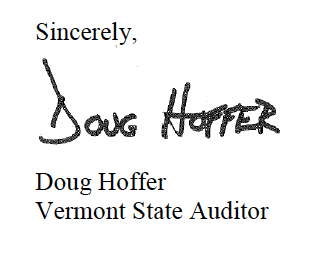
This existential question arises from a new report from Auditor Doug Hoffer (who has an appropriately awesome, take-no-prisoners signature) brings us an example of a self-inflicted U.M. It involves Act 40, a bill that became law during Peter Shumlin’s first year in office. Act 40 was a nobly-intentioned piece of legislation that required each state entity to cut its energy consumption by five percent per year.


Great, no? The state leads the way on energy efficiency, providing an example for us all. Except that, according to Hoffer, Act 40 is nothing but an empty shell, its efficacy unknown and unknowable.

A few key findings:

— The state ” had limited information regarding whether, and the extent to which, its focus on reducing energy consumption resulted in reductions consistent with its goals.”

— The state government’s energy plan “failed to establish a systematic mechanism to evaluate progress toward reducing energy consumption.”

— Not all state agencies prepared energy-reduction plans required by the law.

— Key terms in the law were left unclear. For instance, Act 40 called for “right-sizing” state vehicles, but “right-sizing was not defined” and no criteria were established.

— Energy use in leased space was not included in evaluating Act 40 performance. In 2012, leased space accounted for 20% of building space managed by the Department of Buildings and General Services. There’s a big loophole.

And the kicker:

— “State government energy consumption has not been reported since 2011, and the results reported prior to 2011… contained data and formula errors and had methodological flaws…”

Put it all together, and we seem to have a clear picture of administrative failure that undermined a very good piece of legislation.

Buildings and General Services Commissioner Michael Obuchowski acknowledged many failings in his formal response to Hoffer’s audit. He pleaded, surprise surprise, poverty. He says that the state needs an energy management division to implement Act 40 but there’s no money for such an entity. In the meantime, he says, “BGS will continue to provide these services to the best of its ability.”

Judging by past performance, there seems to be an ability gap.

Obuchowski and Hoffer both say that some improvements are already underway. But why did it take an audit to make the state’s energy management system even attempt to follow the law?

If this was a private entity flouting the law, we’d be going after them guns a-blazing. But how do we hold the state to account for ignoring its own statute?

(And, once again, what does this say about the administrative competence of the Shumlin administration?)

Grüberdämmerung

Ah, Jonathan Gruber, the gift that keeps on taking.

The latest twist in this uncomic opera: Auditor Doug Hoffer has examined Gruber’s invoices for consulting work on behalf of the Shumlin adminstration, and found them seriously wanting.

In Hoffer’s words, his review of documents “raised questions about Dr. Gruber’s billing practices and the State’s monitoring and enforcement of particular contract provisions.” More:

Dr. Gruber’s invoices referred only to “consulting and modeling” and offered no details about specific tasks. In the broadest sense, those three words describe the work performed, but such generalities do not appear to satisfy the intent of the contract.

It’s like taking a math test where you’re asked to show your work, and you turn in a sheet with “WORK” in big letters on an otherwise blank page.

Hoffer further states that top Shumlin officials Robin Lunge and Michael Costa “were aware of the need for more details in the invoices, but approved them nonetheless. … [they] had an obligation to request additional detail from Dr. Gruber, and they failed to do so.”

Gruber’s first and second invoices raise suspicion because each showed the same round number of hours worked (100 for Gruber and 500 for research assistants). Hoffer judges the round figures, and the fact that two invoices totaled exactly the same, “implausible.” He concludes that the administration “ignored the obvious signs that something was amiss.”

To me, this is the real Gruber scandal. The conservative shitfit over a handful of intemperate remarks — made during a period of years in which Gruber must have spoken on the record hundreds of times — was nothing more than political opportunism by the opponents of health care reform. But this?

Even if Gruber was invoicing to the best of his ability, it certainly reveals shoddy management by the Shumlin administration. Which is, unfortunately, of a piece with the administration’s general performance on health care reform. Did they take a relaxed approach to spending money because so much of it came from the federal coffers? Perhaps.

Here’s another fact that reinforces my interpretation. Late last year, Gruber submitted two more invoices. In an email to Hoffer earlier this month, according to VTDigger’s Morgan True, Lunge wrote that the administration was “no longer satisfied with the level of detail provided” in those later invoices.

Why “no longer”? Because Hoffer was examining the invoices and they knew they’d be embarrassed? If there’s another explanation, I’d like to hear it.

There are other problems, as reported by True: Tax documents appear to show that Gruber actually paid his research assistant far less than the amount received from Vermont for the RA’s work. DId he pocket the rest? Did the state’s lax oversight let him get away with it?

I’m a liberal, and I’m strongly in favor of universal access to health care. Our current system is an expensive stinkin’ mess, and no amount of wrongdoing by Gruber or others will convince me that reform is a mistake. But in my book, my fandom only feeds my desire for sound management by those we’ve empowered to enact reform on our behalf, and with our dollars.

The Gruber fiasco makes me wonder about the administration’s oversight of all the other consultancies associated with the reform effort. And, for that matter, its handling of the entire process.

Hoffer has referred his findings to Attorney General Bill Sorrell, who says Gruber’s invoicing raises “major questions.” He says he will meet with administration officials to see “what evidence and records are available to justify the billing amount.”

On behalf of health care reform supporters, and those who backed Peter Shumlin because of his promises to institute unversal coverage, all I can say is I hope there are no more shoes to drop. I fear that we’re only just getting our first peek inside the closet.

Hey, maybe those ski leases are on the table after all.

I heard something very interesting on the latest edition of “Vermont This Week,” the usually bland and boring (see below) Statehouse news roundup on Vermont PBS.

One of the topics was Auditor Doug Hoffer’s report on the state’s outdated and not very lucrative public-lands leases with our biggest ski resorts. One of the guests was Tim McQuiston, editor of Vermont Business Journal. He ought to have his finger on the pulse of the Vermont business community, right?

Conventional wisdom is that the leases can’t be reopened, because resort operators would have to agree to the move, and the Powers That Be don’t seem to be inclined to push the issue. McQuiston thinks otherwise:

I would suspect, in knowing a lot of these people, that they would come back to the table under reasonable circumstances. They know their industry has changed a lot.

Interesting. And what kinds of circumstances are we talking about?

There’s a lot of environmental law they have to comply with. Act 250 is still out there. They’re very involved with other regulatory entities.

So they might be willing to negotiate better lease terms if they get their way on some regulatory matters. That’s one of those good news/bad news situations, isn’t it? Redoing the leases would bring the state more revenue, but it opens the door to some backroom weakening of environmental standards.

Postscript. I say “Vermont This Week” is bland and boring because, well, it usually is. It comes across as overly scripted, and the panel acts like they’re walking on eggshells. Maybe this is a natural consequence of our political media tending to be on the young side, and having relatively little experience in a panel setting. But I do wonder if part of the problem is how the show is planned and produced. If there was more free interchange, if they tossed out the script once in a while, it’d become appointment television for geeks like me. As it is, I rarely watch. This morning, I was channel-surfing and happened to catch the rebroadcast. I don’t go out of my way for it.

How to get those ski leases reopened

Last Tuesday, State Auditor Doug Hoffer issued a report on Vermont’s leases with ski resorts. The leases, he said, were outdated and were not bringing a fair return for the resorts’ highly profitable use of public lands.

At the time, you may recall, the state Parks and Rec Commissioner Michael Snyder basically threw up his hands and said there was nothing the state could do until the leases expire — decades from now.

Well, I’ve been reminded by someone more aware of state finances than I (which probably includes a substantial percentage of my readership) that the state does, indeed, have a hammer it could hold over the resorts’ heads.

It’s a tax exemption, granted in 2002, on ski lifts and snowmaking equipment. This exemption cost taxpayers $1.42 million in foregone revenue in fiscal year 2012.

It’s been suggested that this is basically a giveaway to a lucrative industry. Sen. Tim Ashe, chair of the the Senate Finance Committee, has called for a cleanup of Vermont’s cluttered, nonsensical “tax expenditure” system, and cited the ski equipment exemption as a clear example of the problem. As he put it, “every time they pay less, we all pay more.”

Well, hey. Why not dangle that juicy tax break in front of resort owners, and say something along the lines of “Gee, it looks like you’re getting a sweetheart deal on your leases AND a questionable tax exemption. Tell you what, we’re feeling generous; you can have one or the other, but not both.”

Makes all kinds of sense, at a time when the Governor and lawmakers are scrambling to find revenue and/or cut the budget. Problem is, the underlying reality hasn’t changed since I last wrote about this. Resort owners are politically connected (how many trips has Gov. Shumlin made with Bill Stenger?), and generous with campaign contributions. It would be difficult, if not impossible, to take either of their windfalls away.

Need proof? How about the sound of silence from the Statehouse in the aftermath of Hoffer’s report? Nobody wants to touch this one. It’s a shame. I expect better from my Democratic majority.

Well, here’s another good idea we’ll never hear again

Earlier this week, State Auditor Doug Hoffer issued a report suggesting that the state is getting shorted on leases of public lands to ski areas. The long-term leases were negotiated in the Good Old Days, when ski areas were not much more than trails, lifts, and lodges. And they reflect that; lease payments are based on lift ticket sales.

Simpler times.

Simpler times.

Today, ski areas are ski resorts — with myriad amenities and all-season activities. Lift tickets are a small part of the whole. You could argue that that’s because of investments by private-sector operators; you could also say that none of it would exist without the public lands. The AP’s Wilson Ring put it this way:

The [Auditor’s] report says that inflation-adjusted lease payments to the state declined by 14 percent between 2003 and 2013, but property near the ski areas increased in value by about 150 percent, and meals, alcohol and room taxes have increased by between 40 percent and 61 percent.

Parker Riehle of the Vermont Ski Areas Association scrambled to justify his industry’s bargain-basement leases.

“The better that those sales are and the better that the ski rates are on state land the better that the lease payments are to the state,” Riehle said.

Is he really trying to tell us that rock-bottom leases are more lucrative for the state than reasonably-priced ones? Like the supply-side assertion that lowering taxes will increase revenue? How well does that work, Sam Brownback?

Of course, Riehle was reaching deep into the bottom of his rhetorical barrel; he also claims that the leases have led to the preservation of land and wildlife.

Yes, big expensive resports are nirvana for the ecosystem.

Hoffer doesn’t necessarily recommend trying to reopen the leases; he just wanted to provide information and raise the question.

It’s a very good question, with the state’s budget circumstances so tight that Gov. Shumlin has proposed leasing prison space to the feds (which will keep more state inmates in out-of-state for-profit prisons) and placing a three-year moratorium on the Current Use program, among many other things, to generate new revenue. His administration is effectively searching all the sofa cushions for spare change.

Nonetheless, it’s safe to assume that Hoffer’s report will be quietly shelved. Michael Snyder, Vermont’s Parks and Recreation commissioner, says the state’s hands are tied until the leases expire.

That strikes me as an awfully defeatist attitude. The state does hold the ultimate hammer — it’s our land, after all — and could force the ski resorts to reopen the deals if it wanted to.

Of course, ski resort operators (Bill Stenger, come on down!) are very well-connected people with top-shelf representation at the Statehouse and deep pockets for campaign contributions. I can just hear Our Lawmakers issuing heartfelt paeans to One Of Vermont’s Iconic Industries, a Bedrock of Our Vital Tourism Sector, and pooh-poohing any talk of Reneging On Agreements Made In Good Faith.

Too bad, ’cause if Shumlin’s budget is any indicator, we could really use the money. The resort industry has it to spare. And I’d say we deserve a fair return for the use of public property.

But naah, it ain’t happening. Better luck with your next report, Doug.

Ethical issues in Dean Corren’s TV campaign

Questions have been raised about a couple of Dean Corren’s TV ads. One of them claims that incumbent Lt. Gov. Phil Scott has been endorsed by Right to Life; another shows a series of high-profile politicos who’ve endorsed Corren, but includes a picture of two state senators who have not.

The former is explored by the Freeploid’s Nancy Remsen today. The ad in question features several women talking about reproductive rights. (Their names are not mentioned; one of them is state Democratic Party chair Dottie Deans.) They extol Corren’s support of reproductive rights, and then one of them says “Dean Corren is endorsed by Planned Parenthood; his opponent, by Right to Life.”

Kerfuffle ensues.

Phil Scott insists he is pro-choice, although he does support parental notification for minors seeking abortions, which is one of Right to Life’s pet causes. (It sounds fine in theory, but in practice, a lot of girls seeking abortions come from troubled homes. In some cases, they were impregnated by a family member. Parental notification opens a big fat can of worms.)

In fact, Right to Life has not endorsed Scott, but it has “recommended” him. Corren says this is a distinction without a difference: Scott has Right to Life’s support, if not technically the endorsement. The ad doesn’t mischaracterize Scott’s positions; it just points out that he’s backed by an anti-abortion group.

The Corren people could change the narration to say “Dean Corren is endorsed by Planned Parenthood; his opponent is supported by Right to Life.” The impact of the ad would be unchanged. I don’t think it’s that big a deal either way.

As for the other ad… it starts with Sen. Bernie Sanders endorsing Corren. (Well, technically, he says “I’m voting for Dean Corren,” so maybe Phil Scott would argue that that’s not an “endorsement.”)

And then, for a solid five seconds, there’s a still photo of several Dem and/or Prog officeholders posing together.

I hadn't realized our Auditor was so butch.

I hadn’t realized our Auditor was so butch.

From left to right, we have Sen. Ginny Lyons, Sen. Tim Ashe, Cong. Peter Welch, Auditor Doug Hoffer, Dean Corren, Sen. Phil Baruth, and Sen. David Zuckerman.

After that, the ad cycles through other images and names, and ends with Bernie.

But that one picture is the problem. Lyons and Ashe have not endorsed Corren. Lyons has pointedly not made an endorsement; Ashe has been silent.

The ad is factually accurate. It doesn’t claim endorsements from Lyons or Ashe. But the implication is obvious, and it’s misleading. That picture is on screen for five seconds, which is an eternity in TV ad time. And the big colorful campaign signs clearly identify the two senators, tying them visibly to the endorsement list.

Otherwise, the ad is excellent. It’s well-produced and effective. It drives home the point that Corren is supported by a broad range of liberal and progressive individuals and groups. But that one image is deceptive. It’s within the letter of the law, but violates the spirit. I’d expect better from Corren.