The new state hospital: A milestone, but not the end of the road

Yesterday’s happy-smiley ribbon cutting at the new State Hospital in Berlin was, indeed, a happy occasion. The post-Irene period — almost three years — has been extremely tough on seriously ill patients, their caregivers, and the entire mental health care system. Long waits, days spent in emergency rooms, endless shuffling of patients from one facility to another, constant searching for even a single empty bed. It’s been damn tough, and the interregnum has been longer than it should have been.

But nobody should confuse this milestone with the finish line. There are still a lot of questions to answer and issues to address. (Many of these were covered in Pete “Mr. Microphone” Hirschfeld’s fine piece for VPR, which went above and beyond the pro forma coverage of a ceremonial event and actually addressed the meat of the issue.) First and foremost: is this new hospital big enough?

After Irene, the experts were insisting that a new hospital needed to be at least as large as the old one. Instead, it’s half as big. I realize we’re trying to deemphasize hospitalization and move to a multifaceted, community-based system. But we’re talking about the sickest of the sick: even at 54 beds, that’s one bed per 11,593 residents. A central hospital isn’t for patients who might be better served in outpatient or community settings; it’s for the very, very small number of people who are too ill to function, too dangerous to themselves or others.

It remains to be seen whether 25 beds are really enough. It’ll definitely ease some of the intense pressure on the system, and it should prevent the widespread warehousing of patients in ERs or other unsuitable locations.

And there’s still widespread legislative dissatisfaction with the cost of the new facility, which makes me fear that the hospital will be nickel-and-dimed by lawmakers more concerned with the bottom line than with adequate patient care. Sen. Jane Kitchel, for one: she was more than pleased to take part in the ribbon-cutting, but she’d really like to see the hospital run more cheaply. 

Many lawmakers are complaining that the new hospital’s per-patient costs are substantially higher than the old one’s. That’s true, but I’d point out a couple of obvious items:

The old hospital was inadequate. Everyone says so. It lost its federal certification, which meant it did not qualify for Medicaid funding. If the old hospital wasn’t up to snuff, well, of course the new hospital will cost more.

Many of the costs are fixed. So when the Legislature happily signed off on a smaller facility, it tacitly agreed to much higher per-patient costs. A brand-new 54-bed state hospital would have had higher operating costs than the old one, but it would have cost a lot less per patient than the new 25-bed facility. This shouldn’t be a surprise to anyone in the legislature.

Many of the costs of the old state hospital are now redistributed across multiple locations, and helping to fund new community-based programs. (Or at least that’s the way it’s supposed to work.) This very intensive kind of psychiatric care requires staffers with special training and expertise; in a single central facility, you can have a more concentrated level of expertise. In the new system, we’ll have to spread those people around. And almost certainly hire more of them.

So I don’t want to hear any whingeing from the legislature about the new hospital’s cost. This was their idea.

But it must raise serious questions about the legislature’s willingness to fund the community-based facilities that are supposed to undergird the whole system and prevent a whole lot of hospitalizations. <a href=”http://digital.vpr.net/post/after-long-wait-mental-health-hospital-ready-first-patients”>Via Hirschfeld: </a>

Northfield Rep. Ann Donahue is a mental health advocate who has spent years advocating for a new state mental hospital. Impressive as the new facility is, Donahue says the system won’t function properly unless the community-based facilities are actually built. And she said much of the bed space and treatment capacity called for in the reform plan have yet to be constructed.

“Some of them are still in development, some of them are on budget hold. And we need to really enhance that aspect or we won’t reduce the need for inpatient care,” Donahue said.

At the ribbon-cutting, Human Services Secretary Doug Racine trumpeted the claim that Vermont “has the best mental health services in the U.S.” As of today, that claim is one step closer to reality but, fundamentally, it remains in the realm of political blather. The truth is, Vermont may well have the best mental health care system in the country ON PAPER. But a long struggle remains to turn it into reality. And penny-pinching Democrats are, sad to say, the biggest obstacle in our path.


There’s no need to fear. WonderBoy is here!

Semi-random thoughts upon the hiring of former Douglas Administration stalwart Neale Lunderville, who served as Governor Shumlin’s Irene Recovery Czar, as the interim GM of the Burlington Electric Department… 

— When did Lunderville become Mr. Fix-It for Democratic administrations? Is there not a single Democrat with administrative chops who could be called upon to fill a leadership void in the public sector?

— Between his two government gigs, Lunderville was co-founder of NG Advantage, a firm that deals in compressed natural gas. He was there for less than two years. When and why did he leave?

— Since the Douglas Administration came to its merciful end, Lunderville has held (if I’m counting correctly) at least four jobs. Coincidence, or is there a reason he keeps moving around? (Yes, I know the Irene gig was a short-termer from the gitgo. But even so, there seems to be a pattern here.)

— Lunderville was one of the more notable head-crackers in the Douglas Administration. How committed is he to the ideals of a publicly-owned utility? Especially one with a strong commitment to renewable energy?

— The above question is even more crucial when, according to the Burlington Free Press, “Lunderville will conduct a strategic review of BED operations.” Will his ideological bent inform his strategic review, and shape his conclusions? Hard to see how it wouldn’t.

— He is said to be BED’s interim head, with a six-to-nine-month appointment. At the same time, though, Mayor Weinberger “temporarily suspended” the search for a permanent GM. Seems an odd decision; it often takes more than nine months to fill a top administrative position. Why wait? It seems likely that either Lunderville will stay longer than expected, or BED will soon be searching for another interim GM. Are the skids being greased for Lunderville’s permanent appointment?

Just askin’. Maybe some enterprising member of our paid political media could seek answers to some of these fairly obvious questions.

One further observation. The thing I don’t like about Shumlin and Weinberger hiring a Republican for a tough management task is the same reason I don’t like it when a Democratic President hires a Republican for Defense Secretary, or a military man for a non-military administrative post. It feeds into the stereotype that liberals can’t be effective, tough-minded leaders, and can’t be trusted with critical security and military issues.

Which is nonsense on both sides: there’s no guarantee a Republican will be a good manager, there’s no guarantee a general without the protections of rank and uniform will be an effective leader, and there’s no reason to think a Democrat, or even a Progressive, couldn’t handle a critical managerial challenge or keep our country safe. When Democratic officeholders hire somone like Lunderville, leaving aside the question of his qualifications, it feeds into those stereotypes. And that, in itself, is not a good thing.


Phil Scott’s turning out to be a right whiny li’l bastard

Update: He’s also whining — a lot — about Governor Shumlin. See below. 

For the first time in his Lieutenant Gubernatorial life, Phil Scott faces an honest-to-goodness, fully-financed candidate who can match him dollar for dollar.

And how does Everybody’s Buddy react to the situation?

Kicking, screaming, and griping, pretty much. 

Our Lieutenant Governor. (Not exactly as illustrated)

Our Lieutenant Governor. (Not exactly as illustrated)

As reported by VTDigger’s Anne Galloway, Scott’s recent speech to a Republican gathering was full of complaining about Dean Corren’s publicly financed campaign.

Scott bemoaned the notion that the money for public financing will come out of the state budget.

“It’s coming out of our tax dollars in some form,” Scott said.

Well, yes and no. As debated and approved by the State Legislature, the money is set aside for the purpose of financing any candidate who qualifies for it — which is a very difficult thing to do. Corren had to amass more than 750 donations from registered Vermont voters, none of which could be over $50. He did it in a little over a month. This system’s been in place for quite a few years, and Scott never uttered a peep of protest until now, when the system is aimed squarely at his precious sinecure.

This isn’t the first time Scott has whinged about public financing since Corren qualified. Indeed, so far, it seems to be the major running theme of his campaign.

Which could be a matter of principle. But there’s a distinct whiff of sour grapes about the whole thing. If Scott continues down this very unappealing trail, he could lose a lot of his bipartisan appeal.

Also, he said one thing that prompts a Serenade For Tiny Violins:

“I receive letters from people who said I can’t afford to send you money, I’m living on a fixed income. I support your cause, I support you. Please help us, please make the state more affordable so we can all live here.”

See, Phil Scott’s at a disadvantage because all of his potential supporters among Vermont’s poor and retiree population can’t afford to underwrite his campaign. And it’s all because of Dean Corren’s heartless raid on the public treasury, forcing their tax burdens ever higher.

But that’s not the end of Scott’s bellyaching. He’s also repeating, ad nauseam, his displeasure with Governor Shumlin’s endorsement of Corren. The Freeploid’s Terri Hallenbeck:

Scott said he was surprised that though Shumlin has said he will steer clear of his own re-election campaign until September, he decided to weigh in on the lieutenant governor’s race. “I thought he made up his mind he wasn’t going to campaign until Labor Day. I guess he didn’t include me in that,” Scott said.

Awww. Poor baby.

Although I’d dearly love to see a campaign featuring the whiny bastard side of Phil Scott, it’d be best for our public discourse and for the dignity of the Office Of The Lieutenant Governor if he would stop complaining and face up to the task at hand. You know, roll up his sleeves and get to work.

He’s supposed to be good at that, isn’t he?

The strange case of the missing memoir

May 29, 2012: a night that will live in blandness.

Then-WCAX anchor Kristin Carlson sits down with former Governor Jim Douglas for a friendly  interview about the ex-Guv’s autobiography, which was said to be on its way to the printer. Release date: fall 2012. And, as Carlson said in her intro,

During his four terms as Governor, Jim Douglas was seen as a leader who carefully guarded what he said publicly. But now, he’s opening up about his time as Governor and his nearly four decades in elective office.

“Opening up,” heh? This oughta be good.

What follows, of course, is anything BUT good. In fact, it was a textbook display of that signature Jim Douglas combination of blandness and insufferability.

The classic dead-eyed Jim Douglas "smile"

The classic dead-eyed Jim Douglas “smile”

The ex-Guv hints that “there will definitely be some surprises.” And then absolutely refuses to even hint at a single solitary surprise. Sample colloquy:

Douglas: “… the stories I haven’t had a chance to tell.”

Carlson: “Such as?”

Douglas: “Well, you’ll have to wait, Kristin. but I’ll, I’ll have some stories.”

When pressed, Douglas offered a vague list of subjects, “even the press.” He hinted that his book would chronicle the failings of the Vermont media.

What failings?

“Well, I think you’ll have to wait and see what I write.”

Carlson made one more try, asking about one of the book’s alleged themes: “How a Republican can win in Vermont.” Any hints?

“Well, I’ll get into more detail, obviously, in my memoirs…”

Well, thank you, Governor Douglas, for saying absolutely nothing about the topic of this interview. And thank you for wasting our viewers’ time.

Carlson was too much of a pro to vent her annoyance. But Christ on a cracker, that was a thoroughly painful six minutes. The word that came to mind unbidden was “jackhole.” Jim Douglas deigned to grace Channel 3’s airwaves with his presence, and damn it, his presence is all they’re gonna get.

This trip down Memory Lane was prompted by an inquiry from fellow Green Mountain Daily stalwart “BP,” who emailed the group asking whatever became of the Douglas memoir.

The answer? Nothing, apparently. There’s no hint of any publicity after that brief May 2012 outburst. There’s no hint of a Douglas autobiography appearing anytime since, nor any inklings of a pending publication.

There was a book published in 2011, before the WCAX interview, entitled “The Douglas Years: Dedicated to the People of Vermont.” It’s currently ranked #2,523,904 on Amazon.com’s sales chart. But I seriously doubt this is the purported memoir. For one thing, there’s the date discrepancy.

But mainly, “The Douglas Years” is mighty thin gruel, even by Douglas’ standards. It’s a little over 200 pages long. More than half of that is taken up with photographs and transcriptions of Douglas speeches. As for the content, it’s a painfully dry (even by Douglas’ standards) recitation of issues that faced Vermont during his Administration and how they were dealt with. It reads as though it was written by committee.

(No, I haven’t bought the book; I’ve just thumbed through it using Amazon’s “Look Inside” feature. The Table of Contents alone nearly put me into a coma.)

So I have to conclude that the Great Jim Douglas Autobiography is, after more than two years, missing in action. Did Douglas balk, like a spooked showhorse, when he came face-to-face with putting those closely-guarded stories in print? Did his publisher take one look at the manuscript and judge it unreadably stiff and boring?

I’ve put out a few inquiries via email and to my tens of Twitter followers; so far, no responses. I’ll update if I hear anything.

Holy moly, are Dick Mazza’s knickers in a twist

Crossposted at Green Mountain Daily.

Apparently the race for Lieutenant Governor won’t entirely be the Prog/Dem kumbaya sing that seemed likely when Governor Shumlin endorsed Progressive Dean Corren. Because here comes Dick Mazza, putative Democrat and close friend of Phil Scott, pissing in the communal punchbowl.  Peter “Mr. Microphone” Hirschfeld:

Among Corren’s Democratic detractors is state Sen. Dick Mazza, a political power broker from Grand Isle who will attempt to use his sway to thwart Corren’s bid for the nomination.

… After Democratic Gov. Peter Shumlin expressed support for Corren’s candidacy last week, Mazza says he was flooded with calls from angry pro-Scott Democrats. The result is a newly sprouted coalition of Democrats that Mazza says will work hard to deliver Scott to a third term.

Mazza is talking about an active organization to raise money for Scott and even write him in on the Democratic primary ballot.

Which would be an absolute disgrace.

I detect two strains of thought behind Democrats’ prospective betrayal. First, and relatively understandable, is that some moderate Dems would feel more ideologically at home with Phil Scott than Dean Corren. I can accept that.

What I can’t stomach is the other thing: that some Dems just hate the thought of supporting a Prog, even if there’s broad agreement on the issues.

Look, I realize I’m not a member of this Mutual Aggravation Society that some Dems and some Progs are part of. Because of past slights, real or imagined, they just can’t stand the other guys. A couple years ago a local Democrat wrote a letter to the Times Argus complaining that Shumlin had had the gall to appoint a Progressive to some state commission, and that this Dem would never again vote for Shumlin.

That kind of attitude astounds me.

Maybe if I were part of the long history of the Dem/Prog competitive coexistence I’d get it. But in this day and age, when the two parties work closely together on many issues — and many campaigns — it seems remarkably retrograde. Which is as good an adjective as any to describe Dick Mazza, Senator For Life and Friend Of Phil.


All right, who asked Tommy One-Note for an encore?

It’s been awhile since Tom Pelham, self-proclaimed prophet of fiscal restraint, graced us with one of his interchangeable opinion pieces. But here he comes again, with yet another screed on Vermont’s impending financial doom.

Hey, you keep repeating it, it’s gotta be right sometime, no?

The latest installment, entitled “Inevitable Consequences,” is all about the same stuff as every other Tom Pelham wheeze: the state is on the edge of the abyss because we (by which he means profligate Democrats) are spending beyond our means.

Republicans have, of course, been singing this identical tune for several years now. We are still waiting for the cataclysm to arrive. But hey, they keep repeating it, they’ve gotta be right sometime, no?

Tommy One-Note begins with his one and only guiding principle of governance: “sustainable spending requires that growth in government spending reasonably equate to growth in the underlying economy.” Which is an absurdly dogmatic approach to government, or anything else. But more on that later.

He cites an array of statistics in support of his case that Vermont’s population is stagnant, while public sector spending continues to grow. He sees the gap growing wider and wider until it becomes an unbridgeable chasm.

And you’ll never guess what his solution is.

That’s right, Challenges for Change, the discredited Douglas Administration initiative for which Tom Pelham is the sole remaining cheerleader. There’s good reason for that: Challenges for Change was a bust. 

Before he became Governor, Peter Shumlin was a notable proponent of CFC, touting it as “a great success.” But when he was actually running the joint, he discovered that CFC was a hollow shell, whose projected savings “may not likely be realized.” CFC had fallen far short of its goal in FY 2011, and there was no evidence it would suddenly kick into gear.

“It was a big disappointment and a failure,” Sen. Vince Illuzzi, the Republican chairman of the Senate Committee on Economic Development said last week. “We would have saved time and money if we had simply trimmed all departments’ budgets by 2 to 3 percent.”

And a top House Republican, Patti Komline, called CFC “smoke and mirrors” and “a dismal failure.”

In short, the abandonment of CFC was not, as Pelham claims, due to a lack of fiscal restraint by governing liberals; it was a bipartisan dismissal of a failed experiment. And yet, Pelham still clings to those savings estimates that had lost credibility among virtually everyone not named Tom Pelham.

That’s not the end of Pelham’s myopic approach to budgeting. He says that state spending has risen in spite of a shrinking workforce and a sluggish economic recovery. His reasoning includes the  unstated assumption that, if the state had spent less money, the Vermont economy would have performed exactly the same.

Which is nonsense. Many states fell into the trap of cutting spending in mid-recession, and were rewarded with even slower growth in jobs, production, and tax revenue. Pelham appears to believe that the “extra” money spent by Shumlin & Co. might as well have been tossed into a bonfire — when, in fact, public-sector spending has a beneficial impact on the economy. Just about every state program — transportation, human services, education, corrections, etc., etc. — puts money into the economy. The Keynesian approach mandates accelerated spending in bad economic times, in order to get the engine going at full speed again.

Also, many areas of public sector spending make our economy stronger, and our people safer, healthier, and better educated. That equals progress. And most of those investments would never be made by the private sector. If government doesn’t act, shit don’t get done. Within his own definition of fiscal restraint, Governor Shumlin is making wise investments in clean energy, education, and other areas that will strengthen Vermont in the future.

I’m certainly not saying we should waste money. Indeed, as a liberal, I feel strongly that the public sector should operate as efficiently as possible. And in fact, far from completely abandoning Challenges for Change, the Shumlin Administration has used some of its principles and process in writing budgets and managing the government. Which is another Pelhamian fallacy: some of the relatively meager savings promised in CFC have, in fact, been realized.

It’s just that the Governor has chosen not to bank the savings, but rather to invest them in Vermont’s people and economy. That’s why the financial doomsday predicted by Pelham and others has stubbornly refused to materialize: if Shumlin’s policies work, the economy will improve and revenues will increase. It’s worked very well so far, to the tune of a historically low unemployment rate and an economy that weathered the Great Recession far better than most.

In short, what I’m saying is, Tom Pelham can shut up now. He is wrong, and no amount of repetition will make him less wrong.

The Great July 3rd Bottled Water Brouhaha, a.k.a. Men Behaving Badly

Okay, so there’s a tempest in a water bottle here in Montpelier. For years, the local Boy Scouts have sold water at the city’s Independence Day parade. The Scouts have also done a lot of cleanup work after the parade. But this year, no Scouts.

It began with the Scouts’ request for a vendor permit appearing on Council’s consent agenda, a list of noncontroversial items requiring no debate. Well, Councilor Thierry Guerlain asked that it be removed from the consent agenda; he raised concerns about the antigay policies of the Boy Scouts of America.

(The BSA allows openly gay Scouts, but still bans gays from supervisory or leadership capacities.)

Local Scout leadership responded by withdrawing its request, and its participation in the parade. And now, reports the Times Argus, the city is scrambling for volunteers to cover the duties usually handled by the Scouts. (Note: Both links are to the paywalled Times Argus. Sorry.) 

On Wednesday, when I guest hosted the Mark Johnson Show on WDEV, I spent a few minutes on this story. It seemed to me that Guerlain’s objection was ill-timed and wrongly placed. Sure, the Scouts’ policies are retrograde and offensive; but was this really the time and place for such a fight? I thought not, and I still do. The local Scouts’ participation in the parade benefits them and the community as a whole. And letting them sell bottled water is not in the same league as, say, buying Krugerrands during the apartheid era. As I said on the radio, you’ve gotta pick your battles. It’s one of the more annoying traits of Vermont liberals*: raising highfalutin’ issues of principle on the most petty of pretexts.

*After the show, I had a brief chat with “Sleepy Bill” Sayre, who was preparing to host Common Sense Radio. He acknowledged that he feels the same way about Vermont conservatives. It was kind of a nice moment.  

Since then, I’ve realized that while Guerlain and like-minded Councilors were being petty and small-minded, so were the local Scouts. They could have approached Council to hash out the issue. For that matter, they could have waited for Council’s next move: all Guerlain did was remove the item from the consent agenda. There was no Council action one way or another. The Scouts could also, I suppose, offered to volunteer at the parade without selling water — although to me, that’d be going above and beyond the call. Selling water and raising some money for local activities is a reasonable trade for their cleanup work.

Instead, the Scout leadership had a hissy fit, took its ball and went home. In short, the leaders acted in a way that, I’m sure, is contrary to the spirit of the Scouting movement.

So what we have here is a situation where adults “acted like children,” and the community suffers. And so do the kids, who miss an opportunity to learn some valuable lessons by serving their community. Instead, they get a lesson in pure pettiness and arrogance. From both sides.

When cold comfort is the only comfort you’ve got

Ah, the sweet stench of desperation is emanating from the Vermont conservative camp.

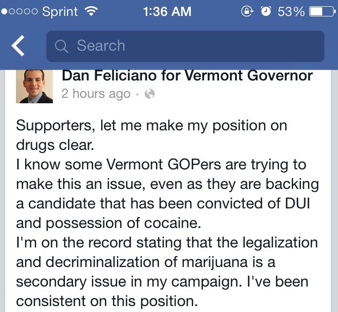
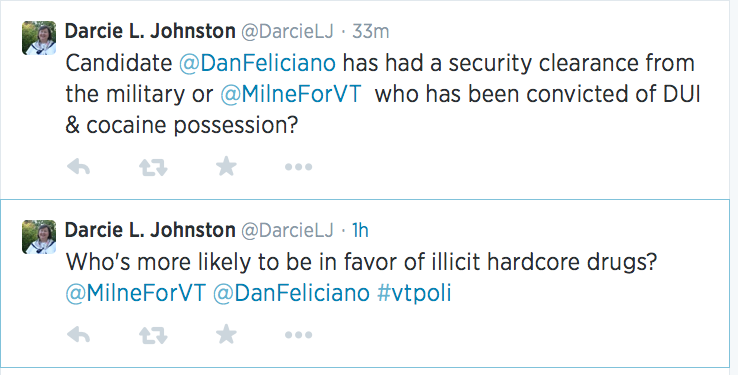
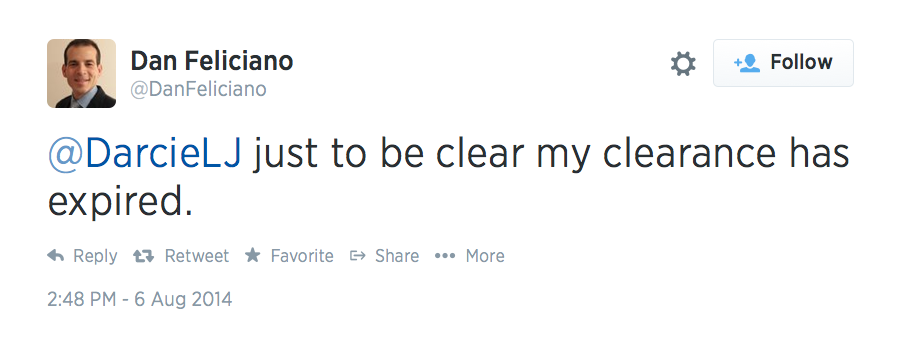
First, the political consultant who hasn’t won anything since unhitching her wagon from Jim Jeffords more than a decade ago, Darcie “Hack” Johnston has responded to my previous post about her Tweets supporting Dan Feliciano, the Libertarian candidate for Governor. He of the typo-riddled website.

Well, I Tweeted about the post, and the Hack replied:

Screen Shot 2014-06-26 at 3.31.05 PM

First of all, let me say I am humbled and honored that the Hackster has taken notice of my existence on this earth. Second, yuh-huh, sure, tons of Vermonters will be joining the Feliciano parade. About the time there’s a snowball fight in Hell. And third, if Feliciano’s campaign had the tiniest hint of hope about it, Johnston has officially given him the kiss of death.

Now let us turn to “Super Dave” Sunderland, occupier of the most thankless job in Vermont, chair of the Vermont Republican Party. With virtually no reason to think his party can unseat Governor Shumlin, he’s resorted to touting the results of a new “poll” indicating widespread dissatisfaction with the Guv:

Screen Shot 2014-06-26 at 3.30.19 PM

Mmmm, about that “poll.” First, it was an online survey, and we all know how useless those things are. And second, it was posted on the Vermont Business Journal website, and we all know which way the VBJ’s readership leans politically. Also, while the “poll” was in progress, Sunderland was touting it on Twitter, which further skewed the results. Actually, it’s surprising how many “A” grades the Governor got.

But hey, Vermont conservatives find themselves with nothing but a big basket of sow’s ears, so I can’t really blame them for trying to make a silk purse.

The Freeploid: Putting the “K” in “Kwality”

Yesterday, news leaked out that the Burlington Free Press is imposing subscription price increases. The paper hasn’t formally released the tidings; it’s just sending notices to individual subscribers. Chickenshit.

Well, today’s page 3 (print and e-newspaper editions) brought the following reflection of the Kwality Jernalism we can expect from the new, costlier Freeploid:

Screen Shot 2014-06-26 at 2.55.29 PM

Yup. “Breaks.”

Whatever our subscription dollars are paying for (extra-large margins, pictures and fonts; lots of reader-generated content; plenty of stock photography), not enough is going into the editorial process.