
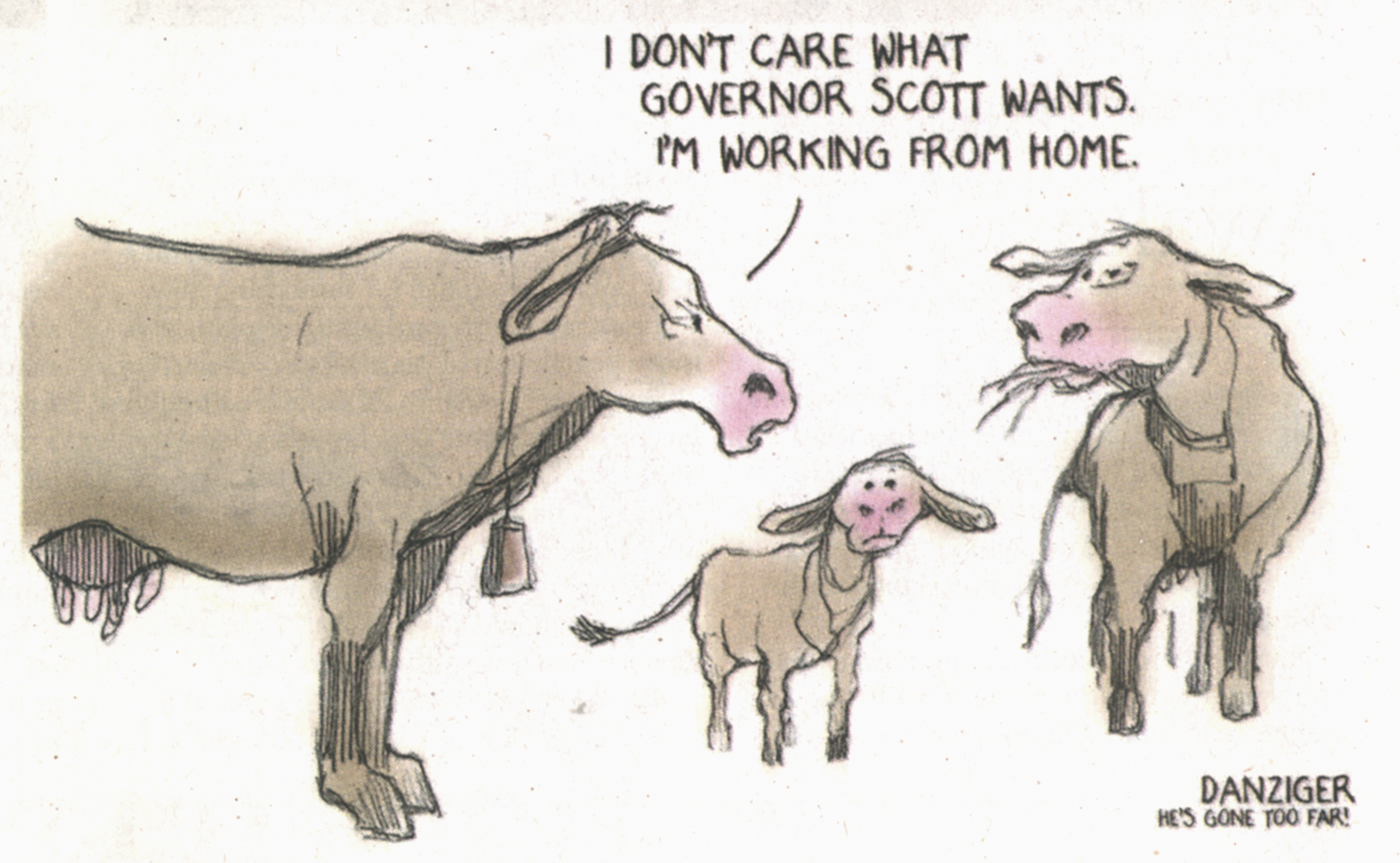
Has Danziger been our cartoonist laureate yet? If not, why not?
Anyway, to business. Recently, Gov. Phil Scott took a flying elbow off the top rope in the opinion section of The Hill, that bastion of conventional wisdom inside the Beltway. It was a complete and utter smackdown from beginning to end. And I’ll stop with the wrestling metaphors now, I think.
The subject was Scott’s return-to-office order for state employees. That’s the one in serious jeopardy thanks to a unanimous ruling by the state Labor Relations Board. That’s the Board whose five members were all nominated and/or vetted by the Scott administration.
Which begs the question, was the return-to-office order a good idea or not?
Enter Dr. Gleb Tsipursky, a widely-published expert on workplace issues in the digital age, dubbed “The Office Whisperer” by The New York Times. He penned (Only in Journalism) an essay published by The Hill on April 14 that ripped the RTO order to shreds. He called the order a “fiasco,” a “blunder,” and “an expensive gamble,” not to mention “a case study in how political theater can collide with labor law, management reality and basic fiscal discipline.”
Ouch!
Tsipursky pointed out a pertinent fact that I hadn’t seen mentioned before, which makes the Labor Relations Board ruling seem like an inescapable conclusion:
Telework in Vermont government was already an established working condition, not a perk handed out on a whim. In testimony to lawmakers in 2023, the state’s own human resources leadership described its telework policy as effective since 2012.
That testimony was given by Beth Fastiggi, the Scott-appointed Commissioner of Human Resources.
I’ve seen the policy described as a response to the Covid pandemic. And obviously, the pandemic triggered an increase in remote work by state employees. But the policy predated Covid by eight years, and that makes it hard to buy Scott’s argument that the policy was a product of the pandemic and we should now return to past practice. Tsipursky again:
This was a mature operating model. The state had data, experience and an existing framework. Yet instead of bargaining over how to refine telework, officials chose a unilateral order that treated a long-settled arrangement like a management toy they could snap back into shape whenever they felt like it.
Tsipursky then points out that a remote work option is a powerful employee retention tool, and that a major academic study of remote work “found that workers on hybrid schedules were just as productive and just as likely to be promoted as those in the office full time — the main difference was that their rate of resignation was much lower.” In short, hybrid work arrangements benefit employers and employees alike.
Tsipursky describes the potential costs of Scott’s order and concludes on this note: “When politicians try to make cultural statements through the machinery of government, they often end up turning symbolic toughness into very real waste.”
Well, that’ll leave a mark. I guess I’m not the only one who thinks that Scott’s managerial competence is significantly overrated, and his ideological inflexibility is badly underrated. I feel seen, in short. This essay deserves wider attention.

