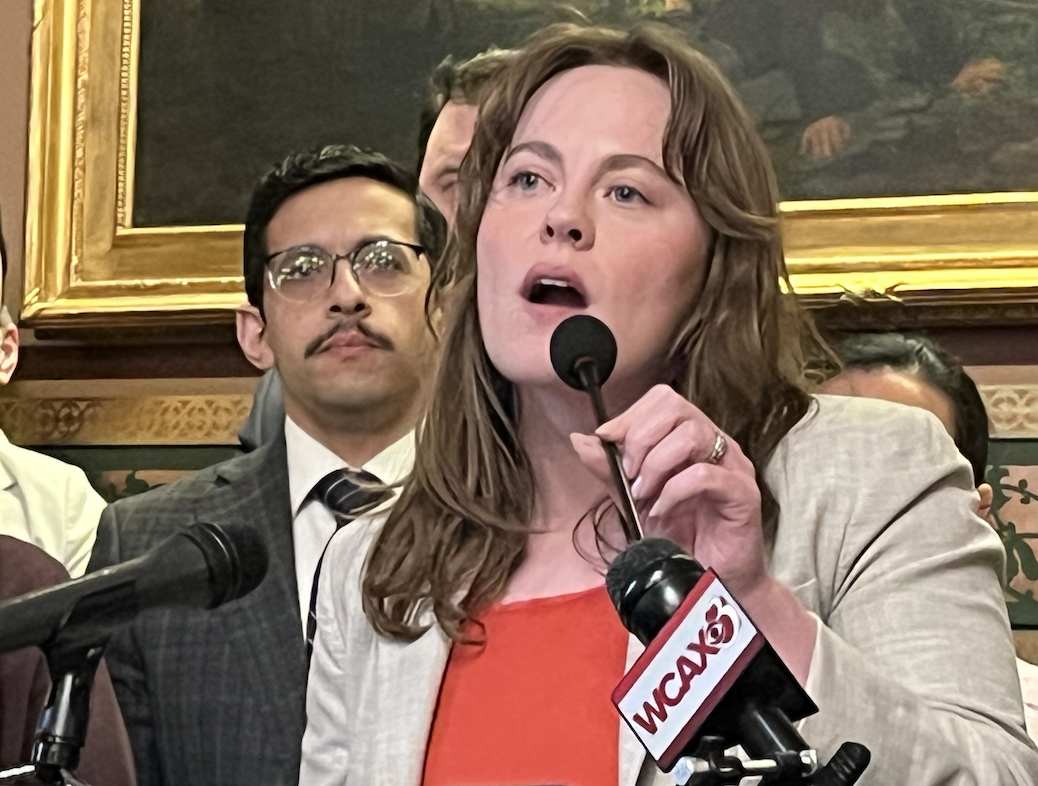
A Thoroughly Predictable Outcome of a Subverted Process

Many, many, many words were spoken in Tuesday’s confirmation hearing for Education Secretary Zoie Saunders before the Senate Education Committee, most of them by Saunders herself. And then, after nearly two hours of jibber-jabber, her nomination was approved on a 5-1 vote, with Senate Majority Leader Kesha Ram Hinsdale on the short end of the ledger.

The full Senate will have the final say (its vote is scheduled for Thursday), but we all know where this is going. Saunders will be confirmed less than a year after the 2024 Senate rejected her on a lopsided 19-9 margin. Immediately following that vote, Gov. Phil Scott effectively overrode the Senate’s power to advise and consent by installing Saunders as interim secretary. And once the Legislature was safely adjourned for the year, Scott named her permanent secretary. That move was challenged, fruitlessly, in the courts, so she continued to serve. And she will continue into the indefinite future.

I can’t really blame the Education Committee for voting yes. It was a profoundly weird situation, having to confirm a nominee who’s already been in office for almost a full year without major missteps or scandals, at least none that we know about. It’s too long a time to suddenly decide she should be here at all, and too short a time for a true accounting of her tenure. (Nor was there any chance to hear from other witnesses who might have offered alternative views of Saunders’ effectiveness.) In a lengthy opening statement larded with the arcane language of bureaucracy, Saunders ticked off a laundry list of initiatives, every one of which was a work in progress with few if any measurables on offer.

Neither is there any evidence, in this very limited hearing, to kick her out. Ram Hinsdale’s vote was more a token protest than anything; it was clear from the opening stages of the hearing that a majority of the committee would approve Saunders. The only other possible holdout, Sen. Nader Hashim, made it clear in his first statement that he would be voting yes “unless something totally bonkers happens in the next 45 minutes.” Committee chair Sen. Seth Bongartz, the third Democrat on the six-member panel, said almost nothing until the very end of the proceedings, and then he opined that “The governor has the right to appoint the people he wants… unless something egregious emerges.” The fix was in, and had been from the moment the Senate’s Committee on Committees created an Education Committee evenly split between Democrats and Republicans, and brushed aside last session’s vice chair, Sen. Martine Laroque Gulick, in favor of the obviously pliant Bongartz.

Continue reading

Public School Reform As If the Public Schools Mattered

The House Education Committee has set aside a fair bit of time this week for discussion of H.454, which sets out Gov. Phil Scott’s education reform plan in a brisk 194 pages. It is to be hoped that the committee’s deliberations will be centered first and foremost on what’s best for Vermont’s public school system. Because nobody else seems to be doing so.

Take the governor, for instance. (Please, says Henny.) He pays lip service to improving education, but his focus is clearly on cost containment. Radically centralizing the system is no guarantee of better quality. (It’s no guarantee of savings, either; the move to statewide negotiation of health insurance for public school personnel hasn’t prevented its cost from skyrocketing.) Doing away with local school districts in favor of five massive regional districts is clearly aimed at cutting administrative costs. And don’t get me started on the provision of H.454 setting minimum class sizes at 15 for grades K-4 and 25 for grades 5-12.

Those are minimums, mind you. What would the average class sizes be? 20 in the lower grades, or 25? 30 in the upper? 35? Cautious administrators will want a margin of error above the state-mandated minimums. And what happens when a school dips below the minimum? Does it close down? Put some crash test dummies in desks and hope no one notices?

Frankly, I wonder why any Republican who represents a rural district — which is the vast majority of Republican lawmakers — could support this plan as written. The class size provision alone would trigger a massive wave of consolidation that would hit rural Vermont especially hard. (Maybe that’s why H.454 has a mere five sponsors while H.16, the Republican bill to repeal the Affordable Heat Act, has 55 and H.62, to repeal the Global Warming Solutions Act, has 29. There hasn’t exactly been a stampede among legislative Republicans to sign on to the governor’s plan.)

Continue reading

In the Long, Storied History of Bad Shelter Ideas from the Scott Administration, This Is Another One

When you’re proud of an idea, when you really think you’re onto something good, you showcase it to the world. You present it openly, in a way that maximizes its chances of coming to fruition.

On the other hand…

There are times when you roll out an idea like it’s a flaming bag of poop. You leave it on the doorstep and head for the hills.

Which brings us to Administration Secretary Sarah Clark’s latest proposal for addressing Vermont’s crisis of unsheltered homelessness — a crisis that’s largely the result of deliberate policy choices by the Scott administration and the Legislature.

This here administration has been desperately trying to kill the GA Emergency Housing program, a.k.a. motel vouchers, for years now. But it has never, ever proposed anything like a real alternative. Instead, it has put forward some notions that have managed to be totally inadequate and financially wasteful at the same time. The policy equivalents of flaming bags of poop, they are.

Its latest bag was delivered on Friday, because of course it was. Friday is newsdump day, don’t you know.

Continue reading

Things You May Not Know About Town Meeting Day Campaign Spending Because Nobody Bothers to Report It

Doubtless I sound like a broken record (Google it, kids) when I mention that our sadly reduced political press rarely reports on campaign finance anymore, but it’s especially true in this case. While doing research on fundraising and spending in the contest for control of the Burlington City Council, I couldn’t help but notice a bunch of other fascinating things from other cities and towns. Like, there are some candidates who are spending large quantities of money for relatively small offices. And a few of ’em appear to be violating state law by failing to adequately account for their finances.

These aren’t huge numbers by any means, but they’re out of proportion to what other candidates are spending for similar offices. Soapbox moment: Any local outlet covering local races ought to look at campaign finance filings to see what their local hopefuls are raising and spending. It’s something their readers should know. It’d be more interesting than the stock previews or candidate Q&As that are long on platitude and short on insight.

It might be nice for the good people of Hinesburg, for instance, to know that Todd Portelance, candidate for select board, has spent more than $2,000 but has reported zero fundraising. If he’s self-funded his own campaign, he has failed to report that fact. And yes, he checked the box on the reporting form that says “I hereby verify, under the pains and penalties of perjury, that the information provided is true and accurate to the best of my knowledge, information, and belief.” So he has no excuses.

I doubt that any chicanery is involved. Carelessness would be my prime suspect. But the purpose of campaign finance law is to let the public know where candidates are getting their money and what they’re spending it on. This is only possible if candidates take their responsibilities seriously.

Continue reading

The Burlington Democrats Are Taking an Awful Lot of Republican Money (and Leaving Quite a Bit of It Unspent)

The second and final round of pre-Town Meeting Day financial disclosures is in, not that anyone in the media paid the slightest attention. The deadline was February 22, so I’m in the “belated” category. Apologies. Had other stuff to get to. Plus, honestly, I felt fairly confident that I could leave it for a few days because campaign finance reportage has practically disappeared from our Incredible Shrinking Media Landscape.

Headline: The two Democratic candidates in competitive races for City Council are raking in the cash, as is the Burlington Democratic Committee. (Reminder: If the Dems win both, they retain a working Council majority. If not, the Progressives would assume the majority.) The Dems’ fundraising far outpaces their Progressive counterparts and any other Council candidate in recent history. And a lot of it is from the upper classes of the greater Burlington area, people who’d be donating to Republicans if the Burlington Republican Committee wasn’t such a disaster. (These donors include many of the Barons of Burlington and others who did, in fact, donate to Republicans in the 2024 general election.)

Subhead: The Dems had left a lot of money unspent as of February 22, which probably means they didn’t expect to raise this much cash. The Town Meeting season is so tightly compressed that there’s no time to redo your strategy because you can suddenly afford more mailers or yard signs or advertisements or balloon clowns or whatever. The upshot: The Barons aren’t getting nearly the full bang for their bucks.

Continue reading

“Governor Nice Guy” Is Out There Pickin’ Fights With the Legislature

Gotta start using air quotes around that appellation for our chief executive, because he seems to be going out of his way to antagonize the Legislature and prepare the fields for another bushel of his administration’s chief cash crop, gubernatorial vetoes. It’s funny, after all that talk about coming to the table and working across the aisle, he’s back in his comfort zone: confrontational mode.

You know, if Phil Scott was a politician — which he continually insists he is not — I’d say he had absorbed the lessons of the 2024 election and decided the path to victory was in demonizing his opponents. It’s smart politics. But it’s anything but nice.

Exhibit A: VTDigger reports that the Scott administration has finally, belatedly, delivered its full public education reform plan in actual legislative language.

On February 25. Almost two months into a five-month session. Three days before the Legislature adjourns for Town Meeting Week. Little more than three weeks before crossover, when any policy bill must have been passed by one chamber if it’s to have any real chance of passing the other this year. It’s just not possible for lawmakers to give due consideration to such a massive reorganization in such a short window of time.

Continue reading

On Impermanence

My customary nattering about the vagaries of Vermont politics or who’s doing what to whom at the Statehouse has been sidelined by two real-life intrusions into this thought space. One is of tremendous consequence only to our household; the other is worth reporting to the greater #vtpoli community.

The second one first. I hadn’t been hearing much lately from Morgan W. Brown, a Montpelier resident and fellow blogger (“Green Mountain Meandering Missives“) who spent years experiencing homelessness and writes eloquently from the inimitable viewpoint acquired from what they call “lived experience.”

I knew Morgan had been hospitalized for a while. I consider myself an acquaintance of his, not really a friend, and I didn’t want to bother him with inquiries from someone in a better position to be curious than helpful.

That changed Monday morning when Morgan took to his blog for the first time since early November with a piece entitled “Medical Update,” where he revealed that he had been diagnosed with cancer that may or may not be treatable. (I hope he doesn’t mind me giving away the conclusion of his post. That collection of tags was simply brilliant.)

I don’t know Morgan well, but I respect him, and my heart sank when I read of his diagnosis.

Continue reading

“Let’s Go to Work and Let’s Win”

You’d probably have to be pretty deep in the weeds of Vermont politics, or perhaps a resident of Manchester, to recognize the name “Jim Ramsey.” (Pictured above with a slightly better known figure.) He’s only been involved in #vtpoli for a few years, but he’s been on a sharp upward trajectory that culminated on Saturday with his election as the new chair of the Vermont Democratic Party, replacing the prematurely departed David Glidden.

Well, technically Ramsey is the interim chair, filling out the remaining months of Glidden’s two-year term between now and November, when Ramsey will doubtless be elected permanent chair.

Members of the party’s state committee held a special meeting via Zoom on Saturday morning to choose Glidden’s replacement. Two people were nominated: Ramsey and former state senator Andy Julow, who was a late entry in the race.

If you needed any evidence that Ramsey had the inside track, you got it from VDP state committee member Susan Borden. In formally nominating Ramsey, she noted that he’d been endorsed by Treasurer Mike Pieciak, Attorney General Charity Clark, and Secretary of State Sarah Copeland Hanzas. The vote wasn’t close; Ramsey took 38 of the 45 votes cast. Julow received the other seven. In pre-vote remarks to the committee, Julow more or less acknowledged his longshot status. But even so, it’s telling that a former officeholder from the most populous region of Vermont finished a poor second to a guy from Bennington County who’d only been active in state party politics for about five years. It seemed clear that Ramsey was the choice all along.

And having heard his pitch to party leaders and learned a bit more about him, I can understand why.

Continue reading

Burlington Democrats are Spending Big to Defend Their Council Majority With a Lot of Help from the Leunig’s Frequent Diners Club

On Town Meeting Day in Burlington, the Progressive Party has an opportunity to do what (according to Seven Days) it has never done before: Hold the mayor’s office and a majority on City Council at the same time. City Democrats are doing their best to ensure that doesn’t happen. And a lot of “their best” came straight from the city’s biggest name in real estate, the Pomerleau family.

We just found this out because the Burlington Democratic Committee has just filed its first campaign finance report for this year’s Town Meeting campaign season. The filing was 17 days late by my count. City party chair Andy Vota, in an email exchange, blamed the delay on difficulties with the Secretary of State’s new filing system which took multiple consultations to work out. Understandable. But as it worked out, the filing came immediately after Seven Days published its big pre-election article on the campaign, so the story makes no mention of the BDC’s fundraising or its highfalutin’ sources.

By state law, candidates and committees involved in Town Meeting Day elections must file financial reports 30 days and 10 days before election day. The BDC will have to turn around quickly to meet the second deadline. Missing the February 2 deadline is not nearly as egregious as the BDC’s 2020 violation, which resulted in a $2,500 fine for failing to file any disclosures until months after Town Meeting Day. (It’s quite unusual for campaign finance law violations to draw any penalty at all; normally, they can get off scot-free if they belatedly correct errors and omissions.)

So… how much does the party have and where did it come from?

Continue reading

Sen. Sam Douglass, Campaign Finance Scofflaw

The folksy Son of the Soil pictured above is Sam Douglass, senator-elect from the Orleans district. Or, as I find myself thinking of him, Senator Scofflaw. Because while he claims to be a “fierce advocate,” he was shockingly blasé about his legal obligations to report campaign finances accurately and promptly. Makes you wonder about his fierceness, not to mention his devotion to fiscal responsibility.

Because his campaign finance filings are the opposite of “responsibility,” and include numerous violations of state law. Fortunately for him, the penalties are laughably small and rarely enforced. Otherwise he’d be in a heap of trouble. As it is, maybe some Concerned Citizen will see fit to file a complaint with the Attorney General’s Office, for all the good that will do.

Let’s start with the fact that Douglass has yet to file his Final Report, which was due on December 15. And there’s a real need for a final accounting, because his most recent report leaves many questions unanswered.

His post-election filing, submitted on November 19, shows a serious imbalance between income and outgo — and not in the way you’d expect. The Douglass campaign has reported raising nearly $41,000 and spending only $27,460. Did he really leave one-third of his bankroll on the table in a race against Democratic Rep. Katherine Sims, who raised more than $76,000? Or has he failed to fully report his expenditures?

Vermont’s campaign finance law and the Secretary of State’s reporting system can be a challenge, but when you run for public office you are obliged to follow the rules. Besides, Senator Douglass is going to be responsible for writing the laws. Shouldn’t he be capable of obeying them?

Continue reading