A Failure With Many Fathers

Timing, Mr. President.

Things have pretty much gone to shit at the University of Vermont. The latest installment features the announcement of a plan to take a meataxe to humanities instruction. A total of 24 academic programs are to be cut, totaling roughly one-fifth of the College of Arts and Sciences’ course offerings. The administration thoughtfully unveiled the plan via mass email because that’s the way Ebenezer Scrooge would have done it if he’d had email, right?

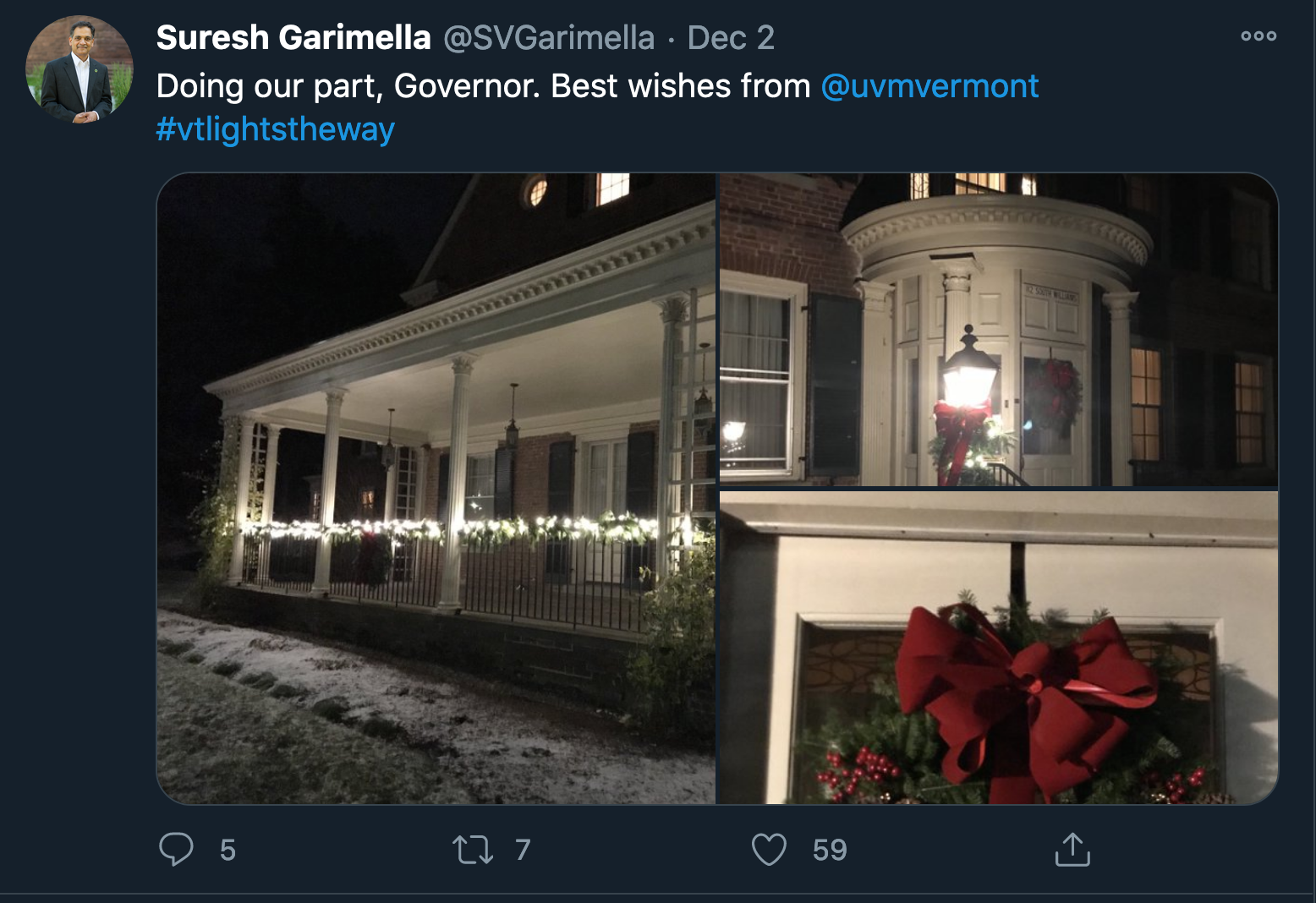
That very same day, after metaphorically turning out the lights in many a campus precinct, UVM President Suresh Garimella posted the cheery tweet reproduced above. Tone-deaf much?

The plan has not been received well, to say the least. The UVM-related Twitterverse has been ablaze with recriminations. Nearly 2,000 people have signed an online petition to reverse the cuts. Campus reaction has been muted because, well, the students have been sent home and teaching is being done online.

Hard to put together a protest under those conditions.

UVM administration has often seemed out of touch and, shall we say, uncollaboriative in management style. Garimella, an engineer by trade, has been in office for less than two years, and his hiring was seen by many as signaling a turn away from the humanities. This year has seen contract talks with the faculty union go nowhere. The administration was forced to rescind planned cuts in lecturers and adjunct faculty after it was met with an uproar.

So, you’re expecting me to slag the top brass and brand Garimella as an enemy of the humanities, right?

You’d be wrong. There’s plenty of blame to go around.

Continue reading

Adventures in Inadequate Governance, part 2

Just tryin’ to keep up…

In part 1, I brought your attention to some appalling facts about Vermont’s lack of oversight for rental housing. Today we turn to three separate articles concerning nursing homes and the coronavirus that reveal further inadequacy in governance. The first is about an apparently toothless settlement with a for-profit senior facility. The second and third detail the toll Covid-19 is taking on some of our most vulnerable Vermonters.

The Intercept, where Glenn Greenwald used to hang his hat before he went batshit, has shone a fresh light on last spring’s worst outbreak in Vermont — at Burlington Health and Rehab, owned and operated by the troubled Genesis HealthCare chain.

Turns out that only weeks before the pandemic struck, Attorney General TJ Donovan had reached a settlement with Genesis over “allegations of neglect” that led to three injuries and one death. That settlement did little or nothing to improve the situation, and within months, 12 BH&R residents had died of Covid-19.

Under terms of the settlement, proudly announced in the customary AGO press release, three Vermont-located Genesis facilities were to pay a fine and hire a Patient Care Coordinator for the three locations plus an independent monitor to oversee quality of care. Was it enough?

“It’s really baffling that the settlement did not include some type of staffing requirements,” said Brian Lee, the executive director of Families for Better Care, a nonprofit advocating for tighter regulation of nursing homes. “Has [Donovan] arrested anybody? Has he prosecuted anybody? Has anybody gone to jail? No. The settlement should have included a requirement for RN staffing. They were short-staffed prior to the incidents and short-staffed after. It’s pretty negligent on the AG’s office to not include that,” said Lee. “The quality of nursing homes is dependent on staffing.”

You can probably guess the next bit. According to federal regulatory records, Genesis failed to increase staffing to recommended levels. Donovan agreed to let Genesis do the hiring, and there was apparently no follow-through by the state to ensure full compliance. This is a problem with Donovan’s negotiating tactics, and also an issue for state regulators. When a facility is enough of a bad actor to trigger enforcement action, shouldn’t the Human Services Agency perhaps provide some extra scrutiny?

I guess not. Well, I can’t say for sure. But what I can say is that whatever Donovan and AHS did, it wasn’t enough. Let’s remember that, the next time Donovan puts out a self-congratulatory press release.

Continue reading

Adventures in Inadequate Governance, part 1

Sumitted for your approval, three news stories on a common theme: What happens when government isn’t up to the task?

Two are about Covid-19 and nursing homes, which I will address in my next post. Under consideration here, courtesy of VTDigger’s Anne Wallace Allen, is a look at Vermont’s wretched rental housing stock. The headline, “About 7,000 Vermont households lack things like kitchens, bathrooms, or heat,” is a bit exaggerated. But the reality isn’t much better.

Nobody knows exactly how many Vermonters are living in substandard housing.

That 7,000 figure is an upper estimate, so the actual number of households without crucial features may be smaller. But the story’s gut-punch is that oversight of rental housing in Vermont is spotty at best, nonexistent at worst.

The state has a rental housing code but no enforcement mechanism. Several of our larger cities have code-enforcement systems. Elsewhere, it’s entirely up to town health officers. They’re usually untrained volunteers with few resources to conduct their business. James Arisman, who formerly served as Marshfield’s health officer, told VTDigger, “Essentially there is no protection for renters in the state of Vermont by an inspection system that is robust and carrying out routine inspections.”

Yeah, that seems a little problematic.

There are plenty of appalling details, but let’s leave it here: How did we get to the year 2020 with such an archaic “system”? It’s yet another example of the Grandfather’s Lightbulb phenomenon. To wit:

Q: How many Vermonters does it take to change a lightbulb?

A: Change it? That was my grandfather’s lightbulb!

Continue reading

This Time, For Sure

By all rights, Miro Weinberger’s bid for re-election as mayor of Burlington ought to be in deep trouble. During his current term, he has overseen the continual failure of the CityPlace redevelopment, embarrassing leadership shuffles in the Police Department, and a summer of protests over cops accused of excessive force.

Not to mention the arrival of ROOOARRR sorry, the arrival of the RRRROOOOARRRR dammit, the F-35’s RRRROOOOOOAAARRRR screaming across the skies RRRRRROOOOOOOAAAARRRRRRR oh c’mon, of the Queen City.

(Yes, that’s a Thomas Pynchon shoutout. Mandatory reading for the mid-70s college intellectual dudebro.)

There’s also the inevitable Incumbent Fatigue that eventually afflicts administrations, both internally and in public perception. (Vermont Governors usually get at least six years in office if they seek it, but rarely more than eight. Miro’s approaching nine right now.)

And did I mention that Miro won re-election with only 48 percent of the vote last time around?

He still won, because two progressive challengers split the remainder.

And wouldn’t you know it, that seems the most likely scenario again this year. It’s certainly Weinberger’s best hope for success.

It’s a dismally familiar scenario for this observer, who’s watched Purity Wars divide progressive parties and movements for something like 50 years. And I’m sorry, but I usually fall on the pragmatic side of this.

After the jump: Storytime!

Continue reading

Stupid Pot Tricks

Never fear… the Essex County Sheriff’s Department is on the case!

A few years ago, when legalizing cannabis was still in the middle stages of legislative debate, Gov. Phil Scott acknowledged that he has plenty of friends who regularly partake of the demon weed. And yet he opposed further moves toward legalization or state regulation.

The underlying assumption was that of course, his friends would never get busted for pot. Nod and a wink, don’t ya know. It might be illegal on the books, but, ha ha, nobody ever enforces the law, so why not let sleeping laws lie?

Bruce Prosper, Jr. is why.

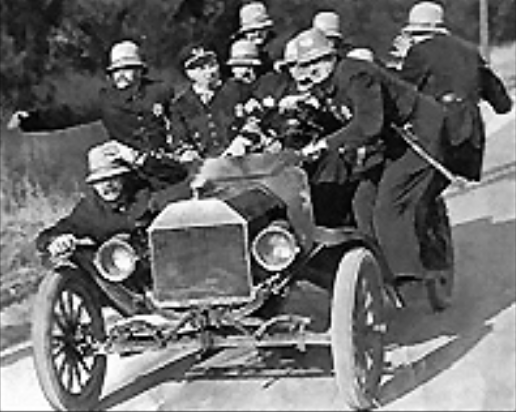
Prosper is the Northeast Kingdom resident who’s paralyzed from the waist down, and grows his own cannabis for medicinal use. Which caught the attention of an Essex County Sheriff’s deputy, who I believe is seen above riding the bumper in the lower left.

He went and got himself a search warrant, deputies descended on the Prosper home, and heroically arrested him and the rest of his family on felony charges that could bring up to 15 years in prison for each.

And the county prosecutor, the widely esteemed political fixer Vince Illuzzi, is insisting on going ahead with the case. Illuzzi told VTDigger that he’s “kind of caught,” adding that “We are obligated to enforce the law.”

Well, horsefeathers.

Continue reading

Greeting Card Governance

Typical Vermont community (Not Exactly As Illustrated)

I have to admit I felt a little twinge of the warm fuzzies when I heard about Gov. Phil Scott’s “Vermont LIghts the Way” initiative. I mean, who could resist this pitch:

“I think it’s time to lift our spirits. Let’s get creative and show the world that Vermonters are here for each other and that even through these dark and difficult times, Vermont Lights the Way. …I hope this effort will spread joy and hope, especially for our kids.”

Yeah, mmm, hot cocoa, puppy hugs, flannel blankies, freshly fallen snow snow, plush teddy bears, holiday music, Mom’s chicken soup.

But of course, I’m a cynical old blogger, so my thoughts quickly turned. “What does this have to do with governance?” I asked myself.

Nothing. It’s good politics, that’s all. And there’s nothing wrong with good politics in its place. But this message is aimed at the comfortable among us — the ones with homes and well-stocked pantries, a bit of disposable income and paid-up utility bills, the ones who’d like to feel as though they’re making a difference without leaving the comfort of home and hearth.

Continue reading

Time to Make a Serious Push for Immigrants and Refugees

Emma Lazarus’ famous poem is often cited as voicing the best impulses of our country. But it’s kind of a double-edged sword: The spirit of generosity is counterbalanced by the implicit message that immigrants are “huddled masses” and “wretched refuse,” which is far from the truth. In fact, immigration —including refugee resettlement — has brought energy, talent, motivation and a propensity for hard work to our country.

Lazarus’ poem makes it seem like an open-door policy is purely a matter of charity. But it’s quite the opposite. The influx of New Americans is, by a long shot, a net positive for our country, our economy and our culture.

Which brings me to this particular moment in Vermont. Donald Trump almost completely closed the doors to immigrants and refugees, which put a halt to Vermont’s efforts to become a destination for New Americans. Joe Biden has promised to loosen restrictions on immigration and refugee settlement, including raising the annual refugee cap from Trump’s 15,000 to 125,000, which is higher than it was in the Obama Administration.

It’s time for Vermont to get in on the ground floor. Gov. Phil Scott has talked of New Americans as a key in growing our economy and easing our demographic crisis. He needs to act in concert with legislative leaders and our Congressional delegation to promote Vermont as an immigrant destination. He needs to consult with the Vermont Refugee Resettlement Program to determine what we can do to help people move here successfully.

This kind of commitment is far more likely to pay off than any of Scott’s penny-ante ideas for attracting new residents, including the endlessly-touted but marginally effective remote worker grant program.

Continue reading

The Progressive Regression

My recent post about the Vermont Democratic Party drew more reaction than just about anything I’ve ever written… with the notable exception of the Latin Motto controversy. Almost all of it was positive, and much of it came from young folks who feel like they got the cold-shoulder treatment from the party.

At least a couple of people asked me to do the Progressive Party. And while I did briefly address their failings in my post-election “Winners and Losers” piece, there’s more to be said.

Short take: 2020 was a disastrous year for the Progs. They managed to hold onto their seven-seat caucus despite three retirements and one upset defeat, which is noteworthy. But otherwise, the bad far outweighs the good.

Let’s start with the electoral defeats of two prominent Prog-identified pols. Tim Ashe finished a distant second to Molly Gray in the Democratic primary for lieutenant governor, and Lt. Gov. David Zuckerman lost by 41 points to Gov. Phil Scott.

It’s hard to understate how big a setback this is for the Progs. They’ve suffered a huge loss of influence in the Senate, with Ashe’s departure as President Pro Tem and Zuckerman relinquishing the gavel. Also, Ashe and Zuckerman were the Progs’ top two hopes for statewide office. They had built their political careers over more than a decade of success, but they’re off the charts (at least for now).

Also, the magnitude of their losses calls into question whether the Progressive label is statewide electoral poison. Ashe lost by 11 points to Molly Gray, who was a complete political unknown at the beginning of the year. Zuckerman faced impossible odds in taking on Phil Scott during the pandemic; but even so, 41 points???

Continue reading

The True Heatmap

Well, looky here. One week after I noted that the state of Vermont’s travel map was “deeply misleading” (text) or “a lie” (headline), the state has issued a new version, reproduced above. And it clearly shows that we’re just as besieged by the pandemic as any of our neighbors.

I’ll take one sentence to crow about feeling vindicated. And then I’ll say that on balance, I’d rather be wrong in this case. Especially since I live in Washington County, which is Ground Zero of our current outbreak. (Thanks, recreational hockey league!)

For those just joining us, the state’s official travel map had made it seem like Vermont was somehow immune from the coronavirus. Other states were assigned green, yellow and red, while Vermont was illustrated in three shades of blue — for the same disease rates. Light blue was the same as green, and dark blue was the same as red. If considered strictly as a “travel map,” one could argue that the coloring was appropriate. But it also sent a signal that Vermont was doing just fine, thank you, and if that led anyone to let down their guard, it helped contribute to the upward spiral in our Covid numbers.

So far, Gov. Phil Scott has received a lot of credit for his coronavirus response. It’s beginning to look like he’s taken a few too many chances as we enter a new and much more severe phase of the pandemic. Throughout, he has listened to his experts and made decisions based partly on their input and party with an eye on the economy — even as he has consistently claimed to be placing science above all.

Did he give his renowned spigot a few too many turns? It’s beginning to look like it. We can’t lay it all at his feet, but he did play a role in the growth of a false sense of confidence among Vermonters. This new map, with its unavoidable and unbroken sea of red, should serve as a wake-up call for himself and his officials and for all of us.

I’m Sure Vermont Democrats Think They’re Trying. They’re not.

On the surface, the Vermont Democratic Party did just fine this election. Sure, Phil Scott cruised to re-election and they lost a few legislative seats. But Scott was virtually unbeatable thanks to his patient, measured response to the pandemic. Besides, it wasn’t one of their own who took the bullet, it was David Zuckerman, a Prog/Dem with the emphasis on Prog. And they elected a bright new hope, Molly Gray, to the lieutenant governorship, held onto the other statewide offices, and held on to lopsided majorities in the House and Senate.

But when you take a closer look, this was a sneaky bad year for the Dems. They once again let Scott steal their lunch money. This was a bad year to take him on, but they’ve barely tried to beat Scott in the last several cycles. Since the 2010 race for lieutenant governor, they’ve put up a parade of under-resourced first-timers against Scott, and he’s barely had to break a sweat.

Gray’s victory is nice, but she was up against a terrible Republican candidate. As for the Legislature, if this wasn’t the year to rack up gains, I don’t know what is. They had the benefit of widespread anti-Trump animus to drive support for down-ballot races, and failed to capitalize.

I didn’t realize how much the Vermont Dems were resting on their structural advantages until I listened to a pair of podcast interviews from the fine folks at Crooked Media. The first featured Ben Wikler, head of the Wisconsin Democratic Party, the second was with Georgia’s Stacey Abrams, founder of of Project Fair Fight. Both have taken state parties that faced seemingly insurmountable obstacles, and both have turned those states into Democratic success stories.

Continue reading