For a full year, the VTDigger Guild has been trying to negotiate its first contract. And it’s been met with an unyielding brick wall on every front. Now, in a series of tweets, it has taken its case to the public.
The Guild organized in the spring of last year, and I was proud to be part of the effort. I believed the union would be a good thing for all parties. And it still can be, if Digger gets serious about a contract.
Until it does, I’m suspending my monthly donation to Digger. I can’t support an enterprise that treats its workers this way. If you identify as a friend of labor, I suggest you think long and hard about doing the same. And write a letter to Digger via this page on The Action Network.
I hate to do this. Digger is an absolute necessity for coverage of Vermont policy and politics. Founder Anne Galloway deserves all the credit in the world for creating this enterprise.
But it’s time to grow up, and enter into a partnership with its workers. This shit won’t fly any more:
Well, it’s Monday, and once again we’ve got a full crop of stupidity in the public sphere. I didn’t intend for this to be a weekly feature, but hey, if they keep serving up the meatballs, I’ll keep swinging for the fences.
This week, the stupid was strong in positions of prominence. We’ve got a U.S. Senator, a State Senate committee, a state’s attorney, and not one but two agencies in the Scott administration. So let’s not keep these important slash self-important folks waiting.
To begin, we’ve got our first-ever Provisional Veepie and our first-ever Sub-Veepie. The P.V. is the I’ma Throw Everybody Under the Bus Award, which goes to none other than St. Patrick Leahy. It’s provisional because it’s about an anonymous second-hand quote from Politico, so there’s a chance that Leahy didn’t say, or mean, this. But if he did, what a doozy.
The article reports that Leahy is expected to run for re-election next year. It includes this line: “The 81-year-old has also indicated to them that he believes he’s ‘the only Democrat that can win the seat,’ said a person briefed on the conversations.”
Woof. Way to simultaneously diss every Democrat in Vermont, Senator.
Something odd and troubling has been happening in southern Rutland County for more than a year now. Bits and pieces of it have been reported in the Rutland Herald, but nobody has put together the big picture.
It’s something you wouldn’t expect in the Vermont of our imaginations, the tolerant place where politics is characterized by civility, and the Religious Right is a toothless fringe. But for almost a year, the Mill River school board has endured harassment from a small group of far-right Christians. (The district includes the towns of Clarendon, Shrewsbury, Tinmouth and Wallingford.) They were originally upset over the proposed flying of the Black Lives Matter and LGBTQ+ Pride flags at the district’s high school, but their list of grievances has grown by leaps and bounds. They’re upset over alleged illegality by the school board, its supposed “very left ideology” which seeks to “politicize and sexualize our children’s education,” a critical Front Porch Forum post by school board chair Adrienne Raymond, and the district’s failure to provide in-school education during the pandemic.
I’m probably missing some stuff, but you get the idea. It’s a great big bag o’nuts.
The group includes Rep. Art Peterson, notorious for denying the existence of systemic racism and saying that victims of discrimination should shake it off and pull themselves up by their bootstraps. Peterson was inspired to run for the House after the school board approved the flying of the two subversive flags.
This spring, the group ran candidates for five school board seats. They didn’t run as a slate, but their issues and concerns were pretty much identical.
If they’d swept the field, they would have been one vote shy of a majority on the 11-member board. In the end, they only won two. The group’s candidates in the March elections were Todd Fillmore (pictured above in an out-of-focus yet somehow telling Zoom screenshot), Bruce Moreton, Julie Petrossi, Matthew Gouchberg, and Arne Majorell, who happens to be Peterson’s son-in-law. Moreton and Gouchberg are now on the school board; Majorell lost his race by six votes.
These people and a few allies are frequent participants in the public-comment section of school board meetings. They’re also active posters on Front Porch Forum. And while they try to couch their concerns in the language of earnest disappointment, they can’t entirely stop the crazy from showing through.
Bureaucracy is often a target for criticism in these parts, but occasionally a situation calls for a plodding old tortoise instead of a flashy young hare. Take Wednesday morning, when the House Transportation Committee got an update on the Vermont Climate Council. The hearing provided a window on the huge amount of detailed work being done by the Council’s 23 members, as a body and in five subcommittees. (Its report to the committee can be accessed here.)
The Council was established by the 2020 Global Warming Solutions Act, which became law when the Legislature overrode Gov. Phil Scott’s veto. Its goal is to adopt a Climate Action Plan by December 1, 2021. That’s little more than six months from now, which is a fast pace for such a body.
The details are, for the most part, boring. But they’re important. One example: As our vehicle fleet goes more and more to electric power, we’re going to need a network of public charging stations. But exactly how much needs to be done? Council members reported today that we need about five times as many as we have now by the year 2025. Determining the extent of the need is the starting point for action. It tells us what priority the charging infrastructure should have in our massive list of climate-fighting tasks, and how much work must be done.
By December, the Climate Council will have assembled all these details into a single tapestry of climate action. And then the real work will start.
A strange hush has fallen over the #vtpoli landscape. The Legislature is set to adjourn at the end of the week, and yet we hear no arguing, no complaining, no House/Senate or even Legislature/Governor sniping, no last-minute knifings of inconvenient bills. The governor hasn’t vetoed anything yet, and he’s barely made any veto threats.
This is looking like the quietest, least contentious session in years. Now, maybe this is a consequence of The Year Of Zoom, with reporters unable to lurk outside closed doors and buttonhole people in the hallways and trade rumors with lobbyists. But when you look at the available record, there’s no evidence of the usual endgame drama.
I mean, just look at VTDigger’s Bill Tracker. It shows no gubernatorial vetoes, five bills signed by Gov. Scott, four bills awaiting his action, 11 passed the House and Senate with differences being resolved*, and seven that have passed one chamber and not the other. The Bill Tracker is not comprehensive, but it is a thoughtful compilation of high-profile issues before the Legislature. And it shows a pretty decent record of accomplishment with few apparent flashpoints.
*Most differences are fairly minor, and agreement this week seems certain.
For those just joining us, The Veepies are my occasional awards for stupidity in the public sphere. We’re still setting a brisk pace in that regard. So, here we go…
The We Gave You a Crappy Half-Apology Because We Had To, But We Really Didn’t Mean It Award goes to the Bennington Selectboard. Last month, the town reached a settlement with former state representative Kiah Morris over the police department’s actions, or inactions, regarding threats against Morris. This came after the state Human Rights Commission issued a preliminary finding that the Bennington PD had discriminated against Morris and her husband James Lawton. As part of the deal, Bennington had to issue a formal apology. And it was kind of half-assed, blame-the-victim stuff: “It is clear that Kiah, James and their family felt unsafe and unprotected by the town of Bennington.”
See, it’s not that the town did anything wrong; it’s just that Morris and her family felt unsafe. Put the onus on the victim. But wait, there’s more!
Whatever little value there was in that “apology” was completely undercut by the town’s attorney Michael Leddy, who insisted that there are “no reasonable grounds to believe” that the town was guilty of discrimination, and by Selectboard chair Jeanne Jenkins, who told VTDigger last week doesn’t believe the police department discriminated against Morris.
All they will acknowledge is that Morris “felt unsafe.” Well, Morris and her family have since relocated to Chittenden County, so problem solved, I guess?
After the jump: Empty climate rhetoric, Medicaid money for school cops, and propping up a dying industry.
The House and Senate have been discussing how and when to return to normal operations in the Statehouse. Media coverage has focused on ensuring that reporters have access to any meetings under the Golden Dome. And that’s important.
But there’s one thing that’s more important to far more people, and I haven’t heard beans about it lately.
After their return to the Statehouse, the Legislature should continue livestreaming all hearings and floor sessions, and archiving them all on YouTube.
This would be a bit of a logistical challenge; the committee rooms are cramped, and it’s tough to get a good angle that encompasses all parties. Decent audio quality is also an issue. But here’s the thing: There’s talk of setting up auxiliary rooms in the Statehouse where people could watch a hearing without being in the committee room. That would ease the habitual (and unhealthy) overcrowding at hearings, and provide access to those who feel a little iffy about breathing the same air as a couple dozen others in the teeth of cold and flu season.
Well, if they’re going to send video to auxiliary rooms, there is no reason on Earth why they can’t put the same feed on YouTube. No excuses.
Earlier this week, after Liz Cheney was purged by the House’s minority caucus, Gov. Phil Scott was asked about the sorry state of the national GOP. His response, per WCAX: “It appears as there’s a sign that is being placed in the window saying you need not apply and if you don’t adhere to those values or that litmus test, you are no longer welcome.”
A natural follow-up, which went unasked, would have been “In that case, what about the Vermont Republican Party, whose leadership is as intolerant as the national crowd?”
Take, for example, Jay Shepard, Republican National Committeeman and generic Mike Pompeo knock-off. He is one of two VTGOP representatives to the national Republican Committee, which makes him a very big fish in the shallow pool of our conservative politics.
Shepard styles himself a genius of inside politics. He runs Junction Consulting, a conservative firm offering its expertise in campaigns, fundraising and so forth. During the 2018 election cycle, his firm got nearly $200,000 from the Republican State Leadership Council to run ads against select Vermont Democratic lawmakers. Hmm, a Republican committee funneling funds to a Republican committeeman. Sounds a little grifty to me.
Well, Shepard’s got himself a new grift. He’s using the VTGOP email list to pump a national group that he co-founded. So, if you signed up for information about what Vermont Republicans are up to, congratulations. You’re getting Shepard’s fundraising pleas for the group, plus a regular email newsletter from its rhetorician-in-chief.
Said group is the American Council for Education and Knowledge. Named, as is customary in right-wing circles, to apply a mainstreamy veneer on a collection of far-right ideologues. As if that’s going to fool anyone.
And what, pray tell, awaits if you click on the link above?
For starters, how about “The time has come to restore the American God, His natural law, and His code of ethics to their proper roles in everyday life.”
Yep, “the American God.” Just like it says in the Bible.
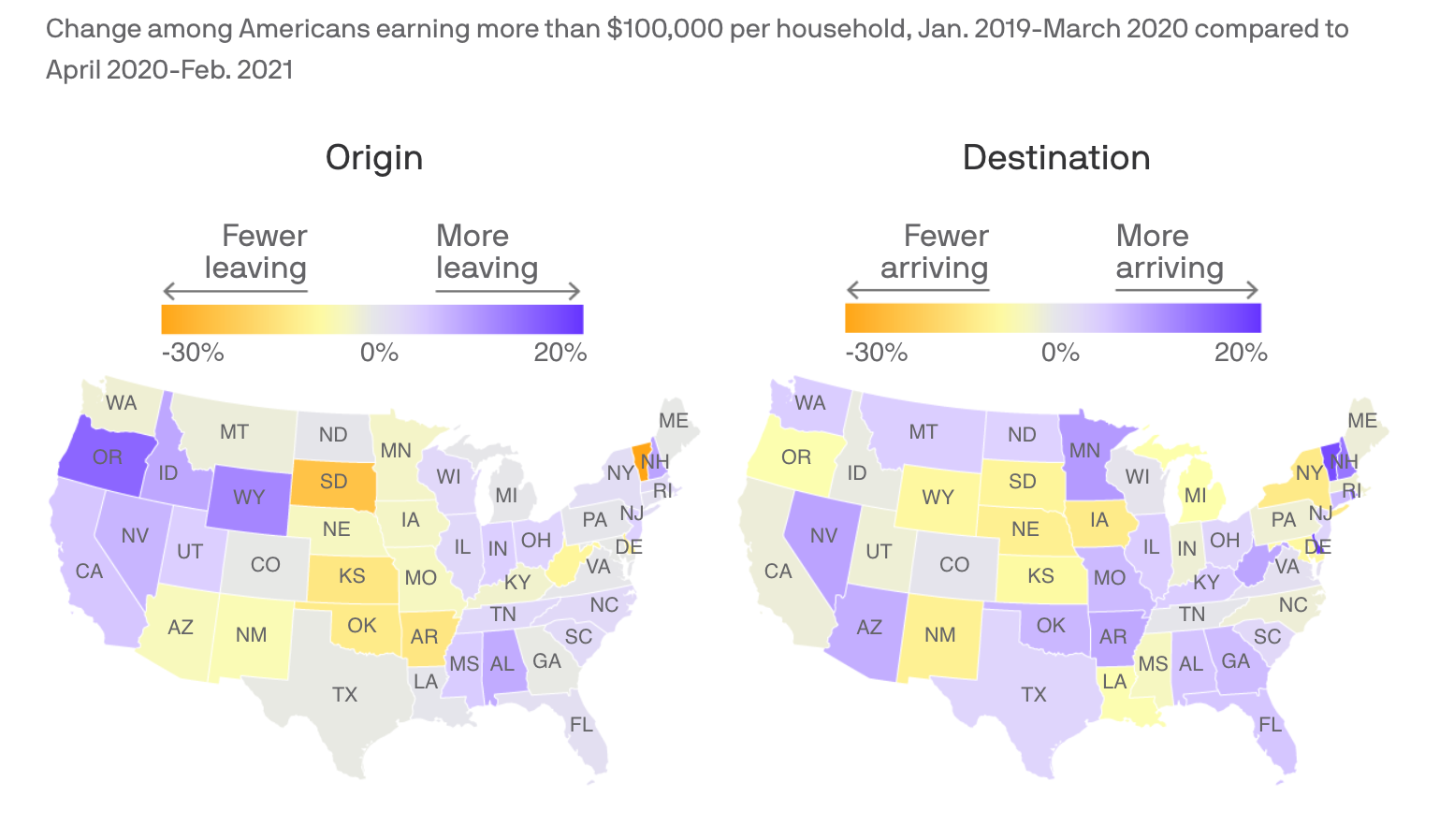
This graph is wonderful news for those who think Vermont’s economy needs to grow. (It is, as I’ve written before, very bad news for our housing supply.) The pandemic has made our state the most desirable in the nation for affluent Americans.
More desirable than our famously low-tax neighbor, New Hampshire. More desirable than the Sun Belt or the tax havens of Texas and Florida. We’re Number One, baby!
It’s too soon to tell if this dramatic shift will continue. But if it does, then it’s time to rethink our policies across the board, from taxation to education to broadband to economic incentives.
The Public Utility Commission is scheduled to hear a case on Friday that could tighten the screws on large-scale solar energy in Vermont, a process that’s sneakily been underway for a while. And to judge by the record to date, its decision seems unlikely to be solar-friendly.
South Street Solar is seeking commission approval for a 30-acre solar array on farmland owned by Middlebury College, which would provide almost one-third of the college’s electricity and help reach its goal of using 100% renewable energy by the year 2028. The project sparked some local opposition because Vermont, but it passed muster with the town planning commission and selectboard.
If the PUC rejects the request or puts significant obstacles in the way, it will underscore a growing problem with solar siting in Vermont: Almost every potential site, even the seemingly ideal, is unacceptable to some.
Everyone is okay with rooftop solar, but there’s simply not enough rooftop acreage to make a real contribution to our renewable energy goals. So where else can it go? We don’t want to clear forest land, we don’t want to impact wetlands or waterways, we don’t want to clutter scenic areas, we don’t want it too close to where we live, and sometimes we don’t even want it on not-at-all-scenic, unused property.
The latter problem killed a solar proposal in Bradford. You know the site if you’ve taken Exit 16 off I-91 or gone shopping at Farm-Way. It’s a large parcel on the outskirts of town within sight of the freeway. There is some commercial development (an auto parts store and a supermarket), but there’s still plenty of vacant land. The site has, I think it’s safe to say, no esthetic appeal whatsoever.
But it didn’t happen because the regional planning commission decided that the land should be reserved for potential development. This site should have been an idea spot for a solar array.






 The Vermont Political Observer.