Category Archives: technology

“Every Alarm Bell in My Body Is Ringing Right Now”

Something happened last Wednesday that should have been a big news story, but it wasn’t. I was out of town so it took me some time to catch up, but you know, I felt pretty secure in thinking that I wouldn’t be scooped by anyone in our sadly depleted media ecosystem. Good for me, bad for the public interest, but here we are.

What I’m talking about is a costly, potentially catastrophic situation involving one of the Scott administration’s information technology initiatives.In brief, this project is badly over budget and way behind schedule. There are huge potential risks, known and unknown. Nobody knows how much the thing will cost, how long it would take to complete the work — or if that is even possible. This includes the boffins at Gov. Phil Scott’s much-touted innovation, the Agency of Digital Services.

Have I got your attention?

Here’s something else. The quote in the title came from Republican Sen. David Weeks of Rutland, a political ally of the governor. He knows whereof he speaks; according to his official bio, his career involved “high-level program management positions in the defense and security sectors” involving “high technology operations and project management in the $3 billion range.”

In other words, Weeks may have more experience in IT-related management than anyone at ADS. And he was appalled at what he heard in a July 29 legislative hearing.

Have I got your attention now?

Continue reading

The Fate of the Innovator Is Not Always Pleasant

I’ve been thinking for a while about BETA Technologies, a.k.a. The Great White Hope for jobs and economic growth in the post-IBM era. Those thoughts have crystallized around a recently-published story by VTDigger’s Theo Wells-Spackman entitled “An Inside Look at Beta (sic) Technologies’ Big Plans for Vermont.”

(I guess we need an AP Style Guide ruling on whether the name is all caps or not but it’s listed on the stock market as BETA, so I’ll go where the money is.)

The story was well done. But it was an example of how an article can be diligently executed but still compromised by its concept. The most frequent offender in this regard is the class of story about “Local Residents Oppose [insert development plan here].” The usual evils are renewable energy installations, cell towers, and proposals for new housing. By their very framing, these accounts give more weight to the opposition — who get the lion’s share of the quotes and the column inches. Supporters are less often heard from if at all, and developers tend to stay away from active engagement because they fear it will just make things worse.

In the case of Wells-Spackman’s piece, “An Inside Look” is fun and exciting, but no matter how hard the reporter tries, the final product is going to make BETA Technologies look good. The shiny factory, the face time with company leaders and supportive officials, all nice. If you begin with “a private tour” of the factory, and you’re kind of already in the host’s back pocket. Access journalism, I think they call it.

Continue reading

Agency of Digital Services: High Promise, Low Performance

Gov. Phil Scott’s reputation as a sound manager of state government took another hit last week — well, it should have taken another hit — with the publication of Auditor Doug Hoffer’s report on the Agency of Digital Services (downloadable here). In short, Hoffer examined six major IT projects and found that only one was completed on time and under budget. He also found that five the six had such “poorly defined measures” that it was difficult to determine success or failure, and that there were “limited efforts or plans” to ensure the new systems met expectations. That’s, um, not good.

The agency was a centerpiece of the then-newly elected governor’s “overall strategy for modernizing state government.” Scott unveiled ADS in mid-January 2017, just days after his inauguration, as a way to unify and streamline what had been a scattered information technology effort. Hoffer’s audit suggests that the agency has fallen far short of Scott’s promise.

It reminds me of Scott’s much-touted commitment to “lean management.” You may not remember that phrase because it’s been years since he uttered those words, but during his first run for governor he said “lean management” just as often as he said “cradle to career,” “affordability,” or “protecting the most vulnerable.” And he promised that in his first year in office, lean management would save one penny for every dollar spent by the state — or about $55 million in total.

Which never materialized, at all, not even close. That’s why you never hear him talking about it anymore.

Continue reading

My Weaselometer Is About to Explode

And so we bid a fond farewell to the former Boy Wonder of Vermont politics, T.J. Donovan. He announced, on Friday afternoon (nothing suspicious there), that he would resign effective June 20ten days from now — to take an executive position with online gaming platform Roblox. His new job as director of public policy and U.S. state strategies, he said, “will allow me to continue to advance consumer protections.”

When I read that, my Weaselometer shrieked, its red lights flashed furiously, and a wisp of smoke wafted from the back of the machine. And that was before I read of the controversy surrounding Roblox. But I knewthat no one on God’s green earth has ever gone from public service to corporate executive “to advance consumer protections.”

Especially not if the new job appears to be Top In-House Lobbyist for Roblox, a publicly-traded corporation worth billions upon billions. I bet Donovan’s salary will let him afford the top-line custom-tailored suits you see in the Statehouse whenever a bigtime corporate lobbyist parachutes in to try to defeat a, ahem, “consumer protection measure.”

Now, I don’t begrudge Donovan cashing in on his legal expertise. He’s been living on public sector salaries for 16 years, and that’s a big sacrifice for a skilled attorney. But I am ticked off that he wants to have it both ways: rake in the big bucks and try to bullshit us about his reasons.

And that’s not the end of the bullshit, either.

Continue reading

The Public Utility Commission Needs an Overhaul

The Vermont Public Utility Commission is truly a curious beastie. If it didn’t exist and you were creating a regulatory body afresh, there is no way on God’s green earth that you’d follow the deeply flawed model of our Earth-1 PUC.

Or should I say “Bizarro Earth”?

The PUC is what they call a “quasi-judicial body.” What this means in practice is that it hides behind a judicial cloak when it’s convenient, and ignores judicial conventions when it’s not.

For those just tuning in, the PUC is a three-member panel whose members serve six-year terms. Candidates are nominated by the governor, vetted by a judicial nominating board and approved by the Senate. By state standards, they are handsomely compensated; PUC Chair Tony Roisman pulls down a tidy $160,763 per year, and the other two members get $107,182 apiece.

The commission is a hugely powerful body that, in the words of its homepage, “regulates the siting of electric and natural gas infrastructure and supervises the rates, quality of service, and overall financial management of Vermont’s public utilities: electric, gas, energy efficiency, telecommunications, cable television (terms of service only, not rates), water, and large wastewater companies.”

That’s, um, quite a lot.

But if you want any insight into its decision-making process, you’re shit out of luck. The commission conceals itself behind its cloak of quasi-judiciality. Its deliberations are conducted behind closed doors. Commissioners refuse to discuss their work because, ahem, they’re quasi-judges.

This makes their jobs easier, but it is decidedly not in the public interest.

Continue reading

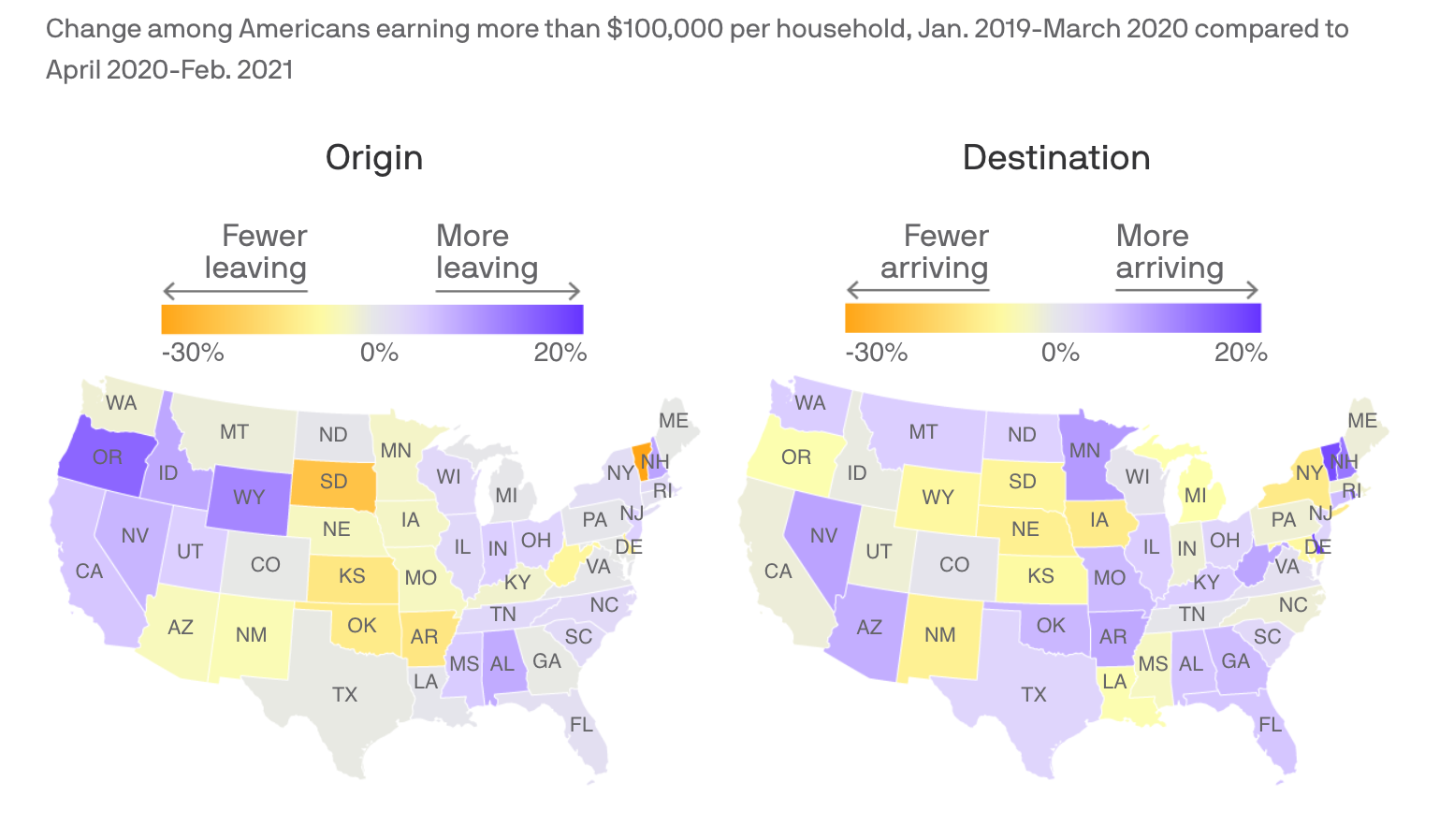
The Well-Off Are Flocking to Vermont

This graph is wonderful news for those who think Vermont’s economy needs to grow. (It is, as I’ve written before, very bad news for our housing supply.) The pandemic has made our state the most desirable in the nation for affluent Americans.

More desirable than our famously low-tax neighbor, New Hampshire. More desirable than the Sun Belt or the tax havens of Texas and Florida. We’re Number One, baby!

It’s too soon to tell if this dramatic shift will continue. But if it does, then it’s time to rethink our policies across the board, from taxation to education to broadband to economic incentives.

Continue reading

A Forced March Through a Dense Thicket of Legalese

It had to be done and done quickly, and they did it.

The Senate Finance Committee, after hours of lengthy discussions packed into three tedious days, finally moved the big broadband bill Wednesday afternoon. I watched about half of the hearings, and boy, I do not envy the committee at all. It was a seemingly never-ending slog.

The House-passed bill, H.360, got the usual hack-and-whack treatment from Senate Finance; the committee passed a “strike all” version, which meant it killed pretty much the entire bill and substituted its own language. But the two H.360s are not all that different in the grand scheme of things. The differences are mostly in the details, which are ridiculously abundant. There’s no doubt that the House and Senate will reach agreement on a broadband bill. Everyone is determined to get it done this session.

Why was it such a slog? Where do I begin?

Continue reading

It’s Amazing What You Can Do With a Billion Dollars

In purely political terms, the Covid pandemic is the best thing that’s ever happened to Gov. Phil Scott. He got to be seen as a decisive leader simply by outperforming the likes of Donald Trump. Throughout the 2020 campaign, he enjoyed a twice-weekly platform on live statewide television and radio. He absolutely dominated every news cycle, and walked to victory in something bigger than a landslide.

And now, state government is swimming in federal relief cash — with more likely on the way. Trump’s CARES Act provided the equivalent of 20 percent of Vermont’s GDP. President Biden’s American Rescue Plan Act is pumping in even more. And if Biden gets his infrastructure bill through, Vermont will get a third massive infusion in less than two years’ time.

The CARES Act alone floated Vermont through 2020 “in aggregate,” as state economist Jeffrey Carr put it. There was pain aplenty, to be sure. But there were winners as well, and the impact was greatly softened by the federal government’s ability (and willingness) to deficit spend. The governor is dead set against raising revenue or increasing the size of state government, but he’s perfectly happy to take whatever the feds will give him.

On Tuesday, Scott unveiled his billion-dollar plan to use a big chunk of the federal ARPA money. It includes just about everything on everybody’s wish list, and provides a huge boost to state initiatives that Scott insisted we couldn’t afford on our own. And the money will be spent over the next four years, which will make it extremely difficult to run against Scott in the next two cycles.

So, hooray for the pandemic!

Continue reading

Mr. Milne’s Recycling Bin

Scott Milne tried to make up for his two previous statewide campaigns, which were remarkably issue-free, by releasing a lavishly illustrated and ridiculously detailed 60-point policy agenda this week.

His Tuesday announcement got lost in what turned out to be a very big news day, including Dr. Anthony Fauci’s guest appearance at Gov. Phil Scott’s Covid-19 briefing and Scott’s veto of the Global Warming Solutions Act.

I felt a little sorry for Milne at the time. But having taken a dip in his mile-wide-but-inch-deep policy pool, I decided it’s probably better for him that this stale batch of recycled ideas didn’t attract much notice. The package is dominated by conventional Republican tropes, failed Scott administration proposals, and plenty of filler to make the agenda seem more impressive than it is. You’d think a guy who’s reinvented himself as an edgy cryptocurrency investor would have some fresh ideas to contribute.

What’s even worse is that Milne completely fails to address some of our most critical challenges. There’s nothing about our raging opioid crisis, not a mention of racism, justice, policing or corrections, and barely a nod to climate change.

Since Milne’s document is searchable, we can quantify that. “Opiates” and “racism” are nowhere to be found. The word “climate” occurs precisely once in the 33-page document. And that’s a reference to Vermont’s economic climate.

After the jump: YOU get a tax incentive! And YOU get a tax incentive! EVERYBODY gets a tax incentive!!!

Continue reading

BREAKING: Jim Condos puts his pants on one leg at a time

Ah, Vermont’s esteemed Secretary of State… champion of transparency, guardian against election tampering, epitome of the principled politician…

Turns out, he can fall for an Internet scam just like the rest of us.

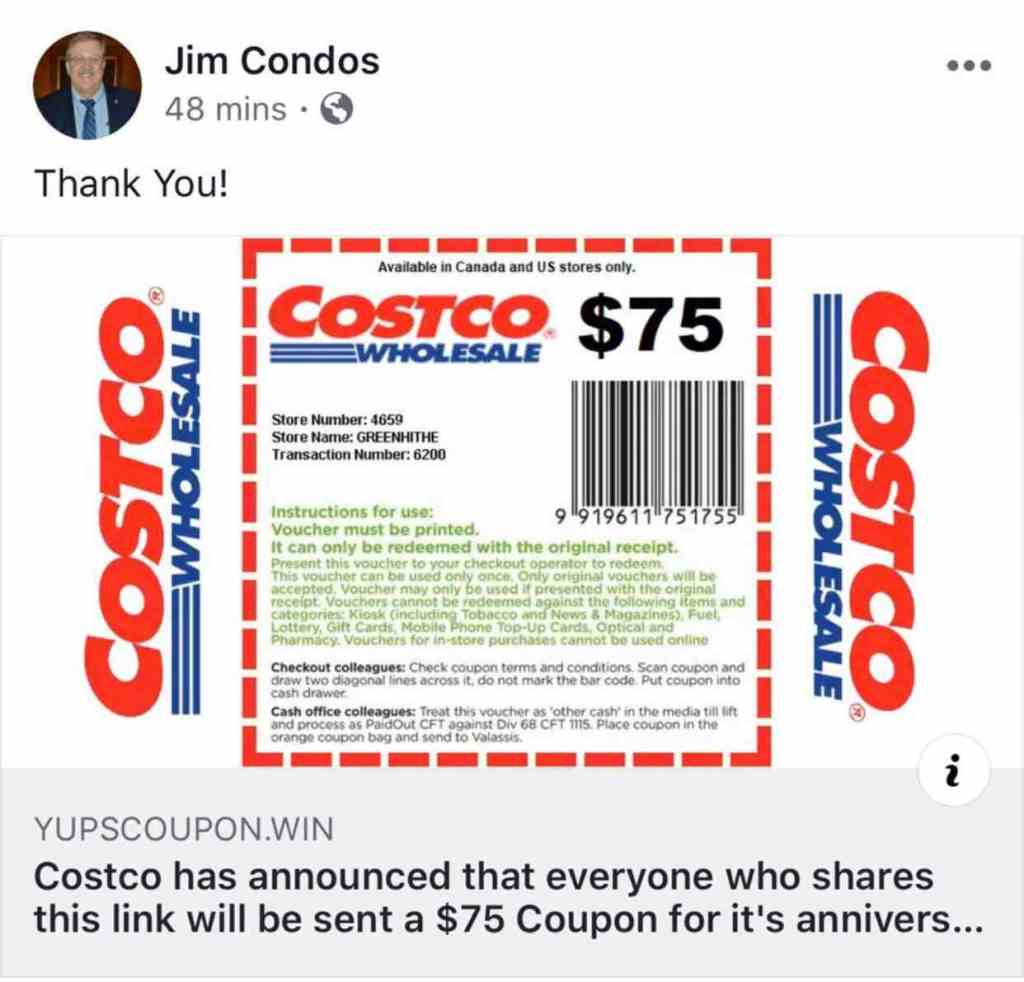
You may have heard about the Facebook ad for discount chain Costco, which offered customers a $75 coupon if they reposted the ad and provided some personal information.

Err… problem is, it was a fake. The real Costco wasn’t involved, and there was no $75 offer. But a lot of people fell for it, despite the fact that this same offer (or a very similar one) has been posted — and debunked — multiple times in the past.

One of those suckers: Vermont Secretary of State Jim Condos.

Yeah, sorry about that, Jim. No coupon for you!

Continue reading