Category Archives: Politics

Oops, Never Mind.

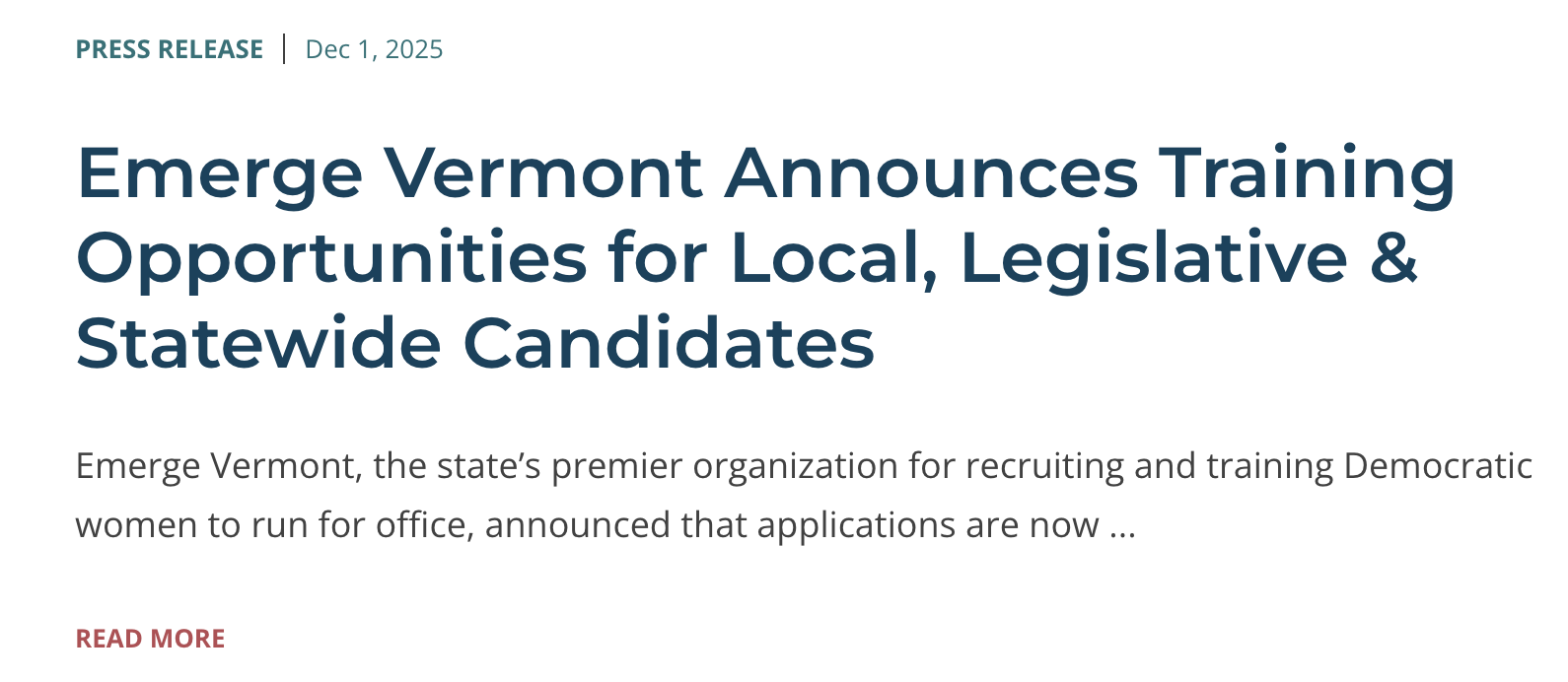
This announcement, dated December 1, is still posted on Emerge Vermont’s website. But those “training opportunities” will not happen, at least not in their present format or timetable. Because, per Seven Days, Emerge America just decided to shut down Emerge Vermont in a nationwide move to eliminate state chapters in favor of a regionalized structure.

A few years ago, I wrote a post entitled “It’s Hard to Overestimate the Impact of Emerge Vermont.” Right now, I feel like it’s equally hard to overestimate the impact of Emerge Vermont’s imminent dissolution.

Emerge Vermont has been a highly effective pipeline for Democratic women who want to enter politics. It has trained hundreds of Vermonters, many of whom are now top elected officials — like U.S. Rep. Becca Balint, Attorney General Charity Clark, Secretary of State Sarah Copeland Hanzas, and I don’t know how many state reps, senators, and local officeholders.

Emerge Vermont can be credited for nearly erasing the gender gap in the Legislature. (It would have completely erased it by now except that Republican caucuses are almost entirely male.) Emerge Vermont has also been an invaluable asset for the Vermont Democratic Party, which has benefited from a steady supply of Emerge-trained women ready to run for office. (Vermont Republicans don’t have a counterpart and, as I’ve said before, they would be well advised to get their donors together and create one.)

In short, this is a sad day for gender equality in Vermont, and for Vermont Democrats.

Continue reading
The Death of Nuts-and-Bolts Political Reporting

My previous post concerning the party reorganization process could have been written a couple weeks earlier. That’s when the information became available. I just plain didn’t get around to it immediately because (1) other stuff got in the way and (2) I was pretty confident that no other media outlet would bother with it.

And I was right. Nobody in Vermont covered it. In fact, nobody in Vermont is covering the nuts-and-bolts of politics anymore. Party reorgs, hirings, departures, leadership changes, party finances: they’re off the agenda. No one routinely (well, really, ever) attends state party committee meetings, conventions, or big fundraising events.

You also see a lot less reporting on individual politicians’ campaign finances. Filing deadlines used to be big occasions. Back when reports were filed in person, political reporters would gather at the Secretary of State’s office to grab the reports and file stories. Everything’s digital now, so all you have to do is open up the SoS campaign finance website and hit “refresh.”

It’s a lot easier. And yet, little to no attention is paid.

Continue reading

Party Reorg: The Rich Get a Little Bit Richer (Updated)

Note: This post has been updated with comment from the Progressive Party, see below.

This fall, Vermont’s political parties have undertaken their biennial obligation to reorganize themselves. It’s quite the task. The parties have to encourage members across the state to take part in town caucuses and establish town committees.

The process Is now over and the results are in. The Vermont Democratic Party had the biggest success, organizing town committees in more than 170 communities (they’re still totting up a few stragglers). The same process two years ago resulted in 150 Democratic town committees. That’s a nice bump, considering (a) they had less room to grow than the Republicans or Progressives, and (b) given the flood and all, it wasn’t the best year for encouraging turnout at political meetings.

The Vermont Republican Party lost a bit of ground, falling from 132 town committees in the 2021 reorg to 120 this time around. The Progs saw a modest increase from 44 towns in 2021 to 48 this year.

So what does it mean?

Continue reading

Desperately Seeking Scandal

Our two most prominent #vtpoli news outlets, VTDigger and Seven Days, are always eager to pounce on any sign of scandal regarding money in politics. They seem especially set on tagging a “For Sale” sign on the reputation of U.S. Rep. Becca Balint.

And now the trial of Sam Bankman-Fried has produced new documentation about his efforts to connect with the Balint campaign, so we have articles recounting the lurid details of his internal communiqués and Raising Questions about Balint’s integrity — and even the legitimacy of her resounding victory in the 2022 Democratic primary.

Well, color me unimpressed. There is no scandal. I’ve never thought so, and these latest stories don’t change my view at all.

Sure, Balint’s team dallied with SBF — who, lest we forget, was considered a financial savant at the time. No one knew he was — allegedly — a fraudster of the highest order. They met with him, they accepted donations from his associates, and they benefited from a huge contribution made to a national PAC that spent the money for ads touting Balint’s candidacy.

But there is no hint that Balint changed her positions to suit SBF and his friends. And there is abundant evidence that his largesse had no meaningful effect on the outcome of the primary campaign. If the new revelations show anything, they show that SBF is one cynical bastard.

Continue reading

In Praise of Shithousery

This, friends and acquaintances, is Jamie Vardy, ace striker for Leicester City FC and world-class shithouse. His specialty is the extravagant goal celebration in front of opposition fans. I do believe he’d rather score on the road than at home, just so he can put on displays like this. A former teammate says that Vardy would ask fellow players how to deliver insults in their language so he’d know how to say “Your sister is a whore” to a Portuguese defender.

Shithousery, broadly defined, is behavior designed to get under your opponent’s skin and hopefully disrupt their play. Kicking, grabbing, taunting, egregious overacting in an attempt to draw a foul, that sort of thing. It’s a quality you hate in opposing players but love when they’re on your side.

Which brings us to Vermont politics, especially Democratic politics, which is woefully short on shithousery. You might think we’re better off that way. To be sure, shithousery can be overdone; there are figures on the national scene who are capable of nothing but. (Ted Cruz, Jim Jordan, Paul Gosar, etc.) Vardy, on the other hand, is a topnotch player who once carried his squad to an improbable Premier League championship.

We need us a Jamie Vardy. By “we,” I mean Vermont’s Democrats and Progressives. The closest thing we’ve got is Bernie Sanders, but he’s not active on the home front. We need someone in state politics happy to throw a sharp elbow in the opposition’s ribs, even if they have to suffer the tut-tuts of the chattering class.

Phil Scott, for all his “nice guy” reputation, is an exceptional shithouse. He knows how to fire a sucker-punch when the ref isn’t looking. Say, when he accuses his critics of playing politics or slams the media for creating controversy. Or when he tiptoes around veto threats while refusing to engage with lawmakers.

It’s how he keeps the Dems off balance. They’re always trying to guess how far they can go without triggering a veto, which makes them water down their own legislation. Which results in Democrats looking like fools when they try to convince their voters that really, if you vote for us this time, we’ll deliver on the stuff we’ve been promising for years. Scott also keeps a stable of shithouses in his executive office, just as fellow “nice guy” Jim Douglas did when he was governor. (Names? Jason Gibbs, Dustin Degree, Tayt Brooks. All three have Two have been at Scott’s right hand since day one; Degree joined them eleven months into Scott’s first term.)

Continue reading

The Soft Abuse of Redistricting Power

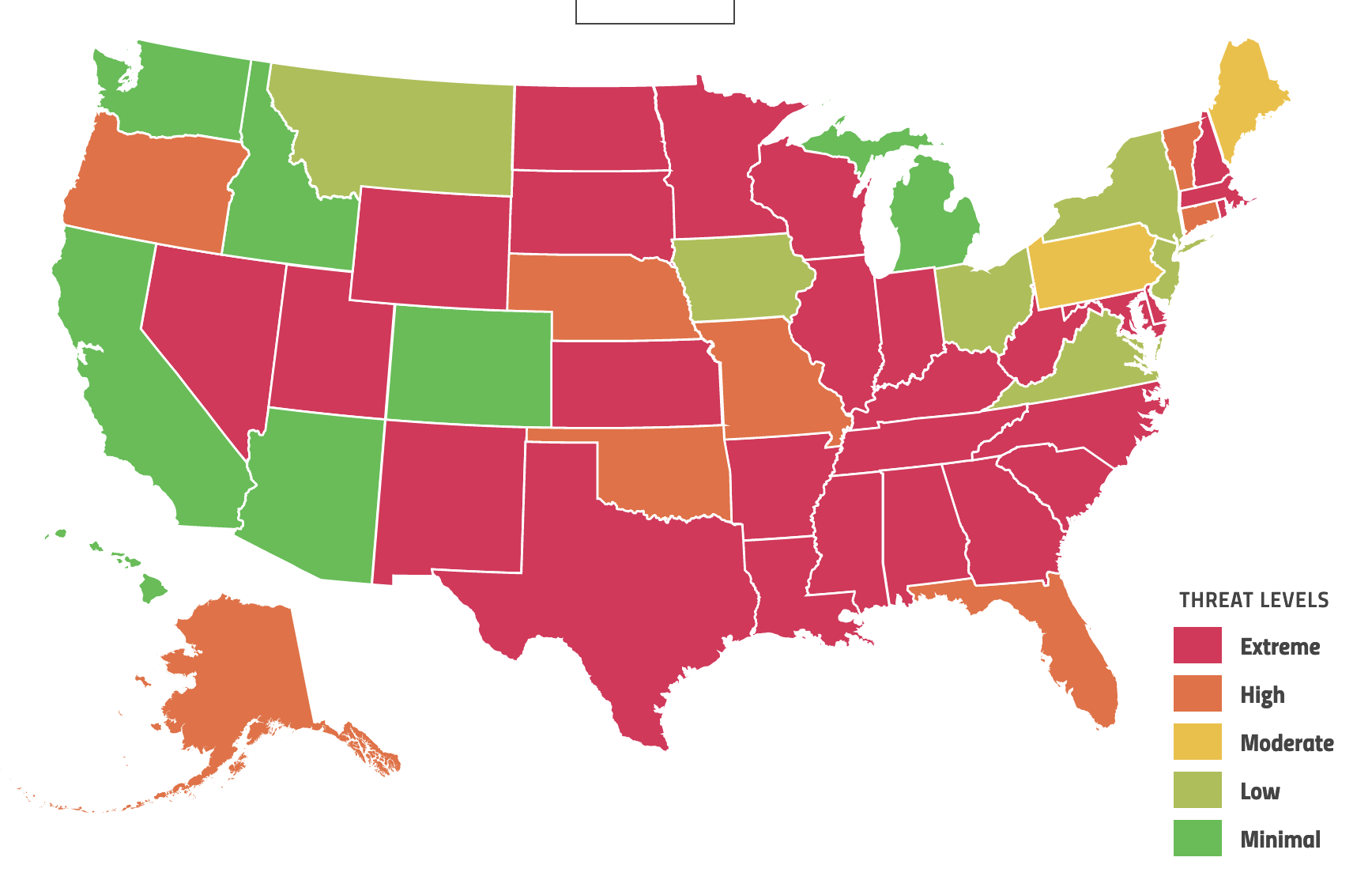
Here’s a little bad news for those who think Vermont’s political processes are above reproach. The nonpartisan group RepresentUs, which opposes political abuses of the redistricting process, has rated Vermont as at “high risk” for such abuse. Along with such bulwarks of clean politics as Missouri, Nebraska, Oklahoma and Florida. Not exactly stellar company.

To be clear, RepresentUs isn’t ranking states by the likelihood of gerrymandering or the historical record or the mendacity of a state’s politicians. It simply considers the legal framework of the process. In practice, Vermont’s redistricting process has been fairly clean. But state law leaves the door open to partisan abuse.

Vermont gets low grades on two points: Political officeholders have the final say on redistricting, and the law doesn’t require transparency. You can see how those points could allow politicians to game the system.

By and large, they don’t. Well, they don’t do outrageous things; they don’t create districts that look like abstract art or imaginary amphibians. But partisanship can, and sometimes does, affect the process.

In fact, we might see a more partisan flavor in Vermont’s 2022 redraw, especially in the Senate.

Continue reading

Will the Vetoes Be Overridden? (to the tune of “Will the Circle Be Unbroken”)

The stage is set. The players are in the wings. On Wednesday morning, the Legislature will return — virtually — for a brief veto override session. All three of Gov. Phil Scott’s 2021 vetoes are on the agenda. The action, for those of us who believe a YouTube screen full of tiny politicians’ faces constitutes “action,” gets underway in the House and Senate simultaneously, at 10:00 a.m.

The House will be first to take up Scott’s vetoes of H. 177 and H.227, the charter changes for Montpelier and Winooski respectively to allow noncitizen residents to vote in local elections only. Meanwhile, the Senate will take up S.107, which would raise the minimum age for public release of information about the arrest and charge of an offender.

This all seems perfectly normal. But in reality, it’s not.

While the Republican governor has set a new record for vetoes with 23, the Democratic Legislature has been loath to even attempt overrides. Scott has vetoed 20 bills from 2017 through 2020; only two of them have been overridden. In the vast majority of Scott’s other 18 vetoes, the Legislature didn’t even try.

So, attempting overrides on three vetoes in a single year is unprecedented during the Scott administration, and I’m guessing unprecedented in Vermont history.

Continue reading

The Gray Eminence

Lt. Gov. Molly Gray is, as far as I can tell, an unprecedented phenomenon in Vermont politics. (Someone with longer tenure than I may recall a comp.) In a state where “Wait Your Turn” is the norm, she entered the arena at the age of 36, ran for a statewide office, defeated a strong field in the Democratic primary, and defeated Republican Scott Milne by a comfortable margin in the general election. Considering the dominance of Democratic men in higher offices, her gender makes the accomplishment even more impressive.

Somehow, I don’t think we’ve fully appreciated how rare and special this was. In February 2020, as she was preparing to launch her campaign, she was an almost complete unknown. (Well, she was an assistant attorney general, but there are dozens of those.) Nobody in the Statehouse had a clue, nor did they take her seriously at first. The betting favorite, and it wasn’t close, was then-Senate president pro tem Tim Ashe.

Once in the race, Gray ran a nearly flawless campaign despite having no experience in electoral politics. That’s immensely difficult to do.

But Gray has often received more criticism than credit. (Yes, including from me.) There are good reasons for some of that; but much of it has to do with two things about Gray that are rare in our politics: Her age and her gender. And that’s troubling.

Continue reading

New Jockey, Same Ride

Belated best wishes and condolences to Claire Cummings, the new executive director of the Vermont Democratic Party. I trust she has an idea of what she’s walking into, since she worked on the VDP’s 2020 campaign.

You know how it seems like a certain storefront or commercial building seems to be cursed? One business after another opens up, gives it a shot, and then vanishes? Well, that’s the leadership of the Vermont Democratic Party.

Cummings is the fourth person to hold the job in less than four years — and the fifth, if you count then-party chair Terje Anderson’s unfortunate tenure as interim ED in 2019. (The five, in chronological order: Conor Casey, Josh Massey, Terje Anderson, Scott McNeil, and now Cummings.) The VDP has also seen chronic turnover in staff positions. The “senior” staff member is Spencer Dole, who was hired in February 2019.

Party chair has also been a revolving door of late as well. The VDP is on its fourth chair in five years. (Dottie Deans, Faisal Gill, Anderson and current occupant Bruce Olsson.)

The casual observer might expect the VDP to be a powerhouse, given the party’s dominance in state politics. But no. If anything, it’s fat, lazy and stuck in a rut. You hear a lot of talk about energizing the VDP, winning back the governorship, and opening the door to young Democrats and BIPOC Vermonters. But when it comes time to put words into action, it’s pretty much the same ol’, same ol’.

Continue reading

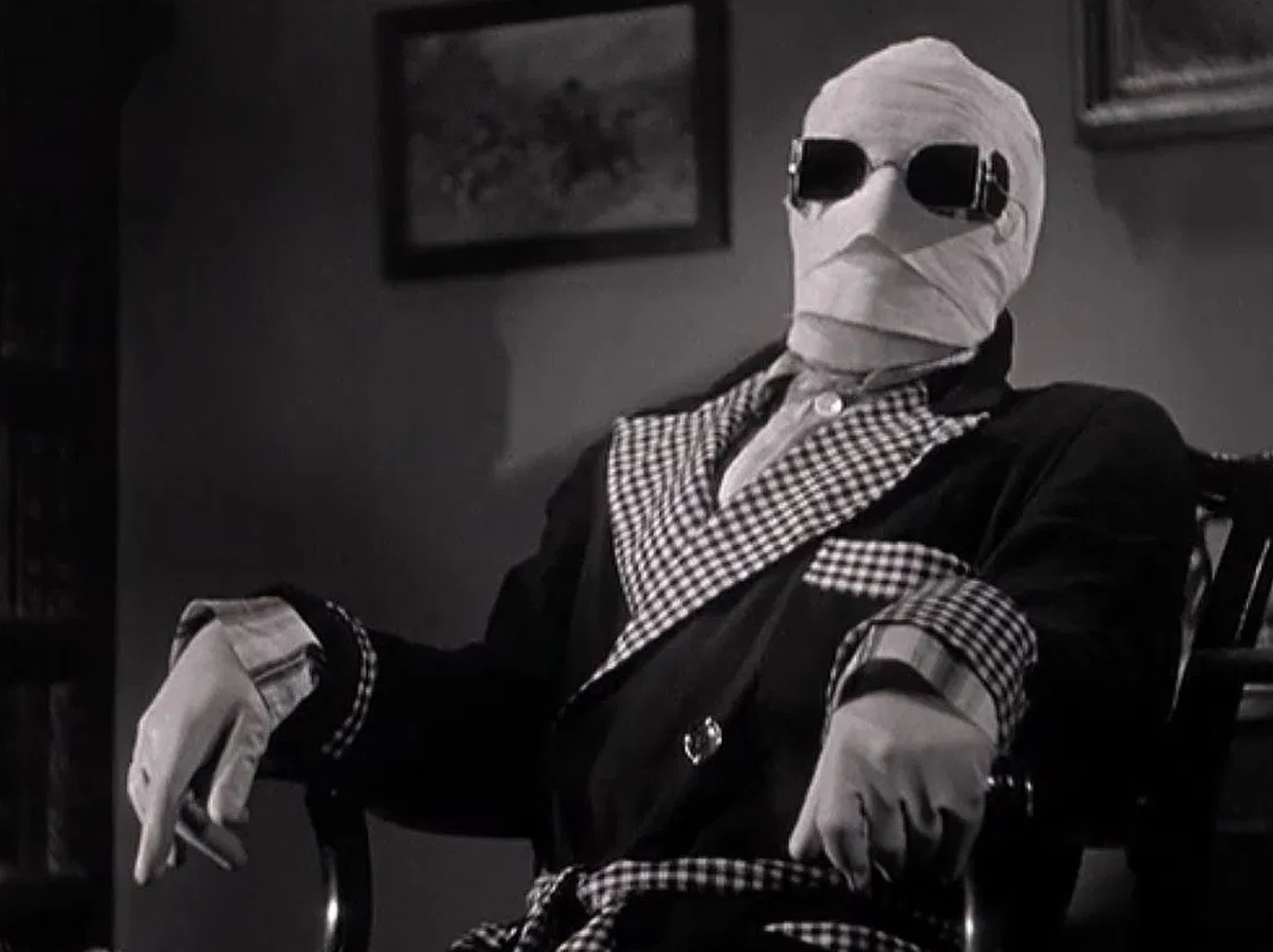
The Reign of the Invisible Man

Harlan Sylvester, large and in charge (Not Exactly As Illustrated)

The House Democrats’ ill-considered pension reform plan was the icing on the cake, the topper in a series of events that expose the fundamentally centrist nature of the party and its officeholders.

And this I trace to the all-encompassing influence of one Harlan Sylvester.

For those just tuning in, Sylvester is a longtime money manager who shuns the limelight — but for decades, he has been the kingmaker of Vermont politics. You don’t get to the top of the heap without his blessing. And it sure seems like the modern Democratic Party has been fashioned according to his fiscally conservative taste.

There have been occasional press profiles about him, and they all describe him the same way. Peter Freyne, 2000: “Mr. Sylvester has had the cocked ear of Vermont governors going all the way back to Tom Salmon in the 1970s.” Freyne quoted then-UVM political science professor Garrison Nelson thusly: “Harlan loves conservative Democrats. He wants to erase the gap between the Democratic Party and the Republican Party.”

Rutland Herald, 2002: “it was Harlan Sylvester’’s considerable influence and strategic skills that helped put [Republican Jim Douglas,] the apparent underdog candidate, in office.”

In 2010, Freyne’s successor Shay Totten described Sylvester as “The most powerful man in Vermont politics.” Totten also quoted Prof. Nelson: “He’s got access to people with real money, and those people with real money will invest in politicians who will protect their interests.”

So that’s Mr. Sylvester, who is in his late 80s but his power has not been visibly diminished. From what I’ve heard, he remains the power behind the throne.

And now let’s look at what the Democratic Party has become.

Continue reading