Last week’s VTDigger/Vermont Public joint report about the state of Vermont’s $789 million housing splurge and its disappointing impact was a true journalistic tour de force. It was a deep dive into an important story. It involved a ton of work, and it provided real insight into Vermont’s housing crisis. Kudos to both organizations and to co-authors Carly Berlin (Digger/VP shared housing reporter) and Erin Petenko (Digger data reporter extraordinaire).
Two thumbs up, ten out of ten, five stars on Yelp, no notes.
But there is a dark side to this, and it has to do with the ever-diminishing state of journalism in Vermont.
I’ve been thinking about the need for a plausible, recognizable Democrat to step forward as a candidate for governor with a campaign focused on a big policy idea. This is because so many Dems seem to be playing into Gov. Phil Scott’s hands instead of carving out a recognizable alternative, and because the Vermont Democratic Party has been weakened for years by the lack of a strong, unifying voice at the top of the ticket.
Also because the only Democrat to actually win the governorship in the last quarter-century was Peter Shumlin, who staked his fortunes on single-payer health care and won a hard-fought 2010 primary and three straight statewide elections. He’s the only Democrat to be elected governor since Howard Dean in the year 2000. Some of you weren’t even born then.
So I was casting around for a big policy proposal that could turbocharge a gubernatorial campaign, and I remembered a post of mine from February 2024 which floated the idea of a $250 million housing bond. That’s right, take our solid bond rating and gamble it on the sensible proposition that building more housing would pay off in economic growth and higher tax revenues. You know, like a TIF writ large. It’d be an idea tailor-made for Treasurer Mike Pieciak, who has the expertise to craft such a plan while preventing the wise heads at S&P from catching a bad case of the fantods. And who needs to give voters a reason other than “Everybody likes Mike” to vote for him.
But now, in light of two recent news stories, I worry that a massive housing bond would amount to nothing more than pissing into the wind, that there simply may not be a way out of our housing crisis. At least not without structural economic changes on a scale much larger than our B.L.S.
Here we go again. Gov. Phil Scott has pulled a maneuver that will have little practical impact, but should suit his political purposes very well.
At his weekly press conference Wednesday, Scott signed an executive order aimed at boosting Vermont’s housing supply. And there was his cabinet’s top housing official, Alex Farrell, boasting that the order “will make a real difference immediately.”
Yeah, well, bullshit.
Scott’s authority to make policy changes without legislative input is quite limited. The items in his executive order might make some incremental difference — eventually — but it’s laughable to claim that this move will resolve our housing crisis or make any measurable progress in the next few months.
The order was less about housing, in fact, than about political positioning. In that respect, it’s already a success.
It’s no surprise that Gov. Phil Scott is turning a deaf ear and a jaundiced eye toward the Queen City, rejecting any idea that his do-nothing administration has contributed to downtown Burlington’s troubles. It’s somewhat more surprising that Democrats on City Council are effectively taking the governor’s side in the argument. Well, perhaps more ill-timed than actually surprising. Because talking like Republicans is what Council Democrats do best.
Let’s take this from the beginning. On August 13, VTDigger published an opinion piece by Burlington’s Progressive Mayor Emma Mulvaney-Stanak, in which she slammed the Scott administration for dramatically increasing the number of unsheltered people and failing to offer Vermont’s cities any help in dealing with the ensuing humanitarian crisis.
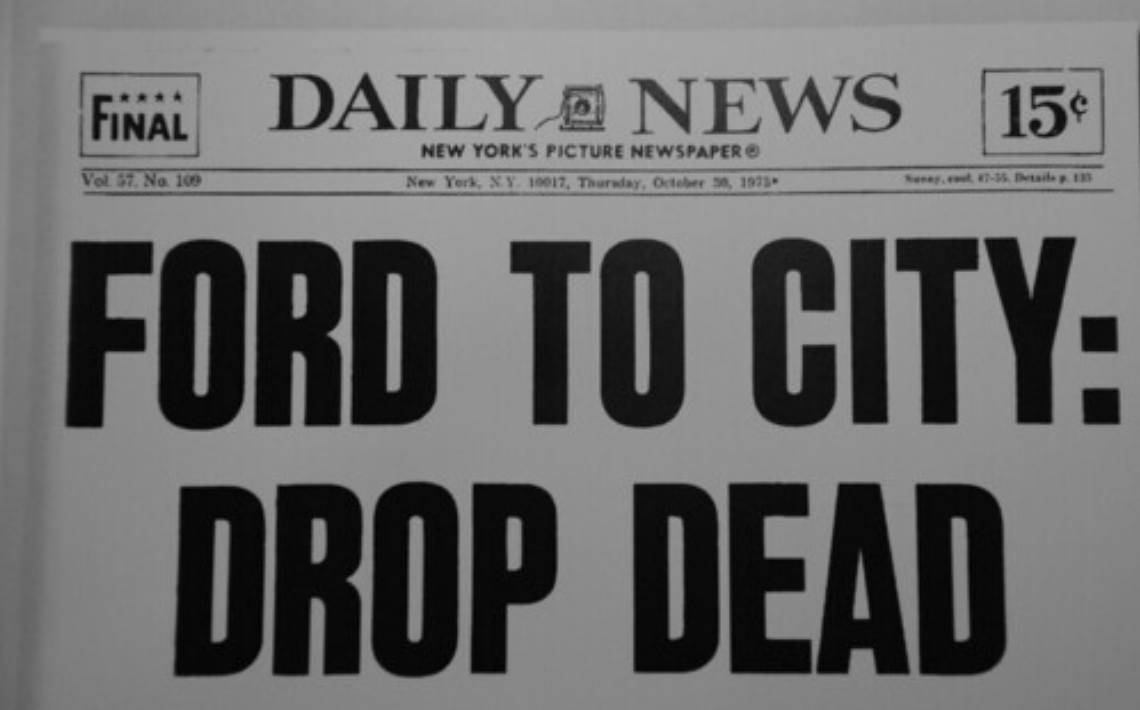
The governor’s response, delivered at a press conference last week, was akin to then-president Gerald Ford’s response to the financial troubles of New York City in the mid-1970s, as reflected in the greatest tabloid headline ever written. LIke Ford, Scott didn’t actually say that Burlington should Drop Dead, but he did argue that the city needed to step up and address its own problems before it could expect any outside help.
Even worse were comments made by Jennifer Morrison, Scott’s commissioner of public safety and former interim police chief of Burlington. According to VTDigger’s Shawn Robinson, Morrison described the city as “terrifying” without explaining what she meant by that, and sounded like someone carrying a grudge from her brief tenure as chief:
Why? Three reasons, as explained by Carly Berlin, the housing reporter shared by VTDigger and Vermont Public. First, the PIT count happened on a very cold night in January, when the city of Burlington was operating an overnight warming shelter that gave dozens of people a very temporary place to stay. Second, the PIT count should always be considered an undercount because, well, homeless folk can be hard to find. And third, this is especially true of the unsheltered; they might be anywhere, and the state makes no effort at all to keep track of where they are or how they’re doing. No matter how diligent the counters are, they’re not going to find everyone.
Also, it must be said that if the PIT count were conducted now, the number of unsheltered would doubtless be even higher because of cuts in the General Assistance Emergency Housing program, a.k.a. the motel voucher system, imposed in the last couple of months.
Man, VTDigger couldn’t have picked a worse possible day to literally slap a smiley face on a map of Vermont. Because it happened on the very day that “over 800 people — including nearly 300 children” were deliberately unsheltered, on one of the hottest days of the year so far, by an uncaring Scott administration. That’s on top of another 138 unsheltered in late June because they had timed out their administration-ordained eligibility limits for motel vouchers. (Further evidence, says I, that the governor doesn’t give a fuck about the homeless.)
This latest offense against humanity was triggered by an administration decision in early June to impose those limits on an extension of winter eligibility into the spring. The decision came as a surprise to helping agencies, advocates, and more than a few members of the Legislature. And it meant that a whole bunch of recipients suddenly found themselves S.O.L. at the end of June.
Including Samantha Burnett, whose shocking story is recounted by Keith Whitcomb Jr. of the Times Argus and Rutland Herald.
“I’m eight-months pregnant. I’m literally due any day,” said Samantha Burnett, 23, during a downpour outside the Econo Lodge in Rutland City.
She said she has been living at the hotel since November. Burnett said she’s from Addison County and lost her job two months ago because her employer wouldn’t approve maternity leave. She has a friend who will let her cook food at her place, but is relying on another friend to find her a rundown vehicle she can sleep in.
Despite her own troubles, she’s most concerned with what will happen to her baby. She’s afraid the state will put the newborn out for adoption because, well, she’s homeless. It wouldn’t matter that she’s homeless because of the state’s own policy choices.
What the hell, Vermont. Is this who we are? Letting an expectant mother sleep in an abandoned car?
I try to limit my use of bad language, I really do. But there are times, and this is one of them.
Gov. Phil Scott, alleged “nice guy” and “moderate” who has insisted that protecting Vermont’s most vulnerable is a pillar of administration policy, just went and did what we expected him to do all along: He vetoed H.91, the Legislature’s carefully crafted replacement for the motel voucher system Scott has been complaining about for years.
Our mainstream media outlets have been saying for weeks that Scott’s stance on H.91 was unclear. In doing so, they ignored the obvious signal from Human Services Secretary Jenney Samuelson that a veto was in the cards from jump street. Almost a month ago, Samuelson delivered a memo to legislative leaders expressing serious concerns about H.91. That should have been all the foreshadowing needed to conclude that we were inevitably going to end up where we are today, with Scott killing a good-faith effort by the Legislature to do the thing he and his administration should have done long ago: Propose a voucher replacement plan of his own.
Phil Scott has been a denizen of the Statehouse for almost a quarter century. He was first elected to the state Senate in 2000, taking office in January 2001. He was a senator for 10 years, and served as vice chair of one committee and chair of another*. He then served three terms as lieutenant governor, whose duties include presiding over the Senate. Then he became governor, where he’s been ever since.
*His Wikipedia bio mentions, as the signature achievement of his time as chair of the Senate Institutions Committee, that he “redesigned the Vermont Statehouse cafeteria to increase efficiency.” Really? Is that the biggest thing he accomplished as a committee chair? Huh.
So it’s safe to say that if anyone knows how the Statehouse works, it’s Phil Scott. He has seen and done it all. He knows how stuff gets done, and how stuff doesn’t get done.
Which makes it all the more curious, or downright stinky if you prefer, that one of his top officials tried to blow up a legislative debate at the last possible minute. It was a thouroughly counterproductive tactic, unless the goal was to deliver a killshot to the bill in question.
The top official is one Jenney Samuelson, Secretary of the Agency of Human Services. On Friday, May 17 she delivered a memo seemingly aimed at derailing H.91, which would create a replacement to the oft-maligned General Assistance Emergency Housing program, a.k.a. the motel voucher system. For those just tuning in, that’s the system Scott and Samuelson have been criticizing nonstop for years without ever proposing an alternative of their own. This year, the House’s patience finally came to an end. It put forward a plan of its own in the form of H.91.
Every spring there comes a moment when you suddenly realize, “Wow, the legislative session is just about over.” For me, that moment came last week, with a bunch of stories about progress on major bills. A look at the calendar made me realize that in many other years,adjournment would have already adjourned. We’re well into overtime already.
We’re also getting a pretty clear idea of what history will make of the 2025 session, and it’s exactly what we all could have predicted last November 6, when Republicans decimated the Democrats’ veto-proof legislative majorities. No longer was the majority secure in its ability to override vetoes.
And they have legislated accordingly, trying to pass major bills that would be acceptable to the all-time record holder for vetoes by a Vermont governor. Scott, meanwhile, has pursued his customary course: Sitting in the balcony, tossing Jujubes at the stage, and emitting a squid-ink cloud of uncertainty around what he’d be willing to accept.
The result is a disappointment to anyone hoping for progressive lawmaking, but an entirely predictable one. What else could the Legislature do, really?
The Vermont State Employees Association isn’t exactly the International Workers of the World. It generally tries to avoid rocking the boat, and comes in for a fair bit of criticism from more progressive elements of the labor movement in Vermont.
Which made it all the more remarkable when two top VSEA officials went before the House Human Services Committee last Thursday to deliver harsh accusations against the Department of Children and Families’ Economic Services Division in general and its top official, Deputy Commissioner Miranda Gray, in particular. Gray, they said, has created “an authoritarian, top-down environment in which fear is used as a weapon,” leaving employees “demoralized and fearful.”
VSEA President Aimee Bertrand (pictured above), a longtime ESD employee, told her own tale of harassment, retaliation, and punitive actions that led her and the union to file an unfair labor practice charge with the Vermont Labor Relations Board. That filing, she said, led to further retaliatory actions. All of which would appear to violate terms of the union’s contract and/or state law.
It was a stunning event. I’ve been in and around the Statehouse for over a decade, and rarely have I seen such dramatic testimony. I don’t think I’ve ever seen such serious accusations made by VSEA against a unit of state government.
You may not have noticed any of this, because the media coverage was pitifully inadequate.