Category Archives: Environment

The recycling market and Act 148

This is the second of two posts about the Bottle Bill, unclaimed nickels, and universal recycling. Part 1 can be read here.

On July 1, the state of Vermont will ban all recyclable materials from landfills. Under a law called Act 148, everything recyclable is supposed to be kept out of the waste stream.

Hooray, right?

Well yes, but there are issues. (Aren’t there always?) Foremost among them, unsurprisingly, is money. Handling trash will become more expensive post-July 1, especially for trash haulers in smaller, more rural service areas. Haulers can’t impose a charge on recycling, so they’ll have to recoup their costs by raising their tipping fees.

That could induce sticker shock in some places. Tom Moreau of the Chittenden Solid Waste District estimates that some disposal fees could triple under Act 148.

Continue reading

Nickels from heaven

In these hyper-tight budget times, would it surprise you to know that there’s a couple million bucks just sitting there, waiting for the State of Vermont to pick it up?

This isn’t just one-time money either; it’s an ongoing, steady source of revenue. And yet the Legislature hasn’t made a single move to grab it.

“What is it?” you might be asking.

It’s the unclaimed nickels from deposit bottles that never get redeemed. Right now, that money goes back to the bottling industry — an estimated $2 million per year.

Free gift for the bottlers? The PYT’s from VPIRG certainly think so. They’ve been lobbying, without success, to revise the Bottle Bill and get that money into public coffers.

Ten states have Bottle Bills. In four, the state gets all the unclaimed money. In three, the state gets the lion’s share but a slice goes to retailers, bottlers, or distributors. Only in Iowa, Oregon and Vermont do private companies get all the money. And since yjomhd seem to work in those seven other states, I think it’s safe to assume that the companies don’t need the extra revenue to collect and process the containers.

In fact, they get more money than they need from another source: selling the containers on the recycling market. A lot more money. But we’ll get to that that later.

Okay, so why isn’t the Legislature falling over itself to get those nickels? Two reasons; one immediate, one more far-reaching.

Continue reading

The Don Turner Guide to Fiscal Responsibility

House Minority Leader Don Turner was the last soldier at the rhetorical Alamo of opposition to the water bill. Even at the last, he was pushing for no new taxes. His idea for a funding source was to divert small amounts of money from various other places and use it to leverage a bond issue.

We’ve been over this before, but I think it’s time to point out exactly how stupid and fiscally irresponsible that idea was.

First of all, his own estimate for his own plan was about $4.2 million, about half the money in the Democrats’ plan. Since the Dems’ plan is designed to be as cheap as possible while still passing muster with the EPA, it’s hard to imagine Turner’s plan gaining its approval.

And as a reminder, if we don’t adopt an acceptable plan, the EPA will come down like a ton of bricks on the only pollution source under its jurisdiction: municipal water treatment. That would be a far more expensive, and less impactful, solution, but it’s the only tool in the EPA’s box.

Okay, beyond the questionable prospects for the Turner plan, the big problem is its dependence on bonds for ongoing expenditures. This is a huge no-no according to the financial whizzes in the state treasurer’s office. Earlier this week, Deputy Treasurer Stephen Wisloski told the House Ways and Means Committee that using bond funds for current expenses is unwise, and a good way to ruin your debt rating. As he put it, “You should make sure the useful life of the asset is at least as long as the life of the bond.”

In simple English: bonding for roads, bridges or buildings GOOD. Bonding for current expenditures BAAAAAAAD. Taking notes, Donnie boy?

And here I thought Republicans were the guardians of fiscal responsibility. In fact, the notion of bonding is a band-aid solution that harms our bond rating in the immediate term and stretches our future finances ever more thinly.

And for what? To avoid a 0.2% tax on property transfers? Yeesh.

I shudder to think how our finances would look if Don Turner or a likeminded Republican was in charge. I certainly wouldn’t look to him for responsible governance.

A pretty darn good day at the Statehouse

Wednesday was a big day for the legislature’s battle to get through a long and tough agenda. The House passed two huge bills, and the Senate approved a positive step in voter access.

Senate first. After Sen. Dustin Degree lost his repeated efforts to derail, slow down, or cripple the bill, the full Senate approved same-day voter registration on a voice vote.

Degree was pushing a mild form of the Republican “voter fraud” canard. The Bush Administration tried very hard for eight years to find and prosecute cases of vote fraud, and produced an average of less than one case per year. But there was Degree, acknowledging that “Fraud may be minuscule,” but insisting we ought to take steps to prevent this mythical plague upon our land.

If the bill passes the House, it wouldn’t take effect until 2017 because Vermont’s town clerks are creatures of habit who are loath to accept change or take on new responsibilities. They insisted on a two-year delay, and still want to fight for tougher rules. Our Public Servants, first and foremost guarding their own turf.

On to the House, which approved two bills that can be fairly described as “landmark.” Neither bill is perfect, but both represent substantial accomplishments.

The “water bill,” H.35, passed on a 126-10 vote, with only a handful of Republicans saying no. It establishes a Clean Water Fund and provides for $8 million a year in funding. This accomplishment is diminished by the fact that the state HAD to do something, or face the regulatory wrath of the feds. Because Vermont is, and has been for a long time, in violation of the Clean Water Act.

Still, getting almost 95% of lawmakers to support a bill that impinges on large segments of the economy and raises new revenue wasn’t a simple task. After a confirmatory vote Thursday, the bill moves to the Senate.

The education bill passed by a narrow margin, but still substantial: 88-59. This one was a tougher sell because education is near and dear to the hearts of every student, parent, grandparent, and community in the state. And near to the wallets of every taxpayer.

This was vividly on display in Wednesday’s Democratic caucus meeting. After an overview of the water bill drew only a couple of questions, the presentation of the ed bill had Dem lawmakers popping up all over the room. Many were specifically concerned about schools and districts in their own communities.

Any kind of education reform bill is a tough haul. This makes substantial reforms in funding and governance. Generally speaking, it’s a decent effort. I think we do have to do something significant to bend the cost curve, and some form of consolidation is almost inevitable. Student populations are declining, especially in rural areas; tiny schools are in no one’s best interest. Not students, not taxpayers, and not other government initiatives that might benefit if the public-school burden wasn’t so heavy.

Both bills will head for the Senate, which makes me cringe. Based on past experience, you never know what the hell they’re going to do. But maybe they’ll surprise me. There are some good folks in the Senate — definitely two more (Becca Balint, Brian Campion) than there were in years past. The atmosphere and legislative product will greatly benefit from the addition by subtraction of Peter Galbraith, whose voluntary retirement from the Senate was a blessing for us all. We should see a lot less capricious obstructionism, if nothing else.

Hard times still to come, many long days and debates — some dramatic, some tedious. But April First was a good day. No foollin’.

Low-carbon sausage making

A resolution to put the Vermont Legislature on record as acknowledging the scientific fact of climate change stalled out this morning, amidst a thick procedural fog. All parties retreated to home base, in hopes of tweaking the language and moving the bill

"The round-Earth theory is being promoted by profit-hungry travel companies. It's four elephants, and turtles all the way down!"

“The round-Earth theory is being promoted by profit-hungry travel companies. It’s a flat earth carried by four elephants, and then turtles all the way down!”

The Senate Natural Resources and Energy Committee heard testimony from four experts plus John McClaughry. The latter cast plenty of aspersions and did his best to sprinkle a pinch of doubt into the overwhelming scientific consensus that climate change is real and that We Humans are contributing to it.

He did say at least one true thing: “I’m not a climate scientist.”

Aside from that, he slammed the Intergovernmental Panel on Climate Change as a political body mired in scandal; mocked climate modeling as a simple matter of picking a convenient endpoint, referred to “the extreme storm business” as a tool of profit-hungry corporations*, implied that resolution sponsor Brian Campion was a tool of VPIRG, and characterized climate change claims as “exaggerated beyond the bounds of ethical practice.”

*Since when does John McClaughry not believe in profit???

Gee, John, don’t hold back. It’s bad for your blood pressure.

As for the experts, Dr. Gillian Galford of UVM’s Gund Institute reported that 97% of the scientific literature agrees that “climate change is happening and is due to human actions.” She walked through several charts that showed the facts of climate change from the global level (everywhere on the planet EXCEPT the northeastern U.S. had an unusually warm winter) to the local (Joe’s Pond ice-outs are happening later and later).

Perhaps the most interesting testimony came from Jody Prescott, retired U.S. Army Colonel and adjunct prof at UVM. He called climate change a “threat trend” of significant concern to the military for its potential impact on global stability, and said that if we fail to address climate change, it “reduces our chances for military success.”

Which might not float your boat, but it’s a valuable perspective to hear.

The other witnesses were environmental activist and UVM freshman Gina Fiorile, and the puppet master himself, Paul Burns of VPIRG.

After the hearing, the committee spent about 45 minutes tossing the resolution around like a rag doll. Most of the objections came from Sworn Enemy Of Wind Power John Rodgers and wind skeptic Diane Snelling.

Frankly, my sense is that both of them don’t want to vote “yes” on the bill, but don’t want to vote “no” either.

Snelling offered a vaguely-couched but insistent objection to a clause acknowledging that Vermont has fallen short of its carbon reduction goals. Which, of course, it has.

Well, to be precise, our carbon production increased during the Nineties and early Aughts and then declined. We’re now roughly where we were in 1990. Which is nice, but our statutory goal was a 25% reduction. Oh well, another statute ignored.

Rodgers can’t see beyond his concern with the siting process. He won’t support a resolution encouraging more action toward carbon reduction if it might mean additional ridgeline wind in his pristine Northeast Kingdom. (I haven’t heard him object to Bill Stenger’s massive brace of EB-5 projects, but there you go.)

Rodgers wants energy projects to be subject to Act 250 — and more. He wants them sited “as near the end-users as can be.” Gee, I wonder how he feels about the massive energy imports we make from Hydro Quebec, currently our primary source of “renewable” energy — and about the likelihood that more transmission lines will be built if we don’t develop our own renewable sources.

Anyway, I’m not arguing that John Rodgers makes sense. I’m just reporting that he won’t support a nonbinding resolution unless it includes language about siting reform and a reliance on “Vermont-scale projects” or something like that.

What struck me is that very few sensible Vermonters are willing to overtly deny climate change. Almost everyone (except John McClaughry) will acknowledge that it’s a problem we need to address — but then they throw obstacles in the way. We don’t want to increase costs, we don’t want to imperil any unspoiled spaces or view sheds. We can’t do anything that’s not in the vaguely-defined Vermont Way. We’re too small to make a difference. In the end, it boils down to this: they see other things as bigger priorities than climate change. Which means they’re not serious about climate change.

Back to the resolution. Committee chair Chris Bray finally decided to table it with the intention of refining the language in time for a committee vote tomorrow (Thursday).

Afterward, Campion expressed surprise that his resolution sparked so much opposition. “I thought it was a slam dunk, and it wasn’t,” he said. “I don’t know how much I’m willing to bend, to be honest with you. I’m okay with a few tweaks, but if it were to change the intent, forget it.” He’d rather have a 3-2 or 4-1 vote on something like his original resolution than a unanimous vote for a watered-down version.

But if we have to fight this hard for a simple nonbinding resolution, how in hell are we ever going to effectively address the onrushing threat of climate change? Or, as Campion put it:

What’s been interesting [about serving on Natural Resources] is how much I’ve learned that we as Vermonters are not doing.  We pat ourselves on the back, beause we do some amazing things. But when you look at not meeting our carbon reduction goals, you look at Lake Champlain and other bodies of water, we still have a lot to do. We have a lot to accomplish, and we’ve got to be very serious and focused on it. 

So maybe James Ehlers wasn’t such a nut after all.

Not too long ago, most of Vermont’s environmental groups were lining up to give Gov. Shumlin a pat on the back for a strong Inaugural Day commitment to cleaning up Lake Champlain. The notable nonparticipant in the cheerleading was James Ehlers of Lake Champlain International, who saw the plan as inadequate and almost doomed to failure.

Vermont’s waters need more science and less politics. That is what we have taken away from the governor’s inaugural address and the subsequent media events.

… We need and want his plan to succeed. But, sadly, it won’t.

For his trouble, he was cast as the outsider unwilling to accept a pretty good plan that was probably the most that could be hoped for, given current political and fiscal realities. Well, that might have been the nicest way it was put:

To his admirers, Ehlers is a fearless crusader for water quality, willing to speak truth to power — even if that pisses off political officials and establishment environmental groups in the process.

To his detractors, Ehlers is, at best, a bombastic ideologue. Some doubt his motivations, wondering privately if he’s fueled more by ego than environmentalism.

But now, here come the “reasonable” enviros sounding an Ehlers-like alarm.

Shumlin’s [Inaugural] message was celebrated by environmentalists. But two months later, many of the same supporters say the state’s cleanup plan is insufficient to achieve state water quality standards.

“It really doesn’t do much of anything to deal with the several agricultural problems that are present in the most polluted watersheds in Lake Champlain,” said Chris Kilian, vice president and director of the Conservation Law Foundation.

Kilian and others are upset over the Agriculture Agency’s handling of farm-related water quality issues. Ag Secretary Chuck Ross has refused a petition to impose “best practices” on farms near impaired sections of Lake Champlain, and seems more concerned with concocting excuses for inaction than for pushing ahead with an aggressive enforcement plan.

Maybe that’s no surprise, considering that his agency is more of an encourager — and enabler — of the ag industry than an environmental enforcer. As Kilian says, “there is no demonstrated track record that we do share the same goal.”

It’s easy to conclude that the Shumlin administration is ambivalent about Champlain; if not for the threat of the EPA hanging over its head, we’d almost certainly still be in “speak loudly and carry a toothpick” mode. The administration’s goal seems to be devising a plan that will barely be enough to mollify the feds.

Ehlers, of course, was saying so all along. He should be forgiven if he indulges in an ironic chuckle.

The drift

The legislature is about a quarter of the way through its four-month session, and Governor Shumlin’s proposals are falling like tin ducks in a shooting gallery. Lake Champlain tax plan? Dead. Education plan? “A place to start the conversation.” Payroll tax to close the Medicaid gap? Flatlining.

Not that this is terribly surprising; the governor exited the 2014 election with significantly diminished political capital. So much so that when Shumlin unveiled his proposals last month, the question wasn’t so much whether they would pass or not, as whether he meant them seriously in the first place or knew from the start that they were doomed.

(Evidence for the latter: an education plan that did nothing to provide near-term property tax relief. That, at least, was a non-starter.)

Not sure what else he could have done after his near-defeat. He could have taken the George W. Bush approach, pressing on regardless of his mandate-free victory, but that’s not who he is. Shumlin likes to talk bold and act incrementally.

Now he’s added deference to incrementalism, and it’s up to the Legislature to generate some vision. The consensus-seeking, conflict-avoidant Legislature. I’m not holding my breath.

I do expect our lawmakers to do some good work; I just don’t expect them to produce anything truly impactful. And we face a bunch of issues that call for some strong, progressive action.

Take, for example, the House Fish, Wildlife and Water Resources Committee, chaired by one of the good people of the Statehouse, David Deen. The committee has already ditched Shumlin’s proposed tax hikes to help pay for Lake Champlain cleanup. The fertilizer fee’s down the tubes because the farmers didn’t like it; the fee for stormwater runoff from developed sites is as good as dead because it would be “difficult to implement.”

Instead, Deen’s panel is looking at a smorgasbord of tax and fee hikes — more numerous than Shumlin’s plan, and less directly tied to the sources of Champlain pollution. The governor’s plan was simpler and made more sense. The committee’s approach will open the door to Republican charges that the Dems are just raising taxes wherever they can. Deen is considering at least four separate tax or fee increases instead of Shumlin’s two.

More important than the specifics of the Champlain plan, though, is the strong signal it sends: Lawmakers — even those who are solid on policy — are loath to take risks. Or, as Deen himself put it:

“There are some very strong voices in the hall opposed to it. And we are reacting to political reality around here,” the Westminster Democrat said Friday.

This session is looking like a big fat lost opportunity given that this is an off-year, and new programs or reforms would have a year and a half to take root before lawmakers have to run for re-election. Ya think next year’s gonna be any better?

This is a typical duck-and-cover reaction, but it plays right into the Republicans’ hands. Let’s say Phil Scott runs for Governor, as everybody believes he’s going to do. He’s strongly positioned as a centrist willing to consider all ideas. And he’s a nice guy to boot.

If voters have a choice between the Democrats’ fear-based centrist incrementalism with a bias toward inaction and Phil Scott’s natural centrist incrementalism with a bias toward inaction, which one do you think they’re going to choose?

I hope I’m wrong about this. It’s still early in the session, and there’s more than enough time to come up with at least one piece of solid small-p progressivism. But I’m not holding my breath.

The microfruits of capitalism

The decrying of “burdensome regulation” is often heard in our land. It discourages entrepreneurship; it’s leaving us behind in the global economy; it raises prices on everything we buy.

All true, to some extent.

But regulations don’t just happen. They are responses to excesses in the marketplace. They are necessarily imperfect responses; bureaucracy is not a precision instrument. Dodd-Frank, whatever its flaws, would not exist if the Wizards of Wall Street had a smidgen of foresight or conscience, if they’d been able to resist the temptation to make a quick billion off toxic derivatives and Collateralized Debt Obligations.

And now we have a new exhibit in our Gallery of Free Market Excess. It’s completely unnecessary, it’s hazardous to the environment, and even industry leaders acknowledge they don’t need it.

Mmmm, fish food!

Mmmm, fish food!

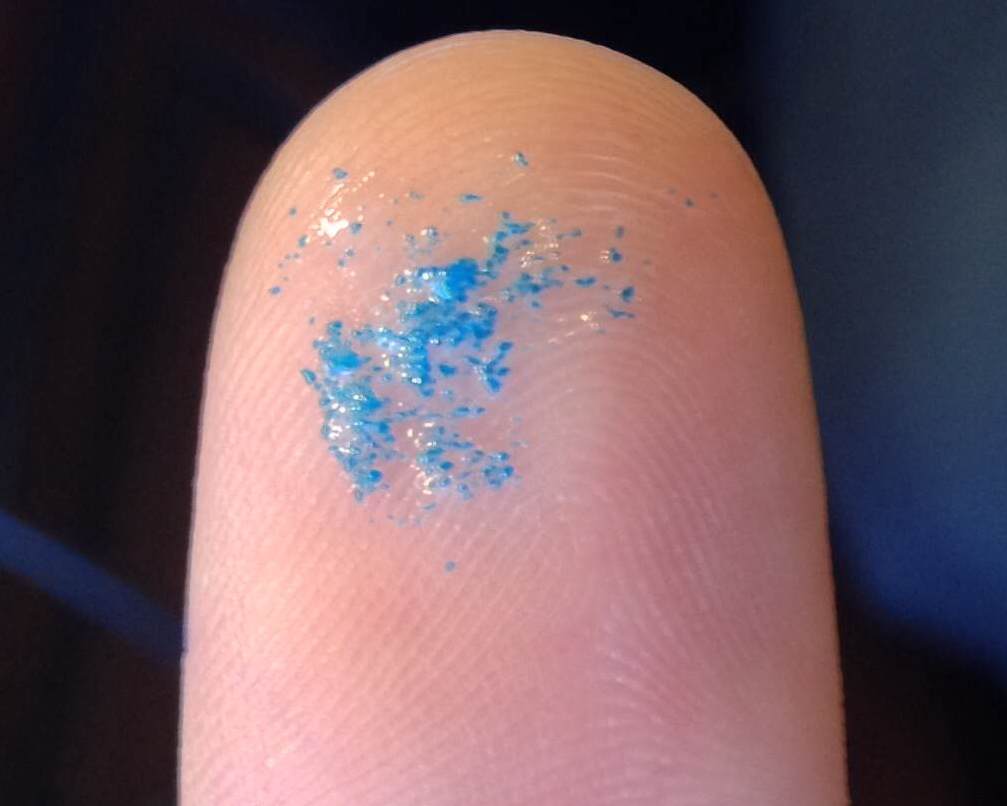
I’m talking about nonbiodegradable microbeads, “barely visible plastic scrubbing grains used in personal care products.” There’s a bill before the state legislature to outlaw them. John Herrick at VTDigger:

Environmentalists and water quality advocates want them outlawed because the non-biodegradable plastic waste is washed down the drain and slips through nearly all of the state’s wastewater treatment plants.

… No studies measure quantities of microbeads in Vermont’s waterways. But scientists who study Lake Champlain say the beads can be spotted along the shores.

Marine animals consume the microbeads, which can cause internal blockages. Scientists also say that toxic pollutants “attach themselves to the plastic beads like a sticker,” and then head up the food chain.

Who the hell thought it was a good idea to put teeny-tiny nonbiodegradable plastic bits into consumer products? Why do Vermont lawmakers have to spend their time debating a bill to ban them?

Well, now you know where regulations come from.

What’s worse, the microbeads are completely superfluous, according to Martin Wolf of Seventh Generation, a Vermont company that uses natural alternatives.

“Microbeads are nonessential. Substances exist that are mineral or biodegradable, perform the same function, and have no meaningful impact on the economics of the products in which they are used,” he told the Fish and Wildlife Committee.

Mike Thompson, who put his soul in escrow to take a job representing the Personal Care Products Council, says “the industry is committed to phasing out microbeads on a timely basis.”

Of course, his definition of “timely basis” may not be yours. The Vermont bill would ban microbeads on January 1, 2017. That’s too fast for Thompson; he wants December 31, 2017, to match a law already on the books in Illinois. And Jim Harrison, the ever-vigilant head of the Vermont Retail and Grocers Association, “prefers a bill that gives retailers time to sell existing inventories.” What, two years isn’t enough?

How many bazillions of microbeads would be flushed into our rivers and lakes during the year 2017? Can’t the industry manage to make the change in two years, instead of three?

Government regulation is, at times, wasteful, inefficient, and counterproductive. The only thing worse than regulation, thanks to the madly-spinning engines of commerce, is no regulation.

Oh, by the way… the carbon tax? It’s dead.

(Note: I’ve updated this post to include more quotes, because the interview is now available online.)

You may have missed the news amid all the hugger-mugger over the inaugural protest, but the Legislature’s top advocate for a carbon tax has already thrown in the towel.

Rep. Tony Klein (D-East Montpelier), chair of the House Energy and Natural Resources Committee, was one of the headliners at last November’s news conference announcing a broad-based push for a carbon tax. “I’m going to push really hard on this,” he said.

Well, that was then. This is now.

There’s not gonna be [a carbon tax] this year. It’s not gonna be passed out of my committee or any other committee.

Klein said those words on January 8, Inauguration Day, in an interview on WDEV’s Mark Johnson Show. I caught the interview when it aired, but it got lost in the Inaugural Shuffle. Sorry about that.

After Klein’s declaration, Johnson asked him why there would be no vote.

It will not pass because, one, the Speaker told me it won’t pass. [chuckle] And two, the way it came out to the public, with a real lack on our part of preparation, there was a pretty scary reaction to it. I accept that; that was a mistake.

That’s a reference to the immediate reaction to the November presser. I’m not sure how he would change the rollout; my own view is that it seemingly came out of nowhere. There wasn’t any build, just a big announcement. At the same time, I’m not sure if any other strategy would have made a difference; too many top Democrats simply don’t like the carbon tax. Well, put it this way: they don’t want Vermont to go it alone: they want a regional or national approach.

Klein concluded:

I’m certainly not going to ask the members of my committee to vote on something that may cause a lot of discomfort, especially if it’s not going to go anywhere.

Which is wise chairmanship. I can’t argue with it. I can’t even argue all that much with Shap Smith’s reputed diktat, because this is already shaping up to be one hell of a session without considering a tax on fossil fuels during home heating season.

It’s too bad, because with oil prices currently low, it’d be a great time to enact a carbon tax. After all, the price of gas is a buck and a half cheaper than it was nine months ago; as proposed in November, the carbon tax would add 45 cents to the price of a gallon of gas. And, lest we forget, 90% of the revenue would go into broad-based tax cuts and targeted rebates for low-income Vermonters.

Klein said his attention would turn toward “aggressive funding” of weatherization and other efficiency measures. Which would be great, except we’re in a budget situation that would seem to rule out “aggressive funding” of anything. If Klein’s committee passes a significant expansion of efficiency measures, we can expect to see it expire on the surgical table of House Ways and Means.

The carbon tax proposal was a carefully-crafted plan that would have minimized the pain on Vermonters, reflected the true cost of fossil fuels in their price, and made a huge dent in Vermont’s carbon footprint. I’m not surprised to see it fall in the face of unpleasant political realities; I’m just sad to see it happen so quickly. Not with a bang, but a whimper.

Senate Natural Resources: Addition by subtraction, at the very least

On Friday afternoon, the white smoke went up the chimney of the State Senate’s College of Cardinals — the three-man (yup, still no women in the club) Committee on Committees* who dole out the committee assignments.

*John Campbell, Phil Scott, Dick Mazza. 

The most closely-watched decision was over the chairmanship of the Senate Natural Resources and Energy Committee. Former chair (ahhhhhh) Bob Hartwell chose not to run for re-election last year; his chosen successor is Addison Democrat Chris Bray.

Hartwell famously cast doubt on the science of climate change last spring in an interview with Seven Days’ Paul Heintz:

“To suggest that mankind is causing the whole climate to shift, that’s a big reach,” he added. “I don’t think anybody’s ever proved that.”

When Heintz pointed out that, in fact, it had been proven by the UN’s Intergovernmental Panel on Climate Change, Hartwell cast doubt on the IPCC’s credibility, accusing it of making “some pretty extreme statements” and claiming the scientific community is divided on the question, which is complete balderdash.

Compare that hot mess to Bray’s position, as reported by VTDigger’s John Herrick:

“Climate change is the largest challenge we face, not just as legislators but as a species,” he said. “There are some pretty discouraging predictions out there about what will happen, but we can’t afford the be paralyzed by that uncertainty.”

That’s better.

The other notable addition by subtraction on Natural Resources is the departure of human popgun Peter “The Formerly Slummin’ Solon” Galbraith, whose main contributions were strident opposition to wind power, a short temper, and frequent grandstanding. Good riddance. He’s effectively been replaced by Brian Campion, Democrat from Bennington, who scored 100% on the Vermont Conservation Voters’ 2013-14 environmental scorecard. 

The other three Natural Resources members were reappointed: Diane Snelling, Mark MacDonald, and John Rodgers. Snelling’s one of the better Republicans on environmental issues, MacDonald is reliable if uninspiring, and Rodgers is one of the worst Dems on the environment; he and fellow Kingdom Democrat Bobby Starr earned a pathetic 38% from the VCV, the lowest scores of any Senate Dem. But without Hartwell and Galbraith, he’ll be a lone voice on the committee.

Bray scored 100% on the VCV scorecard for the last biennium (Hartwell got a dismal 50%); his elevation to the chairmanship is getting positive markers from the environmental community. Paul Burns of VPIRG:

Chris is a very thoughtful, methodical legislator. He considers issues carefully and is receptive to hearing from all sides of an issue. But that’s not to say he doesn’t have his own ideas or vision. He cares a great deal about the environment and he not only believes in climate change, he wants to do something about it.

Those on-the-record views were largely echoed by a Statehouse vet who requested anonymity.

Chris has a strong streak of environmentalism. He is committed to the issues [his committee] will be involved in. He is deliberate, and likes to hear from all sides.

He won’t be a renegade; he’ll be a team player. He won’t cause problems [for Senate leadership]. He’s generally good on the issues; the environmental community should be happy with his appointment.

The enviros’ big worry was that Rodgers might snag the chair, which, given the CoC’s stacking of the 2013-14 committee with some of the worst possible Senators, wasn’t an unreasonable fear. So they’re relieved to get Bray instead. In an ideal world, their favorite would have been Prog/Dem David Zuckerman, but that would’ve been too much to expect from this particular CoC.

Chris Bray’s dedication to environmental issues, and his even temperament, will be tested in the new session. His committee will have to tackle the issues highlighted in Gov. Shumlin’s inaugural — a new renewable energy program for Vermont utilities, and the Lake Champlain cleanup.

His own district is touched by multiple hot-button environmental issues: Champlain, the Vermont Gas pipeline, and the siting approval process for solar arrays. The latter, because the Champlain Valley’s relatively flat landscape makes it desirable for solar. He’ll be torn on the pipeline and solar, since some very vocal advocates are on one side of those issues, and the local business community is on the other. And if he supports Gov. Shumlin’s package of Champlain initiatives, he’s likely to feel some blowback from farmers and developers his district.

He may also be torn between his own environmental beliefs and whatever’s rattling around in John Campbell’s brain these days. We shall wait and see.