Category Archives: Economy

“The Tom and Jeff Show”

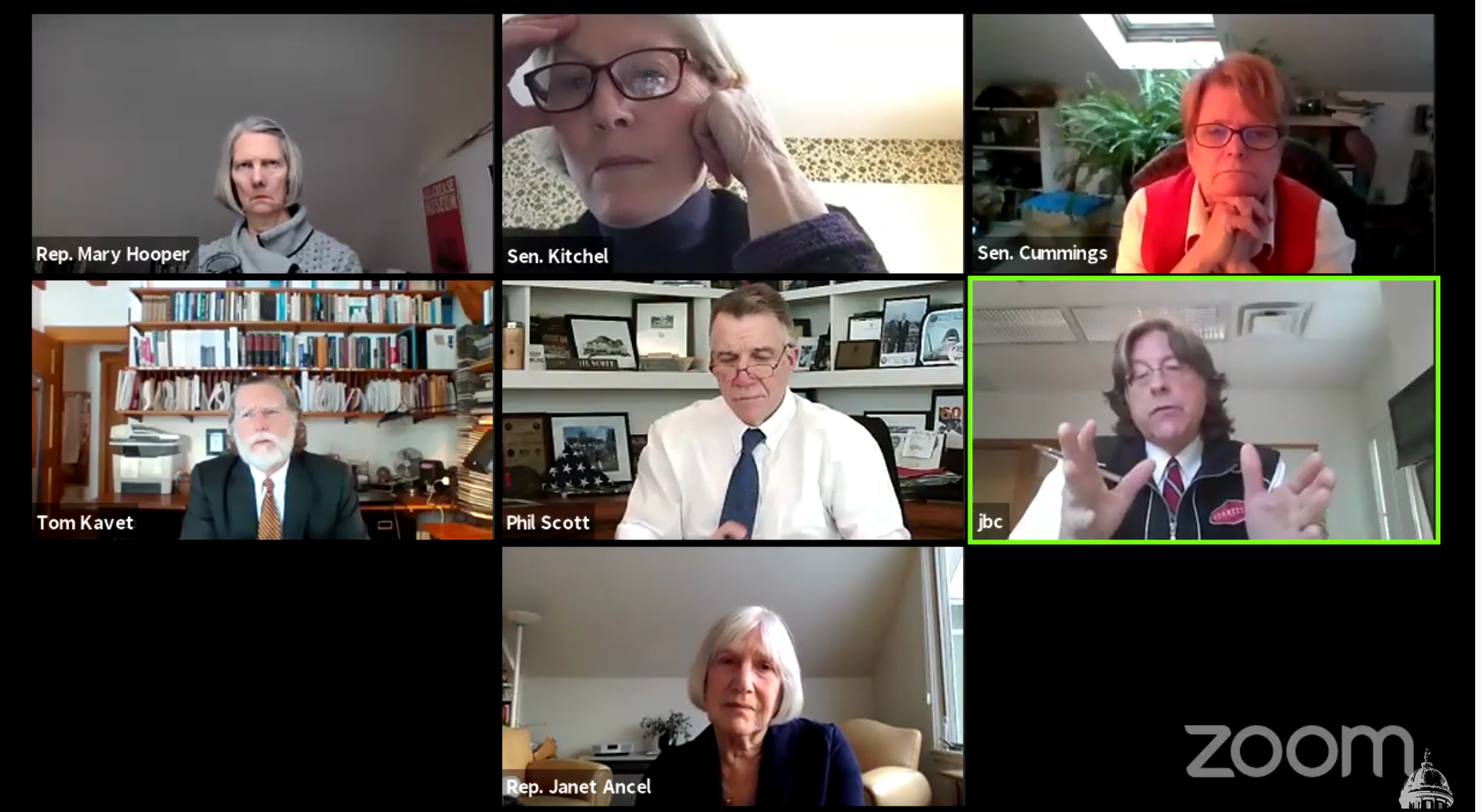
Best: Gov. Scott, great lighting, busy but effective background. Worst: Pretty much everybody else.Extra demerits for “Redshift” Cummings and “Tiny” Hooper.

Vermont’s Emergency Board, an obscure but highly influential entity, held its twice-yearly meeting Tuesday afternoon to receive an updated revenue forecast from state economists Tom Kavet and Jeffrey Carr. Or, as the governor dubbed it, “The Tom and Jeff Show.” (The E-Board includes Gov. Phil Scott and the chairs of the Legislature’s four “money commitees” — House and Senate Appropriations, House Ways & Means, and Senate Finance. All of whom are women, it should be noted.)

Their report is posted as a downloadable file on the Legislative Joint Fiscal Office website. It’s recommended reading; it’s full of economic information beyond the basic tax projections. Video of the E-Board meeting available here.

Considering the pandemic and all, the news is astonishingly good. The new outlook for FY2021 predicts a very slight dropoff in total revenue, about $20M in all. That’s peanuts compared to earlier dire predictions. For FY2022, which begins in July, the new forecast predicts $77M in additional revenue. Carr and Kavet also predict a big increase in revenues for FY2023.

(Now, if you’re concerned about the federal deficit, it’s not all good news. Since 2018, deficit spending has gone from 105 percent of GDP to 135 percent. Covid relief is one driver of the increase; the other is the Trump tax cuts of 2017.)

How can this be? One simple explanation: A tsunami of federal recovery funds. And with Democratic control of the presidency and Congress, Carr and Kavet expect at least one more big infusion. (President-elect Biden has proposed a $1.9 trillion relief package.) So far, federal relief funds to Vermont account for a stunning 20 percent of the state’s gross domestic product.

“Without the federal money, I’d be declaring a five-alarm fire on Vermont’s economy,” said Carr. “We’re all Keynesians now. If we throw enough money at a problem, we can mitigate the damage in the aggregate.”

Continue reading

Ex-Politician Undertakes Research Project; Media Outlet Swoons

Olsen’s treasure trove. (Not Exactly As Illustrated)

Last week, VTDigger posted a curiously lopsided story that trumpeted the intention of former state lawmaker Oliver Olsen to “audit the auditor.”

That would be state auditor Doug Hoffer, who seems to have gotten deeply under Olsen’s skin. The Digger piece went on and on about Olsen’s dim view of Hoffer’s work, cited the views of lawmakers with similar misgivings, and… um… barely quoted Hoffer at all. Nor did it include comments from the many lawmakers who have think highly of Hoffer. It kind of reads like a hit job.

There are two quotations from Hoffer, both apparently taken from emails. In fact, I asked Hoffer if he’d been interviewed by the reporter. “We had no phone conversations at all,” he said. “I had no chance to respond to the allegations [by Olsen].”

Well, that’s Journalism 101, isn’t it? A former editor of mine used to hammer repeatedly on the obligation of reporters to talk to everyone mentioned in a story. That doesn’t seem to be the standard at Digger.

So the article was a little malpractice-y. What about the substance?

Continue reading

Prepping for Disappointment

Well, the incoming leaders of the House and Senate are pouring buckets of cold water on any hopes of a progressive agenda in the next two years.

In some ways, this makes perfect sense. In others, it’s a continuation of the squishy-soft stylings of the outgoing leadership. And that’s disappointing for anyone who was looking forward to the possibility of change.

My former colleagues Xander Landen and Kit Norton have posted a legislative preview, and it’s chock full of Business As Usual — the kind of Democratic strategerizing that’s helped Phil Scott remain governor. Or, shall we say, done little to nothing to draw a clear contrast between Scott and the Dems.

Now, these are extraordinary times. And I have no quarrel with the idea that coronavirus will be first and foremost on the agenda until we’ve vaccinated our way back to normality. The budget alone could occupy the available time between now and adjournment.

So yeah, when Speaker-In-Waiting Jill Krowinski says her top priority is “to bring people together and create a plan of action to beat the virus and it needs to be a recovery plan that leaves no one behind,” I completely agree. Save for the grammatical tic.

But 2022 ought to be a completely different story.

Continue reading

If Doug Hoffer Issues an Audit in the Forest, Does Anybody Hear?

State Auditor Doug Hoffer, whose work is more honored in the breach than in the observance, has released a report that’s critical of the Vermont Economic Growth Initiative.

(Before he sends me a correction, please note that this report is not a formal “audit,” my whimsical headline notwithstanding.)

The report came out one week ago today. You might well have missed it, because it was pretty much ignored by the Vermont media. As far as I can tell, it wasn’t covered by Seven Days or VTDigger or any of our sadly diminished dailies. (The Vermont Business Journal did post Hoffer’s press release on its website without any actual reportage, but that’s about it.)

Which is kind of sad. Hoffer is the chief watchdog of state government, after all. His reports ought to be newsworthy. But the media ecosystem is so diminished that a lot of stuff falls through the cracks.

I also suspect that Hoffer has gotten a reputation as The Auditor Who Cries Wolf, especially when it comes to economic incentive programs. His skepticism runs counter to the conventional wisdom, which is that these incentives are a valuable tool in the box. And that if the state doesn’t offer incentives, it might lose out to all the other jurisdictions that offer incentives.

That conventional wisdom is treated as gospel by the executive branch and the Legislature. Hoffer always gets a polite hearing before the appropriate House and Senate committees, who then proceed to ignore whatever he has to say. And that’s a shame, because Hoffer is a smart fellow with a real dedication to making government run as efficiently as possible. His work should be taken seriously.

Continue reading

When Fact-Checking Fails the Truth

PolitiFact came into existence 13 years ago, with a simple mission: Try to discern the factual basis, or lack thereof, underlying statements and claims from political candidates. Dig through the bullshit, uncover the facts, and determine the truth.

It’s a great idea, but it’s very tricky in practice. It assumes that there is an absolute truth buried under the mountain of political bullshit. But what if there is no such truth? In the political arena, “facts” and “Ideology” are tightly interwoven. For instance, Vermont tends to rank near the bottom of the 50 states, or near the top, depending on what’s being measured. If you tried to determine where Vermont “really” ranks, you’d be dancing into a minefield.

In recent years, VTDigger has been part of the PolitiFact network, generating its own fact-checking pieces in an effort to help voters sort through political statements. Its latest effort, unfortunately, illustrates how PolitiFact-style analysis can lose sight of the truth in its search for “facts.”

In last week’s Digger debate, Lt. Gov. David Zuckerman floated his proposal for a temporary wealth tax aimed at the top five percent of earners — those who reaped the most benefit from the 2017 Trump tax cuts. The revenue would fund one-time investments that, Zuckerman says, would more than pay for themselves in economic growth.

Scott counter-claimed that Zuckerman’s “wealth tax” would reach all the way down to households earning $159,000 or more, which he characterized as “middle class.”

Well, as I pointed out in my debate blog, Vermont’s median income is $60,000, a long way from $!59K. Also, if your definition of the “middle class” reaches all the way up to the 95th percentile, there’s something wrong. Unless you’re saying the “middle class” includes everyone between the fifth percentile and the 95th.

“Think about two teachers, married teachers,” Scott said. But according to a 2019 Digger article, the average teacher salary in Vermont is a touch over $60,000. It’s possible for a teacher to earn $80,000, but it’s very uncommon.

Scott indulged in some misleading rhetoric, in other words. And yet, somehow, Digger concluded that Scott’s argument was “True,” the highest possible rating.

And the headline on the story was the real whopper: “Would Zuckerman’s wealth tax on the top 5% impact the middle class?”

The answer to that question is clearly, unequivocally “No.” And Scott’s claim, as restated in the headline, would properly be evaluated as “False.”

Continue reading

Don’t buy any green bananas

Is anyone feeling confident right now?

You shouldn’t.

Vermont has been spared the worst of the pandemic so far. But even so, we’re dealing with constant uncertainty — and a financial calamity that’s just beginning to be felt.

And every day we’re one step closer to the fall, when coronavirus is likely to hit even harder.

Where do I even begin? Education seems the best place. Educators at all levels, not to mention parents, are furiously trying to develop plans that are subject to change on a moment’s notice. This week, Gov. Phil Scott identified September 8 as the first day of school — but that could mean in-person, online, or most likely a mix of the two. Scott and Health Commissioner Dr. Mark Levine sought to reassure the public that, as Levine put it, “In Vermont, this is the right time to open schools.”

Of course, in the same press conference, Education Secretary Dan French conceded that “This is uncharted territory that acknowledges a considerable amount of uncertainty and anxiety.”

This came a few days after Brigid Nease, superintendent of the Harwood Union Unified School District, posted a letter to her community outlining all the uncertainties and obstacles facing her staff. It’s worth reading, but what struck me was the complete lack of confidence that, even if it was safe to open schools, there may not be enough staff.

Letters of resignation, requests for leaves of absence, Family Medical Leave (FMLA), Emergency Family Medical Leave (EFML), Emergency Paid Sick Leave (EPSL), Exemption status, and leave under the Families First Coronavirus Relief Act (FFCRA) (Which provides up to 12 weeks of leave for employees unable to work because their child’s school is closed) are coming in.

The truth is most school employees are scared to death they will get sick (or worse), bring the virus home to loved ones, have a student in their care become ill, or experience the death of a coworker.

Meanwhile, on the higher education front, colleges and universities are constantly fiddling with their reopening plans — all of which seem to be based on crossed fingers and an unfounded faith in the self-restraint of college students.

Continue reading

A state full of fetishes

FETISH, n. An object regarded with awe as being the embodiment or habitation of a potent spirit or as having magical potency. (Dictionary.com)

The notion of obsessing over, or even worshipping, an object, is often thought of as a sign of primitiveness. Here in the modern West, we know better than to believe a mere object can be imbued with magical powers or even divinity.

Funny thing is, we don’t act that way.

This is true wherever you look. Donald Trump’s wall is a fetish for him and his supporters: If we build it, we will be protected from malign influences. The American flag is a fetish; many value its security above the Constitutional rights it is supposed to represent. Heck, the Constitution itself is a fetish for those who carry it in their pockets but, when they open their mouths, reveal a lack of familiarity with its purpose. As is the Bible.

But here in Vermont, hoo boy, we’ve got ’em in spades. And far too often, our fetish fetish* sucks time and energy away from actually, you know, tackling the real problems we face.

*See what I did there?

Our latest inanimate fixation is a dying maple tree (link to article behind the Valley News‘ paywall), the last vestige of the Ascutney farm owned by Romaine Tenney. When the interstate freeways were being built, his land was in the path of I-91. Tenney repeatedly refused to sell out. When the farm was seized via eminent domain in 1964, he burned down the farmhouse, killing himself, rather than move away.

Only the maple remains. A state-contracted arborist recently concluded that the tree is beyond saving. Due to a local outcry, the state has postponed plans to cut it down and is consulting a second arborist. This isn’t the tree’s first health crisis; as the Valley News reports, “About 10 years ago, cables were installed to stabilize the tree.” Which is a lot of time and expense devoted to an organism with a lifespan that will inevitably end in death.

You know where I’m going with this.

C’mon, folks. It’s just a fuckin’ tree. Let it go. Death with dignity.

Continue reading

The definition of insanity

Doug Hoffer is at it again, pissing in the cornflakes of conventional wisdom. His latest report offers a detailed picture of something we already knew: The value of Vermont’s Remote Worker Grant Program is essentially unquantifiable.

The program offers up to $10,000 to people who relocate to Vermont and work remotely for employers elsewhere. It has generated a ton of publicity and very little in the way of actual returns. Scott administration apparatchiks boast of attracting new residents — a grand total of, um, 110 grantees and 290 new residents.

To quote my favorite comics character, Big Nate: “Whoop-de-dang-do.” That’s basically a rounding error in Vermont’s demographics.

There are other problems with the program’s performance, in addition to the paltry numbers. Almost half the grantees have settled in Chittenden County, which doesn’t need the boost. And the Commerce Agency’s own figures shows that most grantees would have moved here anyway. At best, the grant was only one factor in their decisions, and there’s no way to tell how many of those new residents would have decided against Vermont if the program didn’t exist.

Hoffer also points to the deliberately lax standards for awarding grants, established by the legislature on the principle of “keep it simple and get the money out the door.”

See, we must expect rigorous documentation and enforcement in social service programs, but Heaven forbid we should bother well-educated, white-collar recipients of economic development initiatives. Or businesses that draw on incentives for job training or expansion.

Because pretty much all of Commerce’s highly-touted programs are basically emperors with no clothes. Or, as Hoffer put it, “there is little reliable performance data about some of the State’s largest economic development programs.”

He closes the introduction to his new report with the destined-to-be-ignored clarion call: “When considering funding for Vermont’s economic development programs, we strongly encourage decision makers to take an evidence-based approach.”

Yeah, right. When pigs fly.

Continue reading

Plagiarism is the least significant problem with ACCD report

Ouch, this is embarrassing:

In a report submitted last week to the Vermont legislature, the state Agency of Commerce and Community Development appears to have plagiarized three news stories and used photographs without permission.

Since we’re discussing plagiarism here, let me first disclose that the previous paragraph was written by Seven Days’ Paul Heintz.

The ACCD report was a review of the remote worker grant program — known in the vernacular as the $10,000 giveaway. It offers up to $10,000 to people who relocate to Vermont and work remotely for out-of-state employers. The plagiarized material profiled three recipients waxing poetic about their new lives in Vermont. Large swaths of text were lifted from reporting by Seven Days, CNBC and CNN. It also used photos taken by ace freelance photographer Jeb Wallace-Brodeur without attribution or payment. Which is how a freelancer makes a living, don’t ya know. (Note: ACCD has updated the online version of the report, giving proper credit to the media outlets.)

This is a bad look and an embarrassment for ACCD. And Commissioner Joan Goldstein did herself no favor by labeling the plagiarism as an unintentional “oversight.” (I mean, c’mon, whoever put together the report had to know where the material came from. Someone clearly, knowingly, took an ethical shortcut.)

But in the focus on plagiarism we shouldn’t overlook the meat of the report, which does little to demonstrate the value of the program. Instead, it highlights the program’s inherent flaws.

Continue reading

The Narrow Parameters of Acceptable Debate

So how many political parties do we have in Vermont? Two? Three? Umpteen, if you count Liberty Union and whatever Cris Ericson and Emily Peyton have going on and the Mad Hatter of #vtpoli, H. Brooke Paige?

(I know, he’s a Republican. But any day I can mention Mr. Paige is a good day.)

Well, looking at recent policy debates in the Statehouse, you might just conclude that we have a grand total of one: The Moosh Party. Because on a whole range of issues, there’s little disagreement on the fundamentals; the discussion is confined to the details. At a time when Vermont faces some huge challenges, there’s a complete lack of bold thinking in the executive and legislative branches. We’re All In The Box.

The most basic area of consensus is on state finances. There’s no serious talk of raising taxes, cutting taxes or even significantly reforming our tax system. There’s no serious talk of raising or cutting spending. Streamlining or reforming government seems as unattainable as ever.

(When Phil Scott was running for governor in 2016, he talked a lot about “Lean management” as a way to make government more efficient and free up money to pay for new programs without raising taxes. He rarely, if ever, brings up that idea anymore. His state website touts his PIVOT program (Program to Improve Vermont Outcomes Together, and someone was paid taxpayer dollars to come up with that pukey acronym) but — deep into the third year of the Scott Era — doesn’t cite any cost savings. It does boast of 44 PIVOT projects underway and the training of hundreds of state managers and employees in Lean practices. Which makes me suspect that spending on PIVOT has outweighed any actual savings.)

When times are good and the state is enjoying unexpected revenue, the broad consensus is that we shouldn’t spend it — or at least not very much of it. The Republican governor and the four Democratic money committee chairs are in agreement on that. Except perhaps at the margins.

There’s also broad agreement that the state shouldn’t be borrowing any more money. Remember Sen. Michael Sirotkin’s ill-fated proposal to launch another $35 million housing bond this year? He’s a powerful committee chair, and his idea went nowhere. One of the loudest voices in opposition: Democratic Treasurer Beth Pearce, who’s fiercely protective of the state’s bond rating.

All this broad consensus leaves room only for piecemeal action. Take, for example, the legislature finding $6 million in this year’s budget to boost child-care subsidies. Nothing to sneeze at, but advocates will tell you that it’s a drop in the bucket compared to the actual need — for parents trying to keep their jobs and for child-care workers trying to make a living.

And it’s one-time money. That’s what passes for significant accomplishment in 2019.

Here’s another. Universal broadband is widely seen as a necessity for rural Vermont to become economically competitive. This year, the state enacted Act 79, which produces $1.2-1.4 million per year for broadband grants and creates a revolving loan fund for existing and startup internet service providers. A nice step, but nothing like a game-changer.

Meanwhile, the overwhelmingly Democratic legislature whiffed on three signature issues: paid family leave, minimum wage and a tax-and-regulate system for cannabis. What’s notable about those three, besides the whiffing, is that none of them would have cost the state much money. Paid leave? A new tax. Minimum wage? Employers would foot the bill. Cannabis? Would have brought new revenue to state coffers.

Not even on the table: Climate change, housing, education, the tattered mental health system, economic development, seriously addressing income inequality and health care reform, among others. No effort, through increased state aid or some sort of student debt forgiveness, to confront our affordability crisis in higher education. Nothing to address Vermont’s demographic crisis — except for the Scott administration’s dink-and-doink grant programs that only benefit a handful of employers and workers. On climate change, leaders of both parties acknowledge the crisis and our lack of progress toward established climate goals. But propose or approve a truly game-changing agenda? Not on your life.

Literally.

For years, politicians on all sides have talked about ending our reliance on out-of-state prisons. But actually doing something about it? Spending money on facilities or enacting new programs to reduce the inmate population? Nah.

Any effort to close the ridiculously large and still growing wealth gap, either through boosting benefits or job training or education affordability — or through increasing taxes on top earners? All talk, no action.

Health care reform would seem to be a critical need, considering that the Green Mountain Care Board just approved whopping insurance-rate premiums. But do you hear anything besides the gentle shuff-shuff of hand-wringing? Nope. I think elected officials of all stripes are still scarred by then-governor Peter Shumlin’s disastrous reform efforts. Nobody wants to call that monster out from under the bed.

The biggest exception to this depressing parade of cromulence was Act 76, which establishes a revenue source and administrative structure for waterways cleanup. Nice. But it only came after years of ducking the issue as long as humanly possible — even as toxic algae blooms make an annual joke of our alleged commitment to environmental purity, not to mention killing dogs and maybe causing Lou Gehrig’s Disease.

And action only came under threat of federal intervention. Yep, we can thank the Trump EPA for forcing Vermont to clean up its water.

This around-the-middle consensus isn’t only frustrating for those on the left. It’s got to be just as galling for conservatives, who believe the answer to Vermont’s problems lies in cutting taxes, spending and regulation. You’re not getting any of that from Team Scott, much less the legislature.

It’s funny. Vermont is widely seen as bluer-than-blue Bernie Country. But our current crop of elected leaders is comfortably at home in a narrow band of non-threatening incrementalism.