Category Archives: Campaign finance

Tomorrow’s a big day

March 15 is a crucial day for us Vermont Political Observers, capitalized and otherwise. Not only is it a potential make-or-break for Bernie Sanders, but it’s a deadline day for campaign finance reports from state candidates. And because of Vermont’s relaxed campaign finance law, it’s the first deadline since last July — an eternity in politics, especially in a campaign season that started so darn early.

We will, of course, be watching the primary returns from Florida, Ohio, Illinois, Missouri and North Carolina. I expect Bernie to do better than predicted, as he almost always does; but not well enough to close the delegate gap with Hillary Clinton. The Michigan win, nice as it was, did virtually nothing to close that gap. Hillary’s won a bunch of states by one-sided margins, thanks largely to her yooooge advantage with the black electorate; in order to catch up, Bernie has to not only win a bunch of states — he has to dominate them. That would require some kind of massive unforced error by Clinton, or some kind of unexpected and decisive bad news that would hurt Clinton and help Sanders.

The statistical website FiveThirtyEight has a formula for keeping track of how candidates are faring in the hunt for delegates. It sets a delegate target for each candidate in each state. Right now, it shows Clinton beating her target by nearly a hundred delegates — not including superdelegates. Bernie’s almost a hundred below his target.

Bernie’s Michigan victory netted him a mere seven delegates. He’ll have to pick up that pace substantially and very quickly.

Continue reading →

Protip: If you’re opening a china shop, don’t invite a bull

I don’t know whose bright idea it was to invite the former Most Hated Man in the Senate to Matt Dunne’s news conference on corporate campaign contributions, but apparently it worked out about as well as you might suspect.

In other words, as Seven Days’ Paul Heintz tells it, Peter Galbraith pretty much hijacked the affair.

Galbraith has been a longtime opponent of corporate contributions, having repeatedly proposed a ban during his time in the Senate. Which always seemed more than a bit disingenuous to me, since Galbraith had the resources to self-fund his own campaigns to his heart’s content. In his first bid for the Senate, he put more than $50,000 into his campaign, which was far, far more than any other candidate could have hoped to raise.

(He was the rare diplomat who returned home a very rich man, thanks to his connections with the Kurds and their oil-funded generosity. Indeed, he’s probably the closest thing Vermont has to an oil magnate.)

Galbraith has been musing about a run for governor. I don’t know if Dunne harbored some faint hope of co-opting him, but it sure didn’t work out that way.

You take your life into your hands when you get between Peter Galbraith and a TV camera. So when you invite him to a press conference, you’d best expect that bull to break a few dishes. Dunne, according to Heintz, wore a “somewhat pained expression” as Galbraith went on at length on his own favorite subject — Himself — and whether Himself would deign to run for governor.

Repeatedly. With barely-concealed barbs for the man who had invited him.

Continue reading →

Plausible deniability and the $10,000 envelope

Kudos to Seven Days’ Paul Heintz for a good old-fashioned piece of outrage journalism, a nearly lost art in these days of objectivity fetishism. The object of his scorn: the woefully incomplete “investigation” of Attorney General Bill Sorrell’s demostrably squicky campaign finance shenanigans. (In the interest of self-promotion, here’s a link to my take on the story.)

The whole column is strongly recommended, but I want to highlight one passage — and then It’s Story Time, Kids!

To set this up: In December 2013, Sorrell had dinner with a couple of high-powered lawyers, Mike Messina and Patricia Madrid, who had previously donated to his campaign fund. Take it away, Paul:

“Just before sitting down to dinner, Mike gave me an envelope saying that he and the attorneys from the Texas firm [Baron & Budd] wished to contribute to my campaign for reelection,” Sorrell wrote in the affidavit, which has not been previously disclosed. “I thanked them and accepted the envelope.”

Tucked inside were five checks totaling $10,000 for Sorrell’s reelection campaign.

During the dinner, Sorrell wrote, Messina and his friends “suggested they would come to Vermont at a future date to discuss the possibility of Vermont suing the oil and gas industry, if I was interested.” Baron & Budd has made millions for itself — and the states and municipalities it has represented — by suing the industry over its use of the gasoline additive MTBE.

After Messina handed Sorrell the checks, his clients handed the AG “a folder or manila envelope” containing information about Baron & Budd and a memo touching on “the specifics of relevant Vermont law.” Sorrell trucked it back to his office, gave it to an assistant attorney general and asked him to check with the Agency of Natural Resources to “discuss the possibility” of suing.

Within months, Sorrell’s office had filed suit and hired four firms — including Baron & Budd and Messina — to serve as outside counsel, guaranteeing them a percentage of any money recouped.

The “affidavit” referenced above is a sworn statement provided by Sorrell to independent investigator Tom Little.

Sorrell’s attorney argues that this does “not equate to a quid pro quo arrangement.” Which is downright laughable. But as Heintz notes, Sorrell “practically admitted to the crime” of trading state contracts for political donations.

And now, It’s Story Time.

Continue reading →

Sorrell gets the wet noodle

Scoop of the week award goes to Neal Goswami of the Vermont Press Bureau, for snagging himself an advance copy of the independent investigator’s report on Attorney General Bill Sorrell.

The topline is that Sorrell was exonerated.

The reality is not nearly so simple.

There were six accusations against Sorrell. On two of them, investigator Tom Little found no evidence of wrongdoing. On two others, Little admonished Sorrell for coming uncomfortably close to “crossing the line.”

As for the final two, Little concluded that they were outside the scope of his investigation.

Whaaaaaaaat?

Tom Little was appointed on May 7, 2015. Today is January 22, 2016.

Eight and a half months.

Couldn’t he have told us a bit sooner that he wouldn’t be investigating two of the six counts?   When exactly did he reach that conclusion?

Also, who outlined the scope of Little’s investigation? Well, we know the answer to that: he was appointed by Governor Shumlin. But was it written in a way that excluded certain areas of inquiry?

We were promised a complete investigation of Bill Sorrell’s activities — and that’s not what we got. 

And I think Tom Little, whose investigation was taxpayer-funded, owes us an explanation.

Continue reading →

No room for Lisman

Phil Scott’s campaign launch may have been underwhelming from a rhetorical and policy perspective, but it was a damn fine show. Production values rarely seen in Vermont politics, a large crowd of Republicans desperate for a winner and giving their full-throated backing to Scott.

The crowd was impressive not only for its size, but for its heft. Numerous officeholders and party officials, most of the state committee, a whole lot of significant donors, and the VTGOP’s Mr. Everything, Jim Douglas.

If the event wasn’t specifically intended to discourage Bruce Lisman, it must have had that effect. He was boxed out like the Lions’ secondary on that Aaron Rodgers Hail Mary*. Looking at the crowd and all the big names, and feeling the enthusiasm, you have to wonder how Lisman can possibly make a race of this.

*We Michiganders have an acronym for that: SOL. “Same Old Lions.”

There’s only one chance: to throw open his checkbook and try to whomp up a movement with the sheer power of his money.

Continue reading →

Vermont’s public financing system is worse than useless

Before this year, our mechanism for public campaign financing was woefully limited and seemingly designed to discourage potential candidates. The excessive and punitive rules resulted in the only person ever to gain public financing, Dean Corren, facing an overzealous prosecution by Attorney General Bill Sorrell, our deeply tainted Guardian of Electoral Purity.

But that’s the good news.

The bad news is, the whole system has suddenly become a cruel joke. It’s so bad that unless the Legislature can bring itself to enact a simpler, more generous process, I’d just as soon they kill the thing. In its current state, it’s an insult to the very ideals it purports to uphold.

Continue reading →

The Progressives are kinda screwed

Whiter the Progressive Party? I don’t know; there isn’t a clear path forward, and obstacles litter the landscape. They’ve gained strength in the legislature, mainly by running candidates on the P/D or D/P tickets; but they’ve just about reached the limits of that tactic, and may have hit a glass ceiling.

The Progs are anxious to make a splash in 2016, having sat out the last three gubernatorial elections in order to give Peter Shumlin a better shot at creating a single-payer health care system, hahaha. His abandonment of that goal, barely a month after his third re-election victory, plus the Dems’ habit of triangulating to the center on a host of issues, has left the Progs in a bitter mood. They’re itchin’ for a fight, and would especially like to field a credible candidate for governor.

That’s looking increasingly unrealistic. For starters, nobody seems to want to run.

This is an unintended side-effect of the Prog/Dem strategy, which has put several Progs in positions of legislative influence. Examples: Tim Ashe chairs the Senate Finance Committee; Anthony Pollina has a bully pulpit in the Senate; organic farmer David Zuckerman is vice chair of the Senate Agriculture Committee; and Chris Pearson is vice chair of the House Health Care Committee. One could argue that the Progs have been granted more influence than their sheer numbers would warrant. Or, in the words of Lyndon Johnson, the Democrats saw it’s better to have the Progs inside the tent pissing out, than outside the tent pissing in.

And indeed, it’d be hard to give up that level of influence to make a long-odds, short-funded bid for higher office.

Compounding the difficulty is that any high-profile Progressive would likely depend on public financing. That was a difficult enough pursuit in previous years (just ask Dean Corren or John Bauer). Now, it seems to have become completely untenable.

Continue reading →

Sorrell vs. the record, part 2: Campaign reimbursements

Sorry for the delay in this continuing series; it’s tough work, slogging through a solid hour of Bill Sorrell. He is remarkably inarticulate for such a prominent figure.

SorrellDoggAnyway, I’m taking a closer look at Our Eternal General’s comments in an interview
with VTDigger’s Mark Johnson. I think it’s worthwhile because this was the first time Sorrell has been quizzed at length about allegations of campaign finance funny business and excessive coziness with high-powered lawyers soliciting state contracts.

Part 1 compared Sorrell’s remarks with the public record about the MTBE lawsuit. Today, we turn to Sorrell’s fuzzy reporting of expense reimbursements by his campaign fund to himself.

The matter was raised last spring by Seven Days’ Paul Heintz:

Several times a year, candidates must publicly disclose each campaign expenditure they make, “listed by amount, date, to whom paid, for what purpose,” according to state law.

A review of Sorrell’s recent filings shows that he has routinely ignored the rules. Sixteen times over the past four years, Sorrell’s campaign has reimbursed him for hundreds, and sometimes thousands, of dollars’ worth of expenses paid out of his own pocket. In each instance, the campaign provided only a vague explanation of what Sorrell bought with the campaign cash — and never once did it disclose who it paid.

Sorrell’s response: Hey, a lot of people do it that way.

Continue reading →

Milne for Senate?

Curious item landed in my inbox this morning: an email from Scott Milne.

Well, not a personal email — it was a blast message to his mailing list, entitled:

Scott Milne challenges Pat Leahy to get money out of politics.

The message slams Leahy for holding a fundraising event over the weekend, at which attendees were (according to Milne) charged “$5,000 for face time with Vermont’s senior Senator.” Milne compares this unfavorably with Leahy’s predecessor, St. George Aiken, who “spent $17.09 on his entire last campaign for the Senate in 1968 [and] spent a total $4,423.03 for all six of his U.S. Senate campaigns combined.”

Well, in 1968 Aiken occupied both the Republican and Democratic slots on the ballot, and managed to win re-election with, ahem, 99.9 percent of the vote, which makes me think he wasted seventeen bucks. The bulk of his career took place when the GOP absolutely ruled the roost in Vermont. But I can just hear Milne say, “Leahy is as bulletproof as Aiken; why raise money at all?” To which Leahy would reasonably reply, “In politics, you never know.” Especially since conservative groups have begun to spend money on Vermont elections. It’s only prudent for Leahy to build up a warchest.

But the biggest question raised by Milne’s email is simply, Why? Why is he attacking Pat Leahy?

If this were any politician not named Scott Milne, the answer would be obvious: he’s going to run for U.S. Senate. In Milne’s case, it might simply mean he got out of bed this morning and decided to write a letter.

Continue reading →

The Eternal General bows to the inevitable

It only took him about five months to figure it out, but Bill Sorrell finally announced today that he will not seek an eleventy-billionth term as Vermont’s Attorney General.

The end has been obvious to all since the early May appointment of former State Rep. Tom Little to head an independent investigation of Sorrell’s illegal (or at least thoroughly squicky) campaign finance activities.

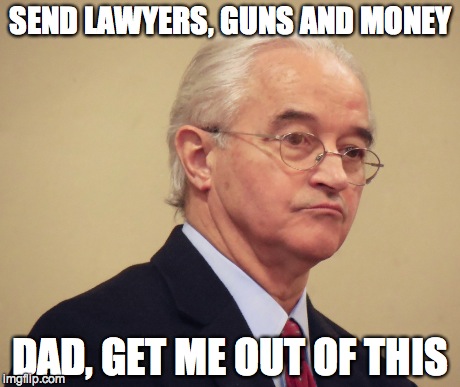
SorrellZevonReally, the end has been all but obvious since Sorrell’s disastrous decision last March to throw the book at Dean Corren for an insignificant-at-best violation of the public financing law. Sorrell had alienated a lot of people over the years with his overzealous prosecution of campaign finance law and his underzealous pursuit of just about everything else in his purview. L’affaire Corren left him friendless in Montpelier and in Democratic and Progressive circles (he long ago lost the Republicans), with the possible exception of Sorrell’s political godfather, Howard Dean.

Today, the end came not with a bang, but an emailed whimper. Paul Heintz:

For a man who has spent much of his adult life in public service, Sorrell made his announcement in a remarkably low-key fashion. Rather than holding a press conference, he delivered the news in a terse, five-sentence statement emailed to reporters Monday afternoon.

Unsurprisingly, he couldn’t see any advantage to be gained from taking questions at his own political funeral.

Continue reading →