Category Archives: Business

Small business should beware of joining the corporate army

A while back, I proposed that Vermont’s small retailers ought to open their own interest group. I suggested the Vermont Association of Independent Retailers, or VAIR for short.

The idea came to me while reading about their putative Montpelier representation, the Vermont Retail and Grocers Association, helmed by the very effective Jim Harrison. One of his favorite techniques is to bring some mom-and-pop types to the Statehouse whenever there’s legislation that might touch on retail interests, such as the proposed sugary-beverage tax.

Truth is, Harrison gives a lot of lip service to the little guy, but his real clients are in Big Retail — the WalMarts, Hannafords, and Dollar Generals of the world. And quite often, the interests of Big Retail are at odds with what’s best for small business. Guys like Harrison draw a stark divide between the private sector and government; in fact, the real divide is frequently found between big retail and small. I would ask this of real independent retailers: which is the biggest threat to your existience? A change in state regulations, or the big boxes and dollar stores springing up all over the place?

This is also true in the broader business world. And in that field, there’s a thousand-pound lobbying gorilla called the National Federation of Independent Businesses, or NFIB. Which has a Vermont branch, helmed by veteran corporate lobbyist Shawn Shouldice. (Who also, I can’t help but note, does PR for Bruce Lisman.)

The NFIB sounds like a joint effort of all the mom-and-pops. It bills itself as “the voice of small business.”

Well, it’s not.

Continue reading

Gannett chief preps golden parachute

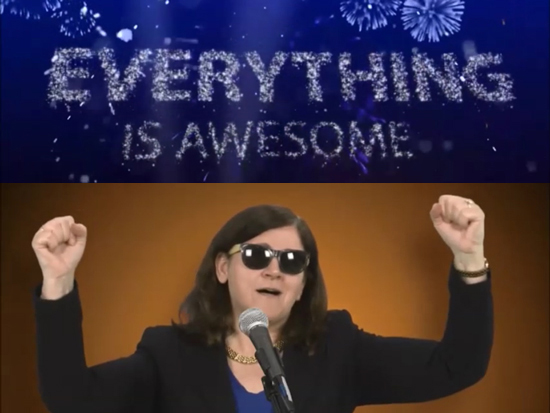
Everything is awesome… when you've just made four million smackeroos.

Everything is awesome… when you’ve just made four million smackeroos.

Gracia Martore, CEO of Gannett, last seen disgracing herself in an unbelievably wrong-headed music video, must really believe in the future of her company.

Because she just unloaded more than 80% of her stock holdings in Gannett. American Banking & Market News reports that Martore sold 123,560 shares of stock in the Burlington Free Press’ parent company, leaving a mere 30,034 shares in her portfolio.

Her take? $4,312,244.

How many reporters would that buy?

Her stock dump comes just before the planned split of Gannett’s newspaper and TV/digital divisions. Gannett will retain the troubled publishing businesses, while new entity TEGNA will get all the broadcasting and digital stuff.

The spinoff is expected to take effect by the middle of this year, which is… hmm… checking my calendar… a mere six weeks away.

And where do you think the price of Gannett stock is going to go, after all its goodies are under a new corporate umbrella? I think we know how Gracia Martore would answer that question.

Keurig Kold: If there’s a market for this, my faith in humanity takes another hit

Been an interesting week for homegrown planet-bespoiler Keurig Green Mountain. First, the maker of costly coffee pods had to do an embarrassing about-face on its decision to DRM-up its new coffee maker. It was a capitalistically noble effort to derail competition for its profitable (and planet-bespoiling) K-cups, but consumers rebelled.

Understandable. It’s kinda like if oil companies made cars, and DRM’d the tank so you could only buy their brand of gas. Consumers would naturally rebel. Or, here’s an even more insane one: it’s as if you could buy a printer dirt cheap, but then had to pay extortionate prices for cartridges.

Oh wait.

Anyway, embarrassing walkback for KGM. But help is on the way, in the form of its new cold-beverage system. Er, “kold.”

Keurig Kold, set to launch this fall, was developed in a partnership with Coca-Cola, Keurig’s largest shareholder, and the Dr. Pepper Snapple Group. Keurig CEO Brian Kelley said the new machine will make a Coke, and other beverages, indistinguishable from the originals.

The magic behind the Keurig Kold: its patented Karbonator system. Ah, the Keurig Kold Karbonator, or “KKK” for short. What could go wrong?

Continue reading

Rent-to-own: Fixin’ a hole

This morning, I sat in on a House Appropriations Committee hearing on S.73, a bill that would set limits on the rent-to-own industry — an industry that’s virtually unregulated and preys on cash-poor Vermonters.

For those unfamiliar, RTOs offer household furnishings and appliances with very little cash up front, but interest rates that’d make a banker blush. Not to mention undisclosed fees and charges. According to Legislative Counsel David Hall, current state law gives the Attorney General rule-making authority; but RTOs write their contracts in a way that effectively puts them beyond the reach of current law.

Hey, I’m sure that’s just a coincidence.

The result is a Wild West marketplace that, according to VPIRG, results in consumers “paying many times the original price of the original item- far more than they would pay if they purchased the item from a traditional retail establishment.”

The bill would establish price caps and disclosure requirements on the industry.

Continue reading

A modest proposal for Mom and Pop

A Republican lawmaker said something dumb this week.

I know, I know. Stop the presses, right?

Rep. Ronald Hubert, R-Milton, who owns a retail business, said between 10 and 12 “mom and pop stores” are closing every year because of state mandates.

Mmmm. And you know this how, exactly? Did the 10 to 12 mom and pops check the “Burdensome State Regulations” box on their mandatory “Reasons for Closure of Small Business” forms?

Now, I have no trouble believing that a dozen “mom and pop stores” are closing every year in Vermont. There’s a natural attrition among small businesses. But aside from that, our hardy moms and pops are under siege — not from state regulations, but from big chain retail. I’ll be you dollars to Maple Glazed Koffee Kup Donuts that the single biggest threat to mom-and-pop retail is the rapid proliferation of Dollar General stores that offer a full range of groceries as well as aisles and aisles of cheap plastic crap.

Which brings me to my modest proposal. Continue reading

Here’s another thing for Jim Harrison to get peeved about

Well, the folks behind the paid sick leave bill — the one that made it partway through the last legislative session before flaming out under pressure from business lobbyists — are back for another round. The Healthy Workplaces Bill, H.187, is up for committee hearings this week.

Darn. Just when Jim Harrison was getting over a House committee’s passage of a very watered-down version of the sugary beverage tax. He seemed to take the very idea as a personal affront, at one point telling the House Ways and Means Committee “I can’t believe you’re talking about this.”

Harrison, for those just joining us, is the cagey and influential chief lobbyist for Vermont grocers and retailers. He’s the one who prattles endlessly about small retailers, but whose salary is largely paid by the big chain outfits that are, in reality, the worst threat to small retail. Far worse than a marginal tax increase or a modest enhancement of workers’ rights.

This year’s version of the paid sick leave bill has been watered down a bit, in an effort to assuage the business community’s concerns. H.187 would set a minimum standard for earned sick time for all Vermont workers. The minimum would be three days per year in the first two years after the bill’s passage, increasing to five days per year thereafter.

As the bill’s backers point out, roughly 80% of Vermont workers already have access to paid time off. Most of the remainder are working low-paying jobs in sectors like retail, food service and home care. Most of those jobs are filled by women, and many of those are working mothers.

Yeah, the women get the short end of the stick. Again.

I expect Jim Harrison will pull his long-suffering act and squeal about how this bill would hurt his members.

C’mon, Jim. It’d pinch your members a little bit in the short run*, but it’d benefit your workers tremendously. And it’s been shown in states with such laws, that worker productivity and morale increase. It’s actually good for business to have employees who aren’t constantly at wits’ end over their family responsibilities.

*It’d hurt small retailers the least. It’d be more inconvenient for big-box stores, chain retail and franchise operations because they have more workers. And those are the people who call Harrison’s tune.

Harrison and his ilk notwithstanding, H.187 actually has substantial support in the business community. Advocates are aiming to gain House passage this year and go for the Senate in 2016.

This is a good idea with very little downside. The costs to business are minimal, and the social benefits are far greater. Hey, let’s do this.

VEGI: A step in the wrong direction

Sometime this week, the state senate will take up S.138, an economic development bill that includes a taxpayer-funded incentive for businesses to create crappy jobs.

Tough assessment? I don’t think so. The bill allows employers to pay its workers less and still qualify for state job-creation incentives. Currently, cash awards from the Vermont Employment Growth Incentive program (VEGI) require that employers pay at least $14.64 per hour. S.138 would lower that minimum to $13.00 per hour — the Joint Fiscal Office’s standard for a “livable wage.”

Well, that’s the livable wage with significant caveats. VTDigger’s Erin Mansfield:

The $13 per hour figure assumes two adults living together in a two-bedroom home, who share expenses, have no children, and have employers that pay 80 percent of health insurance costs.

Problem: that description doesn’t apply to an awful lot of working Vermonters. The consequence: those state-funded jobs leave full-time workers poor enough to “qualify for thousands of dollars in annual assistance,” according to economist Tom Kavet in a report to the legislature’s Joint Fiscal Office.

So we’d be paying companies to put workers on public assistance. This is… progress?

The downward expansion of VEGI is “expected to cost the state between $10 million and $25 million.” Your Tax Dollars At Work.

Kavet’s report leaves no doubt about the dubious value of that public investment:

The Shumlin administration’s plans, Kavet said, “serve to diminish the public return on investment from this program by lowering standards, eliminating basic fiscal controls, or allowing public subsidies when they would not previously have been allowed.”

Commerce Secretary Pat Moulton defends the proposal with the kind of language you usually expect to hear in Texas or Mississippi:

Moulton said she would rather employ a Vermonter at $13.50 per hour than let the jobs go elsewhere. Employees can move up from lower-paying jobs, she said.

“We’re competing globally for jobs. We’re competing regionally for jobs,” Moulton said.

I understand the harsh economic realities of our troubled times, but if you ask me, this is a bad idea. I don’t want my tax money being spent to underwrite dead-end jobs. And I’d love to know what kind of corporate lobbying went into this ill-considered proposal.

The Kingdom EB-5: Spiders in the attic. Lots of ’em.

About 15 years ago, a retired military man appeared in Dover, New Hampshire with an audacious plan: he had a revolutionary design for midsized passenger aircraft, and he was going to start a company — Alliance Aircraft — to build them. He claimed to have solid interest from some of the world’s major air carriers, and he planned to build a factory in some underutilized mill buildings in the middle of town. Good jobs, economic activity, what could be better?

At the time, I was a reporter/anchor for New Hampshire Public Radio, and I did a story about the project. At first everything seemed ideal, but the more I looked into it, the shakier it became. When I talked to experts in aviation and finance, I learned that this guy wasn’t especially well known and that it’s harder than Hell to launch a successful startup in a capital-intensive field like that.

My report raised questions about the project’s viability and public officials’ enthusiastic embrace of same. In the end, Alliance Aircraft fizzled out. No plant, no planes. Mind you, it wasn’t a scam; the head guy was a true believer. There was little or no public investment involved; the project didn’t even get that far.

Which brings us to today in the Northeast Kingdom. If you haven’t read VTDigger’s latest story about Bill Stenger’s EB-5 project, go and do so. It is a must-read.

The story by Anne Galloway focuses on AnC Bio, the biotech facility planned for Newport and funded by EB-5 investment — the federal program that gives green cards to foreign investors who put money into job-creating projects that would otherwise go unfunded. And the story is so full of authentic jaw-dropping “Holy Shit” moments that my mind was drawn back to the halcyon days of Alliance Aircraft.

I’ll recount some of the lowlights here, but please do yourself a favor and read the whole thing. It’s lengthy, but worth your time.

— AnC Bio Vermont is partnered with AnC Bio Korea, which has developed some promising products but has also been in severe financial straits for several years. How severe? Try “its headquarters was auctioned off in 2012” severe.

The Vermont firm is a separate corporation, but it’s entirely dependent on the Korean company for the intellectual property that would be the lifeblood of a Newport plant.

— Stenger’s group said nothing about AnC Bio Korea’s difficulties in its filings with investors or its communications with the state. Galloway: “State officials… weren’t aware of AnC Bio Korea’s problems until in the course of their own research in May 2014, they learned that the Korean headquarters had been sold at auction to satisfy banks and other creditors.”

— After learning of the Korea mess, the state ordered the Stenger group to cease any communication with investors about the Newport plan. This order was ignored. Thanks, Bill.

— Here’s a biggie buried deep in the story. The proposed site of the factory (plus 18 nearby acres) was purchased in 2011 for $3.1 million by a corporation owned by Stenger’s partner Ariel Quiros. Part of the land was sold to the EB-5 consortium, little more than a year later, for $6 million. That’s a tidy profit for Mr. Q. He’d profit even more if the plant is built and his 18 acres are adjacent to a booming factory.

— AnC Bio has yet to seek or receive FDA approval for any of its products, usually a lengthy process. Stenger: “…the FDA approval of products and services will in part be facilitated by the completion of the building.”

Cart before the horse, Bill?

I could go on, but you can read it all at VTDigger. Suffice it to say that this reeks eight ways from Sunday. And beyond the potential implications for the company, its investors, and the city of Newport, this could blow up big-time in Governor Shumlin’s face. He’s been Head Cheerleader for the Stenger projects, frequently traveling overseas to help Stenger and Quiros court investors. His administration set up a conveniently Stenger-friendly regulatory mechanism.

Not to mention that Shumlin’s former right hand, Alex MacLean, was working with the Stenger group through much of this troubled time. If she wasn’t pipelining information back to the administration about all this, she certainly wasn’t doing her political mentor any favors.

If the Newport project implodes or suffers any of several extremely realistic setbacks, it will be another black eye for Peter Shumlin’s tattered reputation for good management. A largely self-inflicted black eye, at that; he didn’t have to identify himself so closely with this project. But he got stars in his eyes, and he may well pay a heavy price.

The nice and the necessary

Congrats to the House Republican Caucus, which finally came up with something like a budget plan, on the very day the House Appropriations Committee passed a budget. Three observations to begin:

— The committee vote was 11-0. Even so, the Republicans were lambasting the budget even before the vote was taken. Are the committee’s Republican members hypocrites, or is it harder to be a simple-minded partisan when the rubber hits the road and you’re in a small room with your Democratic colleagues, than when you’re facing the camera with fellow Republicans?

— The Republicans clearly didn’t take the budget-writing process very seriously, since they waited until Approps had finished its work before offering a single specific cut. Even worse, during the process Republicans frequently objected to cuts proposed by Democrats — again, without suggesting alternatives.

— The Republicans’ budget plan is unworkable on its face. Its major initiative is a call for zero growth, but that’s (a) impossible because some programs are growing, like it or not (Lake Champlain cleanup, for instance), and (b) an abdication of the Legislature’s responsibility to draw up a budget. The responsible course, as Approps chair Mitzi Johnson has pointed out, is to fulfill the legislature’s duty and make the hard choices. Across-the-board slashing is the coward’s way out.

The GOP caucus did identify some cuts they’d like to make — finally. Most of them are short-sighted as well as mean-spirited:

The cuts [House Minority Leader Don] Turner put on the table Monday include eliminating grants to substance abuse recovery centers, scrapping a childcare subsidy for poor mothers, cutting funding for state colleges by 1 percent, and taking $5 million from a fund that would otherwise provide college aid to Vermont students.

Republicans also say spending reductions on items such as the renter rebate, financial assistance for health insurance and the Vermont Women’s Commission are preferable to increasing revenues that would otherwise be needed to fund levels recommended for those programs in Gov. Peter Shumlin’s budget.

Okay, let’s make it harder for addicts to get clean, harder for poor mothers to hold down a job, make higher education less affordable, and make health insurance less accessible. All those cuts would save money in the short term, but cause even more expensive social damage in the long term. The Democrats are trying to walk a fine line, and craft a budget that’s not fiscally irresponsible while still helping to make Vermont a better place to live.

Which brings me to something that Senate Minority Leader Joe Benning said last Friday on The Mark Johnson Show. I don’t have the exact quote, but the gist was, “There are things that are necessary, and things that are ‘nice.’ At a time like this, we cannot do the things that are ‘nice.'”

That sounds good and responsible, but the devil is in the definitions.

Do you think low-income heating assistance is nice or necessary?

How about broadening access to health care? A social obligation, or an extra?

Let’s talk substance abuse treatment, at a time when Vermont is in the throes of an addiction epidemic. Necessary or nice?

The good Senator apparently believes all these things fall into the “nice” category. Many of us don’t agree.

Okay, now let’s look at some items that aren’t on the Republican cut list — and weren’t on the Democrats’ either, for that matter. Necessary or nice — you make the call!

— The state giving $2.5 million to GlobalFoundries, a move that will do nothing to keep the company in the state. On a worldwide corporate scale, that’s nothing. It amounts to a burnt offering meant to propitiate the corporate gods. And it takes a big leap of faith to think it’ll have any effect whatsoever. Necessary?

— The state continuing to let unclaimed bottle deposits go to bottling companies. That’s a $2 million item, I’ve been told. Is that a necessary giveaway? Hell, I wouldn’t even class that one as “nice.” “Noxious” is closer to the mark.

— When ski resorts purchase major equipment, they don’t have to pay sales tax. That’s another $2 million a year. Is that necessary, in any definition of the word?

— For that matter, we’re letting the ski industry make a fortune thanks in large part to bargain-basement leases of public lands. The industry is understandably loath to reopen the leases, but there are ways to get it done. Instead, we’re letting them ride. Necessary? Hell no. Nice? Only for the resort owners.

— Vermont is one of only a handful of states that exempts dietary supplements from the sales tax. Nice or necessary?

In addition, the state gives quite a bit of money in small grants to private and corporate groups. Here’s a few examples:

— The Vermont Technology Alliance gets a $52,250 grant. Why?

— The Vermont Captive Insurance Association gets $50,000 to pay for “promotional assistance.” I realize the industry is a strong positive for Vermont, but the grant is certainly not necessary.

— The Vermont Ski Areas Association gets $28,500. This is the same group that refuses to reopen the leases. Why are we rewarding their intransigence?

That’s just a few I happen to know about. I’m sure there’s lots more. Are grants to industry “necessary” or “nice”? If we’re asking the poor and downtrodden to take major hits to the social safety net, couldn’t we ask our industries to accept at least a haircut?

And if we want to promote business in Vermont, why not take back all these penny-ante grants, put part of the money into a coordinated statewide campaign (like the one proposed by Lt. Gov. Phil Scott’s economic-development crew) and bank the rest?

Also, the state Senate is considering a bill that would make Vermont’s economic development incentives easier to access. Supporters, such as Republican Sen. Kevin Mullin, posit the bill as an investment in Vermont’s future. 

Which is fine. But so is increasing access to higher education, providing child care for working mothers, and helping addicts get clean. Those social programs aren’t just “giveaways,” they are investments in a safer, healthier, more productive Vermont.

Unfortunately, they are investments on behalf of Vermont’s voiceless. LIHEAP recipients and working mothers and addicts and prison inmates can’t hire lobbyists or mount a PR campaign. So we too often fail to invest in them, while we’re more than happy to invest in corporations that might or might not use the money productively — but in either case, it’s definitely in the “nice” category, not the “necessary.”

So you see, Senator Benning, I agree with you. I just have different definitions of “necessary” and “nice.”

The Good Ship Two-Tax leaves the harbor

“Yes.”

That’s the one-word answer I got from House Health Care Committee chair Bill Lippert (D-’Burbs). The question? Did he consult with Speaker Shap Smith and Governor Shumlin before proposing a two-tax approach to funding health care?

As you may have heard, Lippert’s committee yesterday passed a health care bill including a .3% payroll tax and a two-cents-per-ounce sugar-sweetened beverage tax. Thus confounding the predictions of low-budget Vermont Political Observers (ahem) who thought the introduction of the lower payroll tax might be the death knell for the beverage tax.

Asked to elaborate on his one-word revelation, Lippert unsurprisingly didn’t offer much:

“…there are different points of view on different parts of the bill. That’s all I can say, really. The Governor’s made clear that he’s a fan of the payroll tax and not a fan of the sugar sweetened beverage tax.”

Of course, in this budgetary environment, the governor’s going to wind up accepting some items he’s “not a fan of.”

On the other hand, the Health Care Committee is a relatively safe harbor for the beverage tax; it approved the tax last time around, only to see it run aground in Ways and Means. So, will it be smooth sailing for the committee’s bill this year?

Nah.

“Sail through? No, it will not sail through. There are waves and shoals and whatever metaphor you want to use. I’m looking forward to it not being a shipwreck.”

At that point, we abandoned the metaphor. Point being, Lippert has no illusions about the permanence of the vessel — oops — he’s built.

He makes a good case for it, from a liberal point of view. Since the Governor reduced his payroll tax plan, the combo tax was an alternative way to fund an array of health care reforms aimed at broadening access, reducing the uninsured, encouraging expansion of primary care offerings, and further bending the cost curve.

The bill would improve available subsidies in the health care exchange for those making between 133% and 300% of the federal poverty level. Even with current subsidies, many of the working poor can’t afford health insurance. Or their coverage has such high out-of-pocket costs that they can’t afford to use it. Kind of defeats the purpose of health insurance, no?

The sugar-sweetened beverage tax, Lippertays, makes sense as a funding source for health care because it “raises revenue, but is also a way to invest in longer-term behavioral changes and better health.”

Of course, he acknowledges diverse opinions about the beverage tax, even on his own committee, and expects more of the same going forward:

I have no illusions that what we propose will be a final product at the end of the session, but it was our responsibility, and I was given the direction, to work with the committee to identify and articulate priorities that could make a difference now and could be investments for the future, even in a time of tight budgetary constraints. We may have exceeded that, but we did our best.

A number of us came into this session saying, we’re not going to be able to move forward on the universal access through single payer, but there is still reason for us to move forward in a significant way in health care.

Moving forward “in a significant way” required more revenue than the Governor’s reduced payroll tax would provide. Problem is, there’s pretty broad disagreement on the relative merits of the payroll tax and the beverage tax — across party lines. At this point, there’s no consensus on how to pay for health care reforms, or how much to pay. The likeliest outcome: a lot of the reform provisions will wind up on the cutting-room floor as legislative compromises eat away at the Health Care Committee’s revenue proposals.