Last week’s VTDigger/Vermont Public joint report about the state of Vermont’s $789 million housing splurge and its disappointing impact was a true journalistic tour de force. It was a deep dive into an important story. It involved a ton of work, and it provided real insight into Vermont’s housing crisis. Kudos to both organizations and to co-authors Carly Berlin (Digger/VP shared housing reporter) and Erin Petenko (Digger data reporter extraordinaire).
Two thumbs up, ten out of ten, five stars on Yelp, no notes.
But there is a dark side to this, and it has to do with the ever-diminishing state of journalism in Vermont.
I’ve been thinking about the need for a plausible, recognizable Democrat to step forward as a candidate for governor with a campaign focused on a big policy idea. This is because so many Dems seem to be playing into Gov. Phil Scott’s hands instead of carving out a recognizable alternative, and because the Vermont Democratic Party has been weakened for years by the lack of a strong, unifying voice at the top of the ticket.
Also because the only Democrat to actually win the governorship in the last quarter-century was Peter Shumlin, who staked his fortunes on single-payer health care and won a hard-fought 2010 primary and three straight statewide elections. He’s the only Democrat to be elected governor since Howard Dean in the year 2000. Some of you weren’t even born then.
So I was casting around for a big policy proposal that could turbocharge a gubernatorial campaign, and I remembered a post of mine from February 2024 which floated the idea of a $250 million housing bond. That’s right, take our solid bond rating and gamble it on the sensible proposition that building more housing would pay off in economic growth and higher tax revenues. You know, like a TIF writ large. It’d be an idea tailor-made for Treasurer Mike Pieciak, who has the expertise to craft such a plan while preventing the wise heads at S&P from catching a bad case of the fantods. And who needs to give voters a reason other than “Everybody likes Mike” to vote for him.
But now, in light of two recent news stories, I worry that a massive housing bond would amount to nothing more than pissing into the wind, that there simply may not be a way out of our housing crisis. At least not without structural economic changes on a scale much larger than our B.L.S.
This week’s media roundup focuses on a single subject, which was almost inescapable as I made may weekly tour of Vermont news outlets. That subject is education reform, specifically the process outlined in Act 73, the wide-ranging measure railroaded through the Legislature by Gov. Phil Scott with the active connivance of Senate Democratic leadership. It’s now in the early stages of implementation, and wouldn’t you know, everybody seems to hate the thing.
But first. I took a brief trip to Cornwall, Ontario last week. It’s a smallish (by any standard other than Vermont’s; its population is bigger than Burlington’s) city known to Americans, if it’s known at all, as the Canadian side of an international bridge over the St. Lawrence River. While I was there, I did a little reading about Cornwall and came across the story of the Lost Villages.
I’d been through Cornwall many times while driving to and from my home state of Michigan, but I’d never heard of the Lost Villages. They were ten communities in the Cornwall area that were evacuated and deliberately submerged in the construction of the St. Lawrence Seaway in 1958. Roughly 6,500 people were displaced.
When I was back home and scanning Vermont media for this column, I found a common theme: stories across the state about local reaction to the rollout of Act 73. Reactions that include confusion, budding outrage, school officials trying to forestall the worst effects of the process, and universal dismay from those who work in public education. The closest thing to a positive view was, “Oh well, I guess we have to learn to live with this.”
Which made me realize, this is very much a large-scale, top-down, St. Lawrence Seaway approach to education reform. You know, the kind of thing Phil Scott spent his nonpolitical life doing — big, mechanized projects that might do a great deal of good in the aggregate while doing damage at the granular level. But it’s one thing when you conduct such a project for a large-scale benefit like improving long-haul travel. It’s a whole different thing when you deploy the heavy equipment to try to improve the educational experience of public school students.
Which is the goal of Act 73, right? Right?????
Well, I’m seven paragraphs deep into this piece, so I’d better get to the actual subject, don’t you think?
So, five Vermont state representatives visited Israel last week as part of a massive push to show American support for that country. The five, pictured above with a Vermont state flag, from lower right: Matt Birong (D-Vergennes), Will Greer (D-Bennington), Gina Galfetti (R-Barre Town), Sarita Austin (D-Colchester), and James Gregoire (R-Fairfield). The photo, along with similar images of lawmakers from other New England states, was posted on a social media account named “israelinboston.”
The occasion was a nationwide initiative called “50 States, One Israel,” which brought lawmakers from all 50 states to Israel to, among other things, plant trees in the southern city of Ofakim, which was attacked as part of the infamous Hamas offensive of October 7, 2023.
Planting a tree is a nice, anodyne thing to do. The rest of the trip? Not so much.
And before we get to that, I must point out that the trip happened the same week that Vermont’s Congressional delegation unanimously used the word “genocide” for the first time regarding Israel’s attacks on Gaza. Seems a little bit discordant, does it not, for three Democratic elected officials to visit Israel at the same time our members of Congress, two Democrats plus Bernie Sanders, accuse Israel of committing genocide?
Here we go again. Gov. Phil Scott has pulled a maneuver that will have little practical impact, but should suit his political purposes very well.
At his weekly press conference Wednesday, Scott signed an executive order aimed at boosting Vermont’s housing supply. And there was his cabinet’s top housing official, Alex Farrell, boasting that the order “will make a real difference immediately.”
Yeah, well, bullshit.
Scott’s authority to make policy changes without legislative input is quite limited. The items in his executive order might make some incremental difference — eventually — but it’s laughable to claim that this move will resolve our housing crisis or make any measurable progress in the next few months.
The order was less about housing, in fact, than about political positioning. In that respect, it’s already a success.
When I was reading The Manchester Journal’s account of an ICE detainee being whisked away to a prison — oops, my mistake, a “processing center” — hundreds of miles away, it rang a faint bell in the back of my mind.
As The Journal reported, Davona Williams had been moved without notice to the North Lake Processing Center in Baldwin, Michigan.
North Lake… Michigan… why does that sound familiar?
Well, it happens to be a repurposed version of the North Lake Correctional Facility, operated by GEO Group, the for-profit incarceration giant. When North Lake was operating as a prison, the state of Vermont contracted with it to house hundreds of Vermont inmates. It’s located in what can fairly be described as the middle of nowhere; Baldwin is a town of 863 located roughly halfway between Grand Rapids and Traverse City. I can tell you as a native Michigander, that’s deep in the Michigan countryside. Not exactly an easy trip for a family wanting to visit their incarcerated relative. (A 13-hour drive from Montpelier, in fact.)
And that’s where Davona Williams now finds herself. Wonderful.
But there’s more, much more, to tell about the grubby history of the North Lake Name Your Penitentiary.
This week’s crop was looking a little thin until I visited The Manchester Journal’s website and found not one, not two, but three stories worthy of note. One of them was actually published on September 4, and I managed to miss it last time. But it remains relevant, and The Journal has since published a meaningful follow-up.
The Journal is one of three southern Vermont newspapers owned by Paul Belogour, an international financier type who originally hails from Belarus, one of the most corrupt and press-unfriendly dictatorships this side of Kim Jong Un. His 2021 acquisition of The Journal, The Bennington Banner and The Brattleboro Reformer raised many an eyebrow at the time, including mine. So far his stewardship seems to be fairly benign, at least by contemporary oligarchical standards. (Although I doubt that The Reformer will be doing any more overviews of Belogour’s wide-ranging acquisitions like it did before he bought the papers.) And this week, at least, one of his outlets occupies the top spot in Vermont’s incredible shrinking news pantheon.
ICE detainee whisked out of state.The Journal’s Cherise Forbes and Michael Albans were first to report that Davona Williams, the Manchester resident seized by Immigration and Customs Enforcement last month, had been secretly moved to the North Lake Processing Center in rural Michigan. This story ought to reverberate in Montpelier’s corridors of power; last spring, when leading lawmakers were looking to limit Vermont’s cooperation slash complicity in the ICE crackdown, the Scott administration successfully argued that people detained in Vermont were better off in Vermont prisons than elsewhere. Huh, turns out that ICE can move people around willy-nilly no matter where they live or where they were first detained. Which puts us back on the “complicity” side of the ledger.
There’s also a fascinating little Vermont connection with the North Lake facility itself, but that’s beyond the remit of this post.
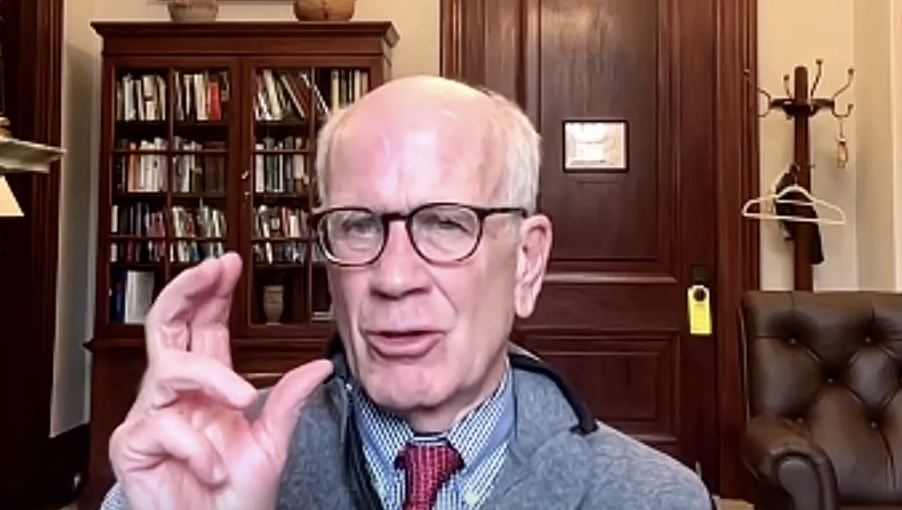
Earlier this week, for the first time in Donald Trump’s second term in office, a sitting Democratic U.S. Senator voted for one of Trump’s nominees for the judiciary.
And in case the headline and image didn’t give away the surprise, yes, it was our very own Sen. Peter Welch, who voted in favor of Kyle Dudek for a seat on the U.S. District Court in Florida.
Democrats have occasionally supported the odd Trump nominee, but never have any of ’em broken ranks on a judicial appointment. There’s a reason for that; Trump’s executive branch officials will be turfed out as soon as their boss leaves office, while federal judges are appointed for life. Dudek was born in 1985, which means he’s likely to serve for at least three decades.
The good senator’s explanation? “[Dudek] is the needle in the haystack—a competent nominee by the Trump administration,’ Welch told Bloomberg Law. When asked what led him to that conclusion, Welch told Bloomberg that “there was nothing specific about Dudek’s record” that led to his “Yes” vote.
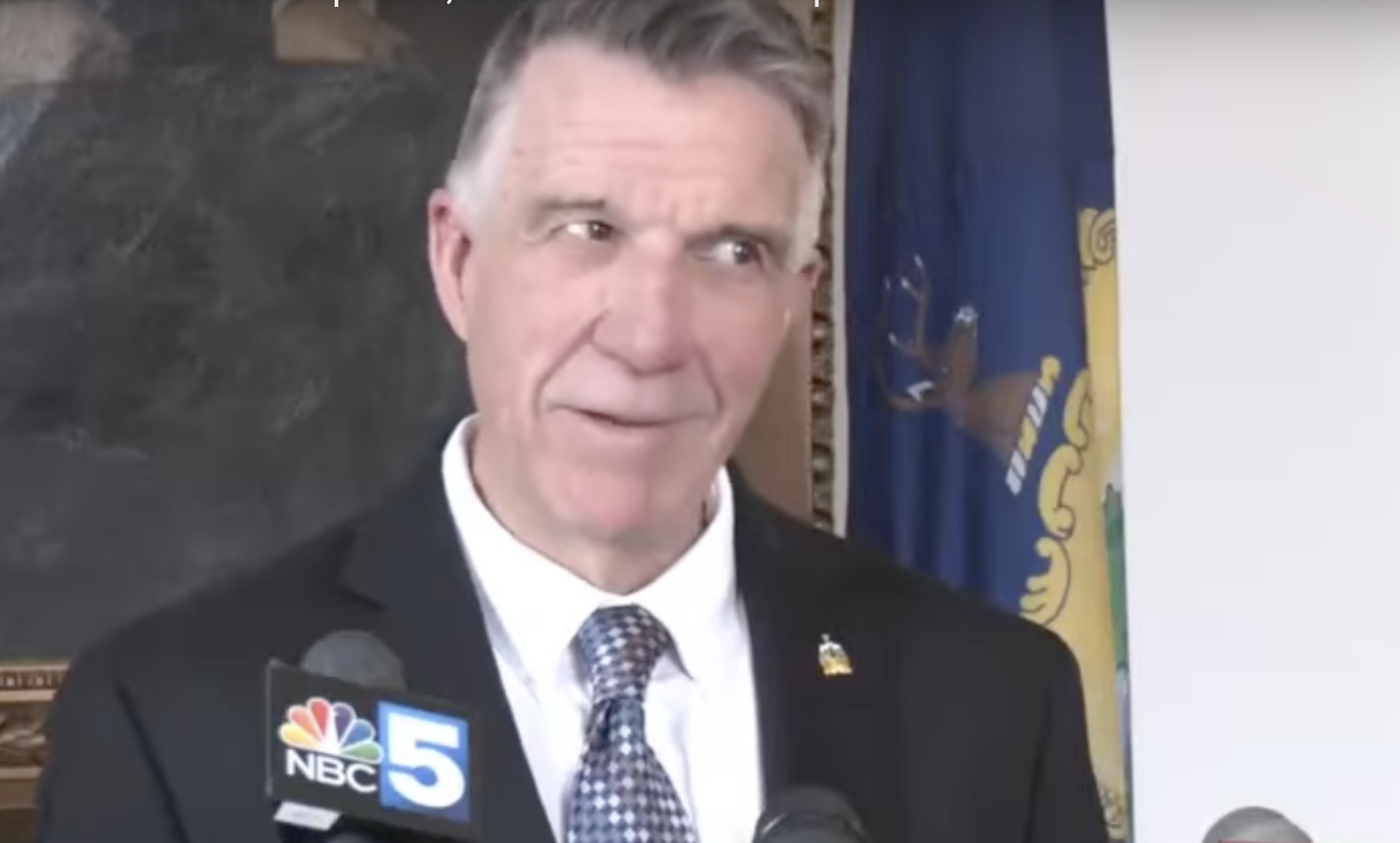
Gov. Phil Scott made a move this week that promises to pay off big time in purely political terms. If it actually accomplishes anything in the real world, that’ll be a bonus.
After insisting for weeks that his administration wasn’t making any plans to help the city of Burlington with its intertwined problems of homelessness, substance use, public safety, and perceptions of the city’s health, Scott announced at his Wednesday press conference that his administration is holding meetings with various Queen City stakeholders with an eye toward unveiling just such a plan “over the next couple of weeks.”
Vermont Public’s Peter Hirschfeld asked if this wasn’t “a change in posture” for Scott and his team. The governor replied that “maybe the perception” of his posture had changed, but the posture itself remained the same.
Which is obvious bullshit, but did you really expect him to openly acknowledge “a change in posture”? Of course not.
I mean, look. A few weeks ago he was brushing aside a reporter’s description of Burlington as “the economic engine of the state” and couldn’t recall the last time he walked down Church Street. Last fall, when his administration brought its dog-and-pony Capital for a Day to Chittenden County, the governor attended some events in the suburbs but skipped the ones in Burlington. And now he’s holding a series of summits with city luminaries? Yeah, that’s a change in posture and a pretty dramatic one.
Setting aside that bit of casual mendacity, it’s a really smart move. And it positions him to pull off a masterstroke that will cement his reputation as a practical centrist. Especially to the Burlington area’s donor class. You know, the Barons.
The nonprofit’s Board cited multiple reasons, some familiar and some perhaps less so. Printing papers consumed three-quarters of its budget; more and more people are getting their news online; and delivery had become increasingly problematic due to the decline of the U.S. Postal Service: “Many residents get The Record 10 days to two weeks after it is supposed to arrive,” the Board wrote.
This decision illustrates one of the many unanswered questions facing local news outlets: To print… or not to print?








 The Vermont Political Observer.