
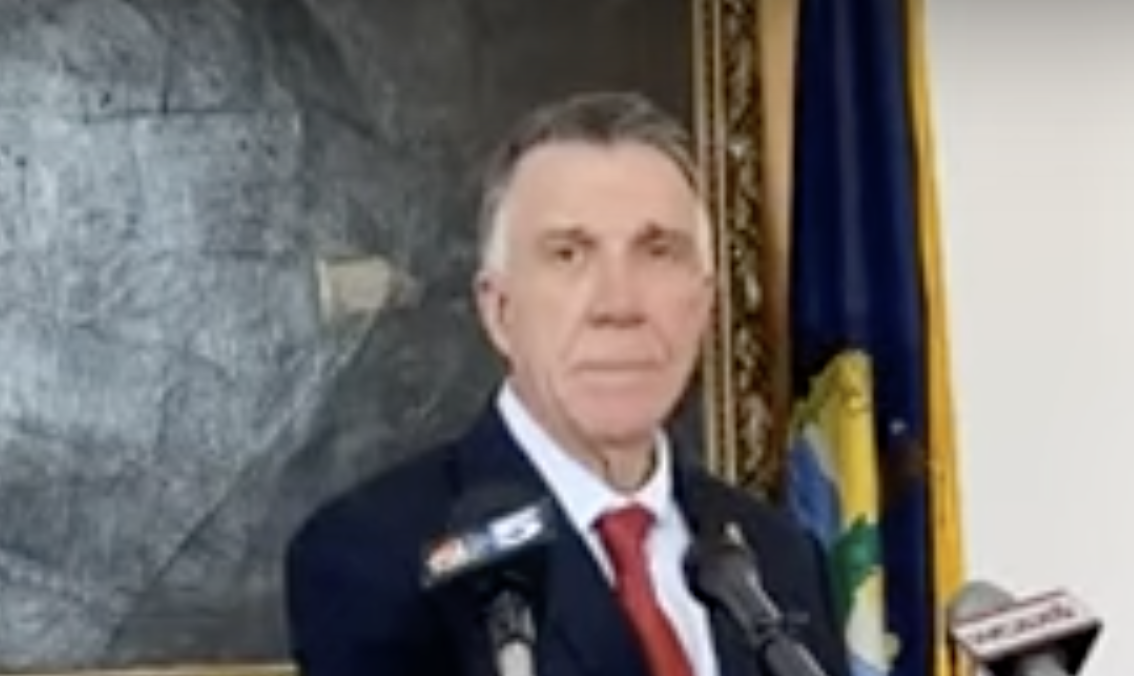
Gov. Phil Scott’s reputation as a sound manager of state government took another hit last week — well, it should have taken another hit — with the publication of Auditor Doug Hoffer’s report on the Agency of Digital Services (downloadable here). In short, Hoffer examined six major IT projects and found that only one was completed on time and under budget. He also found that five the six had such “poorly defined measures” that it was difficult to determine success or failure, and that there were “limited efforts or plans” to ensure the new systems met expectations. That’s, um, not good.
The agency was a centerpiece of the then-newly elected governor’s “overall strategy for modernizing state government.” Scott unveiled ADS in mid-January 2017, just days after his inauguration, as a way to unify and streamline what had been a scattered information technology effort. Hoffer’s audit suggests that the agency has fallen far short of Scott’s promise.
It reminds me of Scott’s much-touted commitment to “lean management.” You may not remember that phrase because it’s been years since he uttered those words, but during his first run for governor he said “lean management” just as often as he said “cradle to career,” “affordability,” or “protecting the most vulnerable.” And he promised that in his first year in office, lean management would save one penny for every dollar spent by the state — or about $55 million in total.
Which never materialized, at all, not even close. That’s why you never hear him talking about it anymore.
In 2021, Finance Commissioner Adam Greshin explained it this way: “It’s not necessarily about savings, it’s about maybe spending the same amount of money and providing better value.”
Nothing wrong with that, but it;s not what candidate Scott thought was possible. And a “lean management” success would have provided him with a nice pot of money to invest in needed programs. The absence of tanglble savings left him playing small ball, proposing incremental steps and — until the Covid pandemic brought floods of federal aid — preventing bolder action on, say, workforce development or broadband or higher education.
Similarly, a state government capable of nimble adaptation in a high-tech world would have meant better service and lower costs. That’s why Scott wanted to create a bespoke agency. His executive order establishing ADS included the following:
1) Improved coordination of technology procurements;
2) Improved project management practices and standards;
3) Improved communication among State agency and department technology resources;
4) Improved IT governance;
5) Utilization of technology skills and resources across departments for the benefit of all agencies and departments;
6) A comprehensive understanding of IT spending;
7) Support of results based accountability;
Hoffer’s report suggests that little of Scott’s promise has been fulfilled. Worse, ADS Secretary Shawn Nailor’s response to the audit actually deflects responsibility for things like project management, interagency communication, improved governance, better understanding of IT spending, and the very concept of “results based accountability.”
Nailor blames overruns, late deliveries and even failure to deliver on the rapid pace of technological change. Fair enough, but everyone lives in that environment. Is ADS uniquely hamstrung? I don’t think so.
Nailor asserts that the job of performance evaluation lies with all the other agencies served by ADS. Problem is, ADS is supposed to have a unique skill set that the rest of state government doesn’t possess. That was the very reason for its creation, right? That skill set would seem to be a prerequisite for accurate performance evaluation.
He also blames the enabling legislation creating ADS for its lack of “the authority to collect, monitor, track, or report on business-side costs and performance measures for technology projects.” Well, excuse me, but I’ve never heard a peep from the administration about any of this. If the legislation prevented ADS from achieving its stated purpose, why did Team Scott never make a fuss about it?
When you compare Scott’s original goals with Nailor’s defense of his agency, you have to conclude that the administration has settled for something far short of its envisioned role. This, as Scott himself asserted when he proposed the agency, is absolutely crucial in an age when pretty much all functions of state government depend on well-functioning, up to date information technology.
I don’t know what it would take to put a dent or two in Phil Scott’s reputation for competent leadership. His two major proposals on reforming the government machine have produced questionable results at best, a negative return at worst. And these are not the only blotches on his escutcheon (which ought to be a journalistic cliché as well established as “veto pen”). His Agency of Human Services has made a complete mess of the motel voucher program, and his Department of Labor repeatedly pissed itself during the pandemic. The Corrections Department is now in its fourth year of “culture change,” the last two under shiny outsider Nick Deml, without much apparent improvement.
I also have little faith in the meager mechanisms of government oversight in Vermont. This is a subject for a separate post, but the Legislature has neither the time nor the resources to provide a check on the executive branch. In fact, the Legislature is largely dependent on the executive for information.
If a department was screwing up in a way that didn’t directly lead to deaths or unignorable snafus, would we even hear about it? Our ever-diminishing media has precious little capacity for investigative deep dives. (But hey, they’re building a creemee database.) Hoffer does yeoman’s work, but he has a tiny staff and can only do so much. But in the case of Phil Scott, a body of evidence is growing, and it’s not making him look any better.
 The Vermont Political Observer.
Still the best Governor we’ve had since Hoff. As an independent, I’ve watched the democrats destroying this state for years. Tax tax tax. The average Vermonter can’t afford to live here because the democrats want to tax everything. I prefer the democrats but someone needs to get control of their tax and spend policies…
well, at least they’ve gotten internet to every home
Been here almost a decade and Vermont has one of the worst IT infrastructures I have ever experienced – amateurish and incompetently designed and engineered websites and services galore….just totally clueless people running this place at an astronomical cost to taxpayers. Understanding the intentional parochialism and provincialism our ruling classes cultivate, to keep average Vermonters ignorant and down, its no wonder the state is governed by the ‘not invented here’ syndrome.
Financial ties to politicians and players need to be thoroughly mapped and examined as there is so much self-dealing and corruption hidden by that nice, white smiling faces of ‘we’re so special’ Vermonters. Zero accountability has been built into the structure down to the local level because if these people actually has to face scrutiny and consequences the state would collapse. This is why the political class refusing to do anything concrete about ethics and transparency. Out FOI is a joke – I have to actually sue a municipal body for documents if they refuse to acknowledge and comply with a request. There is no penalty for failure to comply with the law. My state rep could two sh*ts if public servants comply with the state’s own laws. However, if I fail to comply with their slightest request, they are all over me.
The press plays an important role in legitimizing this – sure they may report on the surface but rarely look under the hood because that would threaten and incriminate the very people they rely on to feed their ad revenues. Plus the damage to Vermont cracker jack white reputation of moral purity would dissolve.
Anyone who’s had a garbage boss knows exactly what type of manager Phil Scott is: A fevered ego, unimaginative, self-centered, vindictive, petty, and insecure. But that’s pretty much all politicians, init? Some are just better at hiding it than others.