Tag Archives: Tom Stevens

The Business Elites Expand Their Portfolio, and Other Notes from the 9/1 Campaign Finance Filings

Well, those Burlington-area business types have slightly expanded their playing field as they try to weaken the Legislature’s ability to override gubernatorial vetoes. They’d backed a handful of centrist Democratic challengers to Dem/Prog incumbents (most notably Stewart Ledbetter and Elizabeth Brown*, only to see them all go down to defeat. (A similar effort was made by Brattleboro businessfolk in support of an unsuccessful challenge to Rep. Emilie Kornheiser.) They also backed some Republican hopefuls with a chance to knock off Democratic incumbents in November including LG candidate John Rodgers, two state reps running for Senate, Pat Brennan and Scott Beck, and the uncle-and-nephew tag team of Leland and Rep. Michael Morgan, running in a two-seat House district currently split between the two parties.

*We’d previously noted that Brown spent an appalling $35 per vote. It was actually $35.42, for those keeping score at home.

And now that same bunch of Vermont-scale plutocrats is throwing their weight, in the form of four-figure donations, behind Rep. Chris Mattos, running for Senate in the Chittenden North district currently repped by Sen. Irene Wrenner, and Steven Heffernan, Republican Senate candidate in Addison County. (A district that, according to Matthew Vigneau, solid Twitter follow and bigger election nerd than I, hasn’t elected a Republican to the Senate since the year 2000. Which was the year of the great civil-unions backlash that saw Republicans win in multiple unexpected locations, so grain of salt required.)

I haven’t come across any similarly blessed Republican candidates for House, but I didn’t do an exhaustive search. Then again, perhaps these low-grade plutocrats have decided (as have I) that the House is a lost cause for the Republicans.

So who’s giving how much to whom?

Continue reading

A Happy Little Primary Night Cash Fire

Tuesday’s primary election turned out to be a snooze. The most interesting development was how much money was wasted trying to unseat a small number of Democratic incumbents. They all won, as far as I can tell.

Firmly atop the Futility Rankings is former TV anchor Stewart Ledbetter, who finished fourth in the race for three state Senate seats in the Chittenden Central district. He raised almost $60,000 and spent a bit under $40,000 (tentative). He “earned” 3,159 votes, which cost him and his well-heeled donors about $12.56 apiece. Bargain!

Elsewhere in the “beat the Democrats” game, House Ways & Means Chair Emilie Kornheiser brushed off a challenge from business-backed Dem Amanda Ellis-Thurber, while the Waterbury duo of Reps. Tom Stevens and Theresa Wood defeated “affordability” Dem Elizabeth Brown, who spent gobs of cash and didn’t really come close to pulling off an upset.

Two quick takeaways: If there’s an anti-tax revolution brewing in the hinterlands, it did not show itself in the results. At all. And those allegedly smart business leaders just squandered a whole lot of money trying to push the Democratic caucuses toward the center. They might have scored one small victory, as Danforth Pewter chief Bram Kleppner took a Democratic nomination for House in Burlington. But that’s about it.

Continue reading

Mr. Dragon Brings the Fire

The House General & Housing Committee got an earful this morning from the mild-mannered Paul Dragon, Executive Director of the Champlain Valley Office of Economic Opportunity which, although its name sounds like some kind of neo-centrist business-promoting outfit, is in fact one of the biggest providers of shelter and services to unhoused Vermonters.

He was speaking in support of H.132, the Homeless Bill of Rights, a piece of legislation that’s been kicking around House General for several years now. Despite the sponsorship and support of committee chair Rep. Tom Stevens, the HBOR has never managed to even make it out of committee. But he’s trying again, and bully for him.

Dragon brought prepared testimony about what he called the “unprecedented levels of homelessness in Vermont,” which I’m going to append to this post because it’s just absolutely brilliant on the current crisis, misconceptions about the homeless, and all the ways we’re failing to meet this moment. (You can watch his testimony here, starting at the three-minute mark.) But first, let’s establish his bona fides.

Continue reading

This Is Not the End (UPDATED)

The House and Senate steamed ahead with their motel voucher-free budget, but they fell critically short at the very last hurdle. Thanks to a group of Democrats and Progressives unwilling to evict thousands of Vermonters because “it’s time” or “we just couldn’t find the money,” the House came short of the margin needed to override a gubernatorial veto.

The final tally: 90 votes for the budget, 53 against. House leadership will have to persuade at least three members to abandon their principled stand in order to win an override vote. And Gov. Phil Scott appears bound and determined to deliver a veto.

Update! The official roll call shows that 17 Democratic/Progressive lawmakers voted “No” on the budget. That means leadership will have to flip at least six votes to override a veto, not three. Working on a fresh post about this.

So what happens now? The Legislature is adjourned until June 20, when a three-day override session is scheduled. If Scott does veto the budget, leadership will face a choice: Convince three or more dissidents to join the Dark Side, or craft a compromise on housing that will meet their demands. Looming ahead of it all: The requirement that the state must have a budget in place when the new fiscal year begins on July 1.

One big fly in the ointment: Nearly half of the 1,800 households in the motel voucher program will have already been evicted by then. The program’s eligibility standards tighten at the end of this month, so a last-ditch fight to save the program will come too late for more than 1,000 people facing unsheltered homelessness in less than three weeks.

Continue reading

Quick Follow-Up: How Many Lawmakers Have Experienced Homelessness?

The latest installment of VTDigger’s series on legislative ethics and financial disclosure is essentially a redo of one of my all-time favorite stories about the Statehouse: Taylor Dobbs’ “House of Landlords,” a 2019 exploration of how many lawmakers are landlords, property managers or contractors, and how that affects lawmaking.

The answer then, as it is now, is (a) a whole awful lot who (b) seem disinclined to enact any laws that might affect the interests of the propertied class.

Well, the Digger story focuses on landlords versus renters and as in 2019, the former are thick on the ground while the latter are scarce as hen’s teeth. One consequence of this imbalance, now as then, is a lack of movement on creating a statewide rental registry. Similarly, there’s no action to be seen on limiting no-cause evictions. The very concept is gunned down in a hail of anecdotes about longsuffering landlords and dissolute tenants. Rarely if ever do we hear the other side of the story — hardworking tenants who pay their rent on time and struggle to get their landlords to do necessary maintenance or repair.

So let’s take the next logical step, shall we? The Legislature is deep in discussions about how to avoid — actually, whether to avoid — a crisis in unsheltered homelessness about to hit Vermont. How many legislative decision-makers have ever experienced homelessness?

Continue reading

House Democrats Are Told How They Could Avoid a Humanitarian Disaster, and They Said “No Thanks”

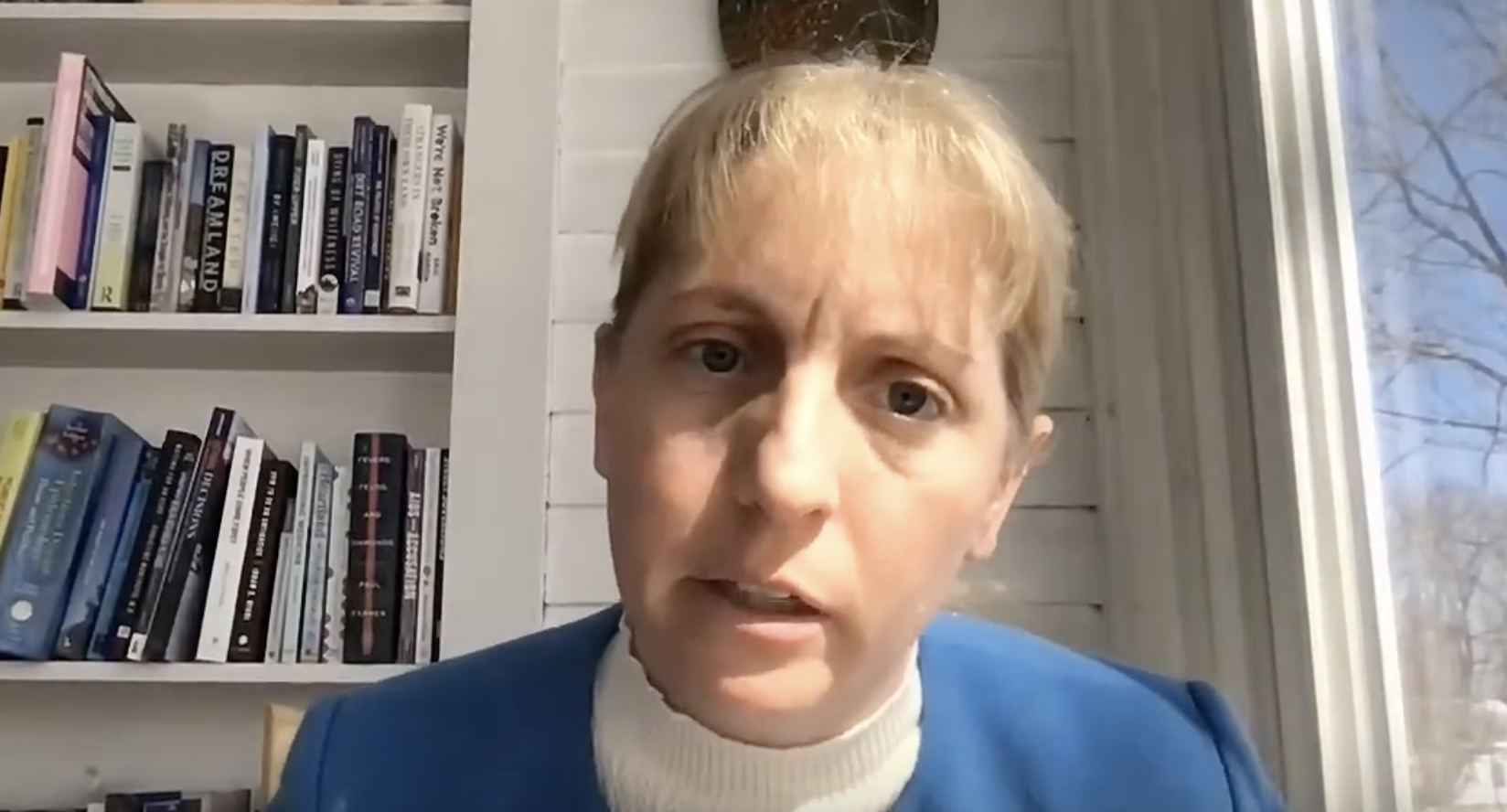
If there’s anyone on this earth who could understandably be Sick Of This Shit, it’s Anne Sosin, pictured above in a space that Room Rater wold give at least eight out of 10. (“Nice window, background not too busy, solid but unpretentious bookshelf.”) Sosin has gone from arch-critic of Gov. Phil Scott’s Covid policies to interim head of the Vermont Affordable Housing Coalition, where she’s taken on the thankless task of developing plans to tackle the housing crisis that House Democrats routinely ignore.

On Thursday morning, Sosin appeared before the House General & Housing Committee with an articulate, well-researched and professional presentation on why it makes moral, political, and financial sense to address our crisis of housing insecurity. Her presentation was entitled “The Cost of Inaction on Homelessness and Eviction.” (Video available here; Sosin begins at the two-minute mark. Her presentation is downloadable here.)

The committee listened politely and sent her away. And within roughly 12 hours, the full House had approved a budget that ignored her testimony.

In other words, the cake was baked before Sosin got into the kitchen. Her appearance was nothing but window dressing.

(I’ll also note that committee chair Tom Stevens mispronounced her last name, which betrays a certain lack of engagement, especially since this wasn’t her first appearance before his committee.)

(It’s SOSS-in, not “SO-sin.”)

Continue reading

Storm Clouds Above the Statehouse

There is much to be said about Gov. Phil Scott suddenly pulling a voluntary paid family leave program. For instance, that he has never ever pushed this issue at all unless the Legislature is actively considering a universal program. This isn’t a principled position, it’s an artifice meant to draw votes away from the Dem/Prog caucuses.

But something else, something subtler but equally discomfiting, is on my mind at the moment.

There are signs that the House-Senate tensions of past years are flaring back up again. If so, key legislation could fail because of differences between the two chambers, real or imaginary. If that happens, they’ll be disappointing the voters who elected record numbers of Dems expecting them to get stuff done.

This tension was minimized if not eliminated in the current biennium, thanks to the efforts of House Speaker Jill Krowinski and outgoing Pro Tem Becca Balint. It’d be a shame if Balint’s departure triggers a return of the bad old days.

The usual sniping between House and Senate is most often expressed in senators’ apparently innate sense of superiority. I don’t know how many times I’ve seen senators speak of state representatives as if they’re misbehaving kids on a school bus, and treat House legislation as if it’s toilet paper stuck to their shoes.

The most prominent example of the House-Senate tension has been the twin battles over paid family leave and raising the minimum wage. The House has preferred the former, the Senate the latter. The result: No paid leave program and woefully inadequate movement on minimum wage. On two occasions the Legislature has passed watered-down versions of a paid leave program and Scott has vetoed them. The inter-chamber differences have done much to frustrate progress toward enacting a strong paid leave program over Scott’s objections.

And now, here we are again with an apparent House-Senate rift on paid family leave.

Continue reading

Stealth Conservatives: A Leopard Can’t Change Its Spots, But It Can Try to Pass as a Cheetah

Meet Kathi Tarrant, mom, musician, teacher, and Republican candidate for the Vermont House in the Washington-Chittenden district currently represented by two Democrats, Tom Stevens and Theresa Wood.

Ms. Tarrant might not like it that I topped this piece with a picture of her at the August 2021 Patriot Rally on the steps of the Statehouse. The event was captured on video by the good folks at Orca Media, and you can see several speakers talking about the poor attendance. And you can see Tarrant talking about the federal lawsuit she filed against Gov. Phil Scott over his mask mandate. Yep, she’s one of them.

But that’s not how she’s presenting herself in the race for House. Instead, she’s donned the garb of a garden-variety conservative — to the right of Phil Scott, but not quite off the deep end. In a candidates’ forum sponsored by ORCA and another of my former employers, The Bridge, she managed to avoid subjects like the Covid vaccine and climate change denialism (“CO2 is NOT a pollutant”) and weather conspiracy theories and her membership in 802Freedom, the online community of anti-vaxxers and their ilk.

Instead, we got anodyne language about carbon taxes, ballot security, supporting law enforcement, fixing the housing shortage by unleashing the landlords, doubts about cannabis legalization, Second Amendment absolutism, and opposition to Article 22 over its wording, not its intent.

Now, it’s possible that she’s completely changed her political orientation in the past year. But it’s much more likely that she’s trying to pass as a standard conservative when in fact she’s way out on the fringes of political discourse.

Continue reading

Adventures in Inadequate Governance, part 1

Sumitted for your approval, three news stories on a common theme: What happens when government isn’t up to the task?

Two are about Covid-19 and nursing homes, which I will address in my next post. Under consideration here, courtesy of VTDigger’s Anne Wallace Allen, is a look at Vermont’s wretched rental housing stock. The headline, “About 7,000 Vermont households lack things like kitchens, bathrooms, or heat,” is a bit exaggerated. But the reality isn’t much better.

Nobody knows exactly how many Vermonters are living in substandard housing.

That 7,000 figure is an upper estimate, so the actual number of households without crucial features may be smaller. But the story’s gut-punch is that oversight of rental housing in Vermont is spotty at best, nonexistent at worst.

The state has a rental housing code but no enforcement mechanism. Several of our larger cities have code-enforcement systems. Elsewhere, it’s entirely up to town health officers. They’re usually untrained volunteers with few resources to conduct their business. James Arisman, who formerly served as Marshfield’s health officer, told VTDigger, “Essentially there is no protection for renters in the state of Vermont by an inspection system that is robust and carrying out routine inspections.”

Yeah, that seems a little problematic.

There are plenty of appalling details, but let’s leave it here: How did we get to the year 2020 with such an archaic “system”? It’s yet another example of the Grandfather’s Lightbulb phenomenon. To wit:

Q: How many Vermonters does it take to change a lightbulb?

A: Change it? That was my grandfather’s lightbulb!

Continue reading

A little backdoor action at the Statehouse

We’re in the late stages of the legislative session, a time when everyone wants to hear the final gavel come down and get out of Dodge. And when a whole bunch of bills are flying from chamber to chamber, from committee to committee, providing plenty of opportunities for lawmaking legerdemain. Or, as one observer put it, “the time of year when stuff is going to be slid through the cracks.”

I hear of two provisions designed to open the door to expanded gambling in Vermont. Both are attached to seemingly unrelated bills. In both cases, gambling opponents are trying to keep their eye on the bouncing ball.

The culprit, it’s safe to say, is Sen. Kevin Mullin, Republican chair of the Senate Economic Development Committee, a staunch supporter of, and crafty finagler on behalf of, expanded gambling in Vermont. For a number of years, Mullin has been pushing to expand the definition of state-sanctioned gambling, by hook or by crook.

Continue reading